
The Monster Hunter Stories series has come a long way. Starting as a multimedia project with the first 3DS game and a tie-in anime, the series doubled down on delivering a high-quality monster-taming RPG experience with 2021’s Wings of Ruin, expanding the scope of the game while maintaining the approachable mechanics and kid-friendly storytelling. Monster Hunter Stories 3: Twisted Reflection seeks to up the ante even further, launching day-and-date across all current-generation platforms. The series’ ambition is expanding accordingly with these new platforms, and Twisted Reflection goes beyond the promise of a Monster Hunter-themed Pokémon competitor for kids. Rather, the more mature storytelling, heightened production values, and expanded combat mechanics seek to fill the void left behind by Breath of Fire and appeal to the dedicated RPG audience that demands more than just cute Monsties to befriend.
The most noticeable change between previous entries and Twisted Reflection lies in its narrative. Past titles focused on young protagonists making their way in the world with a lighthearted tone akin to Pokémon or Dragon Quest Monsters. Twisted Reflection, by contrast, wastes little time thrusting you into conflict and calamity. You inhabit the shoes of the prince (or princess) of the Kingdom of Azuria, already an experienced Ranger and Rider. The Rangers are a non-military group of Riders who protect the ecological balance of Azuria, and are hard at work investigating the Crystal Encroachment threatening the local environment. Crystallization has ravaged certain parts of the landscape and even affected the monsters, with crystals on their hides causing them to become feral & aggressive, and granting them dangerous new abilities.
Meanwhile, the neighboring Kingdom of Vermeil amasses its military on Azuria’s border and petitions the King of Azuria for peace negotiations. The Vermeil negotiators reveal that Vermeil lies ravaged by the Crystal Encroachment; shards of crystal rain down from the skies, killing crops and endangering the lives of the citizenry. Facing starvation and ruin, Vermeil is left with two options: invade Azuria for its arable and relatively untouched land, or partner with Azuria to cross the Meridian to reach the fabled Sacrosanctum, where the Vermeilians believe they can find the key to stopping the Encroachment. The King of Azuria refuses, reminding the Vermeilians of the covenant both nations made with the Wyverians, an ancient race that guards the Meridian and prevents entry to the Sacrosanctum. With the negotiations at a standstill, the Princess of Vermeil, Eleanor, volunteers to remain in Azuria, offering herself up as a hostage to stave off Vermeil’s invasion. The protagonist becomes her escort, welcoming her into the Rangers and showing her the Azurian way of life. Once war becomes imminent, the two agree to violate the Covenant and cross the Meridian to save their kingdoms from destruction, both from ecological collapse and war.
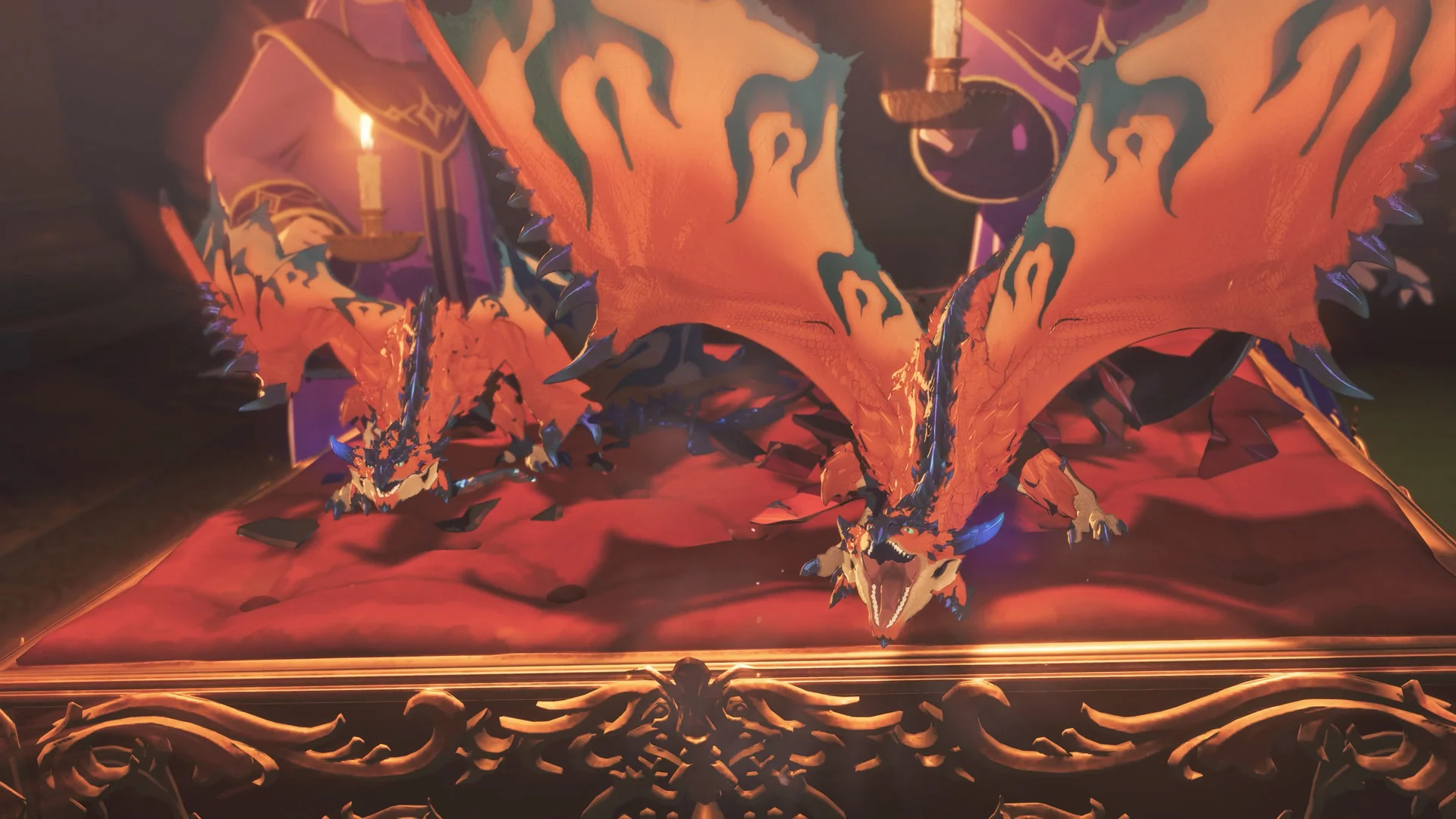
These themes of environmental destruction and resource scarcity leading to conflict are much darker and more complex than the good-versus-evil storylines of the previous games, and character motivations are colored by shades of grey. Vermeil doesn’t desire war, but is left with no choice in the face of extinction due to the encroachment. Azuria is not blind to the plight of their neighbors, but the relationship between nations is complicated by the betrayal of Queen Amara, the protagonist’s mother, who hailed from Vermeil. The Traitor Queen stole a Rathalos and fled across the Meridian, leaving behind the prince and the Rathalos’s twin, his partner Ratha. All talk of the Meridian reminds the King of this betrayal, leaving his heart hardened to any cooperation between the two nations. The protagonist, on the other hand, desperately wants to know why his mother left, and his choice to defy his father and cross the Meridian is as much about finding his mother as it is about saving the warring kingdoms.
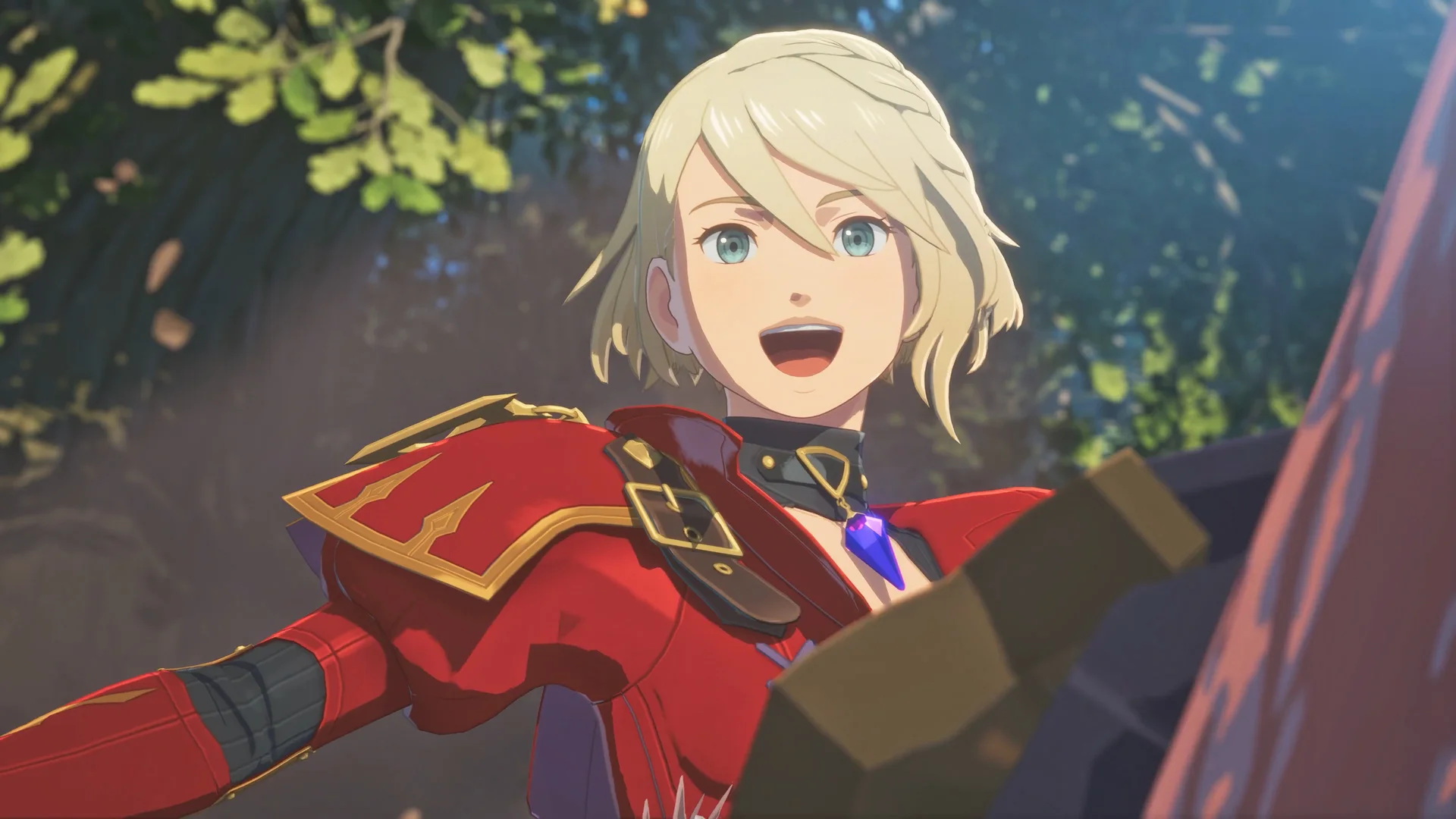
I enjoyed the more mature approach to storytelling. However, there are juvenile elements carried over from prior games (such as referring to monsters as “Monsties” or the comic-relief Felyne mascot Rudy) that clash with the story’s darker, more serious tone. At times, the game feels caught between its expanded narrative ambitions for an older audience and attempts to avoid alienating those looking for a light-hearted, Pokémon-style experience. Despite those reservations, the initial hours gripped me, and I’m quite interested in seeing where the plot goes next.
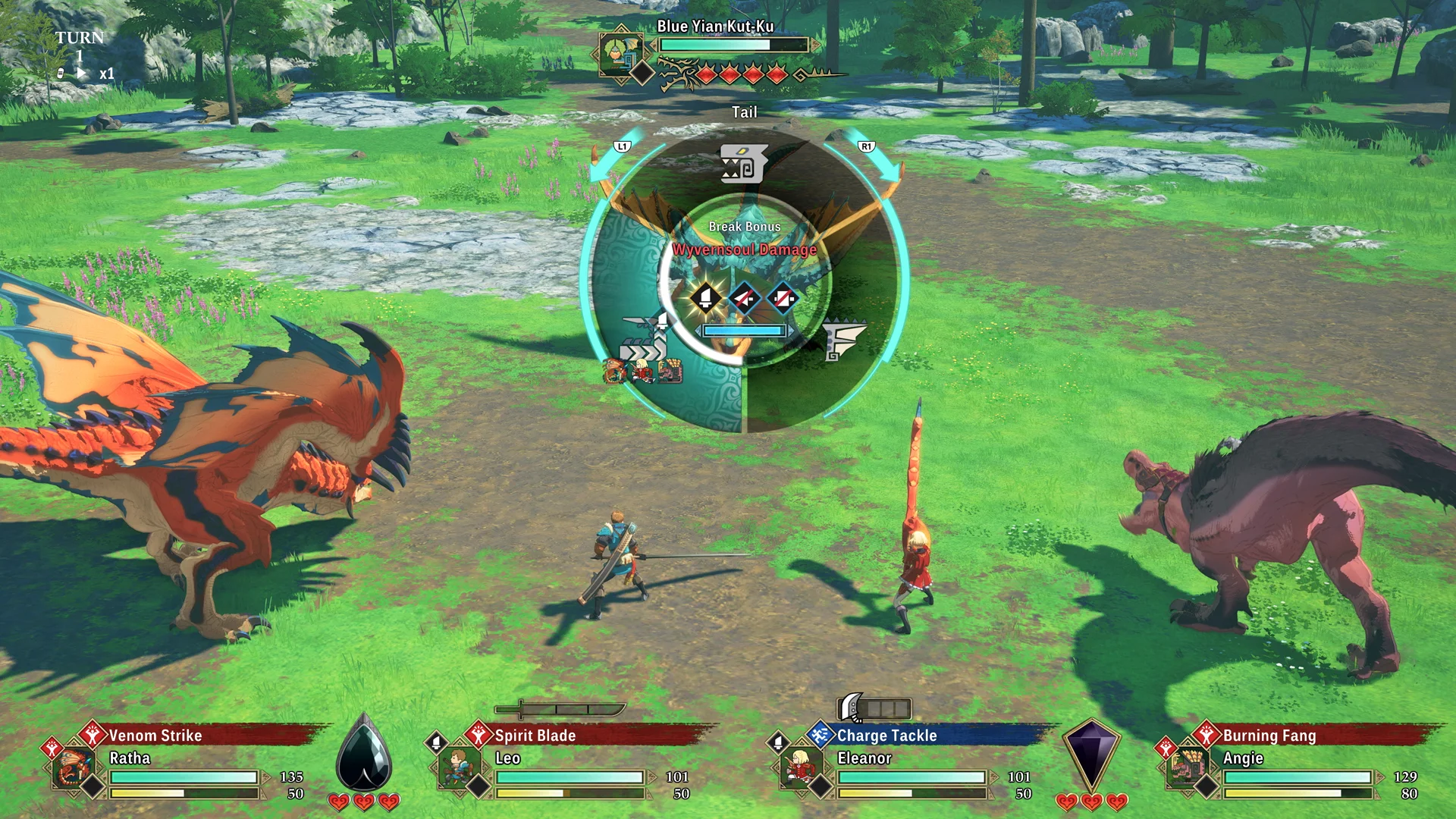
A rock-paper-scissors combat system (Strength beats Technical, Technical beats Speed, Speed beats Strength) that many criticized for being overly simple has been a defining feature of the series up to this point. The developers at Capcom have taken these criticisms to heart. The core system remains, but new systems exist on top of the combat to make encounters significantly more strategic and satisfying than past entries. For starters, another Rider and their Monstie always join you in combat. Since you always have four participants in battle, encounters feel similar to a traditional JRPG party-based system. While I wasn’t always happy that the other Rider is AI-controlled, I have to admit it conveys a similar feeling to cooperative play in the main series, where you must pay attention to your teammate’s actions to combo effectively against a strong monster.
Monsters feel suitably threatening and in line with the main series, despite most fights being four-on-one. Enemy monsters hit very hard (sometimes taking you or your Monstie out in a single hit) and have much larger health pools than you or your allies. Monsters have a Wyvernsoul gauge beneath their health bar; when this gauge is depleted, the enemy is Toppled, and the party can perform a Synchro Rush (think All Out Attacks from Persona) where everyone gets a free hit on the monster. Fights are a careful balance between dealing damage, guarding against enemy attacks, and whittling down the Wyvernsoul gauge to level the playing field. You can also strike at specific parts of the monster (much like the main series) to disrupt certain attacks or abilities. Additionally, you can swap between three equipped weapons (one for each damage type) or the six monsters in reserve during your turn. Combat in Twisted Reflection strikes a balance between strategic turn-based combat and the feeling of fighting a large monster from the main series, and is the first time that the spin-off series fulfills the mechanical potential of the “Monster Hunter as a turn-based RPG” premise.
The monster-raising mechanics received some recent polish and coexist nicely with the narrative’s themes of ecological stewardship. You gather monsters by searching monster dens dotted around the map for eggs, with some eggs being more potent than others. Once hatched, monsters reveal their particular traits, including stats, abilities, and a Bingo Bonus that determines their potential. Night gives you a chance to encounter Powerful Invasive Monsters, and once defeated, you can rescue endangered species’ eggs from their dens. Once hatched, these endangered monsters return to the environment to flourish, with adult specimens now roaming around the area and their eggs appearing in regular dens as they repopulate.
Most monster-raising games end up feeling more like eugenicist simulators, constantly breeding and discarding dozens of creatures like a mad scientist until you arrive at one with optimal genetics. Twisted Reflection bucks this trend by requiring you to be a true conservationist, rewarding you with higher-quality monsters only after you’ve revitalized endangered species and stabilized their natural habitat by removing feral monsters. I appreciate this shift in focus, and it cements the Stories series’ cohesion between mechanics and message better than the main series has ever managed.
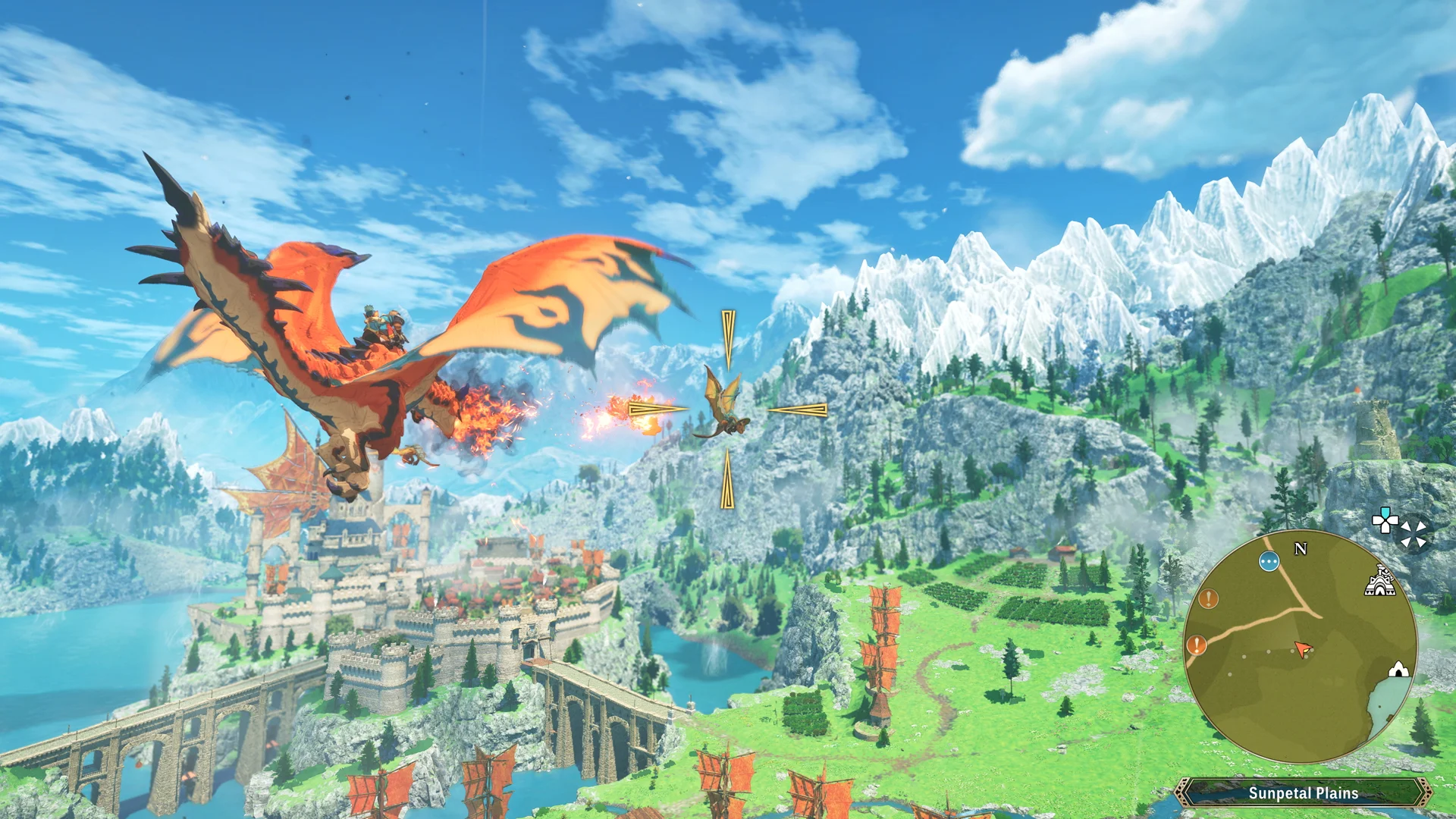
The most obvious way Monster Hunter Stories 3: Twisted Reflection illustrates expanded scale and scope is in its presentation. Unfortunately, this is also where the game has flown a little too close to the sun, at least on Switch 2. Make no mistake, Twisted Reflection is a beautiful game: the world is vast and vibrant, lighting and shadows are far more realistic, human characters and monsters alike have more realistic sizes and proportions. Animations are chief among the visual improvements, with characters showcasing heft and weight as they gear up to run or slow down, monsters’ wingflaps rippling as they glide through the air, and each Monstie possessing its own characteristic gait as it traipses through the lush environments. There are some truly spectacular visual effects in battle, especially during the kinship attacks where monster and rider strike together.
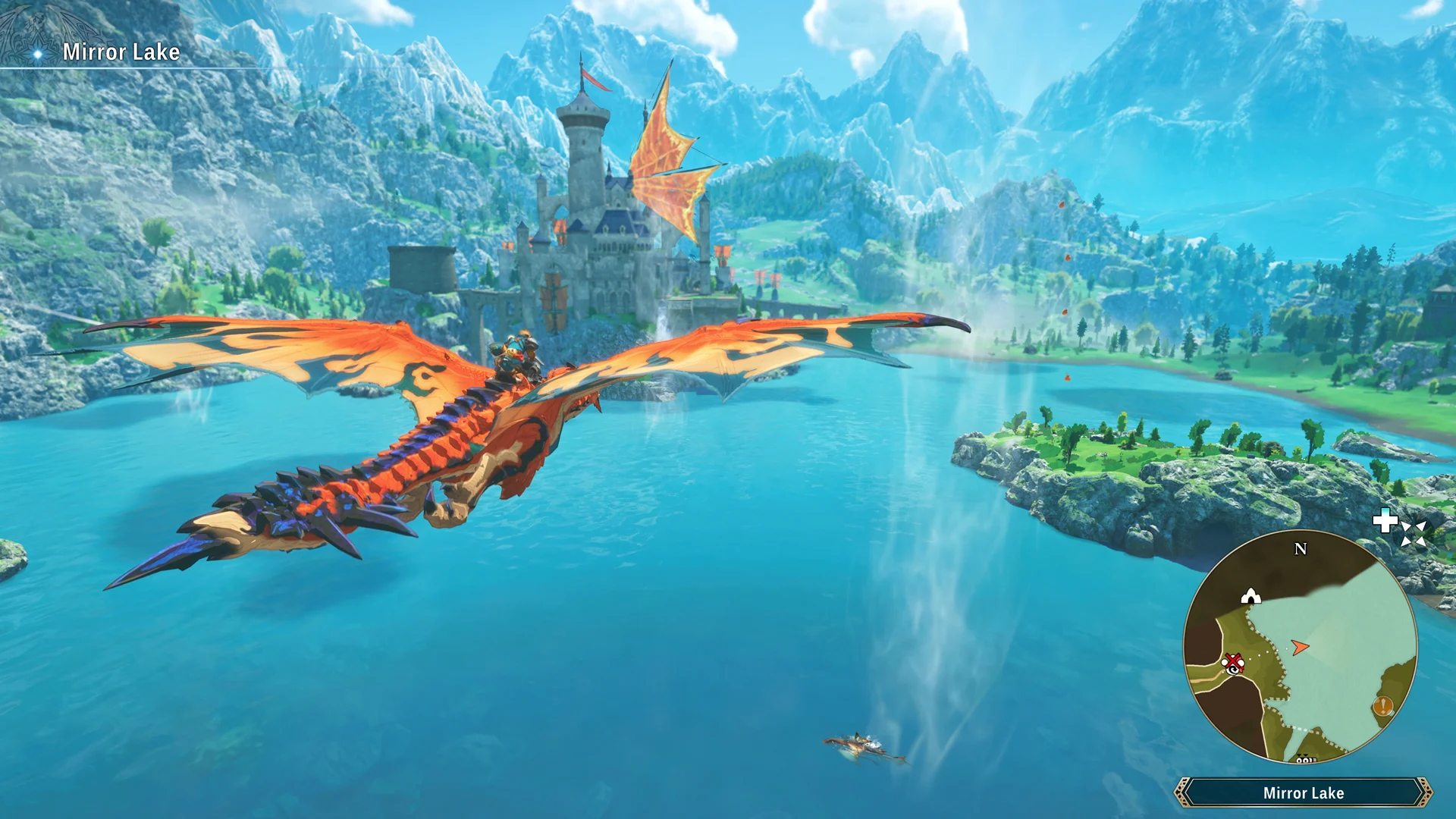
What brings this heightened presentation down is the performance, at least on Switch 2. The framerate suffers in heavily populated areas like the castle town, and stutters abound when you take flight on your Rathalos and soar above the environment. Performance is much better on the ground and rock-solid during battles, but draw distances in the fields are marred by blurriness for far-off locations or choppy animations for monsters rendered at a distance. There were times when I felt Twisted Reflection was one of the best-looking Switch 2 titles due to the impressive art style and animation quality, but those moments were inevitably dashed by shaky performance in both handheld and docked modes, where the game struggles in its most ambitious moments to maintain its 30 FPS target. It’s certainly not unplayable, especially for a turn-based RPG, but performance-conscious players may want to stick to the PS5, Xbox, or PC versions.
Capcom is certainly swinging for the fences with Monster Hunter Stories 3: Twisted Reflection. They’ve expanded the storytelling ambitions, the complexity of the combat mechanics, and the presentation is truly AAA quality, so much so that it’s a bit more than the Switch 2 can handle. If you’ve dismissed prior entries for being too juvenile or too much of a departure from the main series, I think it’s worth giving the game a second look. Thankfully, Capcom has made a free demo available on all platforms, so there’s no reason not to download it and try it for yourself. Monster Hunter Stories 3: Twisted Reflection launches on March 13th, 2026, for Nintendo Switch 2, PlayStation 5, Xbox Series, and PC, and you can check out the game’s official site for more details.


Leave a Reply
You must be logged in to post a comment.