
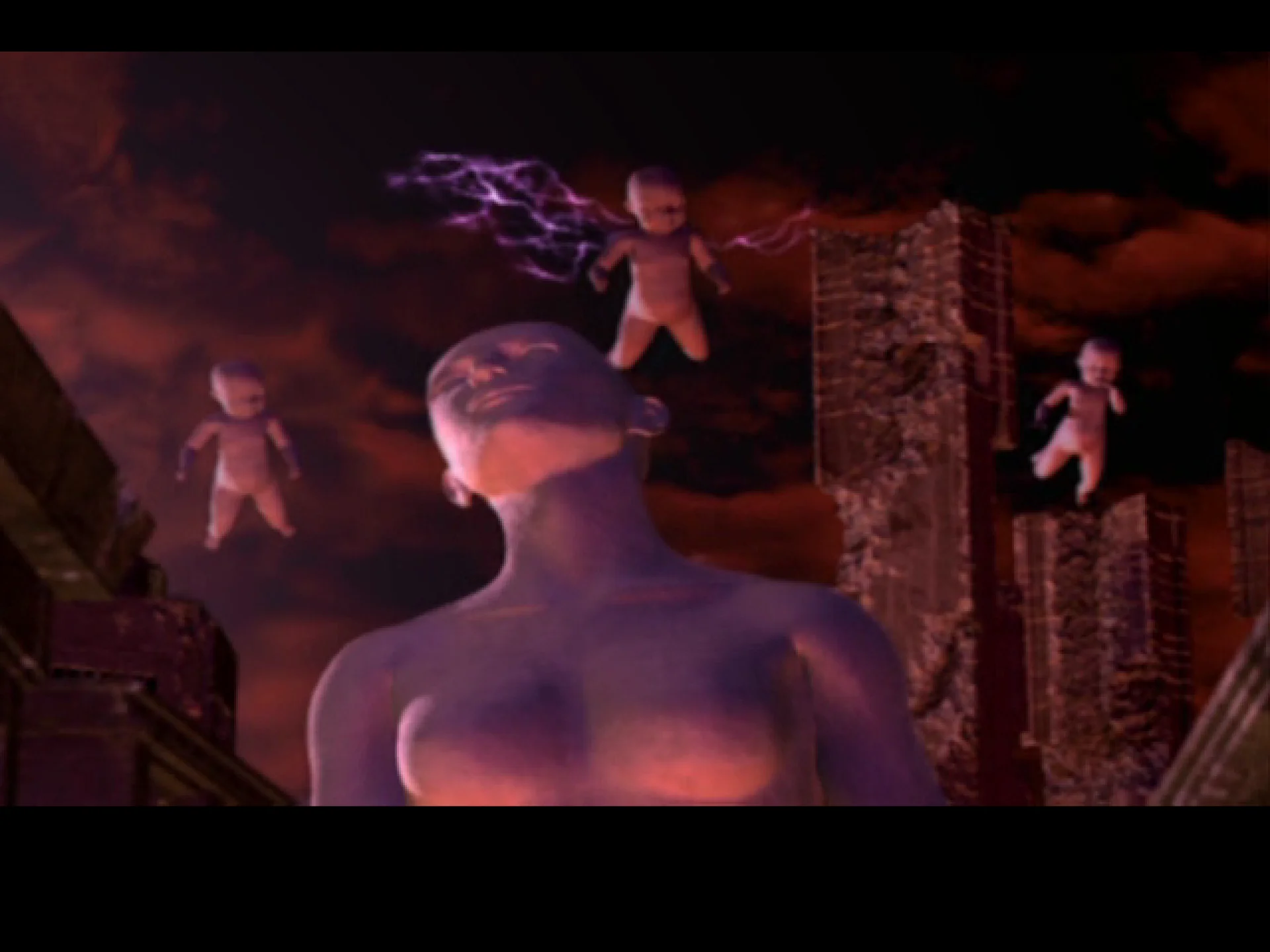
I was thinking of writing a retro review of Drakengard. Then I realized I would have to assign a final score. Multiple scores, in fact: Graphics, Sound, Gameplay, Story, Controls… you know, the tried-and-true review measurements. I’ll be honest. If I approached this scoring with the mindset that I apply to other reviews, Drakengard would not fare well in most categories. That alone says something, but to assess the game’s quality in this way does a big disservice to what it achieves.
Drakengard is a bad game. Drakengard is a fascinating game. Both these statements are true.
What makes Drakengard so interesting—dare I say “good”—defies the logic of the supposedly objective measurements we’ve used for decades. If you gave a first-time gamer a controller connected to a TV with Drakengard running, that may warrant a minor jail sentence or at least community service. But if you gave Drakengard to someone who’s played a hundred games and become disillusioned with how derivative they can start to feel, you may just renew their interest in videogames.
I’ve heard fans say the story is what makes Drakengard worth playing. These people say that the refreshingly horrific and subversive plot and characters redeem the questionable gameplay that surrounds them. That Caim and Angelus’ quest of massacring an evil empire (and eventually demonic forces) because humans suck is some sort of profound moral statement. I don’t buy it. If that were the case, you’d be able to experience all of what makes Drakengard “good” by watching its cutscenes or a summary video. But I don’t think that allows you to appreciate the finer qualities of the game.
And by finer qualities, I mean razor-sharp rough edges. Edges so rough you can impale yourself on them and contract tetanus, yet marvel at their construction as you’re being pierced and infected. I actually had fun playing Drakengard even though it’s not a particularly fun game. It only becomes fun if you surrender yourself to its maniacal presentation and consume its gameplay as an extension of a greater whole. Drakengard is fun insofar as its game design becomes a means of expressing narrative design. Drakengard can only possibly work as a videogame. Even then, it’s a miracle that it works at all.
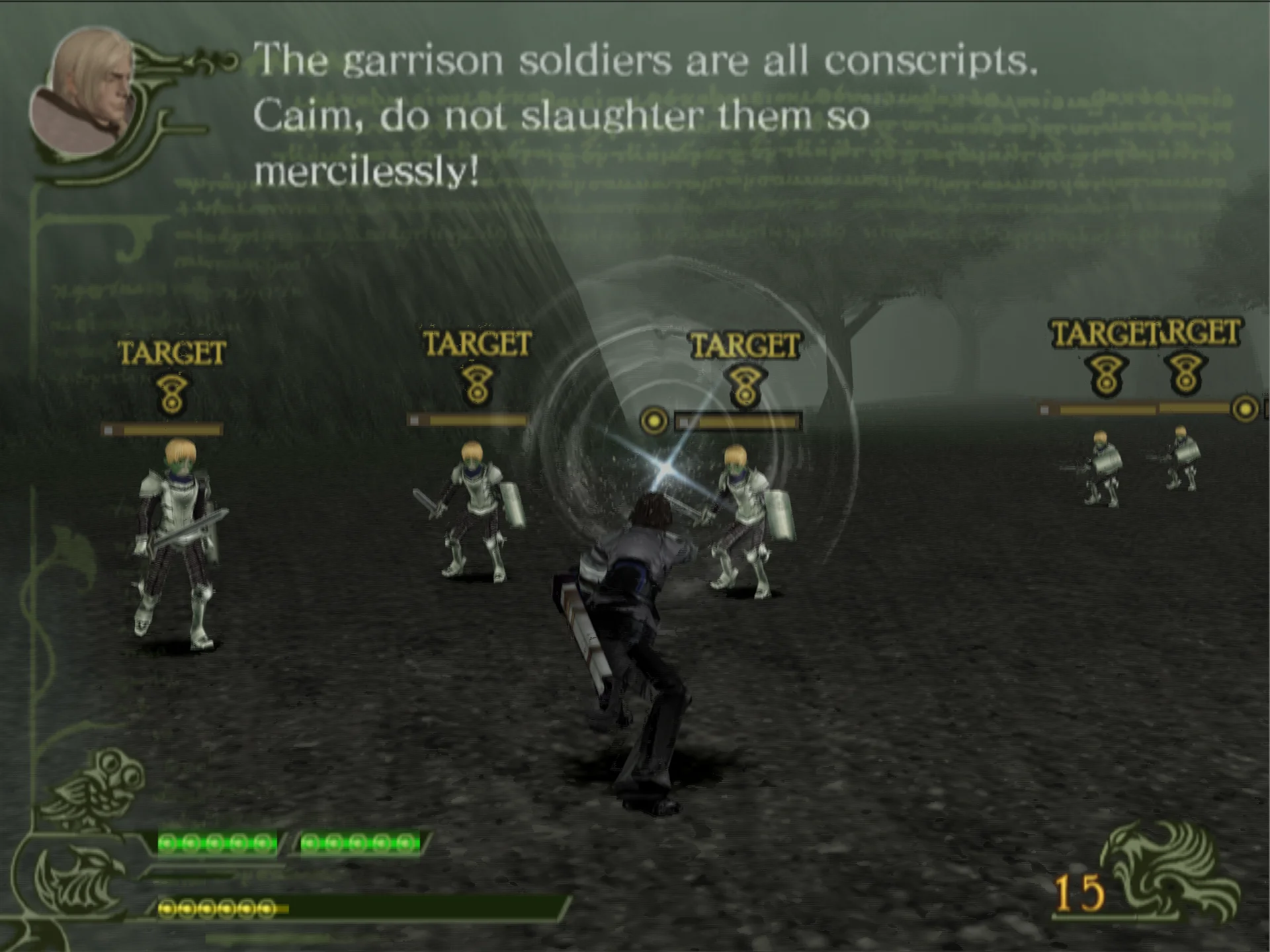
I don’t want to scrutinize Drakengard under the same measurements that I’d apply to a normal review. At the same time, I do want to cover all those review categories as I try to paint the whole of the curiously fascinating experience it offered. Whatever this game did to me since playing it with a few fellow sickos for a podcast here has stuck, for better or worse. So, for the next few paragraphs, I’ll discuss how each of these typical review criteria contribute to Drakengard‘s twistedly coherent artistic statement in a way few other commercially minded games have been able to manage.
Graphics: I’m Drowning in Brown and Red
Oh, the PS2 generation. You poor thing. Born too early to reap the benefits of HD graphics, born too late for the artistic charm of pixel art or low-poly 3D models on prerendered backgrounds. It’s not that all PS2 games look half-baked to a modern eye. It’s just that a lot of them do. Let’s just say that 3D graphical “realism” looked a lot different in the early 2000s than it does now.
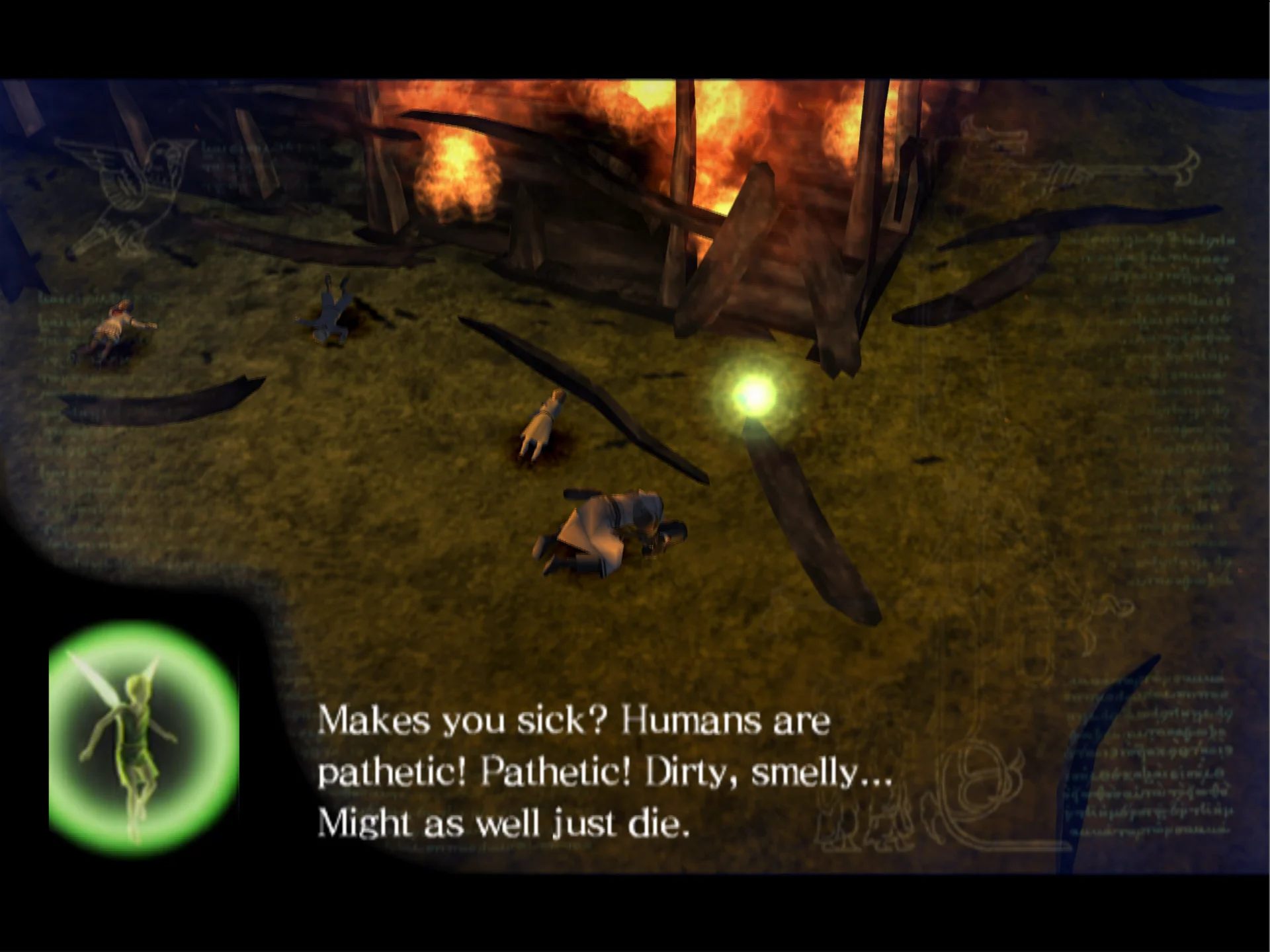
Drakengard leverages this ugly realism to great effect. The world of Drakengard is quite horrid in spirit, so why wouldn’t it be horrid on the surface as well? Most missions take place in rural plains, stone castles, and other such barren wastelands devoid of natural life and beauty. So, yeah, most everything you see is washed out and brown. The most colorful it gets is the greenery of the forest missions early on, and what happens there is that a village of elves gets massacred. So, what do you expect? The lush vistas of Final Fantasy X’s Spira? Nay, I say. Show me a feces-colored world ravaged by human conquest and sin.
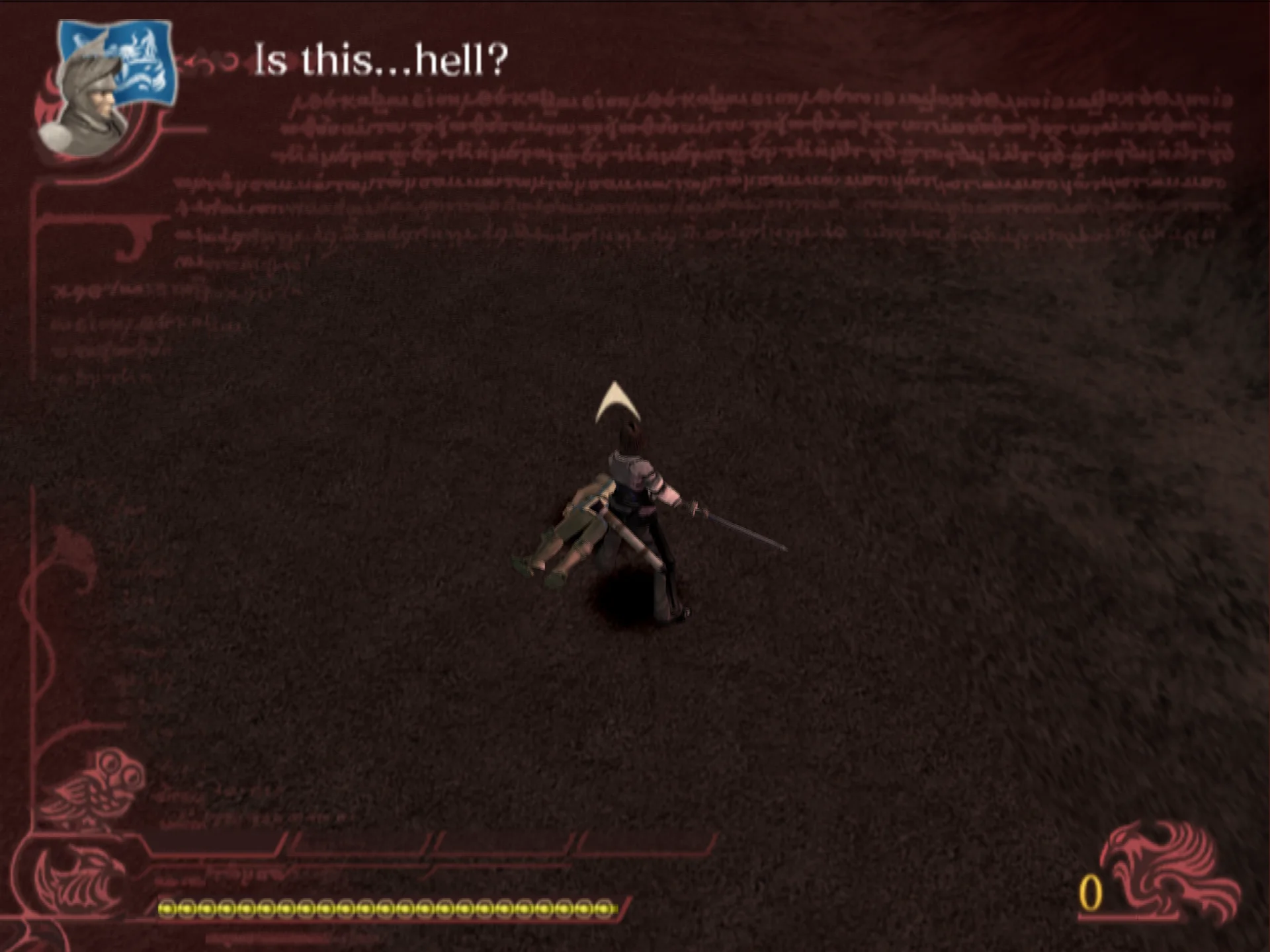
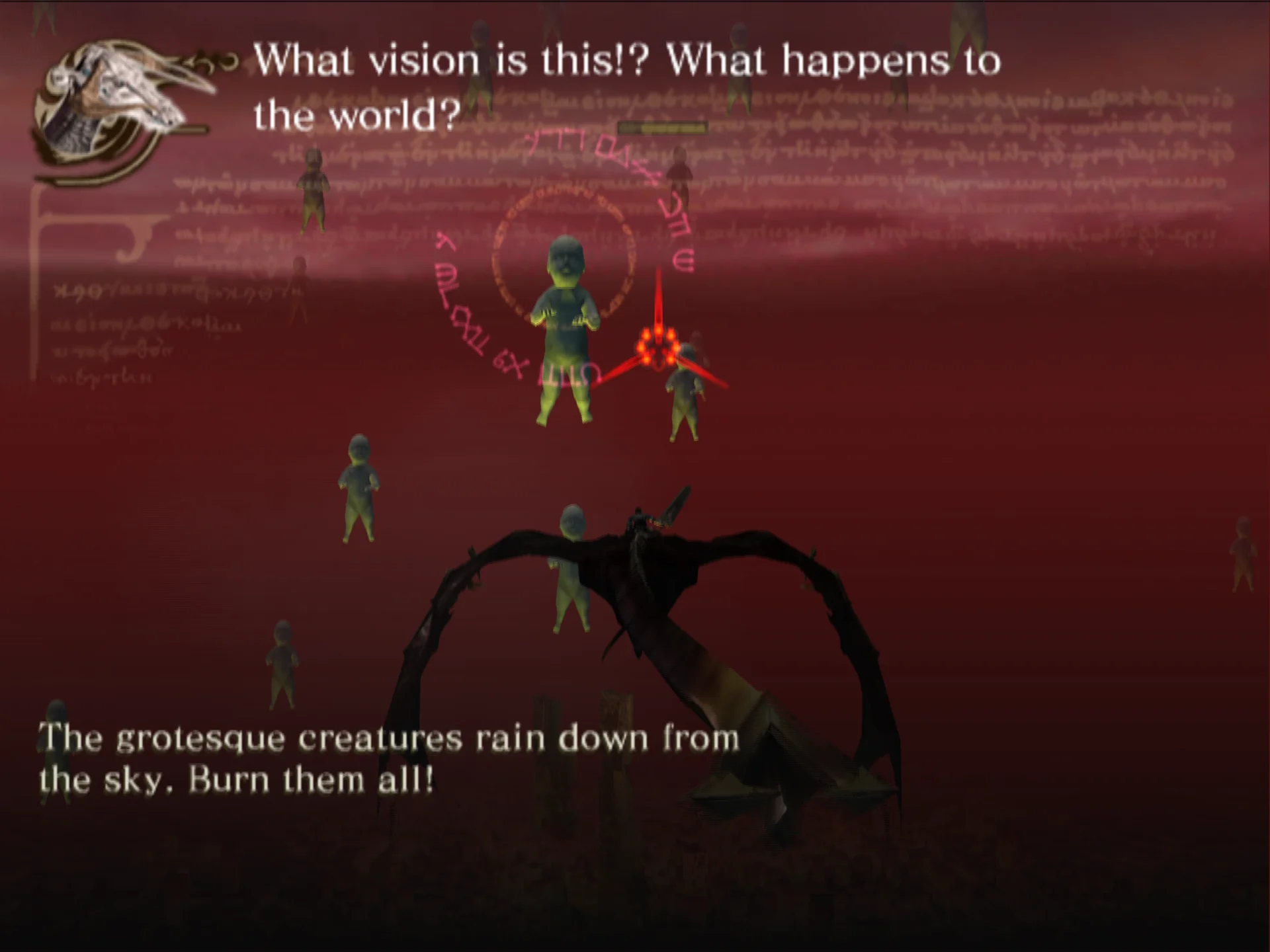
You know what goes well with brown? I mean, not well, but as an effective way of getting good hell-like aesthetics? Red! Blood! Fire! Decapitation by sword! Mass incineration by dragon breath! Around Drakengard’s climax, plot events become more dire (of course) as the world truly turns into a living hell. What better way to convey that visually than through wastelands and ruins tainted with a brownish red as giant babies try to eat you? Exactly. Well played, Drakengard.
And hey, you know what isn’t ugly? That 60 FPS, baby.
Sound: My Ears are Splitting, and I Love It
I’ll say this one with zero irony: I love the Drakengard OST. It’s a creative and technical masterpiece of videogame composition and perhaps the biggest reason that there is any sense to what I’m saying in this article. With that said, I’d just as soon spin it out of context as Lou Reed’s Metal Machine Music or the soundtrack from Eraserhead. In context, though? It’s the key element turning the musou-inspired gameplay loop into an interactive simulation of murderous insanity. If you were to replace Drakengard’s OST with the music from any other fantasy RPG, it would fundamentally alter the game’s DNA.
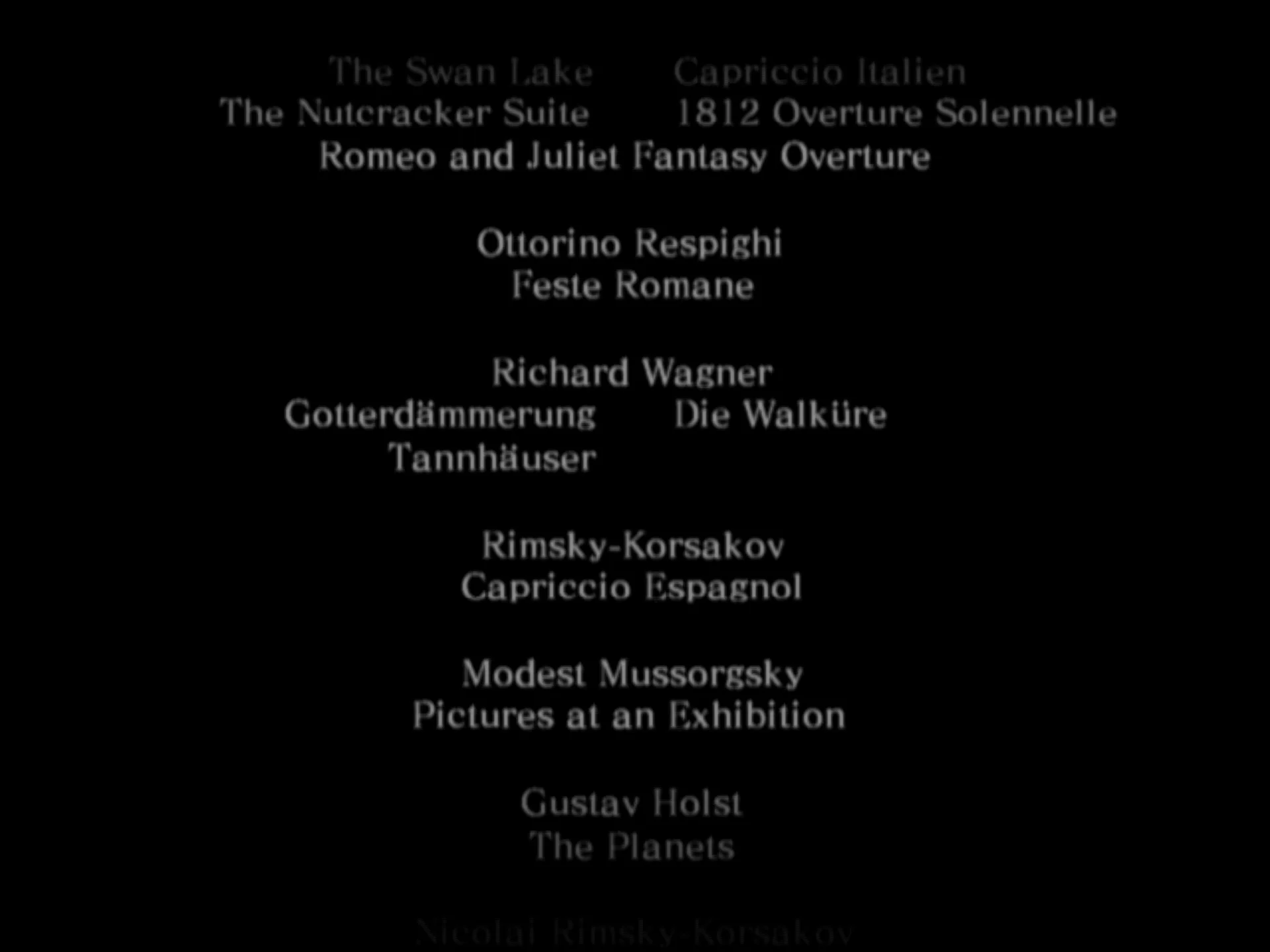
The score pulls samples from various famous classical works and then throws them into a blender, shredder, and meat grinder for good measure. You can’t convince me it’s not fascinating (and hilarious) to experience the ear-abusing music for over a dozen hours and then see Mozart, Tchaikovsky, and Wagner’s names appear in the sample credits. Nobuyoshi Sano’s score pulls elements from these classic compositions, re-recorded them, then digitally mixed and cut them to create the sonic insanity you hear in-game. To further disorient your senses, it also incorporates sounds like bird chirps into the mixing. The intended effect was to create a corrupted version of something familiar. By extension, you could say that is the mission statement for the entire game.
Controls: I Am the Chaos
I’m not going to lie. This one is pretty hard to defend, at least for the ground missions. You can’t convince me that the controls for the aerial missions don’t make for some of the most satisfying dragon combat in any game. After all, Drakengard’s development team inherited veterans from Namco’s Ace Combat series, and it turns out their feel for silky aerial motion and intuitive dogfighting translates easily from airplane to dragon. For better or worse, however, these missions are not the bulk of the game.
And yet! I was able to familiarize myself with the ground mission controls and begin mastering them. There’s an absorbing monotony in positioning yourself against opponents according to weapon type and pressing square, then square, then square, maybe triangle (etc.) while watching Caim decimate yet another mob of enemy scum. Sure, trying to manipulate the right stick so the camera looks in the desired direction is akin to threading a needle after drinking three cups of coffee and four shots of vodka. But war is chaotic! Do you think you’d have perfect 360-degree vision in the throes of bloodshed? The game’s even nice enough to show all nearby enemies’ proximity to Caim as red dots on the compass. It’s perfectly workable if you’re not too spoiled by modern gaming’s homogeneous standards. Yes, yes, it’s janky and lacks fluidity or weight, but, uh, whatever! Let’s move on.
Story: Show Me a Mass Murderer and I’ll Write You a Tragedy
And here we are with the game’s alleged redeeming factor: the story. Honestly, I don’t think there’s anything profound to gather from this tale of relentlessly depraved people and corrupted civilization for anyone but the edgiest of edgelords. However, it’s safe to say that the young Yoko Taro fit the bill. Drakengard’s world is painted with 50,000 shades of Berserk’s pessimism and brutality, Neon Genesis Evangelion’s uncomfortable Freudianisms, and (I imagine) more obscure otaku deep cuts. And it relentlessly hammers over your head and on your nose how profane and irredeemable everything is. Jealousy, lust, wrath, and those four other sins seem to drive each character’s motivation.
If, like me, you don’t find that particularly inspiring, Drakengard’s story is merely an unhinged vibe to attune to. It is set dressing for a game that is simultaneously like multiple others and obstinately unlike any of them. It is indulgently morbid in a way that simply works, sense or meaning be damned. Caim is a savage protagonist who hates everyone and everything except violence and his sister (both of which he may like a little too much). It’s a blatant subversion of all the “heroic” killing players commit in the Final Fantasies and Dragon Quests of the RPG world without any of the hope of an Undertale or Moon. Caim’s desire for bloodshed is selfish and relentless. Meanwhile, the supposedly madonna-esque damsel-in-distress has secret incestuous longings. Drakengard’s story starts at dark and consistently spirals down towards depraved.
As if that wasn’t enough, the companions Caim eventually allows to follow him include a traumatized pedophile, a traumatized psychopath, and an incredibly annoying (and traumatized) little boy. Has there been another RPG that follows such a miserable bunch? There are interesting subtleties in the characterizations, but they mainly serve to skewer humans’ tendency towards contradiction between what they believe and how they act. Everyone is despicable—especially when they pretend not to be—yet how much can we blame them when the world they live in is equally contemptible? Listening to these characters’ banter during missions becomes morbidly funny in its offputting weirdness. Yet, as someone who’s seen the Power of Friendship persevere a few too many times at this point, Drakengard’s cast is a welcome breath of rank air.
Aside from the banter dialogue, Drakengard generally tells its story through in-engine cutscenes. Even the presentation of these scenes feels off. In each one, the camera looks down on the characters from above. These scenes feel theatrical in their awareness of bodies and space, and judgmental in how it distances us, the viewers, from the action. One particularly memorable scene shows Caim repeatedly thrusting his sword into a corpse on the ground. I can’t recall another RPG using cutscenes to try disconnecting me from my avatar in such a seemingly deliberate way. Watching these characters feels like observing rats in a science experiment. All I see are a bunch of pathetic creatures and their disturbing problems and emotions. In both story and gameplay, Drakengard dehumanizes humanity.
How I Learned to Stop Complaining and Love the Gameplay
Let me make this clear: I like Drakengard’s gameplay. I had actual fun playing this game. I can’t promise anyone reading this that you’ll also have fun if you play it, so don’t hold me responsible for any decidedly unfun experiences if you deign to pick up the controller. However, I can at least try to explain why I had fun playing, as it’s the feeling I’ve most grappled with since completing the game.
I believe the fun had less to do with the feel or reward of the game design itself than its coherent integration with everything else. It’s no secret that Drakengard’s gameplay is heavily musou-inspired. I’ve tried playing an older Dynasty Warriors game before, and it did nothing for me. In a traditional musou game, you pick a hero, mow down opponents, and grow. It’s supposed to be epic and satisfying by making you feel strong. For me, it was so predictable in this premise that it felt mechanical—devoid of humanity. All Drakengard had to do to make me pay attention was flip the context. Turns out musou gameplay is more interesting (for me, at least) when you’re asked to question the mass murder while you indulge in it. It doesn’t have that problem of lacking humanity because it’s tap-dancing on humanity’s grave.
In practice, this dance is a monotonous procession of pressing the Square and Triangle buttons as Caim mows down wave upon wave of human livestock. The key to making this work narratively and mechanically is Angelus, the red dragon, who reluctantly makes a soul-bonding pact with Caim, which provides Caim the strength he needs for his murderous desires. Even during most ground missions, Caim is able to ride on Angelus to rain fire from above and dispatch groups of enemies like insects. It helps that most enemies in the game are quite annoying to deal with, so it supports the feeling that they deserve it. At its best, swapping effectively between the two characters’ unique murder styles got me into the most unsettling kind of flow state where I began disassociating as an optimal, unfeeling killing machine.
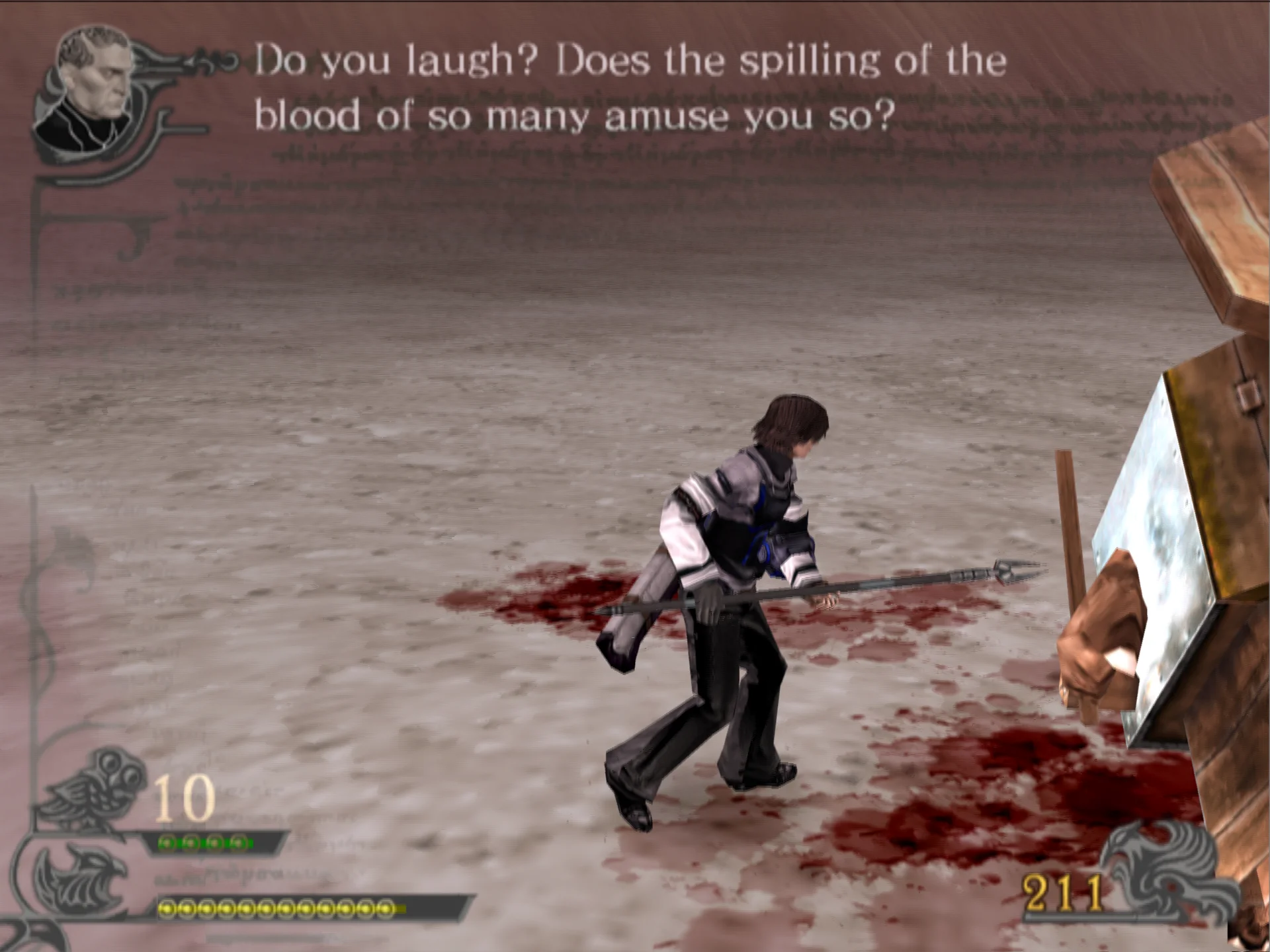
The pact’s only drawback for Caim is that he loses his voice. The most in-game banter, then, comes from Angelus, who casts constant judgment on humanity’s pathetic existence whilst sounding like a chain-smoking grandma. Especially as a complement to the OST, it’s the exact flavor text needed to fuel the game design’s impetus for unheroic mass murder. Clearing a mission rewards no victory theme, celebratory animation, or other fanfare. Just a somber little tune as Angelus throws out some acidic pseudo-philosophy, like:
“humans are a race to be pitied”;
“Wise men choose death before war. Wiser men choose not to be born”;
and “What difference is there between he who kills and he who prays? Fools, these humans.”
I neither know nor care if this writing is intended to be sincerely interesting or just amusing. The Point, I think, is that it works in such stark opposition to how RPGs usually communicate reward. It is a pure indulgence in its own subversiveness and a reminder that videogames are tricks that try to make us feel proud just for investing time into them. And yet, I can’t help but see Drakengard as a celebration of the medium’s capacity for expression. And by expressing itself in such an unconventionally maniacal way, Drakengard is an invitation for any aspiring developers to break from convention with glee and reverence for videogames’ potential. It was the stepping stone that led to NieR, after all.
In Conclusion?
Drakengard isn’t “so bad it’s good.” It’s good because the ways in which it’s bad thematically support the ways in which it’s good. It’s good because it feels perfectly coherent. It’s good because its bad elements shock us into recognizing what videogames are and all the things the corporate world would (usually) never dare them to be. Not as a game, really, in the commercial-friendly design sense that we like our games to be “useable”—fluid, comprehensive, gets us in a flow state to sink hours into. But maybe as art?
You may be reading all this and think Drakengard sounds pretentious. I assure you that is not the case. For any artistic work to be pretentious, it needs to try to Say Something. Drakengard doesn’t really manage to say anything. It’s just an interesting mishmash of noteworthy and flawed elements that work as a perfectly coherent videogame experience. It’s more of a pure videogame than anything else Yoko Taro would work on, all of which try to flesh out Drakengard’s obstinately cynical backbone with a more nuanced and mature perspective on humanity. But Drakengard is more mood than message. To play Drakengard is simply to experience what it is and marvel that it even exists.