
Since its humble beginnings in 2009, FromSoftware’s Souls series has flourished into one of the most beloved in gaming. Its success is plainly evident by the sheer number of games released since then that almost directly copy the formula, to varying degrees of success—Souls-likes, as they are called, a few to be covered in Part 2 of this list. However, rare few have been able to capture the magic touch of Hidetaka Miyazaki, as the titles he directed or supervised arguably remain the best in the business.
Like every long-running franchise, things can get confusing for people trying to get into the series and its descendants. This is only made worse by the fact that several entries made by Miyazaki and FromSoftware don’t even have ‘Souls’ in their titles, and even the numbered entries in Souls aren’t necessarily direct sequels to each other. So, where to begin?
Where it all started…
It’s almost uncanny how the creation of the Souls series mirrors the gameplay loop that allowed it to make a name for itself: perseverance in the face of overwhelming odds.
Future game director and FromSoftware president Hidetaka Miyazaki got more than a handful of strange looks when he left his job at Oracle Corporation to instead work as a designer at FromSoftware at 29 years old. Despite leaving most of his paycheck behind and starting over his career from zero, Miyazaki diligently worked as a coder for the Armored Core team before an opportunity was presented for him to work his creative magic: a failing fantasy ARPG project within the company called Demon’s Souls.
The dire state of the project allowed Miyazaki to have complete control over every aspect, and he overhauled nearly everything from the ground up in time for an October 2008 Tokyo Game Show demo—only to be met with derision and ridicule from attendees of the event, according to producer Takeshi Kajii. To make matters worse, Sony did not print enough copies of the game in Japan; even as it consistently sold out, its audience was small early on.
But word of mouth quickly spread about this game that so starkly defied gaming trends at the time with its patience-testing gameplay and esoteric but intriguing lore. A fiercely dedicated fanbase began to grow around the game, and sales quickly picked up, especially after its Western release (which Sony later regretted pushing to third-party publishers Atlus and Bandai Namco). The rest, as you might have guessed, is history.
What exactly is a Souls game?
Without a doubt, the first thing that comes to mind when mentioning the Souls series is the difficult gameplay, which has become an easy marketing slogan for Bandai since Dark Souls. But what exactly makes these games difficult for some players? Perhaps it is the following key gameplay features of the series:
Souls (currency) – Although they go by different names outside of the mainline Souls games, the concept remains the same. Rather than gaining experience automatically per enemy kill, you’re rewarded with a number of “souls” you can use to level up stats of your choice or as currency to barter for goods. None of this matters, however, if you die before reaching the next bonfire or merchant as you lose all of your souls and only have one chance to recollect them from the spot where you died after respawning; die again, and they’re gone forever.
Bonfires – Over the years, bonfires have become iconic even beyond FromSoftware’s catalog as brief but memorable moments of respite in a world otherwise hell-bent on ending you. In terms of gameplay, bonfires are a place to level up your character, fast travel between areas, replenish your estus flasks or other healing items, and fully heal your character. But be careful: when you rest at a bonfire, all the enemies in an area will respawn as well.
Boss Fights – The Souls series’ takes on bosses are some of the best in the business. Usually marking the mid and endpoints of a level, these fights serve not only as the ultimate test of your understanding of certain game mechanics but also as significant lore beats, often adding to the mystique and wonder of the world.
Multiplayer – One of the Souls series’ most ephemeral and strange aspects it its multiplayer. From messages on the floor to cooperative multiplayer in the form of player summon signs (typically found near tough boss fights), Souls games offer plenty of helpful ways to play with others. On the flipside, there is also PvP, mostly player-initiated but occasionally random or even (rarely) required. Those willing to delve deeper will find entire communities dedicated solely to Souls multiplayer, from PvP fight clubs where dozens of players congregate to fight to the death, to players dedicating entire save slots to helping out players in need.
Despite the notoriety of Souls games’ difficulty, the heart of the Souls series would undoubtedly be its matchless environmental storytelling. At a surface level, each game’s world appears bleak and barren: monsters savagely claw at your HP bar within moments of picking up the controller, precarious drops and traps lurk in the shadows, and every death puts you at risk of losing potentially huge swathes of experience forever. But dig a little deeper and you’ll find that doom and gloom only paint half the picture. Whether it be a group of strangers you just met coming together to praise the sun in unison, basking in moments of brief respite after a particularly grueling gauntlet of enemies, or even just picking up crumbs of lore from conversing with NPCs, it is the contrast between these moments of hope and levity with a world fallen to chaos that defines the Souls experience, and has inspired the ensuing Souls-like genre.
Intro by Dom Kim
Mainline Games
The following titles are developed by FromSoftware and contain all the key Souls-like gameplay features listed above. These are widely considered to be the “canon” Souls series games, though two of the following games notably do not have “souls” in their title: Bloodborne and Elden Ring.
All games are available on all modern systems (PS4, PS5, Xbox One, XBX|S, & PC; additionally, Switch systems for Dark Souls Remastered), unless otherwise noted.
Demon’s Souls (2009)
Only on PS3 (Original) and PS5 (Remake)
by Noah Leiter
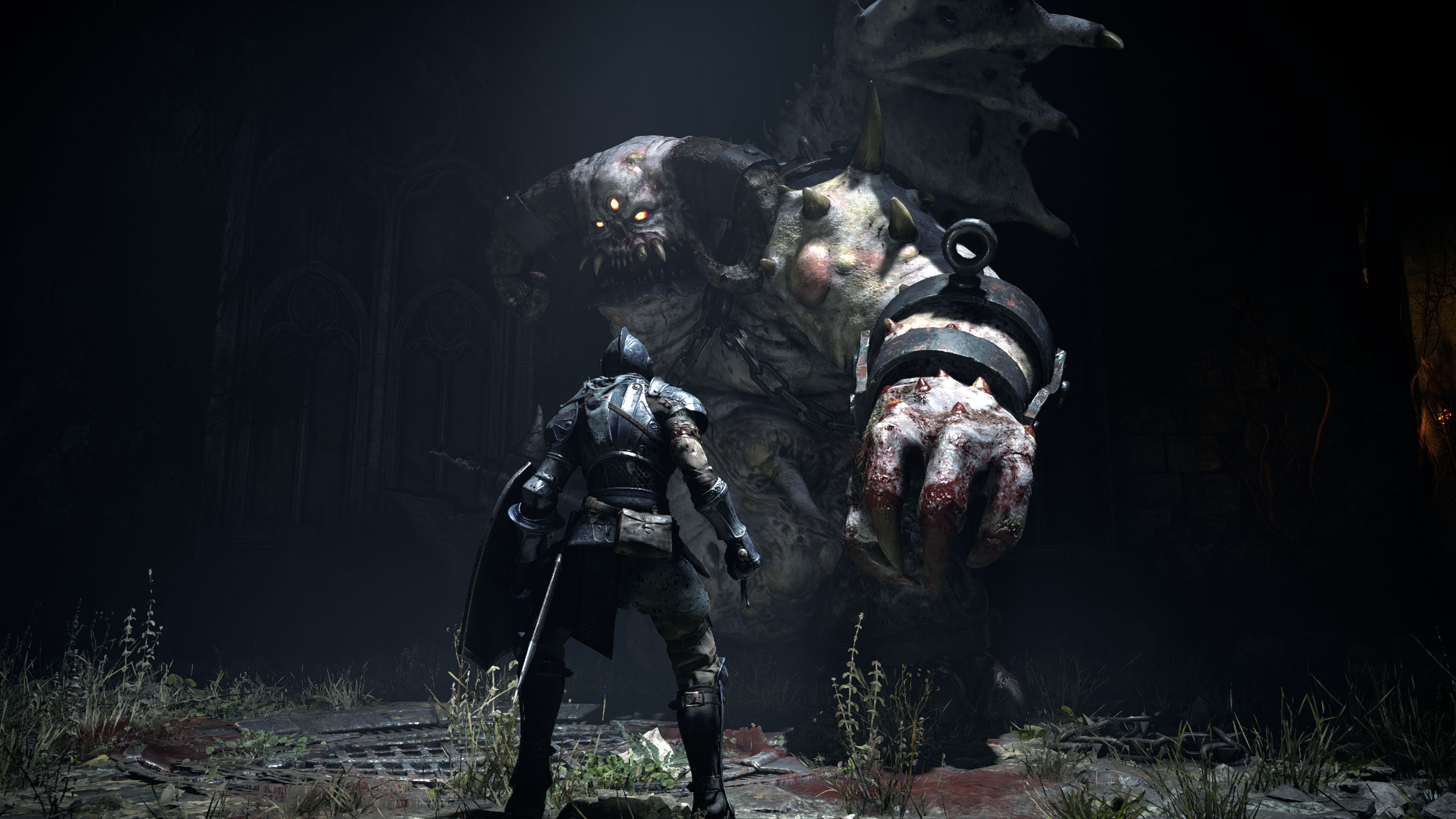
While some look as far back as Armored Core IV in 2006 or even earlier for the birth of the Souls canon, the widely accepted start of modern Souls is Demon’s Souls. This PlayStation 3-exclusive action RPG was technically Souls visionary Hidetaka Miyazaki’s third game as director at FromSoftware, following Armored Core IV and Armored Core: For Answer (2008).
Demon’s Souls explores themes of transience and cooperation through adversity, and it was inspired by an interaction Miyazaki had in a winter snowstorm some years earlier. While driving one snowy night, Miyazaki came upon a hill that he and the cars in front of him could not ascend. However, cars on the flat ground at his rear pushed his and other vehicles up the hill, so he was able to escape and move along. When creating Demon’s Souls, Miyazaki sought to recreate the weird ephemerality of this car ride in a snowstorm, coupled with the anonymous transient cooperation of being pushed up a slippery hill by strangers. Thus, the game’s asynchronous multiplayer elements—cooperative boss fights, player-left messages, and bloodstains which show other players’ deaths—among other key features of the genre, were born.
The surreal atmosphere and gothic vibe of Demon’s Souls is thick throughout, especially in its opening hours, which see the player die and apparate into a fading purgatory for erstwhile soldiers. In death, the player becomes a “soul of the lost, withdrawn from its vessel,” an undead warrior tasked to strike down demons that have shrouded the living world in a dense fog. However, these demons and their lairs are dangerous and mysterious, so without the cooperation of others, overcoming them is like climbing a slippery, snow-covered hill. There’s grit in this game, a reminder of necessary determination. But more than grit, every element of Demon’s Souls—its surreal medieval setting, its level and boss design, its multiplayer—imbues the sense of transient cooperation Miyazaki felt on that hill. Paired with rock-solid combat, movement, and performance borne of Miyazaki’s previous experiments with the Armored Core series, Demon’s Souls plays and feels like a dream. It is an unmissable classic of the genre, with a drop-dead gorgeous remake on PS5 in 2020, a series staple that still holds up today—no matter how you play.
Why should I start here?
Demon’s Souls is the earliest game in the series, but it’s also one of the newest: the 2020 remake on PS5 has active multiplayer today, and it holds up to modern standards of graphical fidelity, gameplay, load times, and performance. Of course, nothing can match the moody, sepia-gray sheen of the original on PlayStation 3, so older and newer tastes in videogames will find something to love in Demon’s Souls.
Dark Souls (2011)
by Dom Kim
Demon’s Souls’ success, however late, did not go unnoticed, and Bandai Namco was quick to partner up with FromSoftware to begin developing a sequel. Intellectual property rights as a PlayStation-exclusive title prevented this sequel from being Demon’s Souls 2 outright. Still, the additional creative liberties taken as a spiritual successor proved to be just what was needed to make Dark Souls one of the most iconic games of the 2010s.
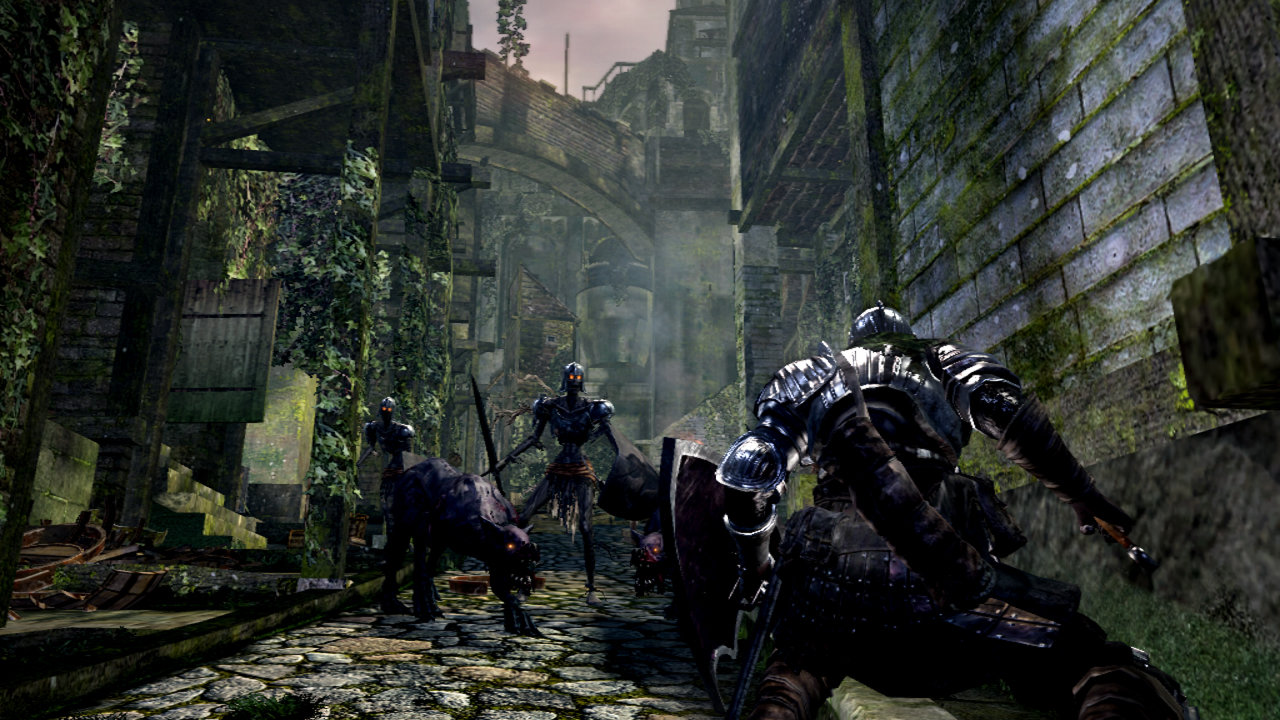
Awakening in the dying world of Lordran, where the slow but inevitable fading of the First Flame threatens to usher in an age of darkness, you are a “chosen” undead tasked with fulfilling the prophecy of reigniting the First Flame in order to prolong this Age of Fire. The minimalistic, lore-driven approach to storytelling from Demon’s Souls makes a welcome return, with item descriptions and NPC dialogue taking the usual spot of cutscenes and exposition dumps beyond the game’s opening minutes.
One of the key differences from Demon’s Souls, however, is the intricately connected nature of Dark Souls‘ Lordran. Instead of loading into individual levels from a central hub area, smart shortcuts and seamless transitions are littered throughout the world, making Lordran one of the most authentic-feeling fantasy worlds to date. The journey from the ramparts of the Undead Burg to the marble halls of Anor Londo remains a modern classic of level design since the game’s original release more than a decade ago.
Dark Souls saw almost immediate success, surpassing Demon’s Souls’ year-long sales within a week, managing to carve itself a strong niche despite the absolutely stacked gaming roster of 2011. The phrase “the Dark Souls of X,” referring to the notorious difficulty, was adopted into the gaming lexicon almost as soon as people began wrapping up their first playthroughs, and soon several spinoffs and indie titles hoping to emulate some of Dark Souls’ success began to appear in what would eventually become the “Souls-like” genre.
The huge wave of success also saw the team revisit material that was cut during development, resulting in the release of the Artorias of the Abyss DLC along with the PC port in 2012. Although the PC port was met with backlash due to its poor state, the DLC was absolutely marvelous. Lifting the veil on many intriguing but unexplained aspects of the lore, the ways in which Artorias of the Abyss tied back into the main game made it one of those rare pieces of extra content that didn’t feel tacked on at all.
Dark Souls, however, was not without its flaws. Areas such as Blighttown struggled to run at framerates faster than a sluggish PowerPoint presentation if you looked in the wrong direction, and the sharp drop in quality in the second half of the game lets you almost pinpoint the exact moment that FromSoftware ran out of time and funding during development. The 2018 remaster addresses the technical front of the issues with a proper 60fps frame cap, but the latter half’s lacking content will probably take a Resident Evil 2-esque remake to properly do over.
Why should I start here?
Dark Souls is as good a starting point as any for newcomers. As the genesis of many of the themes found in later entries, as well as some of the best worldbuilding in the series as a whole, this is still an entry well worth playing and revisiting. It is also the beginning of the Dark Souls subseries, a superbly fun trilogy to play in order.
Dark Souls II (2014)

by Dom Kim
The story behind Dark Souls II is a troubled one, beginning from the very first moments of its development. With his hands full from developing the Artorias of the Abyss DLC for Dark Souls, along with directing a brand new project within FromSoftware (this “new project” eventually became Bloodborne), Miyazaki could only contribute to the development of Dark Souls II as a supervisor instead of working on the game in his usual very hands-on capacity. Tomohiro Shibuya was brought in to direct, but despite his grand plans for the sequel, his ambitions often clashed with reality. Envisioning a sprawling open world with a huge emphasis on lighting and shadows, the developers at FromSoftware were soon tasked with the nightmarish task of creating a new engine from scratch while developing Dark Souls II, all in a time span of three short years. Immediately, the cracks began to show as the hardware limitations of the Xbox 360 and the PlayStation 3 severely hampered any meaningful progress, and development ground to a halt just a year before release as the technical hurdles proved too high to overcome. Shibuya was promptly offloaded from the project by FromSoftware’s upper management after they reviewed the state of the game, and Yui Tanimura was brought in to bring Dark Souls II over the finish line.
In a way, it’s a miracle that Dark Souls II ever saw the light of day given that Tanimura overhauled the project in its entirety, but the strains on the quality of the game are noticeable. Dark Souls II attempts to have a much more involved story than its predecessor, but ends up missing out on the fantastic environmental storytelling that made the first game so memorable. Uninspired map layouts and level design replace the first’s intricate verticality and interconnectedness. Enemy placement feels like a long continuation of the haphazard latter half of Dark Souls. Lighting and shadows are scaled back significantly from what was shown in earlier demos of the game, leaving only muddy and discolored visuals, and the controls feel floaty and imprecise despite the game running much better than Dark Souls ever did.
Boss fights are also similarly subpar, representing some of the lowest lows of the entire series. The base game has barely any encounters even worth remembering. The run-ups to the bosses are also the series’ most atrocious by a wide margin. Getting to the boss in decent shape is usually more difficult than the fight itself, with some combination of environmental hazards, hordes of enemies, and narrow pathways (sometimes all three at once!) trying their best to do you in. Dark Souls II felt more like a game trying to live up to the expectations of Bandai Namco’s “Prepare to Die” marketing slogan than it did a cohesive Souls experience, making it the black sheep of the Souls series for most fans, at least until the Scholar of the First Sin Edition on PS4 and Xbox One shored up most of the issues people had with the base game.
Thankfully, Tanimura was given a proper chance to direct from the ground up with the three Sunken Crown DLCs following the initial release. He even managed to create some of the best boss encounters in the series throughout this DLC trilogy by offering a much more coherent overall vision in terms of audiovisual design, story, and gameplay flow. Unfortunately, the DLCs are also home to some of the most infamous areas and enemy gauntlets and so couldn’t entirely escape some of the tiresome ideas of the base game.
This is doubly frustrating, considering that from a perspective of player agency, Dark Souls II improves upon its predecessor in almost every way. A whole host of new gear and weapons coupled with a much smoother leveling curve opened up a huge variety of interesting builds you could work towards. Much stronger netcode and dedicated PvP arenas allowed the multiplayer to go beyond its rather gimmicky state in Dark Souls.
Don’t get me wrong, within the wider scope of action RPGs as a whole, Dark Souls II is still a mostly fun and enjoyable experience. But the troubled development, combined with the sky-high standards set by its predecessor makes it the weakest entry of the Souls series by a fair margin for anyone seeking the singleplayer experience of previous installments.
Why should I start here?
The online play in Dark Souls II is second to none, so if you’re more interested in the multiplayer functionalities of the Souls games, this is a great place to start.Scholar of the First Sin Edition is also a more polished way to experience the single-player of Dark Souls II, and it includes the base game and its DLC.
Bloodborne (2015)
Only on PS4… :'(
by Noah Leiter
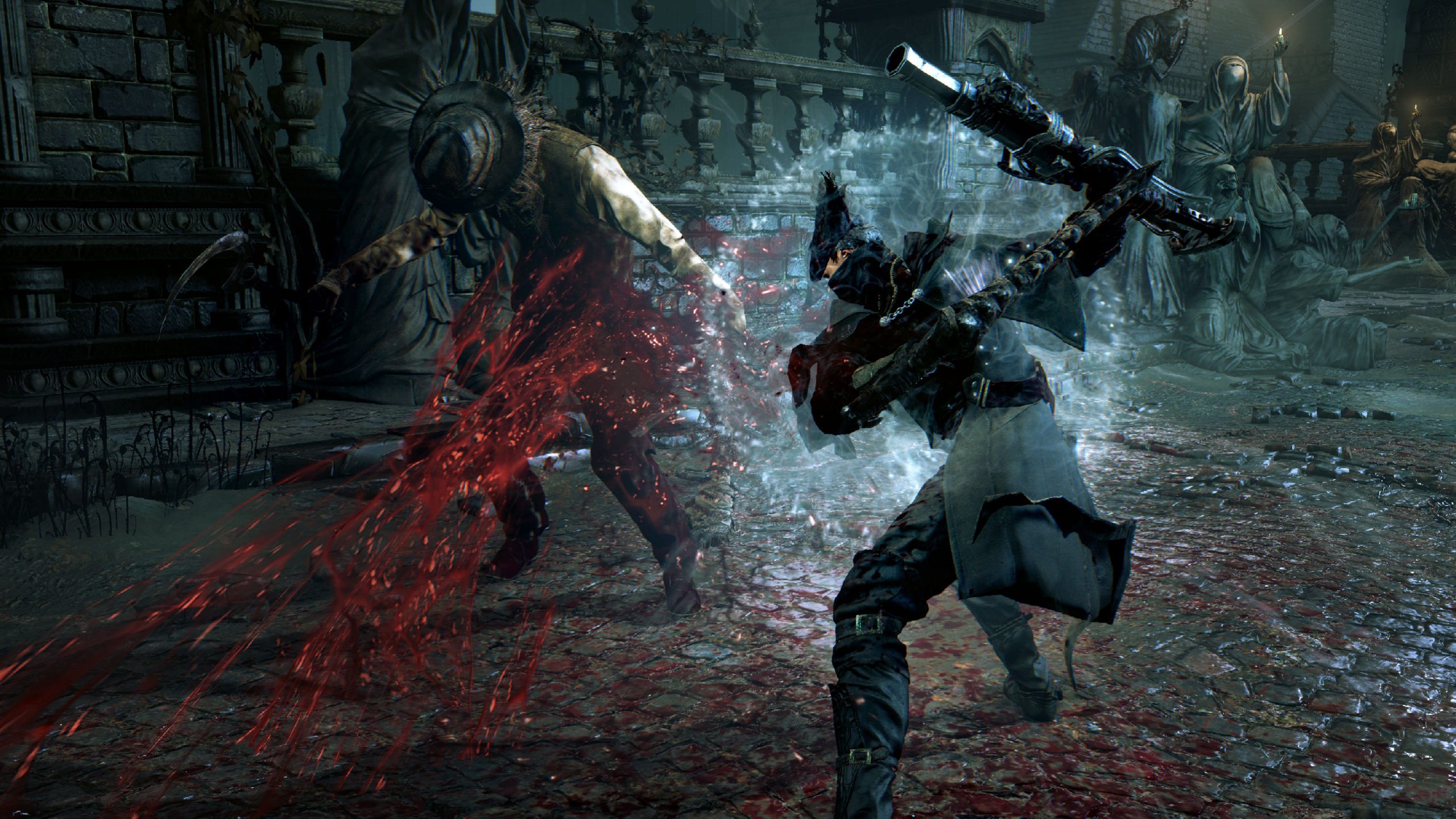
Patience, preparation, perseverance. These were the ways of Dark Souls. Builds and loadout setup, currency farming, boss strategizing, and multiplayer are like pavement players can slowly lay in front of them to ease their path forward. Bloodborne, on the other hand, is a gorgeous, bumpy cobblestone pathway. You must follow its linear forms as the game directs, and you must contend with its curves and ridges as they come. In this way, Bloodborne is decidedly more aggressive than other Souls-like on this list, and it is certainly a tougher challenge.
Perhaps the gameplay trinity at play in Bloodborne, then, is persistence, pugnaciousness, and phlebotomize. You must be aggressive, willing to iterate on enemy and boss encounters, but most of all, you’ve gotta let it rip, baby. You’re practically a vampire in Bloodborne—the more blood you tear out of your opponents, the more you eat up any damage they do to you. Your health bar’s likely to steadily drops from enemy attacks, and thus where Dark Souls would ask you to run and heal, Bloodborne whispers darkly under its breath: bathe in the blood of your enemies. Preserve your precious consumables and your health bar by playing offensively when possible; a well-calculated retaliation is a key preservation strategy here. This is made all the more important as loadouts are more constricted—you have fewer consumables, often limited by Lamp (Bonfire) visits—but there are more buttons for switching and using equipment, such as how you can now swap between two modes for every weapon, offering playstyle variety without slower-paced, sometimes disruptive, menu traversal. Bloodborne does not want players to interrupt its action or its journey for preparation’s sake. Its systems are instead designed around constantly moving forward through the endless Night of the Hunt.
Speaking of, the story in Bloodborne is as wild and strange as any on this list. You are a Hunter in a gothic city called Yharnam. After contracting a rare illness, you are trapped inside a dream of Yharnam (which is also the real Yharnam?), and you must wrest the city from the clutches of eldritch nightmare creatures in order to wake up and for the sun to rise again on the darkened city. Bloodborne is like Link’s Awakening’s evil twin: a game set in a dream, but this time it’s a nightmare, a maddening, endless sleep paralysis from which one may only wake with interminable violent contusions and chokehold breathlessness. Where Link’s Awakening is lyrical and serene, Bloodborne is gory and ferocious. I’ll leave it there, so you may uncover its other mysteries yourself, as playing Bloodborne is like reading the juiciest Victorian novel, full of horrors that reflect lived reality but also explore a rich, unimaginably dark aesthetic in compelling fashion from end to bloody end.
Why should I start here?
Victorian horror vibes, perpetual nighttime, unorthodox sapient creature terror, you know, the Mary Shelley of it all. Bloodborne is a book most eligible for judging by its cover. In fact, it is exactly what you expect it to be. So, instead of reiterating the game’s designs, I’ll offer a gesture, rather an invitation: join us on the Night of the Hunt, come play Bloodborne, and become part of gaming’s most exclusive and accepting cult of personality. We have wikis and fan art and the best dang demake ever made. But more importantly, join the fight against the dark terrors of the night. No, I don’t mean that lil’ cutie Father Gascoigne, I am of course talking about the true shadowy fiends of Bloodborne fandom: Sony executives who are holding the game hostage in a prison of 30fps and PS4 loadtimes. Play Bloodborne as it is, and become part of the Church of Bloodborne PC, a cardholding member of the Sony-please-port-this-to-native-PS5 revolution! Come for the vibes, stay for the punch. It’s not poison, I promise! (We are not responsible for any Beast hairs in the punch.)
Dark Souls III (2016)
by Dom Kim
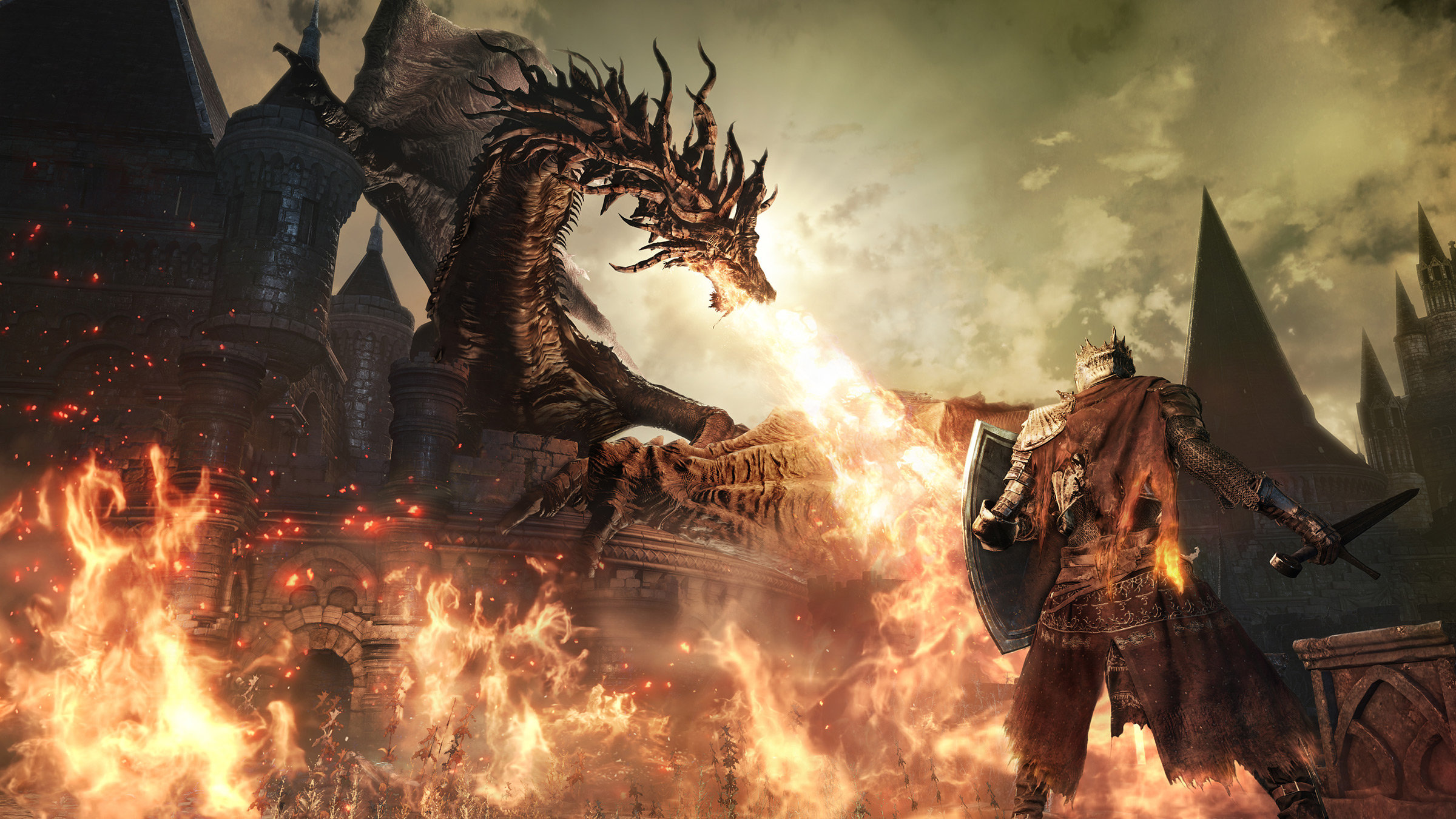
Around the time that Dark Souls II had to rebuild the entire game from scratch in mid-2013, Miyazaki quietly returned to the mainline Souls trilogy to begin his work on Dark Souls III. His impact is felt immediately, returning to a style much more reminiscent of the original Dark Souls than its sequel.
For starters, the moment-to-moment gameplay in Dark Souls III is far and away the most palatable in its trilogy. The inconsistent input lag is vastly reduced, floaty character movement is nixed almost entirely, and players can finally utilize the full range of motion in the analog sticks instead of being tied down to clunky eight-directional dodge-rolling. Its slick gameplay makes it and Bloodborne the first games in the series to actually feel like modern titles.
Additionally, the quality of the game is the most consistent of the series. The trademark dip in quality past the halfway marks of Dark Souls I and II is far less obvious (although the absolutely hellish swamp level continues to overstay its welcome), and the boss roster is all killer (mostly) no filler, extending all the way to the two DLCs, Ashes of Ariandel and The Ringed City.
The mana system makes a return from Demon’s Souls, replacing the previously odd system of limiting spell casts like ammo. This also served as the resource players would spend to cast weapon arts, a weapon’s “special move” if you will, although most weapon arts ended up being far too impractical to see any real use beyond niche online play.
But even Miyazaki’s directorial return seems to be unable to quite recapture the spirit of Lordran. Lothric is absolutely littered with gorgeous vistas and landscapes, and you can feel that every level was intricately crafted from top to bottom. But the manner in which the world comes together is somewhat uninspired, especially with the return of the central hub like Demon’s Souls. It doesn’t quite feel like an organic world like Lordran did, as much as it feels like a fairly straightforward single-player ARPG.
Why should I start here?
By far the most polished entry in the main Dark Souls trilogy, if you wanted to start playing the Souls games but without some of the jank of earlier entries, this is the place to be.
Elden Ring (2022)
by Noah Leiter
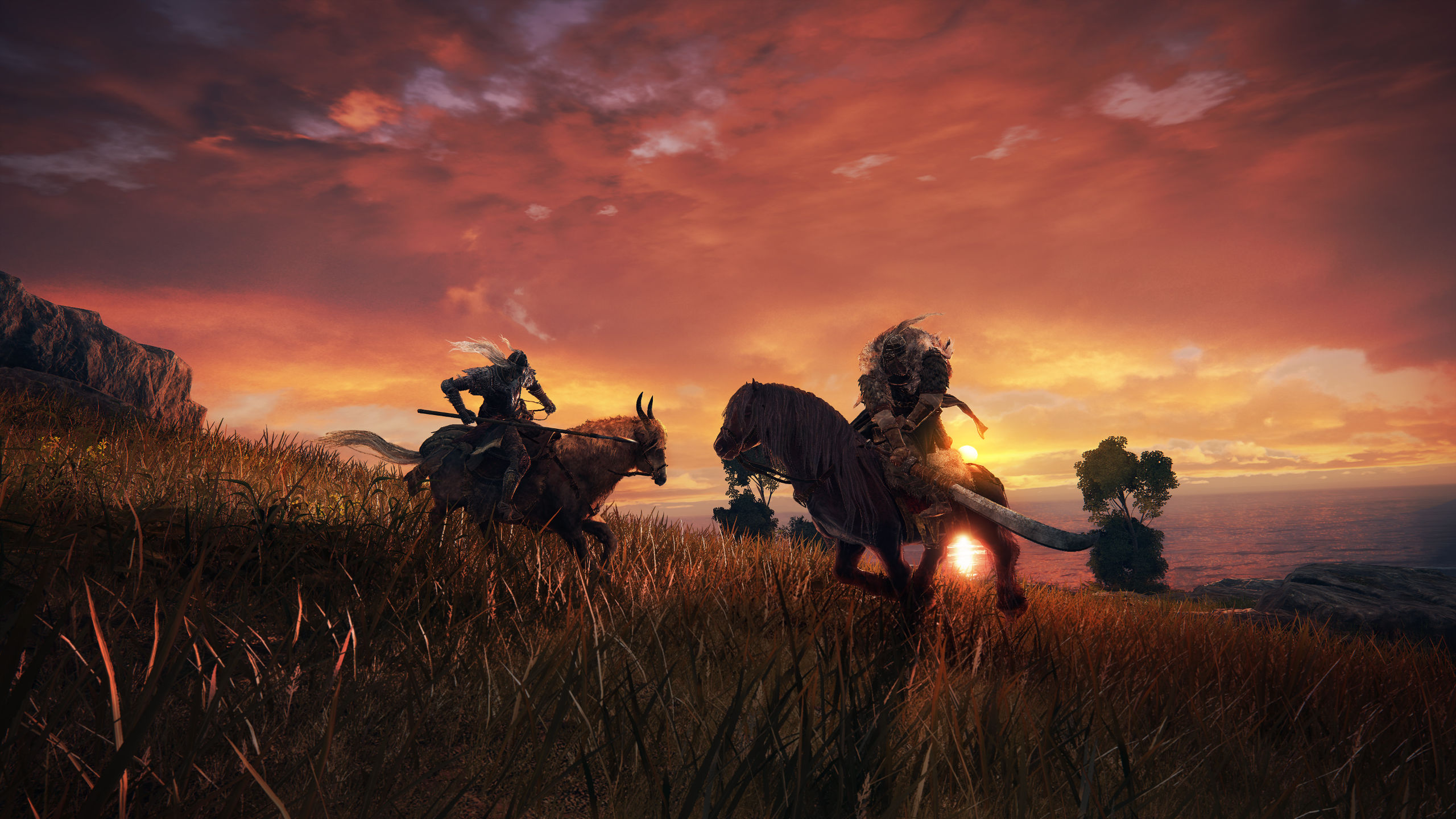
The most recent FromSoftware-developed Souls-like game (as of 2025) is Elden Ring, a game whose three-year buildup from announcement to release nearly reached supernova levels of hype from its fandom. However, in rare fashion, especially in the age of Early Access and broken launch promises, it managed to exceed even the unreasonably astronomical expectations of its fans, releasing to widespread popularity and acclaim and rising to the tops of “favorite game of all time” lists everywhere.
And, honestly, Elden Ring is where I would personally start with the genre/series as a newcomer. Whether you’re interested in a gothic aesthetic, a challenge, or competitive multiplayer, Elden Ring is an action RPG veteran’s treasure trove. Additionally, if you’re newer to the genre, there’s plenty here to love. Perhaps you want a sprawling and immersive literary story oozing with queer undertones, or a style as uncanny and artsy as a 1970s prog rock dust jacket, or perhaps you just want something delightful and approachable from a myriad of playstyles; any way you slice it, Elden Ring is an attractive suitor. The game rewards both players who take it slow and those who wish to play hard and fast, as well as both those who crave single-player adventure or challenge, and those who want a more cooperative experience. You have options to summon players and varying NPCs, spirits, and magic to guide your play, but you can also run headlong into everything with nothing but a sword and a pot on your head to protect you. Elden Ring is an ideal example of a “something for everyone” RPG. Sure, it caters to the battle-hardened masculine crowd the genre unwittingly draws, with its familiar character builds, cheeky invasions, big bosses, and level hazards. However, Elden Ring also presents a pleasant, interesting, and inviting world rife with round-the-corner possibilities, wondrous vistas, encouraging cooperative multiplayer, and subtle story beats, making it a genre-best entry for both those seeking the achievement of a hard-won victory and those looking for an engaging story/setting.
Doting fans of the genre can whittle hundreds of hours of enjoyment out of its multiple story endings, collectible items, robust build possibilities, and its multiplayer options. Conversely, those looking only to dabble can rock through its story and bosses in 30 hours or less, especially when playing with a friend, or even with a matchmade online cooperator—cooperative options in Elden Ring are simple, quick, and intuitive either way. Of course, even less committed players can simply binge watch a few hours of Vaatividya content and absorb Elden Ring‘s engaging lore in a fraction of the time.
Why should I start here?
Whatever you are looking to get out of Souls-like, Elden Ring delivers it in droves and then some. And by the time you finish it, whatever that means for you, you’ll be ready and motivated to dip or dive into the rest of this list: