

“A deadline, a narrative mode, and a setting.” These guiding factors and a slew of practical constraints were the foundation of what would result in Dragon Age II, perhaps the oddest release in BioWare’s storied catalog and certainly of the beloved fantasy IP. Not odd in the way of Anthem’s misguided ideation or Sonic Chronicles’ existence, but odd in its very construction as an RPG and a sequel to one of the most respected titles in the genre.
Something about playing Dragon Age II feels off. In one moment, you’re investing yourself in some of the most raw and flavorful dialogue in a AAA RPG, and the next, you’re being sent back to a generic location on a quest that fails to distinguish itself in any meaningful way apart from the character interactions it involves.
Author Charlotte Reber understands this all too well, and what she put together here is a book mainly about writers, their role in RPG development, and the fans they inspire. Her deep dive into Dragon Age II is a fantastic new entry in indie publisher Boss Fight Books’ ever-expanding library of monographs about individual games, both widely revered (see: Final Fantasy VI) and niche (Legend of the River King). What makes Dragon Age II a compelling case study is that it sits between these two extremes of legacy, and that’s exactly what Reber fixates on throughout the book.
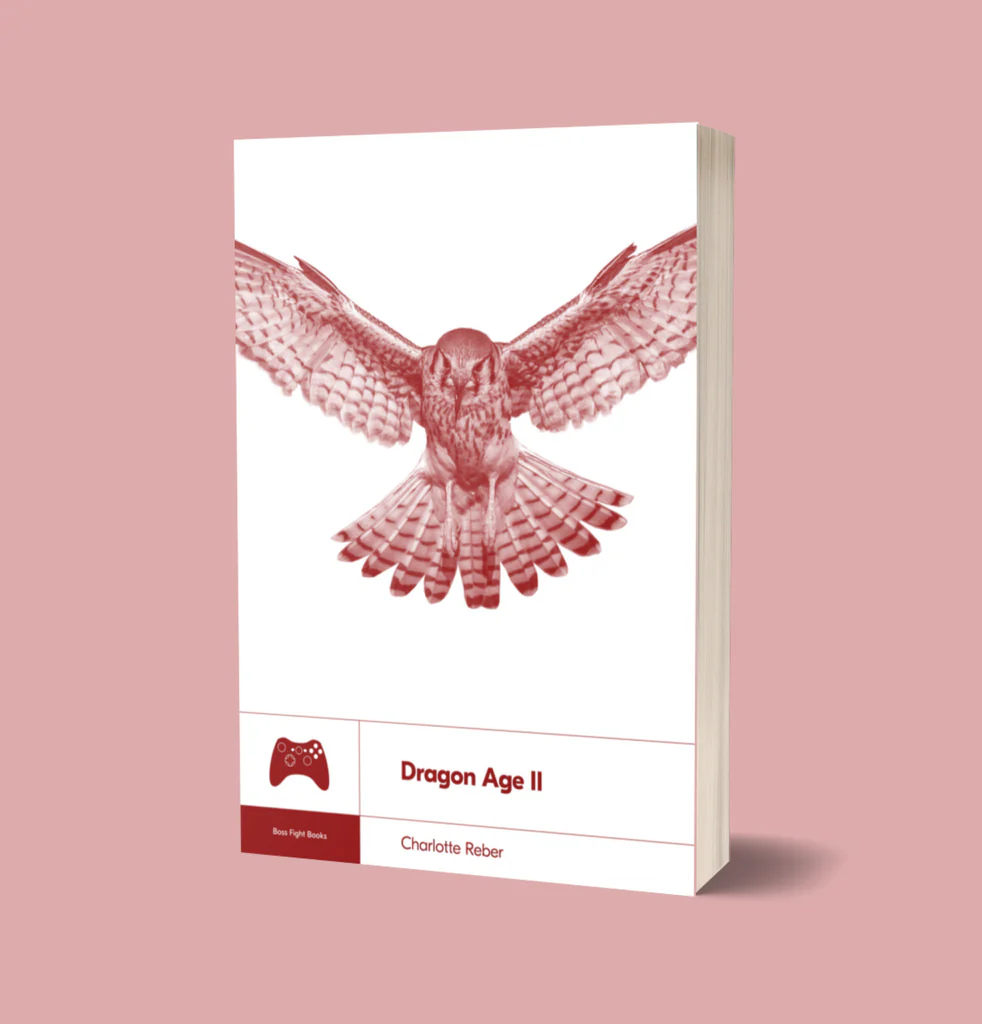
How did a sequel primed for success end up as such an unexpected product? And how did the game, despite such a negative initial reception to its oddities, become something of a AAA cult classic? Reber unpacks her history with the game, the ambitions of its writers, and the passion of its fans to address these questions.
Dragon Age II’s narrative mode adopts a three-act structure that tells a personal story about protagonist Hawke and their family and friends (or rivals). The setting is Kirkwall, a single city full of political unrest that develops over time through each act. And the deadline to plan the story and write the 280,000~ words that comprise it was imminent.
The game was in development for just over a year and, as Reber describes, the writers needed to get cooking first to set the table for the other teams—a privilege the role isn’t often afforded in such major studios. The narrative mode and setting are thus creative workarounds to the publisher holding a figurative gun to BioWare’s figurative head. Ironically, they’re also crucial aspects of Dragon Age II’s distinct identity and appeal. Reber navigates this “pressure creates diamonds” reality while not making any excuses for the unreasonable cause of that pressure (i.e., EA’s fiscal-related demands).
Anyone even tangentially familiar with the realities of game development knows that it’s a creative process rife with compromises and sacrifices. What we refer to as a “development team” is ostensibly working as a focused whole to provide the best product they can with the resources they have. At the same time, this unit is made up of several separate teams with drastically different skillsets and priorities.
We don’t get a full picture of the creative process across these teams here, but that’s not the point of Reber’s book. Rather, it focuses on how the writing team, led by David Gaider and supported by Sheryl Chee, Jennifer Hepler, Mary Kirby, and Lukas Kristjanson, went on what sounds like a joyfully manic creative binge in a secluded part of the office. This tight-knit group of BioWare veterans, remarkably comprised of only a single straight man, was known around the office as the “Estrogen Brigade” and the boisterous room where they worked as the “Writers’ Pit.”
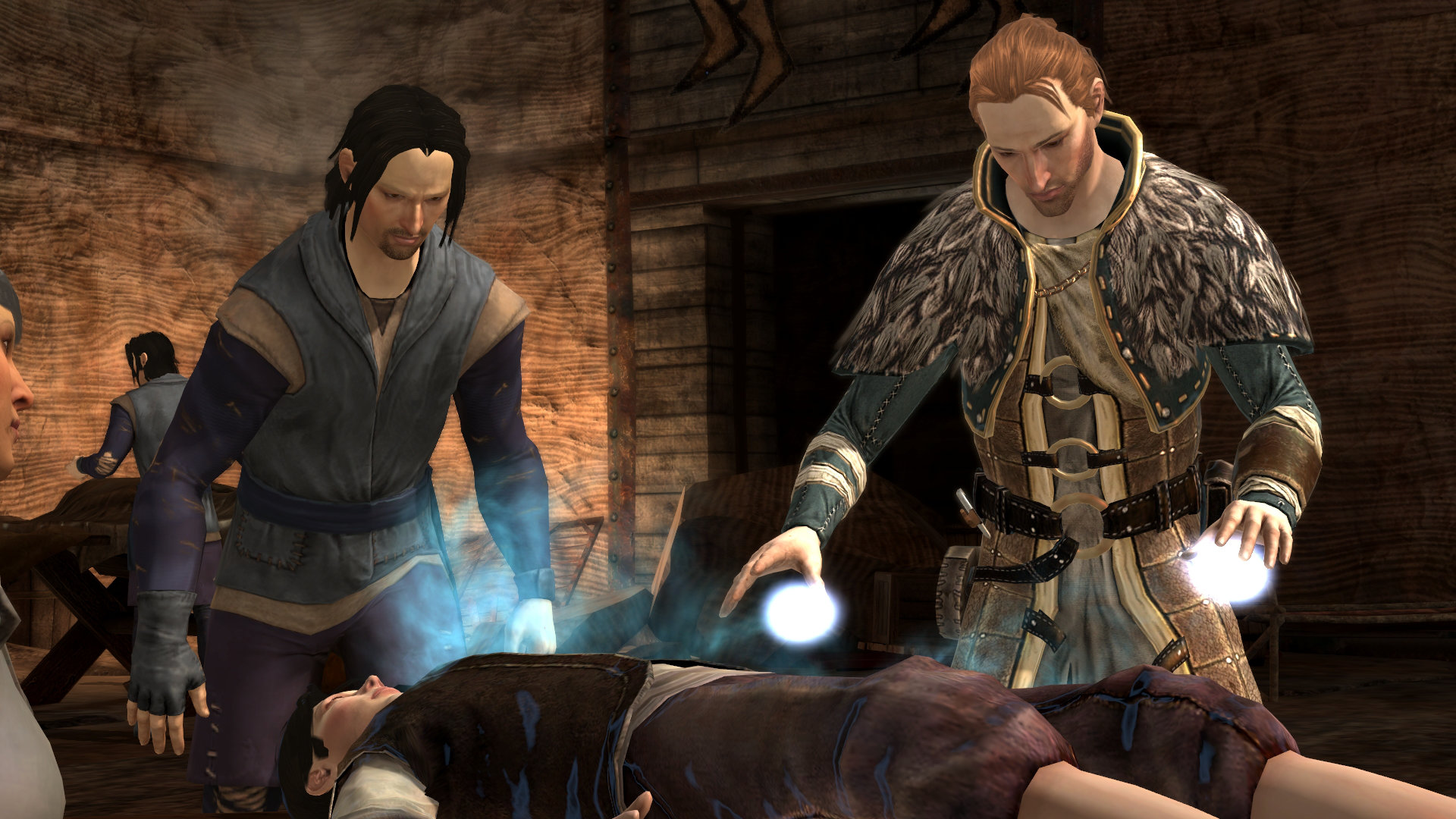
Reber’s energetic depictions of the scenes taking place in the Writers’ Pit are peppered with insightful interviews and written excerpts from a variety of sources since the game’s release. She effectively conveys why Dragon Age II’s writing has such a raw, kinetic energy to it. It’s the standout aspect of the game, and I was delighted by the way the book paints the intentions of each of the writers that made it sing.
We learn who wrote which characters and why they ended up the way they did, and how the team adapted to their first crack at a voiced protagonist. The book examines not only the game’s creative oddities and the development realities that shaped them, but digs deeper into individual visions and collaborative execution drawn from a range of first-hand accounts smoothly integrated into a story about the game’s critical and historical significance.
I especially appreciate Reber’s attention to the technical aspect of videogame writing, and how crucially BioWare’s writing process at the time informed design and programming work. For example, the book discusses the team’s distribution of “talk tables” made up of a spreadsheet tens of thousands rows long, each containing a single line of text paired with a string of numbers that indicates its triggering criteria. It also describes the trouble of word budgets, particularly for a game whose writing needs to be supported by cinematics and voice-over, which led to the decision to only offer a human version of Hawke, the player character.
In terms of material costs, writing is normally the cheapest thing you can create for a videogame. However, with an RPG of Dragon Age II’s scale and focus, the “expense” of writing must be approached with the practical limitations of other departments in mind. Consequently, it’s usually writers who are forced to drop the most of their creations on the cutting room floor.
One portion of the book covers how Laidlaw was forced to change the completed ending(s) into a more streamlined and generic big bad scenario to accommodate the gameplay team. The book is full of such insightful anecdotes that would be of interest not only to Dragon Age fans, but also to people curious about how writing for a videogame differs from any other storytelling medium.
The last few chapters feel somewhat disconnected from the seamless flow the book had managed to that point, but they are no less important as pieces of Dragon Age II’s legacy. One later chapter takes a darker turn, discussing the game’s release and the almost unprecedented online, proto-GamerGate vitriol of fans and the larger gaming community targeted at the developers. The team faced a complex cocktail of criticism regarding the game’s “dumbing down” of CRPG systems, the bisexual representation of the romanceable companions (from both homophobic and queer players), and illogical and hateful scapegoating of individuals like Jennifer Hepler.
The final chapter ends on notes both somber and hopeful. It details the exodus of essentially all BioWare’s veteran writers before and after the release of Dragon Age: The Veilguard, while sending the message that BioWare’s beloved IPs will not die as long as the passion of their fans continues to drive their own creations.
Dragon Age II is a “favorite, not best,” as Reber, Gaider, and lead designer Mike Laidlaw all put it, which tend to be the most interesting games to talk about. It’s an undeniably flawed game with an undeniably big heart. One not afraid to take risks despite its publisher’s pressures. One that tells a uniquely personal story for a title with its level of budget and notoriety.
For Reber, the book is a way of critically grappling with loving something that others love less and trying to show them why they should care even if they don’t agree. Time has turned Dragon Age II into “The Cool One to Like” of the series, and Reber makes a compelling case for why.
This book is a blueprint for how to preserve a game’s legacy in writing. It navigates thorough accounts of Dragon Age II’s development history and creative process, the social effects of its release and reception, and its impact on a longtime fan who can celebrate its unique achievements while acknowledging its limitations. These are all crucial aspects of a game’s identity and meaning. I don’t think it matters how much you like Dragon Age II. If you want to understand it—fulsomely as an interesting corporate product and artistic work—you need look no further.
You can purchase Dragon Age II (the book) digitally or in paperback on the Boss Fight Books website.
This article is based on a free copy of the book provided to RPGFan by the publisher. This relationship in no way influenced the author’s opinion, and no compensation was provided in relation to coverage. Learn more on our ethics & policies page.