
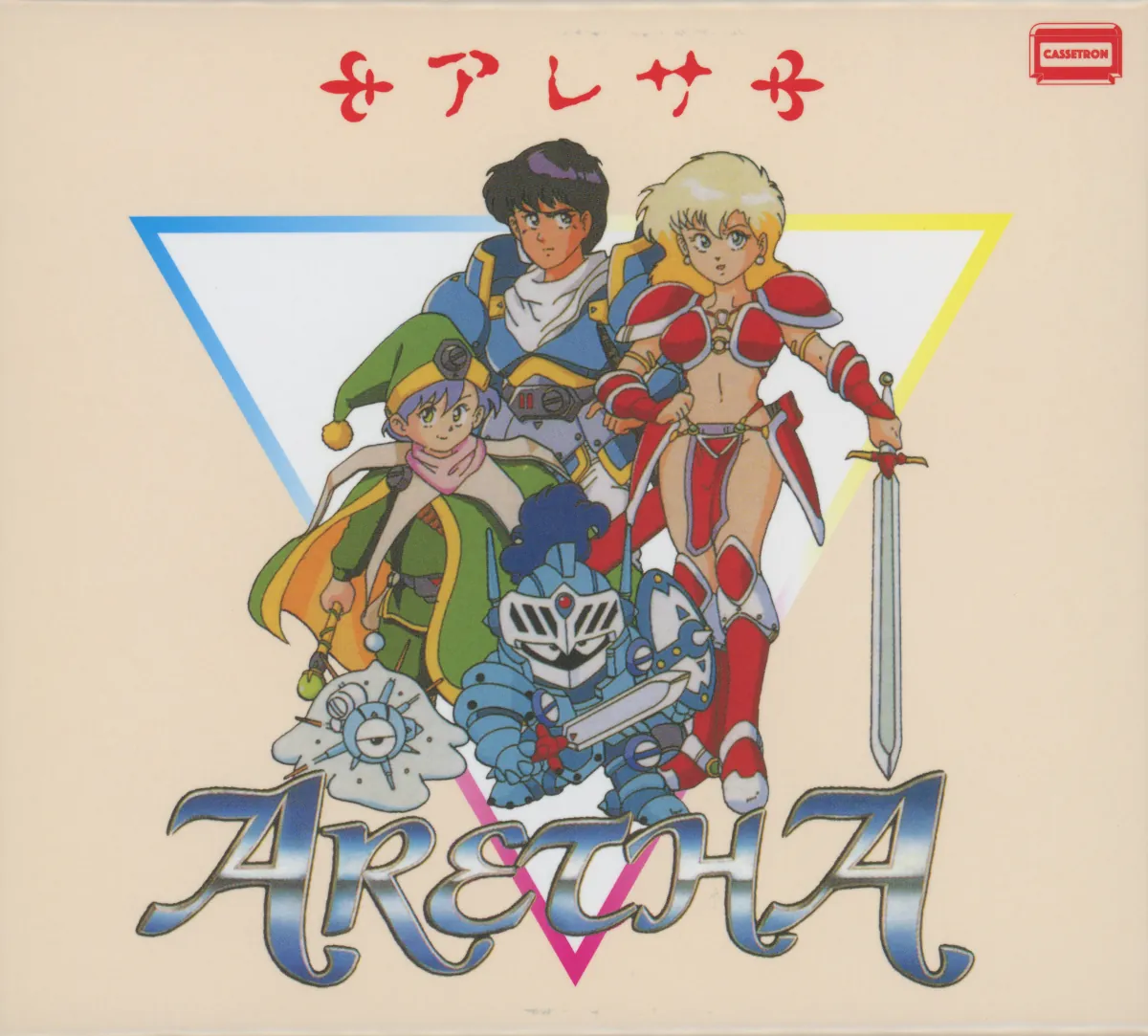

I only know a handful of Aretha fans. No, I don’t mean Aretha Franklin. I’m talking about the trio of Game Boy games (and, later, a follow-up trilogy of Super Famicom games) from the tiny dev team Japan Art Media. For decades, I’d only known about this series because of an arranged album for the SFC title Aretha The Shining Land. I wasn’t even aware of the original Game Boy trilogy. I only learned of their existence in 2019 thanks to Daniel Todd’s excellent reviews for this series over at Hardcore Gaming 101.
After reading the HG101 articles, I wanted to learn more, to experience more. Why? Because Game Boy RPGs, when done well, are amazing to experience. Given that Aretha‘s visuals looked like a carbon copy of the Final Fantasy Legend (SaGa) Game Boy titles, I was hooked. Then, my attention turned elsewhere, life went on, COVID happened, and I once again forgot about Aretha.
THEN! My interest was renewed in mid-2025 because boutique game music publisher Cassetron saw fit to publish the full Aretha Game Boy trilogy’s music. For the first time, these chiptune OSTs would be available to the world. How exciting! A breath of fresh air!
Or, maybe not.
A few weeks prior to getting my hands on the Aretha 35th Anniversary Soundtrack Box, I got to play the revitalized Game Boy Color RPG Infinity and enjoy its incredible 8-bit soundtrack. In my OST review, I noted how wonderful it was to hear the device used to its full capacity, including panning over stereo (something GB had as an advantage over NES hardware). Really, that game’s soundtrack was impressive, nearly on par with the legendary works of Nobuo Uematsu and Kenji Ito on the Final Fantasy Legend and Final Fantasy Adventure games (again, SaGa and Mana, respectively). I also mentioned in Infinity‘s review that its soundtrack outclassed many a rival Game Boy soundtrack.
Count all three Aretha soundtracks as being inferior to Infinity.
These are very, very basic scores. The presentation is rudimentary, rarely making effort to utilize advanced effects to push the three-channel music to the limit. More often than not, it reminded me of the simple, sometimes lazy scores that licensed game publishers would do for NES titles. You know exactly what I mean: the wacky, orchestral melody of The Simpsons opening theme by Danny Elfman, pared down for NES or Game Boy. If someone worked hard to do it well, it could be really cool. Instead, these chiptune “demakes” were often vanilla transcriptions of a melody and a bass line with almost no work in voicing, oscillation, or clever counter-melodic lines in the middle channel.
(And if we’re being truly honest, there are times that the early Dragon Quest soundtracks suffered this way when compared with their Symphonic Suite forms.)
One thing I can say in favor of the Aretha trilogy is that the soundtracks improve with each entry. The first game, solely composed by Tsuyoshi Tanaka, borders on forgettable. I appreciate the simply stated melodies of “JAM OPENING” and “PROLOGUE,” but any building enthusiasm is dashed when I hear the saccharine waltz that is “LEISURE” (the music for the game’s hub area, Halo-halo Town). The battle theme “ASSAULT” and final dungeon music “PANTHEON” help to make up for things, but I feel the first Aretha OST is more miss than hit.
As an aside, “PANTHEON (Howard Castle)” is worth noting for that track subtitle. The evil wizard and antagonist of the Aretha franchise is named “Howard.” Also, Aretha is not the name of the protagonist, but the name of the kingdom/realm/world. Our protagonist is named “Materia.”
The final track on disc one is audio ripped from what I imagine is an old VHS tape. I would have preferred having the audio and video, because it appears many cool and silly things were happening in this promotional video.
Aretha II offers a major improvement in overall quality. Kazuyasu Hiroe is credited as a co-composer with Tsuyoshi Tanaka for this title; sadly, the liner notes do not offer track-by-track composer breakdowns. There are re-used key themes on this one, including the title screen, and that’s perfectly understandable. But there are plenty of new themes that I thought lifted up the quality of Aretha II musically, particularly with battle themes and the three “surface” themes (including “CRADRE” which I’m guessing ought to be “CRADLE,” though I’m not sure). The strength of these themes are in the simple, catchy melodies and good syncopation in the bass lines.
Aretha III is the strongest of the bunch. We have all four composers on this project, and this many cooks did not spoil the broth. There are more re-used tracks here, some from the first game and some from the second, and they all come with minor improvements from a sound programming standpoint compared to the originals. Even the updated Halo-halo Town theme, “ELATION,” is more bearable than what’s on the first Aretha. The new/original tracks for Aretha III are noteworthy for more complex use of the hardware than previous titles, like the oscillation changes throughout the song “ORIGIN.”
Regarding the final “35th Anniversary Megamix” track: this is not an arrangement. Rather, it is a six-minute montage stitching together various themes from the Aretha trilogy. According to series creator Mitsuru Takahashi, as written in this album’s liner notes, he is the one responsible for crafting the Megamix. It’s nothing too special, but a fun way to remember some of the Aretha trilogy’s key themes. Perhaps Takahashi put it together for promotional purposes as well, because it’s the only track I found available for streaming from this entire album on YouTube.
While I definitely appreciate the Aretha 35th Anniversary Soundtrack Box as a fan of the chiptune era and as a believer in media preservation, I do not count it among the best music the Game Boy has to offer. At some point, I would love to see the JAM team make a similar soundtrack box for the three Super Famicom games in the Aretha series to see if that music fared any better. For today, though, I think I’ll give Infinity and Final Fantasy Adventure some re-listens!