
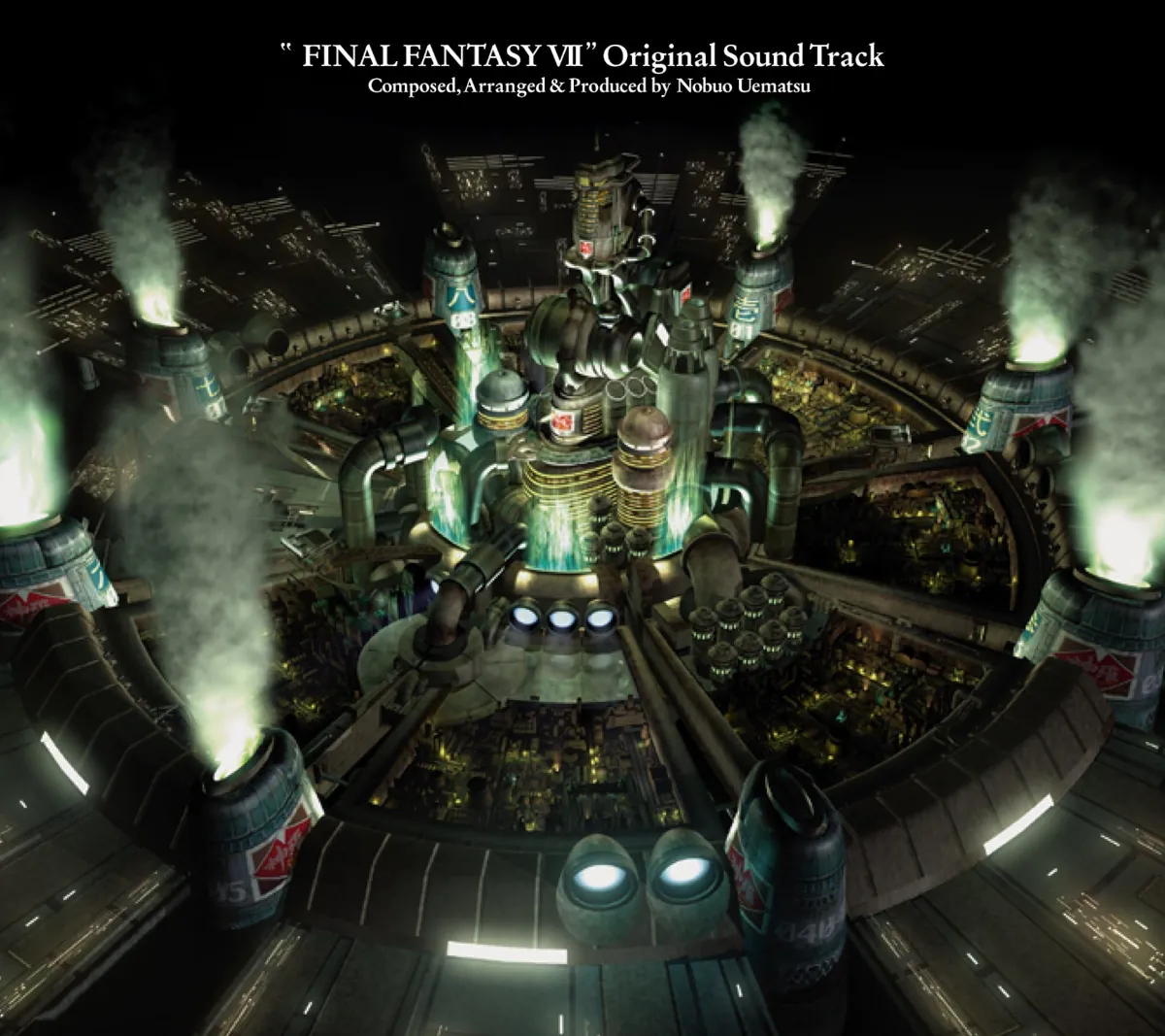

Not only did Final Fantasy VII finally bring the iconic series to a unified worldwide release staggered throughout the year 1997. It also, more importantly, brought JRPGs into the Western zeitgeist. Reviewing Nobuo Uematsu’s original score for FFVII is akin to reviewing the soundtrack to The Empire Strikes Back—these songs are so embedded in my mind and memories that I know every next note, even if I no longer focus on their musical quality. For all the many arrangements and interpretations these compositions have seen, these PSOne MIDI-synth originals remain crisp, clean, and delightfully melancholic, as much synonymous with traipsing the overworld of Gaia and the slums of Midgar as they are with teenage me lying in bed and brooding up at the ceiling through the dark. Let’s return to that time and place with the first disc of four.
Much of disc one covers the smoke-choked city of Midgar, and so feels a bit hopeless and foreboding. The version of “The Prelude” that starts things off is one of my favourites in the Final Fantasy series, and the mid-song kicker sets the tone for the epic yet moody sound palette. “Opening – Bombing Mission” is said to be the first track Uematsu composed for the game, and still evokes a steam engine train hurtling through the city in one of the most iconic and cinematically ambitious intros in all of gaming. Things continue dourly with slow, hopeless tracks like the aptly titled “Anxiety,” the gentle “Flowers Blooming in the Church” echoing Aerith’s forthcoming theme, and the heartachingly bittersweet “Tifa’s Theme,” which tonally suggests many of Tifa’s past and present struggles growing up under the looming shadow of the domineering Shinra Corporation. I’ve always found “Barret’s Theme” to be too militaristic (even for a dude with a gun for an arm); the track perhaps serves better as the de facto theme for his eco-terrorist AVALANCHE group.
There is also a heaping of smooth, sneaky tracks, like “Under the Rotting Pizza” (a strange metaphor for the Midgar sector plates carried over from the Japanese track title), bass-heavy “The Opressed,” and, of course, the snappy “Turk’s Theme.” Here, I love the linear beat combined with the multifaceted percussion and simple scaling melody—you want to hate the Turks for shooting at our heroes Cloud and Aerith, and yet they’re too cool to hate! For battle themes, we’re treated to “Let the Battles Begin!” which loops after about a minute and fifteen seconds but absolutely crams that time with a punchy horns and hi-hats, capping off and resetting with a sharp whistling tune. Then there’s the boss theme, “Fight On!” with its crunchy electric guitars (crunchy like biting into tin foil) and MIDI-organ feeling very much like a callback to tracks from Final Fantasy VI.
Disc two opens with the “Main Theme of FINAL FANTASY VII,” the most sombre map theme in the franchise, but one that conveys a hopeful sort of longing that pairs nicely with the spinning overworld, so full of mystery and potential. It also serves as a theme for protagonist Cloud Strife, and snippets from it appear in various melancholic tracks as Cloud experiences, erm, internal strife. This disc has a nice mix of anxious, story-pushing songs (“On Our Way,” “In Search of the Man in Black”), lighthearted tracks like the chocobo themes, and memorable area/town themes (“Costa del Sol,” “Gold Saucer”).
Uematsu’s increasing talent for incorporating recurring melodies throughout his songs to create an overall sense of cohesive, operatic drama—something he did quite well in Final Fantasy V and perfected in VI—shows here. Uematsu’s tracklisting and Final Fantasy VII’s storytelling work in tandem to maintain the overarching mystery of what the turncloak hero Sephiroth’s goal is. The periodic bouts of anxiety and moroseness are enough to keep reeling players through the main plot even as we visit an eclectic range of locales.
No locale has a more iconic theme than the third disc’s opener, “Cosmo Canyon,” coalescing simple, Indigenous/Latin American-inspired synth instruments into a rolling wave of sound. Perhaps it’s the MIDI limitations, but I love how certain “instruments” carry over between tracks in shared areas, like the pounding drums appearing here, in “Desert Wasteland,” and in “Lifestream.” While disc three has the highest number of throwaway tracks, it’s elevated by some great character themes: Yuffie’s skip-and-hop “Descendant of Shinobi,” the no-nonsense “Cid’s Theme,” and one of Final Fantasy VII’s most enduring and tragic songs, “Aerith’s Theme.” For all the many times it’s been reimagined, “Aerith’s Theme” appears sparingly in a handful of key emotional scenes, somewhat crystallizing its simple beauty. “Buried in Snow” is a great area theme, reverbing discordant elements into something resembling a tune, painting a picture of a party lost in a blizzard. I also love how “Who…Am I?” serves as an edgier sister to disc one’s “Who…Are You?” It comes together more solidly as Cloud approaches his late-game epiphany/breakdown.
In very theatrical form, disc four returns to earlier Shinra-centric elements and ups the ante and tempo in “Shinra’s Full-Scale Assault” and “Attack of the WEAPON.” Of course, there’s got to be room for an elated ‘airship theme’ with “The Highwind Takes to the Skies,” which at last puts a triumphant spin on Cloud’s/FFVII’s Main Theme. Beyond propelling the final act forward, there’s not too much of note on this final disc before the climactic final musical sequences save it.
“Judgment Day” brings back the industrial elements of disc one’s Midgar tracks and battles between hope and hopelessness. Things crash into a sort of twisted inversion on the “Let the Battles Begin!” theme with “JENOVA COMPLETE,” the high-energy bleeding then into “Birth of a God.” This track is rocking and organ-driven in a very similar way to FFVI’s final boss music, combined with earlier Jenova themes, though it occasionally breaks to the dread-filled opening of the final boss theme yet to come. You know the one…
“One-Winged Angel” opens by booming and sweeping aside all hope you’ve yet garnered, then launches into the unforgettable choir stabs. Fun fact: despite sounding like they’re singing about frogs in Paris, the lyrics are actually medieval Latin poetry about violent, burning, undying anger. Neat. Every doom-filled moment of the seven-plus-minute “One-Winged Angel” feels necessary. Finale song “The Planet’s Crisis” is a curtain call that rolls back through many of the movements and moments players have hitherto experienced, though it teeters on planet-wide destruction until its magnificent last minute. Finally, I feel that the “Ending Credits” are overlooked despite its original, impressively composed melodies, which crescendo into the Final Fantasy series theme. In their thematic and dramatic intentions, the finales in Final Fantasy VI and VII overlap in many ways, and in ways I’ve not seen the series return to since.
Returning to Uematsu’s original soundtrack of Final Fantasy VII after experiencing many, many newer renditions of these compositions, I’m of two minds. I’ve always loved the consistency of the MIDI sound palette, and I still think it lends itself to the moody sci-fi elements of the story in ways that the more triumphant FFVII Remake and Rebirth miss. In its moodier moments, and in the undeniably iconic character and area themes it creates, Final Fantasy VII is simply one of the best soundtracks of the 90s. Still, after seeing fuller interpretations of FFVII‘s music across a wider array of instrumentation, I can hear some more of the sameness and limitations here, especially when I (work hard to) separate what I’m hearing from the memories they so strongly evoke. Though I don’t always want to return to that place, Final Fantasy VII’s soundtrack will forever transport me to my teenage years when I first played the game, and that makes it a gem—I mean, materia orb—worth preserving.