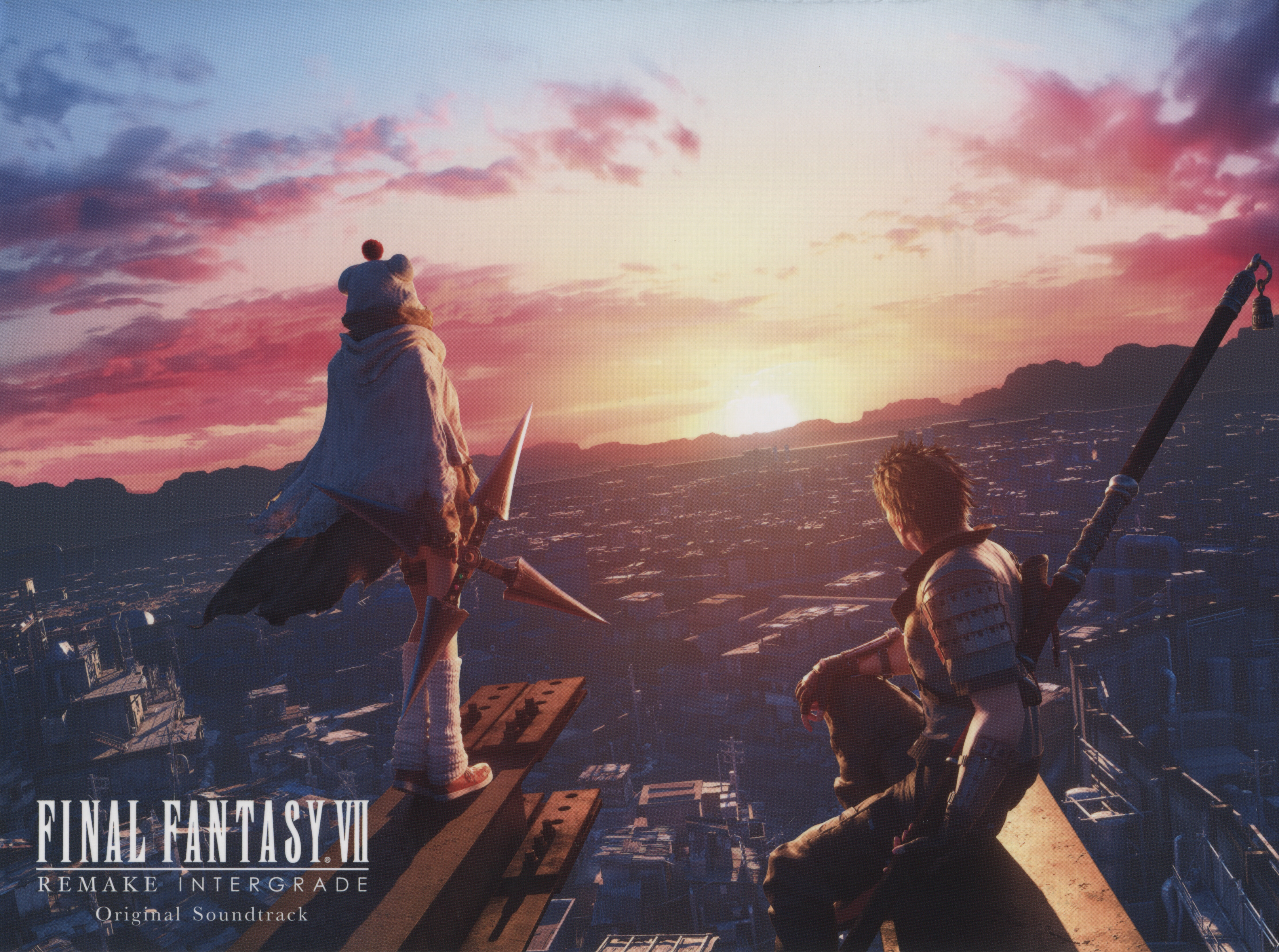


After surprising me with a 7-disc soundtrack for Final Fantasy VII Remake, and then a supplemental 4-disc PLUS soundtrack not long after, it should not have surprised me that Square Enix’s music team produced an additional 3-disc soundtrack titled Final Fantasy VII Remake Intergrade Original Soundtrack, with tracks encompassing the DLC chapter Episode: INTERmission. I was worried it would be full of redundant content, as was the case with the PLUS soundtrack, especially since the chapter focused just on Yuffie. Thankfully, the music team, led again by Masashi Hamauzu and Mitsuto Suzuki, produced a soundtrack of predominantly new content and many pleasant surprises.
But first, I’ll speak about our girl Yuffie, who gets the opening three tracks. “Your Girl Finally Made It” is the opening cutscene for the chapter, which nicely introduces Yuffie with the original Nobuo Uematsu “Descendant of Shinobi” melody and gives a nice nod to the “Main Theme of Final Fantasy VII” as well. But more central is the arrangement fully dedicated to “Descendant of Shinobi” that immediately follows. It is a sizeable departure from Uematsu’s original, which was quite laid-back; here, gone is the casual lilt arising from the original’s triplet meter.
This Yuffie is more determined and serious (especially when the short “Wutai” motif appears in the lower registers), though her playful energy is still present in the track, particularly in the whimsical and impressive range of instruments, orchestral and exotic. The following “Battle Edit” track has similar attention and care, being energetic with a great violin lead and plenty of new counter-melodies and shifts in texture to keep things moving.
I initially assumed these opening tracks would set up the sound for the rest of the DLC chapter, with the “Descendant” and “Wutai” motifs and exotic instruments peppered in everywhere in a cheerier version of the main Remake soundtrack’s orchestral-electronic hybrid. It seemed reasonable to predict that my favourite track would be some triumphant mashup of the “Descendant” motif with the main battle themes, perhaps with an appearance of “Lifestream” or “Main Theme” thrown in for good measure. So imagine my surprise when the album’s highlights turned out to be a bunch of jazz pieces and a set of absurd vocal tracks.
These jazz pieces centre around five tracks titled “The Runaround.” These tracks are led by composer/arrangers Tsuyoshi Sekito and Mitsuto Suzuki, largely in the style of high-energy bebop jazz (which many will perhaps be familiar with from the popular Cowboy Bebop soundtracks). What’s great is that the team brought in real jazz players and let them loose on these tracks, producing dizzying and virtuosic delights.
This might sound reductive, but often jazz in video game music is just video game music with elements of jazz in it. But “The Runaround” tracks are straight-up jazz, and they are delightful. My only complaint is that we didn’t get a seamless arrangement of them, and that the last two iterations are lower-energy than the openers; I would have loved a seamless arrangement with a proper climax (maybe on Intergrade Soundtrack PLUS? Just joking!).
After these jazz centerpieces, there are a few additional jazz tracks on the album. “Quiet as a Mouse” and “Good Morning, Levikron” are in the category I described earlier of video-game-music-with-jazz-elements, the former being just a short but cute ditty, and the latter a nice bridge between the jazz and the electronic elements of the Remake soundtrack. Then there is the wonderful “Main Pillar Maintenance,” a very effective hazy and minimal atmospheric track. There are also two tracks related to Shinra’s cruel executive director, Scarlet: “Cruelty Personified” and “Sadistic Test Run,” both of which are fittingly noir jazz in style. I do wish these were longer, but they all still nicely contribute to this jazz flavour on the soundtrack.
The other highlights I mentioned are the zany vocal tracks, which cover an impressive range of styles. The bulk of these are appended to the end of the soundtrack and come from the Happy Turtle quests, with both English and Japanese counterparts. All are deeply silly given their subject matter, yet all given far more care and attention than I would have expected from such tracks. My personal favourites are “Why Can’t I be a Turtle” with its darker pop vibes, the incredibly convincing and charming throwback of “Turtle Doo-wop,” and the bizarrely funky “Technologic Terrapin,” but I don’t think any of the tracks are bad.
I generally prefer the Japanese versions of these vocal tracks, though the one clear exception is the “Global Ver.” of “Give in to the Riptide” which is actually an entirely different song from its Japanese counterpart. This “Global Ver.” is written and performed by Shootie HG, who Final Fantasy fans might recognize from Final Fantasy XIII-2’s “Crazy Chocobo.” Here (and on another track on this soundtrack, “The Happy Turtle Fight Song”) Shootie HG again delightfully juxtaposes his heavy metal sound with incredibly silly lyrics. Combined with the jazz tracks, these are still a minority on the soundtrack, but they left a strong impression and greatly coloured my thoughts of the soundtrack as a whole.
The rest of the soundtrack is rather business-as-usual, but when that business is an extension of the Final Fantasy VII Remake Soundtrack, it’s pretty good. Present are many new battle themes, and tracks like “Ramuh, Lord of Levin” and “The Crimson Mare” definitely feel like extensions of the Remake soundtrack, being grounded in “Fight On!” melodies and instrumentation.
“The Gigantipede” also shares the “Fight On!” base, but is enriched by portions of “Descendant of the Shinobi” and “Wutai” melodies. What I appreciate is that the track isn’t so much an arrangement of any one of these as it is a new piece by Shotaru Shima that weaves in all these different motifs, and I would love to see this approach more in future remakes.
Hamauzu also composes three notable new battle tracks here, and each is stripped down from the rock-orchestra fusion that characterizes much of the Remake battle tracks. “Dissonance” is darkly atmospheric and electronic, but also slower-paced to bring a very different kind of intensity than the usual battle tracks. “Nero, the Sable” is a standout track that consists of a very agitated piano and often harsh strings, yet it still boasts an impressively large sound. I was swept up in its demented atmosphere that differed greatly from the sinister overtones of Sephiroth’s and Jenova’s themes.
“Chorus of Pain, Dance of Death” is less impressive but still solid, here focusing on choral and orchestral colours that Hamauzu draws from the sound established by Uematsu, but in the service of a track that is characteristically Hamauzu in its thickness and density, even in its quieter moments.
There are a number of other Hamauzu battle tracks here, but I was surprised to see that these are all updated arrangements of his work from Dirge of Cerberus in 2006. The originals already feature a very similar sound palette to Remake, and so Hamauzu does not significantly change the arrangements. “Deepground SOLDIERs” is based on “Wild Pack,” a relentless track that is here punchier, but still lacking in melodic figures that would make it more memorable.
Better is “Pain Sensation Level: Max,” an arrangement of “Pegasus Riders” with strong leading violins and new material for the strings and synths throughout. “Diabolic Creation,” an update of “Fierce Battle,” is the one I find to be most successful, here more urgent and exciting with great shifts in texture and rhythm, even though I feel that it lost a bit of what made the original more unique.
The only real disappointment I felt was “Weiss the Immaculate,” the new version of “The Immaculate,” which may have been ahead of its time originally but now feels quite dated since it is a sound that Hamauzu would later hone in tracks like “Fang’s Theme” from Final Fantasy XIII. It mainly suffers from taking too long to build up its few ideas. All in all, these tracks were are nice inclusion, even if I felt Hamauzu could have given some a more significant facelift.
On the opposite side of the spectrum from these battle tracks are the few quiet and emotional moments of the soundtrack, all of which tugged at my heartstrings. “A Hero Lost” is a beautiful piece with little segments of “Tifa’s Theme” over a gentle background that feels like soft breaths at times, ending with the only truly downcast version of the “Descendant of Shinobi” melody on the soundtrack.
“Melphie and Sonon” takes a small fragment of “Wutai” and slows it right down to make it a mournful little phrase that will appear later on here and also in Rebirth. “Seeing Melphie Again” starts tensely before bringing the “Melphie and Sonon” motif and “Sonon’s Theme” to a sad climax, while “Facing Disaster” is a short but effective little piece that sounds mournful even as it builds and briefly soars. Lastly, “The Sky’s the Limit” is the only one of these with a more positive outlook, being a soft version of “Descendant of Shinobi” that carries the warmth of the first rays of dawn.
As usual, about a dozen other short cutscene pieces are scattered about that quickly establish a dark and ominous atmosphere. These sound just like the ones on the main Remake soundtrack, unfortunately lacking strong, defining characteristics, as in the case of tracks such as “Unexpected Threat,” “Prelude to Death,” or “The Abyss.” The only ones that stood out for me are the piano-centric “Commence the Cleansing” and “Chaotic Pulsars,” the former with many dissonant chords and the latter with frantic runs, both foreshadowing the direction that “Nero, the Sable” would take.
There is also the collection of “Fort Condor” tracks, all of which make some use of Uematsu’s original theme. Only the first is a direct arrangement of the original track; Yoshitaka Suzuki composes new material to mix in for the other tracks. These tracks are serviceable, but like the minigame that they accompany, are just a diversion from the main attractions.
Lastly, there are a few miscellaneous tracks to mention. “Materia Production” and its “Battle Edit” are solid electronic tracks to further the atmospheric electronic pieces of the main Remake soundtrack, the latter being particularly enjoyable. “No Escape” is another good electronic track, elevated by its connection to its more orchestral battle version, “Fighting Spirit.”
Finally I want to bring attention to the aforementioned “Sonon’s Theme,” which is a nice complement to “Descendant of Shinobi,” melding elements of “Wutai” with a more mature vibe and encapsulating Yuffie’s growth. And then there is the new ending track, “The Journey Continues – Good-bye, City of Mako,” a lovely orchestral rendition of “On Our Way” that at first is led by acoustic guitar and ends on a slightly reharmonized rendition of “Aerith’s Theme,” with some tension to leave the door open to the next installment.
At the end of all of this, I can say that the Final Fantasy VII Remake Intergrade Original Soundtrack was a very pleasant surprise, boasting a much more diverse range of styles than I had anticipated. I appreciate that there were more new compositions here, and even if none of the new melodies are as catchy or memorable as Uematsu’s originals, in many cases they made up for it with boldness or uniqueness in their execution. I also loved that Hamauzu reached back into his Dirge of Cerberus work, even though I think he could have given them a bigger upgrade.
Although the Episode: INTERmission is fairly minor as a DLC chapter, fans should be sure to pick up this soundtrack, which charmingly broadens the musical world of the Final Fantasy VII Remake.