
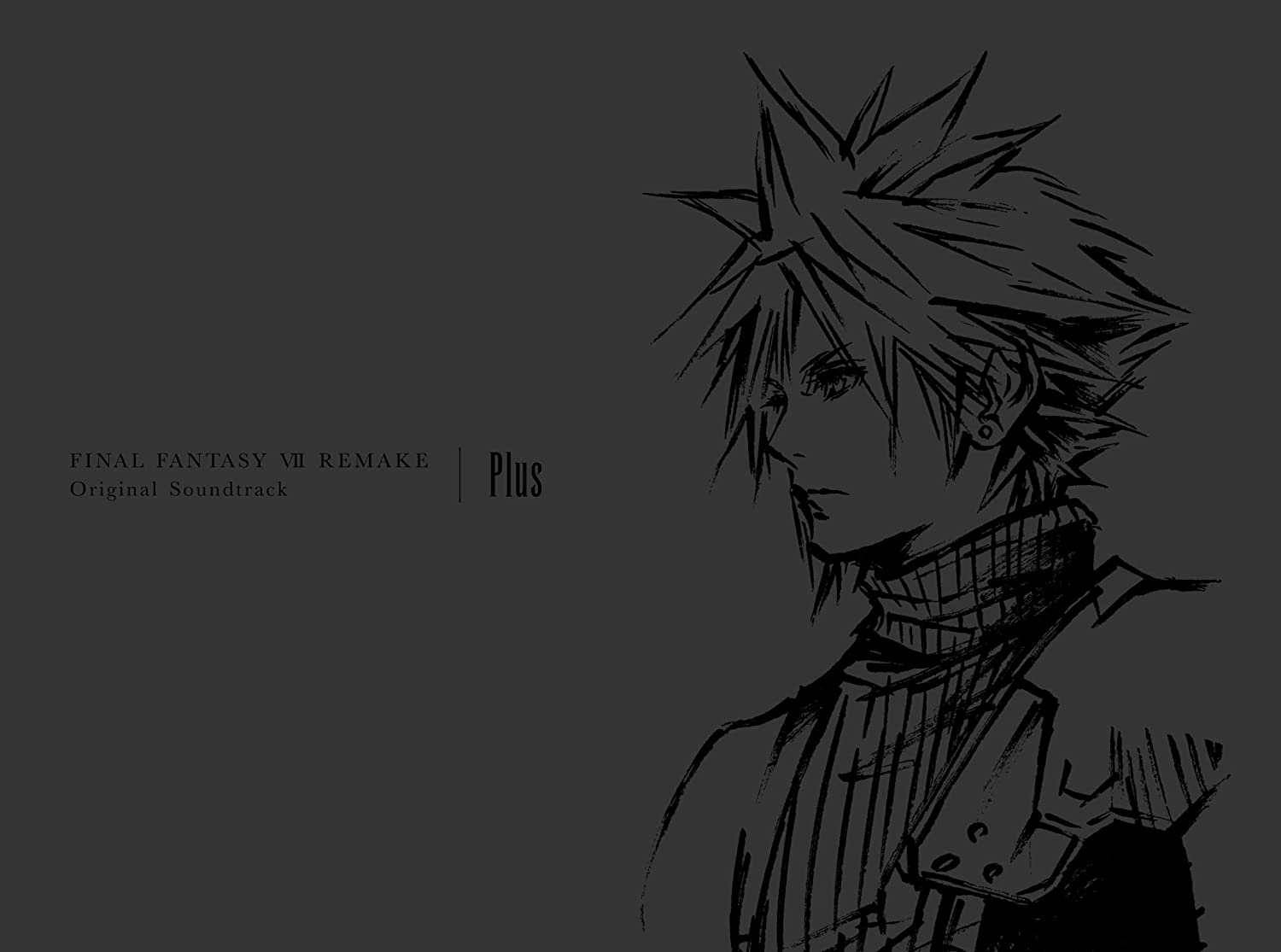



When the original soundtrack to Final Fantasy VII Remake released, I was astounded to see that it covered seven discs, with an additional bonus disc on the limited edition release. I was even more surprised when, just a few months later, Square Enix announced Final Fantasy VII Remake Original Soundtrack PLUS, an additional release of supplemental material across another four discs. Releases of supplemental material for Final Fantasy as PLUS albums have happened here and there in the past, but I didn’t expect one for an album as expansive as Final Fantasy VII Remake, and it still surprises me with how extensive it is.
I had some initial concerns. While I enjoyed the Remake Soundtrack, it seemed to stretch Nobuo Uematsu’s original material rather thin, narrowing the scope to a handful of early themes from his original 1997 soundtrack. Although it’s true that the Remake Soundtrack had new compositions from a team led by Masashi Hamauzu and Mitsuto Suzuki to round it out, I could hardly imagine wanting another four discs of content. It doesn’t help that the other PLUS albums have rarely felt essential, largely appealing to collectors and completionists. Usually, they contain prototypes, alternate-language vocals, and minor cutscene tracks that function in the game but are too insubstantial to work as standalone entertainment. So what does Final Fantasy VII Remake Original Soundtrack PLUS have that the Remake Original Soundtrack does not?
Unfortunately, this PLUS album does include its fair share of minor cutscene tracks that do not hold up outside of the game. These four discs contain dozens of these tracks, most of which are only about one minute long and can be slim on melodic content (so as to not get in the way of voiced dialogue). Some tracks are a bit longer because they combine cutscene and gameplay material (thanks to all those fancy seamless transitions), but this still isn’t enough to elevate the tracks above filler status.
Thus, cutscene tracks like “First Contact,” “Rude Arrives,” “Escaping the Sewers,” and many others are simply too short to enjoy on their own, even though they are effective in quickly establishing tense, exciting, and even epic atmospheres. Some feature very abrupt shifts in energy that make sense in the context of the scene, but are more jarring on their own, such as “Hojo’s Laboratory” or “Confronting Jenova.” As a whole, they are tedious because of their heavy reliance on leitmotifs from the Remake Original Soundtrack, so that they feel like snippets of tracks that are better developed elsewhere. It doesn’t help that the atmosphere across both the Remake Original Soundtrack and these cutscene tracks is so oppressive and intense, with few breaks or shifts in mood: it all makes for a tiring listening experience.
That’s not to say nothing in this grouping of tracks stood out. I enjoyed the way “Mako Reactor 5” teases the main battle theme before actually unleashing it, while “Memorial Museum” brings reflective sadness to the usual “Shinra” melodies. “Words Left Unheard” is “Who…Are You?” in a solid piano and orchestra rendition, while “A Death Not Ordained by Fate” persuasively combines Sephiroth’s motifs with distortions of the “Main Theme of FFVII” melody. But these are far outnumbered by the faceless flock. Thankfully, there are still a few shifts and breaks in the dark mood sprinkled across this soundtrack. A number are spooky and playful in character, like “Poor Man’s Course,” the two “Corneo’s Mansion” tracks, and “Mayor Domino.” They all do their job, but they’re also not tracks I find myself wanting to return to often, aside from perhaps “Reeve’s Flight” with its incorporation of a surprising character theme on a distant piano. Other small diversions include the refreshingly optimistic “They’ll All Be Fine” and the tease of the tribal “Red XIII’s Theme – Nothing More.”
Several brighter electronic tracks are also present, but these are also mostly unremarkable, like the two instrumental versions of “RUN RUN RUN” and the “Muscular Mettle” jingles. Among the palate cleansers of the PLUS soundtrack, I could find only a few standouts: Daiki Ishikawa’s two “Shinra Combat Simulator” tracks with their calming ethereal atmosphere, the wistful electric guitar rendition of Hamauzu’s “Jesse’s Theme” in the first half of “Flying Over the Undercity,” and the humorous “Rock that Dress, Aerith,” which refashions her theme as a short but fun rock rendition.
But speaking of “Aerith’s Theme,” her theme receives a lot of treatment here, more so than on the Remake Original Soundtrack, and these also help to dispel the darker atmosphere of the soundtrack (though some do contribute to it). “The First Guy I Ever Loved” is a slow and spacious take on the theme, while “Aerith’s House” is the closest to the original here, but feels more warm thanks to the greater emphasis on wind instruments. “Elmyra’s Request” starts similarly but then subtly changes the harmony to suggest uncertainty, a feeling that is amplified a bit in “Every Moment Matters,” then more drastically at the end of the “Memories” and “The Cetra” versions of the theme. “The Cetra” version is an especially strong piece of musical storytelling, as towards the end the uneasy elements build and threaten to engulf the main melody entirely, and though the melody finally breaks free, it does not fully resolve before the track ends. Despite having heard many versions of “Aerith’s Theme” over the years, these are all welcome additions to me, as I apparently haven’t tired of Uematsu’s beautiful melody yet.
There are also a handful of soft and emotional tracks to mention. There are two versions of “Anxiety,” but they don’t distinguish themselves from other versions. There are also melancholy variations of Hamauzu’s “Avalanche Theme,” but since the original did not have a strong melody, these variations feel weak too. “Bitter Memory” is a soft and lovely rendition of “Dear to the Heart,” and I hope to see more of it in the future.
“Tifa’s Theme” also gets two renditions: “Tifa’s Tears” starts with some lurking darkness but then gains confidence and beautifully blossoms with an orchestral and piano climax, while “Hole in the Sky” is a fully downcast reharmonization of the theme that I wish had a chance to develop more. “Leslie’s Theme – One Day” is a lovely and beautiful orchestral companion to Yoshinori Nakamura’s original from the main Remake soundtrack. Lastly, “Ending – Out of Destiny’s Reach” is a serviceable orchestration of the “Main Theme” that only becomes notable with the rousing yet ominous reharmonization towards the end. Even if some feel dispensable, these tracks, along with the “Aerith’s Theme” variations, are the highlights of the PLUS soundtrack for me.
The final grouping of tracks are the energetic battle tracks, but many have only minor changes from the main Remake soundtrack. “Bombing Mission – Infiltration” extends the original Remake soundtrack version with the loop that plays past the opening scene, but the extension feels like an emptier version of the first half. Similarly, “Ghoulish Symphony” is just “Ghoul” with an extra minute of atmospheric buildup at the beginning, while “Specimen H0512” is just “Crab Warden” with an extra minute at the end for a variation of the “Main Theme” melody. “Midgar Expressway – Long ver” has an additional minute of material sprinkled about, with a notable short electric guitar solo that happens a few minutes in, while the other changes are likely to go unnoticed. Not to mention the unchanged battle tracks.
There are a handful of battle tracks with new arrangements, but even these still feel too similar to the versions on the main soundtrack, including the three versions of “Hurry!” and “The Turks: Rude.” Only the arrangement for “Those Chosen by the Planet – Destiny Comes” feels significantly new, taking the original ominous track and giving it more bombast. It weaves in more leitmotifs, notably distorted versions of “Aerith’s Theme” and “Lifestream” at the end, though I found the orchestration here strangely lacking, particularly when compared to the other endgame battle tracks on the main soundtrack.
More successful here is “Escape from the Shinra Building,” a fun medley of many key themes and their variations that does a great job of depicting the frenetic escape scene. But my favourite track here is actually “Emergency Stairwell,” which is just Daiki Ishikawa’s “Operation: Save Aerith” from the main Remake soundtrack (expertly mixing fragments of “Let the Battles Begin!” with his own melodies and figures), but audaciously the track is extended by abrupt resets that introduce heavy distortions without warning or transition. By the end, the track has become borderline unlistenable, but this is perfectly suitable for what is going on in the game, so that I have to admire his vision and execution here. In the end, all of these battle tracks are enjoyable, but they largely further the feeling that this PLUS soundtrack is redundant.
It is true of Final Fantasy VII Remake Original Soundtrack PLUS that there is little on the album that I would consider bad in itself; as tracks in the game, they are work and are well produced (as opposed to other games where often the filler content is noticeably lower sound quality than the main material). But the issue here is that the bulk of the material is too short and redundant in both motivic and atmospheric content to hold attention when we already have the gigantic Remake Original Soundtrack.
Even the physical edition is sparse with little to hold interest. Each person has their own preferences, but the only tracks I return to regularly are the arrangements of the softer emotional material, which are lovely and moving. Only collectors and completionists should consider getting the PLUS soundtrack as a whole, but even then, it may result in disappointment because, even with this release, there are still unreleased tracks from Remake. I think this release ultimately has little to recommend itself to anyone.