
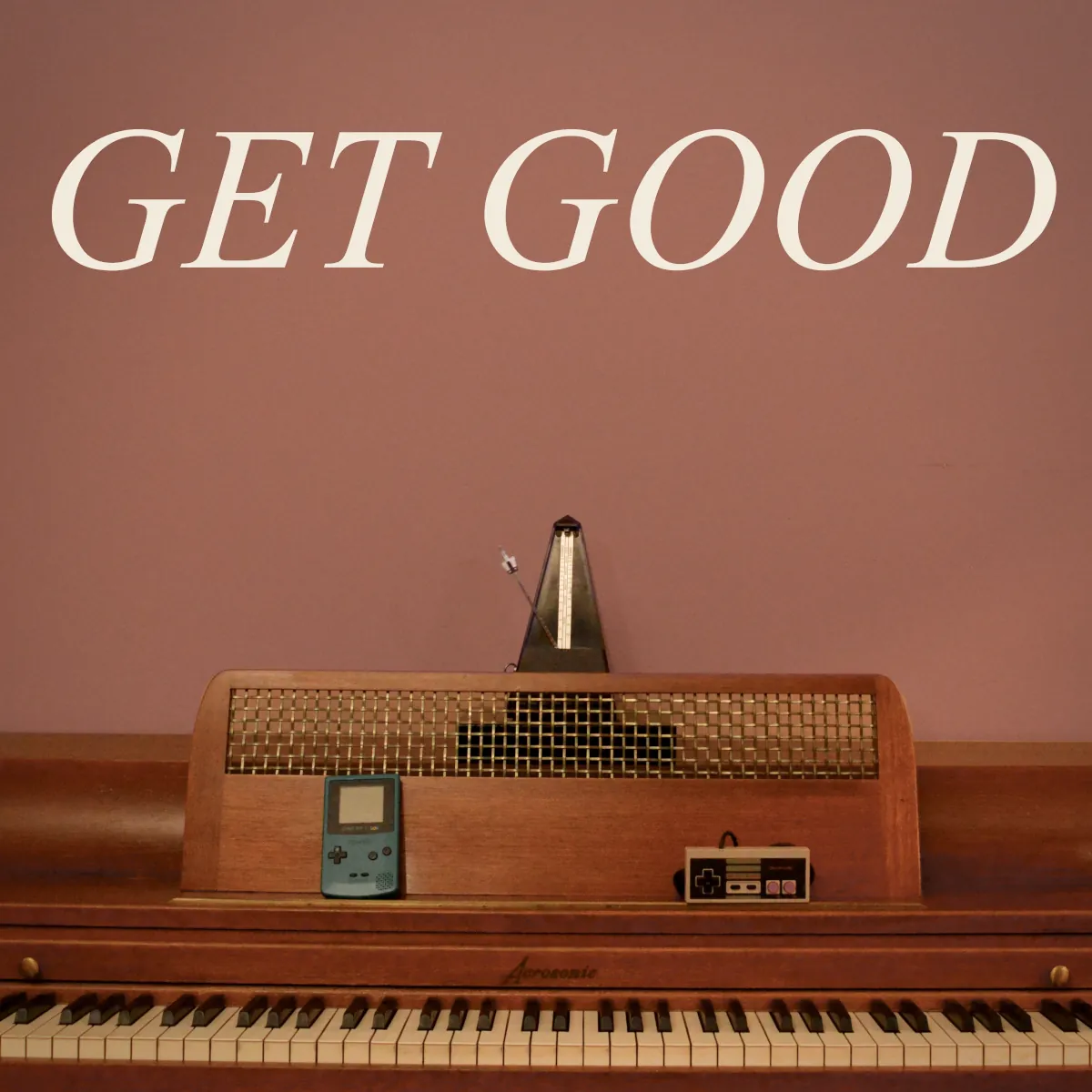


Normally, when someone tells me to “GET GOOD,” it’s because I’m complaining about difficulty in NES-hard games (or Souls-like games). In this case, however, I think they’re telling me to jam out to the second album from 8-bit & The Single Players. Not to be confused with the also-excellent 8-Bit Big Band, the artist in question here is a jazz group led by Ben “8-bit” Kidd, he of YouTube channel excellence, 8-bit Music Theory.
In 2022, Kidd was actually a guest on RPGFan’s own Rhythm Encounter podcast, wherein he teased his group’s first album, Let’s Play. While this is a great album in its own right, we don’t have a review of it on RPGFan because this GameCube-centric album only featured two songs across its ten tracks that fit our realm of coverage (Zelda titles, of course!). In contrast, GET GOOD, which features music from NES and Game Boy titles, is almost exclusively RPG territory, so I had to jump on it!
GET GOOD opens with an original composition, a one-minute chiptune-inspired introduction that transitions from the synthesized realm to the jazz band: horns, winds, rhythm section, everything you could possibly want! I love the way this track sets an expectation for what’s to come. This Winnipeg-based jazz music powerhouse is ready to take over!
And take over they do, with a ten-minute Metroid suite. Yes, this is one of the two tracks that doesn’t fall in RPG territory, but I have to give the crew their flowers here. The jump back and forth between the main Brinstar area music and Kraid’s theme is clever as can be. Near the end of this track, the classic 6/8 Kraid track is slowed down and reharmonized in a major key. Then it accelerates, with the horn section popping angry tones like Samus firing missiles in all directions. Excellent arrangement!
Next up? We get a trio of tracks from the original Pokémon games. Things are fun and funky right from the start. The five-minute “Title Theme” arrangement features some interesting tempo play within the first minute, followed by a slick trombone solo (courtesy Eric Ladish). Kidd, acting not only as arranger but also as the band’s drummer, offers clever fills to signal the transition from the trombone lead to a surprising trade between piano and horn section, before finally giving way to a great piano improv section.
In “Battle! Trainer,” the dueling stars right from the top are guitar and saxophone. These two instrumentalists (Emmanuel Bach on guitar, Niall Cade on tenor sax) act as rival trainers. The band keeps time perfectly while our rivals toss musical Poké Balls, summoning moments of melodic brilliance and/or mayhem. I love the concept, I love the execution. Another excellent arrangement!
To end our Pokémon block, 8-bit & The Single Players offer a bright, mid-tempo arrangement of “Cycling” that I did not see coming. This might be one of my favorite tracks on the album, and I wasn’t expecting it to be at all. In the latter half, we scale back to the rhythm section: smooth bass, a nice guitar solo, keys filling in the harmony, and Ben Kidd holding it all together with a light groove on the drums. When the horns return at the end, the feeling is one of triumph and, maybe, the feeling of a safe return home after traveling many Routes.
In a surprise move that I found delightful, 8-bit saw fit to arrange a track from Dragon Quest IV. The bigger surprise, for me, was that this wasn’t an arrangement of the classic ocean music “Sea Breeze.” I thought that was the obvious choice, given there’s an entire 8-bit Music Theory episode about this song. However, I’m happy to be tricked in this case, because I think the better choice for a good slow jazz number is the one they went with: “Elegy.” I can get with this one just from the incredible sustained notes on the saxophone. The quality of the performance and recording is evident in the technical details. I watched the waveform as the song played, listening to how the crescendo on the saxophone holds without washing out the hi-hat brushes. As much as I love the bold statements from the saxophone, it’s the improvised piano work from Carter Graham that I find myself drawn to throughout so much of this five-minute piece. Is it wrong that I find so much joy and contentment from an elegy?
Our second non-RPG track is from an RPG-adjacent series. It’s Castlevania III: Dracula’s Curse, and the tracks chosen here are a medley of the “Prelude” and “Beginning.” The prelude portion is fleshed out well in the arrangement, but you better believe you’re here for the “Beginning,” the Level 1 stage theme that’s every bit as iconic as “Vampire Killer” and “Bloody Tears.” This is absolutely one to be enjoyed!
GET GOOD‘s penultimate track might not be one you know unless you’re an avid follower of the 8-bit Music Theory channel. You see, 8-bit dedicated an entire episode to this little-known, Japanese-only Game Boy game Kaeru no Tame ni Kane wa Naru (fan-localized as “The Frog For Whom The Bell Tolls“). This is a fantastic game in its own right, one that this frog hopes to write a retro review for someday before I croak. You see, The Frog For Whom The Bell Tolls was developed by largely the same team as The Legend of Zelda: Link’s Awakening. Frog came out first, and this original title created the template for a fun new Zelda game on Game Boy. The two games also share a composer, Kazumi Totaka, a prolific Nintendo composer whose work includes the Wii Shop Channel theme! Fitting, then, that the last two tracks on this album are first Frog, then Zelda.
“The Prince’s Adventure” (from Frog) is one of the shorter tracks on GET GOOD, but the musicians pack so much goodness into this one that I can live with it. The straight four rhythm allows for some sharp licks from the entire ensemble, as well as some loosen-your-shoulders improvisations. I love it when the song comes together with the four famous Westminster Quarters tolling of the bells. Totaka and 8-bit are a match made in heaven. You’re going to love this bright, lively number.
Now, I know I mentioned Totaka as a composer on Link’s Awakening, but he wasn’t the only composer for that project. In fact, one of its most famous pieces, “Ballad of the Wind Fish,” was composed by another Nintendo great, Minako Hamano. To do this one justice, The Single Players got a few extra players, in the form of a string quartet: Kristina Bauch & Liana Nadurak on violins, John Sellick on viola, and Sam Nadurak on cello. The strings’ ostinato heard under the winds and horns handling the melody is one of those sublime, warm experiences. After a clear statement of the melody, the band strips back to just piano and drums (brushes, of course!). From this soft point, the piece rebuilds in layers, with Niall Cade’s soprano sax solo taking “Wind Fish” to new heights. When the strings return near the end of this arrangement, I’ve reached melted-puddle status. The warmth… It’s just too good…
GET GOOD is the kind of album that any VGM aficionado is bound to enjoy. For my part, I find myself in awe of the entire project. Here I am, just writing about music, and I don’t think my musical commentary holds a candle to the in-depth analyses you’ll find on the 8-bit Music Theory channel. Ben Kidd doesn’t just talk the talk, though. He walks the walk. He can explain what makes a composition or arrangement worthwhile. And then, in his spare time, he can put together incredible ensembles of local musicians and release albums like GET GOOD. Even if jazz isn’t your favorite musical style, I think you’re going to find plenty to appreciate here, especially with the string quartet in the final track. My recommendation: it would be good to get GET GOOD (i.e., purchase it!). At the very least, go ahead and stream the whole album on any number of platforms, including YouTube (below).