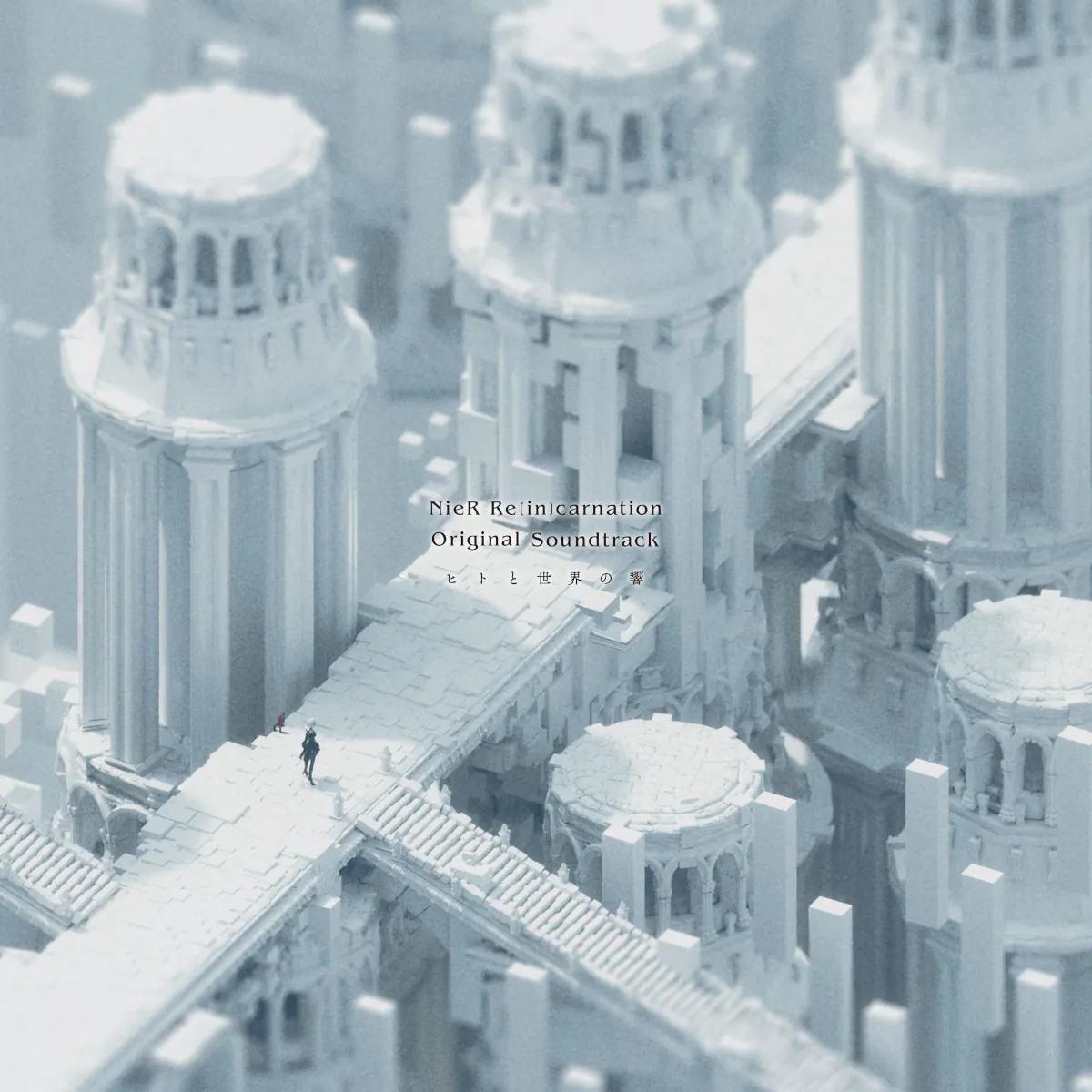


Released exactly one year after the NieR Re[in]carnation servers were shut off, NieR Re[in]carnation Original Soundtrack: The People and the World contains all of the music for the third and final season of the mobile title. I have been methodically working my way through all of the NieR Re[in]carnation soundtracks over the past year as part of my lengthy grieving process. With The People and the World, the music helps me find a bit of closure, as did the incredible finale to the game’s story.
The People and the World first focuses on android 10H and her companion Pod-006; over time, it broadens the scope to include Fio and Levania from the first season, Hina and Yuzuki from the second season, and some surprise entities pulled in from other DrakeNieR/Taroverse, including androids Devola and Popola, and even a brief cameo from SINoALICE. I note all of these characters because of the musical representation they get in The People and the World.
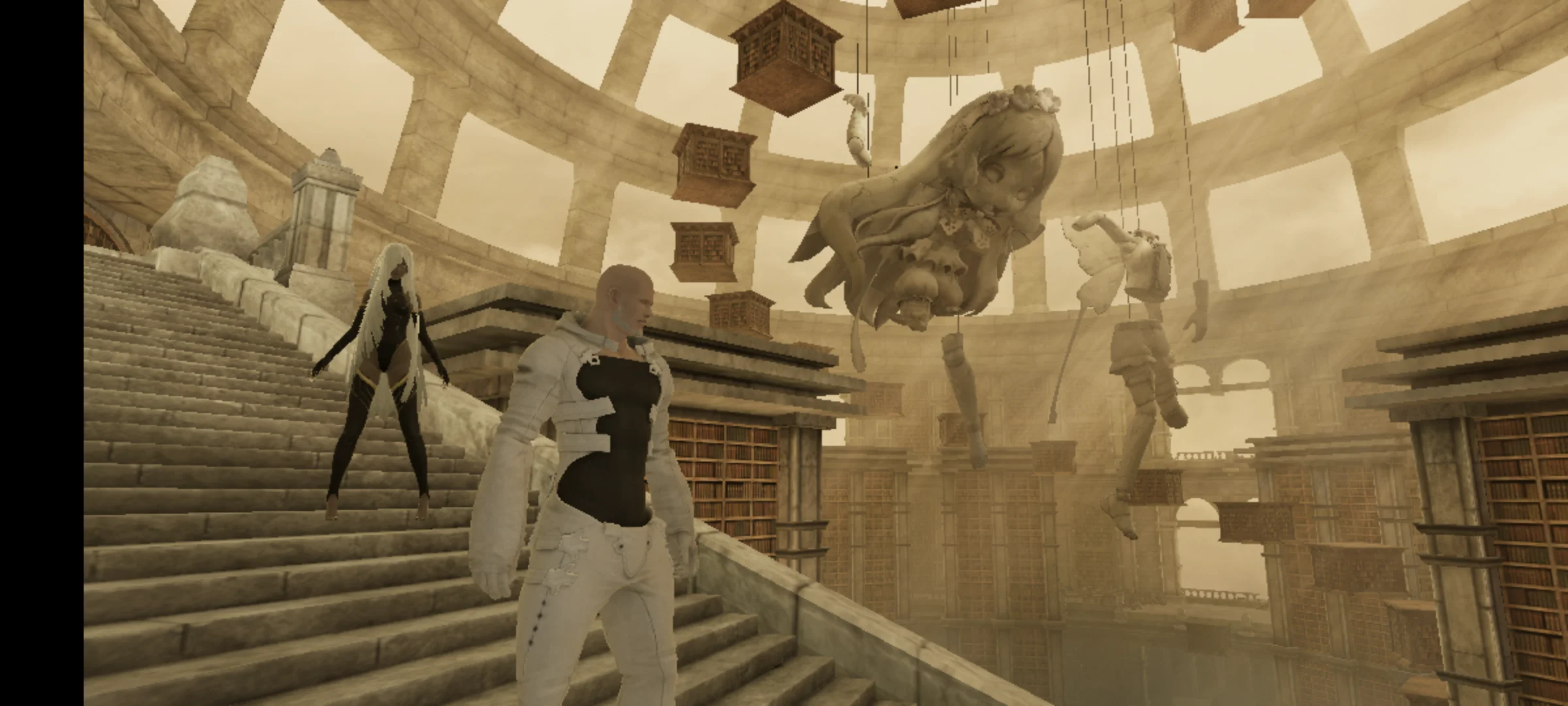
Let’s start with track ten, then. “Kasukana Hikari (Faint Light)” has an alternate title listed in the Japanese tracklist: “Gisho to sekai (The Book of Lies and the Universe).” SINoALICE fans will likely recognize the track title, as well as the music. Here, Keiichi Okabe is self-arranging the main theme for SINoALICE, another mobile game from the twisted mind of Yoko Taro. This music was added to the OST for one brief sequence, in which the game’s characters wander through The Cage and come across a vast library alongside giant statues of the characters Para and Noya. I enjoy Okabe’s approach to this arrangement, adding new bits of rhythmic percussion to turn this theme into something befitting a dungeon/environment in-game experience.
Next on the docket are two NieR classics. The tracks “Kyōshū (Homesick)” and “Kanjaku (Tranquility)” also have alternate titles, only listed in the Japanese version of the tracklist. These alternate titles are “Inishienouta (Song of the Ancients)” and “Odayakana nemuri (Peaceful Sleep),” respectively. I was pleased as punch to hear Emi Evans finally grace the Re[in]carnation stage; however, these are not new recordings. In “Song of the Ancients,” Okabe slows, stretches, and reverberates Emi’s vocal track to match the scaffolding of new instrumental accompaniment. And “Homesick” is a great alternate title for this piece: for android 10H, she’s been stationed away from her home planet and her brethren for thousands of years. Shotaro Seo’s arrangement of “Peaceful Sleep,” however, is my favorite of the three borrowed tracks for this OST. Emi’s voice maintains center stage with synth pads and some light piano guiding the rest of the track. Sublime.
Jumping back to the album’s start, we have “Chigiri (Promise).” As with the previous two OST volumes, this track serves as the vocal theme for the chapter. “Chigiri” is sweet, dulcet, and absolutely uplifting. In this way, it stands in sharp contrast to the two previous vocal tracks. Given NieR Re[in]carnation‘s surprising happy ending, this is a fitting piece of music. Vocalist Yukino Orita brought tears to my eyes with this one the very first time I heard it. Almost two years later, I’m still awestruck.
(A note to the wonderful folks at Square Enix and MONACA putting together NieR concerts: I’m so glad Re[in]carnation is getting some representation, but let’s expand past “Inori!” Give “Chigiri” the shine it deserves!)
The next three tracks are all menu and environment themes. “Strange Path” is an upbeat piece that marks the earliest piece of music in 10H and crew’s journey off the moon. I was surprised by how catchy this piece is. Shotaro Seo takes the reins from Keiichi Okabe with “Distorted Logic,” a gloriously ambient track filled with digital noise, human whispers, and whirring synths. I feel the conflict between machine and android within this piece. As for the fourth track, “Soft Wind,” it’s an upbeat piece of music that appears to be sampling Orita’s vocals from the opener, and it is a joy to listen to!
We finally hit a battle theme at track five: “Shūshō (Agitation).” I believe the vocals on this track are from Saki Nakae, though they may also feature Yukino Orita on the chorus. The beat on this one is perfect, a grand mix between synth instrumentals and human vocals. Shotaro Seo is at his best when he pens a piece like this. Not to be outdone, Keiichi Okabe throws down an equally impressive battle theme in “Kikkyō (Surprise).” Our vocalists are in expected form with fantastic chanting parts, especially with the drag triplets. Harmonically, though this track utilizes only a few chords, they are big, vague chords with plenty of extensions highlighted in piano arpeggiation. It’s a lot to keep track of; fitting, I’d say, for a NieR battle theme.
Another fantastic battle theme is “Sokuin (Sympathy).” This particular battle theme serves a wild, interesting purpose that references Ending E of NieR Replicant ver.1.22474487139…—to that end, Okabe crafted a battle theme that feels more in line with Replicant than Automata in the special, secret third game that is Re[in]carnation. The percussion especially reminds me of the many battle themes in Replicant, including the boss battle version of “Song of the Ancients.” The vocals are intense, and they cause me to reflect on Kainé’s desperate refusal to accept what fate tried to deal out to her.
Kuniyuki Takahashi, a MONACA composer who had a significant impact on shaping NieR Automata‘s soundscape, jumps in with two wall-of-sound choir pieces. “Anei (Foreboding)” and “Futō (Tenacity)” are two versions of the same choral piece, the former used for exploration and the latter used for battle, when Pod-006 and the digital party she carries with her finally touch down on planet Earth. This piece truly grounds the Re[in]carnation experience in the world of its forebears, all while acknowledging the many changes in the years (Millennia? Aeons? Who knows?!) since the events of NieR Automata. It was a great choice, bringing Takahashi in for this.
(Aside: just writing about this brings back nostalgia for something I can never play again. I love this game’s story so much. See more in my article The End of Service: A NieR Re[in]carnation Postmortem Retrospective.)
For the massive final battle sequence, the MONACA members contributing to this OST (Okabe, Seo, Takahashi) joined forces to create a medley-finale entitled “Hengai (Endless Beyond).” The percussion is pounding, the brass is booming, the strings are soaring, and the vocals are vivacious. Multiple motifs weave together, including some vocal work from the earlier OST volumes. Clocking in at over seven minutes, this is one of the most powerful and memorable tracks across all three volumes. It’s another good candidate for a live concert performance!
In the end, though, Re[in]carnation ends not with a bang, but with a whisper. “Kuon (Eternity)” is a harp solo arrangement of the game’s main / vocal theme from the first season, “Inori (Prayer).” This is a good choice for an ending, and in some ways, it helps me process my grief.
And here we are. Having stepped through all of the NieR Re[in]carnation OSTs, I’m not sure this is my favorite, but it definitely has some of the highest points in the musical series. And while Re[in]carnation‘s music doesn’t generally surpass Replicant or Automata in quality, I think I could make an argument that “Promise” and “Eternity” can stand toe-to-toe with those OSTs. Whether you had a chance to experience this delightful mobile title or not, I think any NieR fan could appreciate the Re[in]carnation OSTs. If you’re going to take that journey, I recommend grabbing all three volumes before they go out of print.