
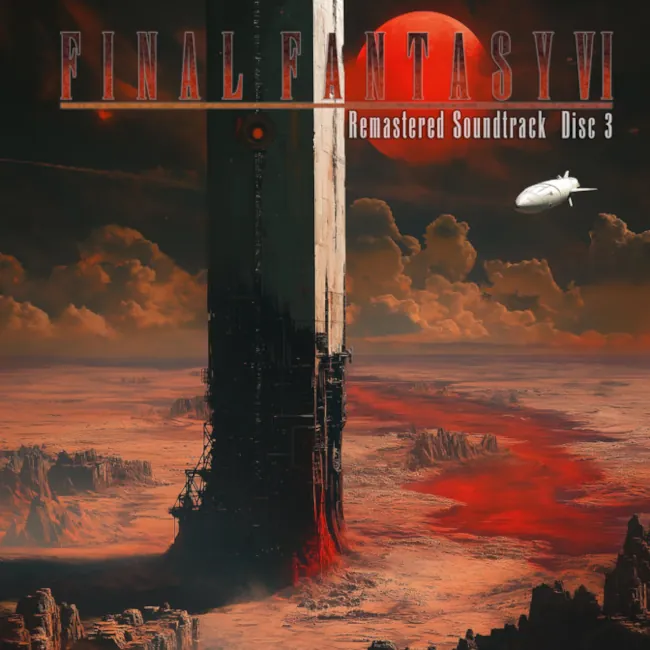


We’ve reached our final stop: the end of Sean Schafianski’s full Final Fantasy VI remastered project! In my review of Disc 1, we looked into Schafianski’s scope and process in these upgraded arrangements. Reaching Disc 2, we identified key points in the FFVI OST that Schafianski handled in perhaps divisive ways—particularly the Opera sequence and secondary character themes like Relm and Strago.
In Disc 3 of Remastered Soundtrack: Final Fantasy VI, we find Sean Schafianski in his best form. Moreso than on the other discs, Sean treats us to studio recordings of his woodwind instruments and is more willing to bend his rules about maintaining song form and structure. The payoff, from my perspective, is obvious.
I want to start by saying this opinion of mine is not shaped solely by the big-ticket items. Yes, the four-part final battle “Dancing Mad” is top-tier (as we discussed with Sean in Rhythm Encounter Episode 164). Yes, the lengthy “Ending Theme” that includes a complete medley of character themes is robust—maintaining Uematsu’s standard of giving slight variations to tempo and structure so that the character themes aren’t mere repeats of their base form. Yes, as expected, the second world map theme “Searching for Friends” is every bit as enjoyable now as it was in 1994. These are the obvious selections, and Sean Schafianski applied his Remastering/upgrading approach very well.
What stood out to me, rather, was the high level of care and unexpected twists and turns for some of the lesser-celebrated tracks from the end of Final Fantasy VI. The recorded winds on “Magic House” are just so good, I think this might be my favorite track across all three discs. The quality approaches what Schafianski has achieved in his Jazz Arrange album series. I love it.
“Fanatics” and “Last Dungeon” are also solid. The musical lead-up to the end of the journey feels so poignant and memorable, and somehow these new arrangements bring life to those wonderful, intense memories. And then there are little details like the electronic noises we find in “New Continent.” These are emulated upgrades of what Uematsu already had in his 1994 originals, but they sound ideal. I think what Schafianski did with “New Continent” is an example of taking a better direction than the Final Fantasy VI Pixel Remaster team did with this same track. That’s high praise, given how much I love all the Pixel Remaster music!
You know what else surprised me? “The Prelude.” I am serious. You’d think this series staple, a melody based on some simple arpeggiation, would be perfunctory at this point. However, careful listeners will notice that Nobuo Uematsu offers slight variations in every instance of this iconic musical piece from game to game. Thus, if I may refer to it as “The Prelude (as featured in Final Fantasy VI),” this version deserves a bit of extra attention. More attention than I’ve given it in my past writings, at any rate. Building out that new melody and the harmonic progression (which first came into being in Final Fantasy IV) below it, VI hits with us some lovely new passing notes.
I think it is clear how close Uematsu was to really nailing it down as he does Final Fantasy VII, and I say this because I think Schafianski utilized synth voicings that align very closely with VII, but now placed back into VI. I can’t help but think this was an intentional choice on his part. And if it was, well: good choice, sir.
Alright, here’s my bottom line. While all three discs in Remastered Soundtrack: Final Fantasy VI warrant a listen, they may not warrant a purchase for every fan. If you’re going to pick any one of the three discs for your private collection, however, I think it’s gotta be Disc 3. Production value, clever arrangement ideas, and general elevation of the source material—this final disc really has everything I was hoping to experience with this ambitious project!