
Despite how deliciously macabre and heart-wrenching noir can be, we see so few in the gaming landscape. Rich with rain-soaked, harsh realities, a down-on-their-luck detective battles their troubled past when a dame clad in fire-red walks through their door (dames—always dames). Well, have no fear, because Aether & Iron intends to contribute to the genre, though departing from the formula in meaningful ways.
We play as Gia Randazzo, a smuggler struggling to find work after she engaged in a truly heinous act that shot up her reputation like a Tommy gun. As fortune would have it, a notorious yet secretive fixer finds her a cake job: escort a young damsel from the Uppers to the Lowers. How hard could it be? What ensues is a tale of revolution, deceit, conspiracy, and a reshaping of New York City’s past-future.
“Past-future?” What am I even talking about? Aether & Iron takes place in the 1930s, but with groundbreaking technology in the form of a resource called “aether.” Much of New York is flying high up in the sky, and that’s thanks to the Well, a floating ball of tech that consumes aether. Aside from that, much of the setting feels like cliche 1930s fare, from the clothing to the accents. That’s not a bad thing, mind.
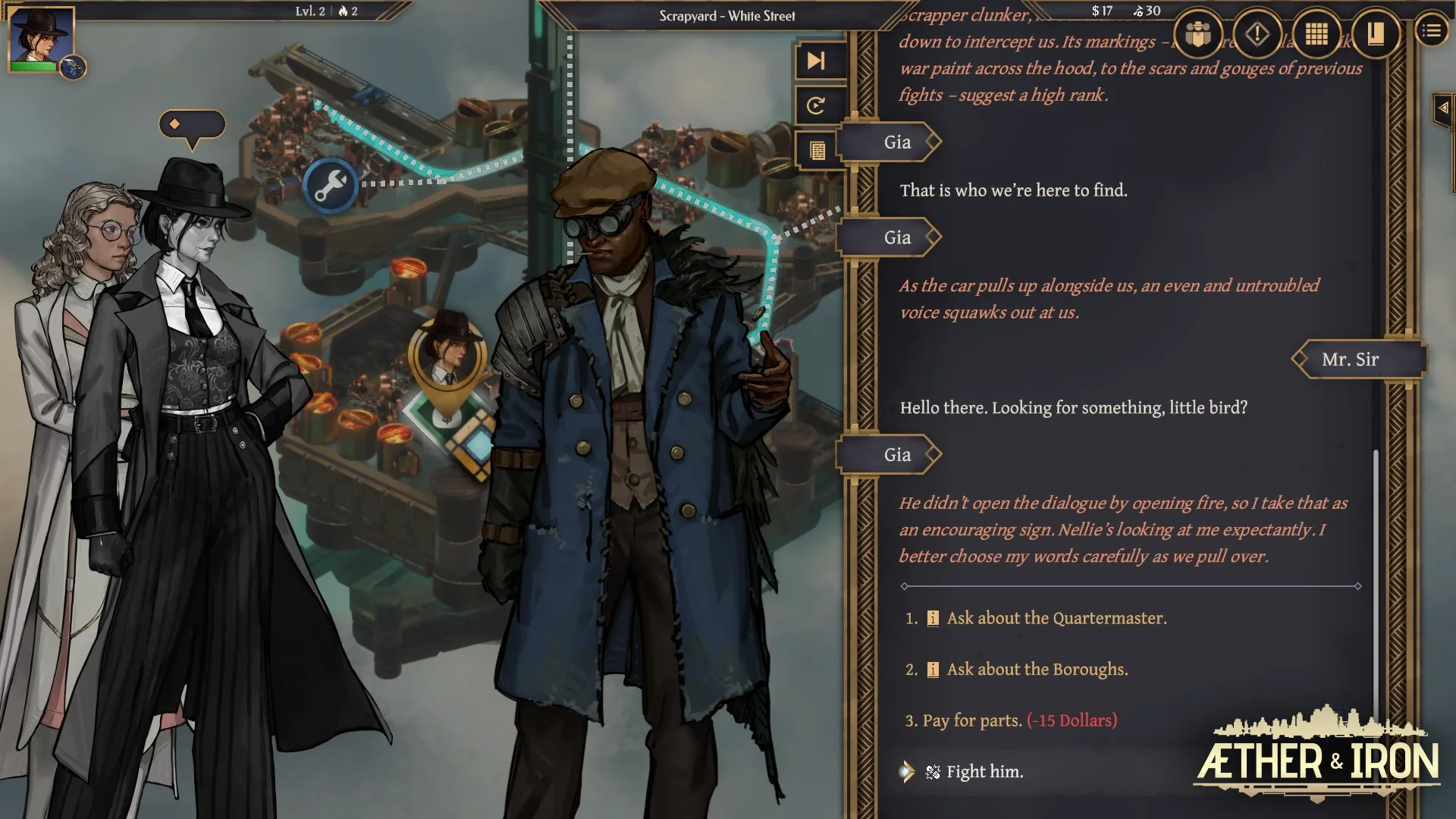
Yes, we have a female lead in a noir, which, while not the first time it has happened by any means, is certainly not the standard. Gia and her voice actor absolutely knock the story out of the park, too. Aether & Iron is primarily driven by its strong cast, significantly comprised of females. One has to wonder why we don’t see this more often, or why it’s even noteworthy for me to mention it. The story here breathes new life into the gaming landscape.
Without spoiling too much, soon after meeting her escortee, Gia realizes that there’s more to this helpless walking brain clad in white than meets the eye. In fact, so much more that a mysterious bounty hunter in black finds the need to relentlessly pursue her and her research papers. What could possibly be so important? Her client’s nebulous research aside, Gia eventually finds herself working odd jobs for a rebel group to overthrow barons: tyrants who rule the city in the worst possible ways. These two story arcs, combined with Gia battling her own demons, make for a narrative that pivots seamlessly in a delicate dance until its thirty or so hours are up.
The voice actors enhance a script saturated in metaphors, analogies, and poetic descriptions of thoughts, feelings, environments, and observations. Somehow dense, yet accessible, Aether & Iron is one of the most well-written games I’ve played in a long time. Every line bears weight, yet the script never drags. Players’ time is respected, but Aether & Iron makes sure to welcome us into a world worth exploring. Relatable and human, its tragedies make us reflect on our own world. We root for the heroes not just because this is a well-written and acted story, but because we feel the pain of the oppressed.
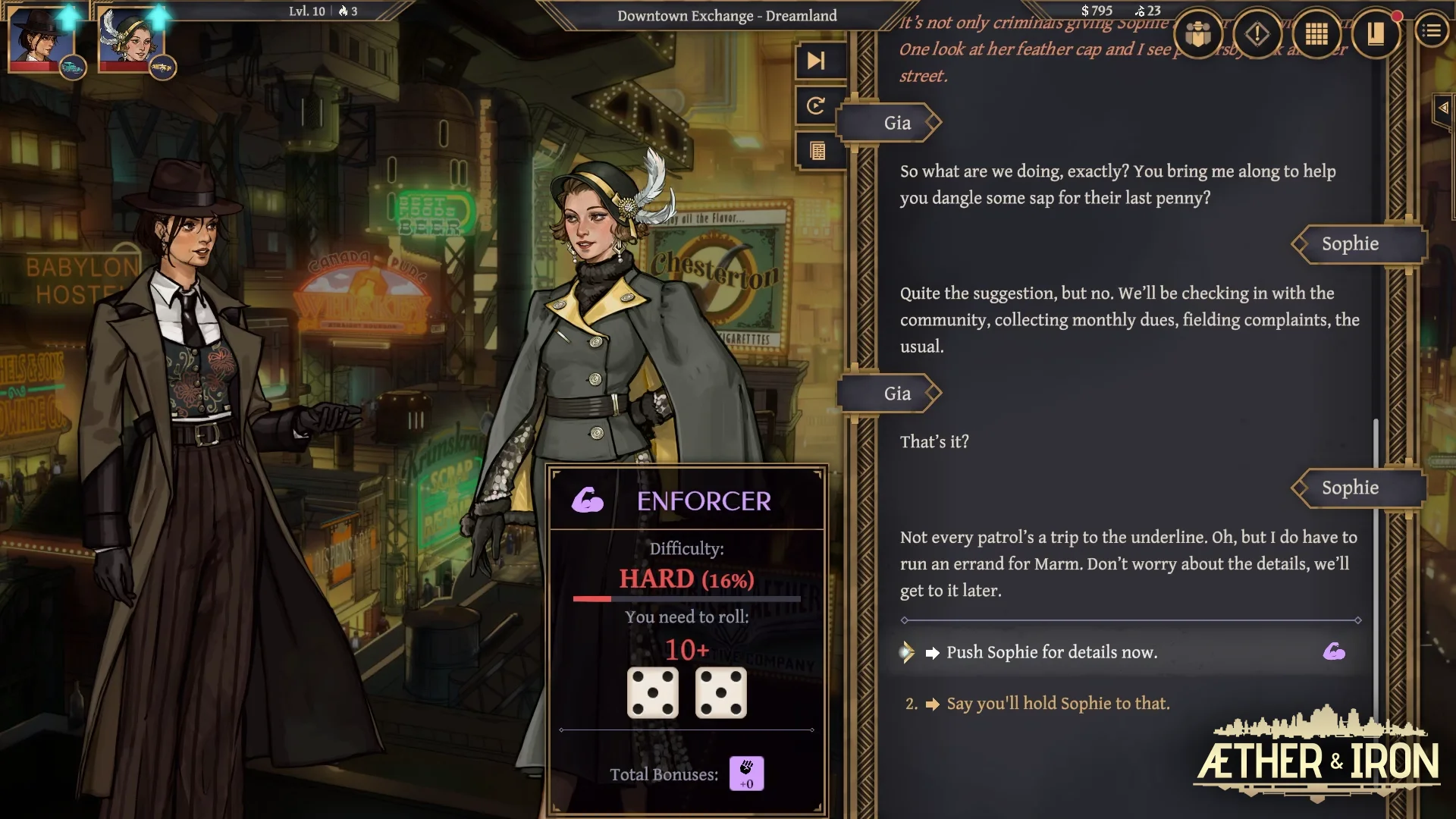
Gia’s voice actor isn’t the only star, though. Almost every character, primary, secondary, or tertiary, enjoys powerful acting that oftentimes made me just want to sit back and listen endlessly. While the varying plots and drivers make Aether & Iron an adventure worth fighting for, some of my favorite moments are when the crew has downtime and all of the beautiful personalities come together at a bar to engage in low-stakes nonsense. If the personalities weren’t powerful and unique, this wouldn’t be so fun.
The music’s no slouch, either. Composed by two-time Grammy-winning composer Christopher Tin, as well as Grammy-nominee Alex Williamson, expect to be enthralled with music reminiscent of noir—lots of strings, horns, and light percussion. Performed by a live orchestra, Aether & Iron’s music would bring one to tears if the gripping narrative didn’t draw so much attention. Unfortunately, not everything meets the standard set by the story, music, and acting.
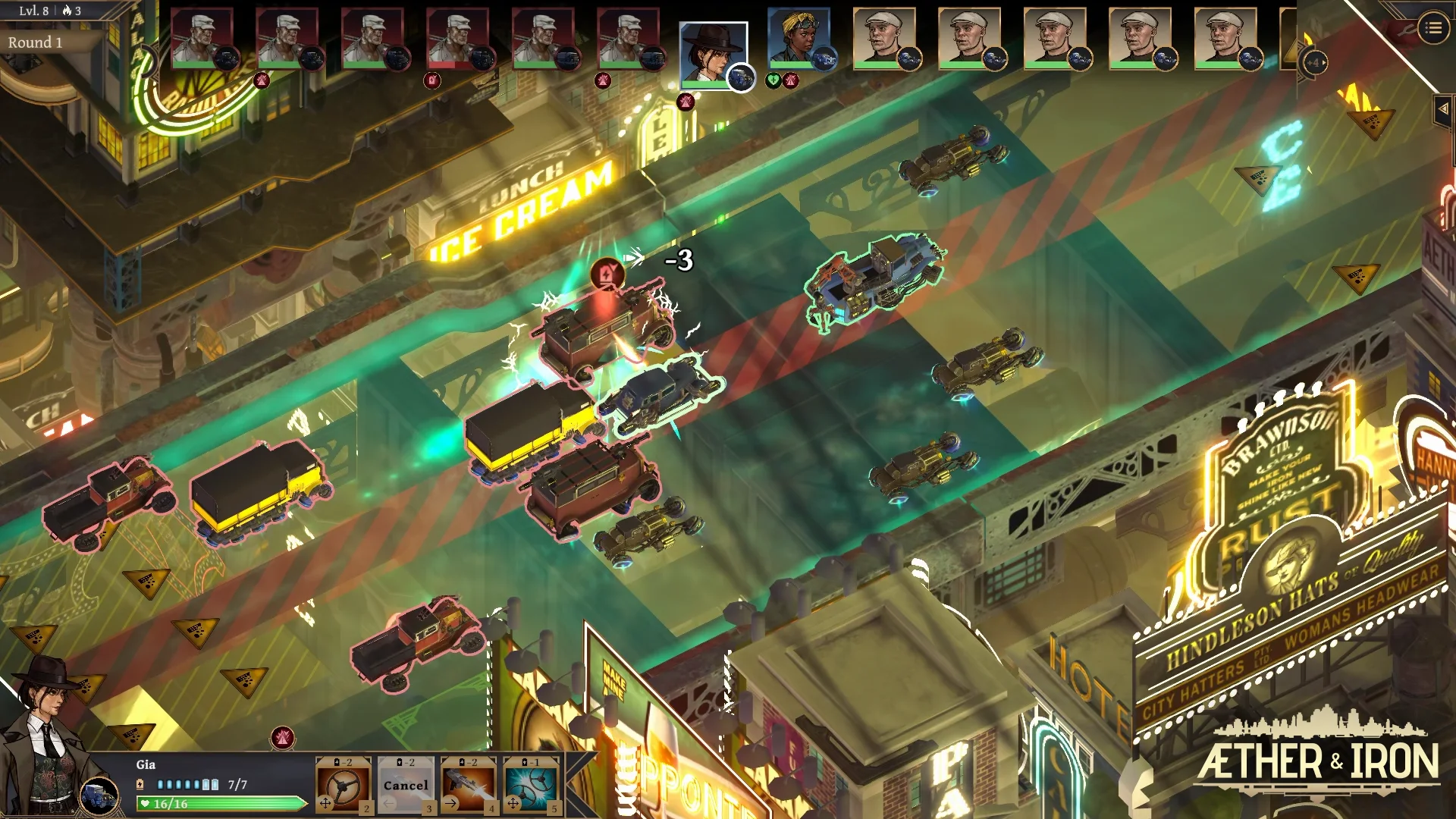
Buildings whip by during the the visually impressive combat, which uses cars as units on a battlefield-road that must be the longest straight-away in history. The cars are no gimmick: expect to run into passersby just trying to get from A to B during your reckless combat. Not only that, but accelerating takes way more action points than decelerating to the back of the large, grid-based rectangle.
Each car can be outfitted with an engine, repulsor, guns, storage, and armor, as long as you mind the weight limit. Light, small cars have limited cargo space and health, but make up for it with a variety of weaponry and the ability to zip around the field. Tow trucks offer firepower and support abilities, while vans and their ilk tank and dish out collision damage.
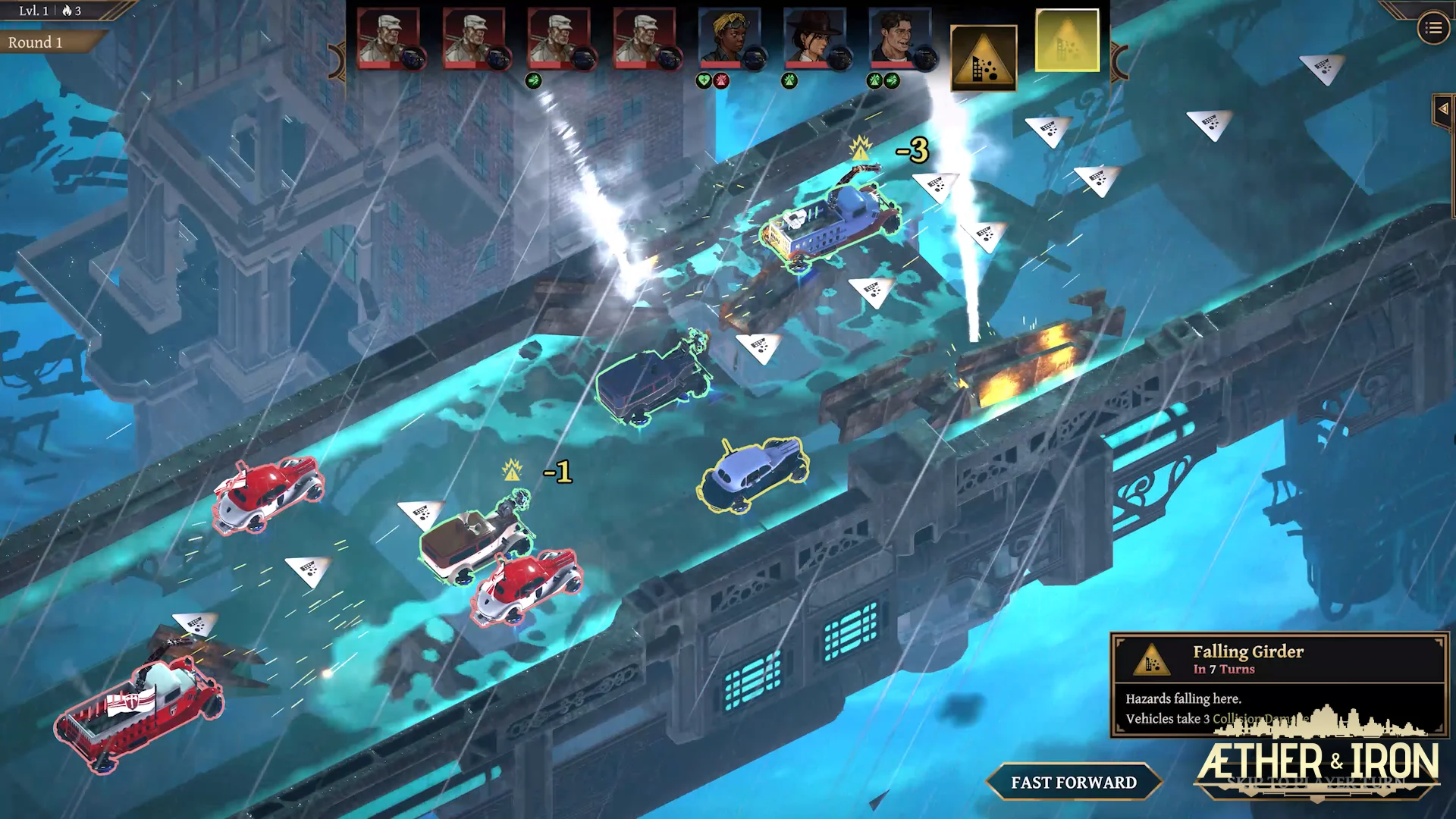
So, what’s the problem? As novel and engrossing as this battle system is, it can feel half-baked. Some battles are an absolute pleasure to puzzle out, while one or two offer strange difficulty spikes, and several can be cheesed pretty easily. I also saw little incentive on Normal difficulty to change the gear on my cars. Theoretically, players can buy new cars, but I never saw much of a reason to do this. Money’s tight for the most part, which is great, but I’d rather purchase dialogue rerolls and repair kits than buy minimal improvements or completely re-tool my strategy just to add a point or two of damage to my clunker.
Other gameplay mechanics, like hiding illicit cargo from safety checks, only really come up in the first few hours, and quickly don’t matter. Heat is a mechanically neat stat players build for engaging in loud, risky behavior, but it doesn’t have a substantial impact on gameplay. A storage system exists, but I saw little point in saving anything for later. Aether & Iron‘s gameplay is filled with interesting ideas that ultimately don’t go anywhere or feel tossed at the wayside early on.
Character dialogue frequently requires skill checks, which can be built for each character on a variety of skill trees intertwined with combat abilities, and while it’s fun to roll the dice and see what success or failure results in, I rarely found successes substantially important. Mind, this is all from a gameplay perspective—the joy of seeing what a character says in response to a failure or success is always exhilarating, because the writing and voice acting always impresses.
One last quibble about the controls and technical issues. First, targeting with a mouse and keyboard feels most intuitive, but the various menus get in the way, giving me my fair share of misclicks. Momentarily frustrating, this is where the control woes end. Now, the technical issues—hoo boy. Aether & Iron is certainly playable, but it’s rough. This list is not exhaustive, but expect: incredibly slow load times, black screens, a bizarre save system that doesn’t actually save your most recent progress, actors misreading lines and then repeating the line with the correct take, and dialogue loops. My hope is that they hammer out these kinks soon after release, but those averse to these initial hiccups should be forewarned.
Aether & Iron rises above its quirks with sheer creativity and artistic expression. I love the hand-drawn world, the characters I wish I could engage with far beyond the credits, and the struggle Gia and New York City’s citizens engaged in. A story worth telling, it’s a cliche noir tale told from an entirely different angle and elevated by a cast that stands above most others. My hope is that we see more tactical RPGs with imaginative systems like this, with their creative visions better realized.