
The original Brigandine on the PlayStation stood out from the rest of the tactical titles populating the burgeoning SRPG subgenre on the platform by offering a macro-level strategy layer. The game’s focus on conquering territories across a large map and incorporating detailed preparation before tactical battles aligned more with PC strategy titles of the era than with Final Fantasy Tactics or Vandal Hearts. This combination of free-form map-conquering and hex-grid turn-based battles was undoubtedly niche, but memorable to those who took the chance on it. 20 years later, publisher Happinet surprised diehard fans when they released a long-overdue follow-up, Brigandine Legend of Runersia, on Switch and PS4.
Thankfully, the wait for a new entry in the surprisingly enduring franchise was much shorter this time around, as Happinet and new developer Adglobe (known for Ender Lilies and Ender Magnolia) return with Brigandine Abyss. Brigandine Abyss maintains the core grand strategy and tactical battle fusion that made the previous titles cult classics, yet falters in its presentation and heightened storytelling ambitions compared to its predecessors, delivering an experience that sacrifices some mechanical and narrative depth in its attempt to streamline a hardcore franchise for a broader audience.
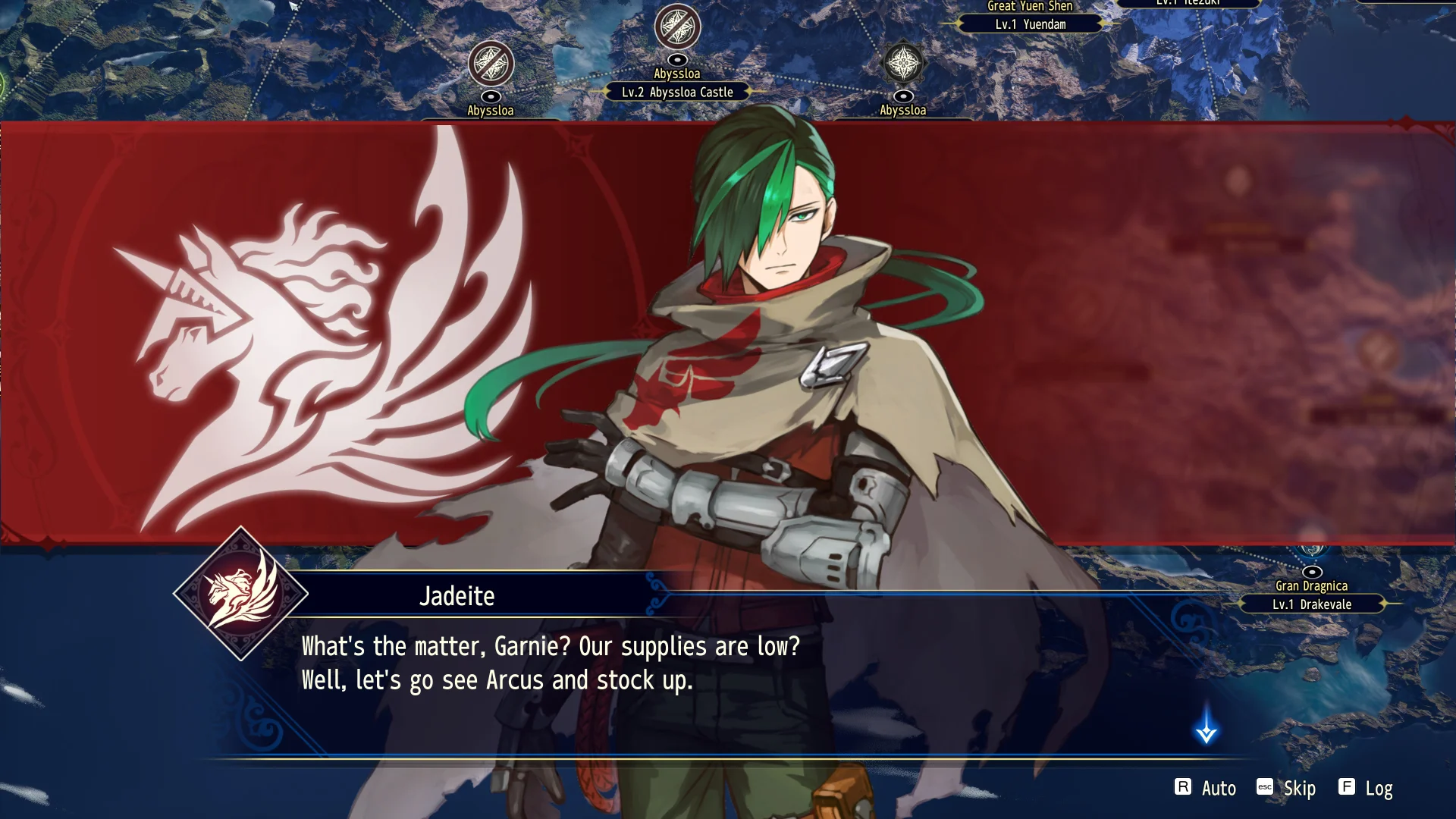
Brigandine Abyss takes place on the continent of Meltitea, suddenly embroiled in war after the Kingdom of Solginat is taken over by the king’s scheming advisor, corrupted by the dark force known as Abyss. This newly formed Abyssloa Empire begins its conquest of the continent, and you can choose between one of six factions to play as, each with its own starting position, cast of characters, and unique motivations for fighting back against Abyssloa. I chose to play as the Scarlet Will, a mercenary group loyal to the king, forced on the run with the nation’s princess in tow. A familiar narrative foundation for any Fire Emblem fan, though some of the other factions are less conventional, such as a mad scientist and his band of human experiments in Pandemyuon, or Gran Dragnica’s young dragon tamers outraged at Abyssloa’s mistreatment of their kin.
Your faction choice determines your starting position on the continental map, and your initial rivals. Every nation will eventually confront the Abyssloa Empire as you conquer more regions of the map, but each has its own narrative justifications for the conflict. The Scarlet Will’s storyline revolves around a rival mercenary band, called the Ebony Fang, that betrayed their home kingdom in favor of Abyssloa. Each faction has its own Event Battles that advance the story, and Scarlet Will clashes with the Ebony Fang multiple times across their journey to unite the continent against Abyssloa.
Brigandine Abyss differs from most SRPGs in its structure. Rather than a linear series of battles interspersed with story scenes, Abyss takes place over many Seasons, with each Season divided into three phases: the Organization Phase, the Attack Phase, and the Invasion Phase. The Organization Phase is where you will spend most of your time, preparing your units for combat, taking on quests to earn materials, and purchasing items from the Niffrom Market. The Attack Phase is the shortest: each region under your control declares attacks against neighboring regions held by another faction, as you observe which factions may attack your holdings. The Invasion Phase is the final phase; this is where the turn-based tactical battles actually take place as you invade enemy territory or fend off an invasion from a rival.
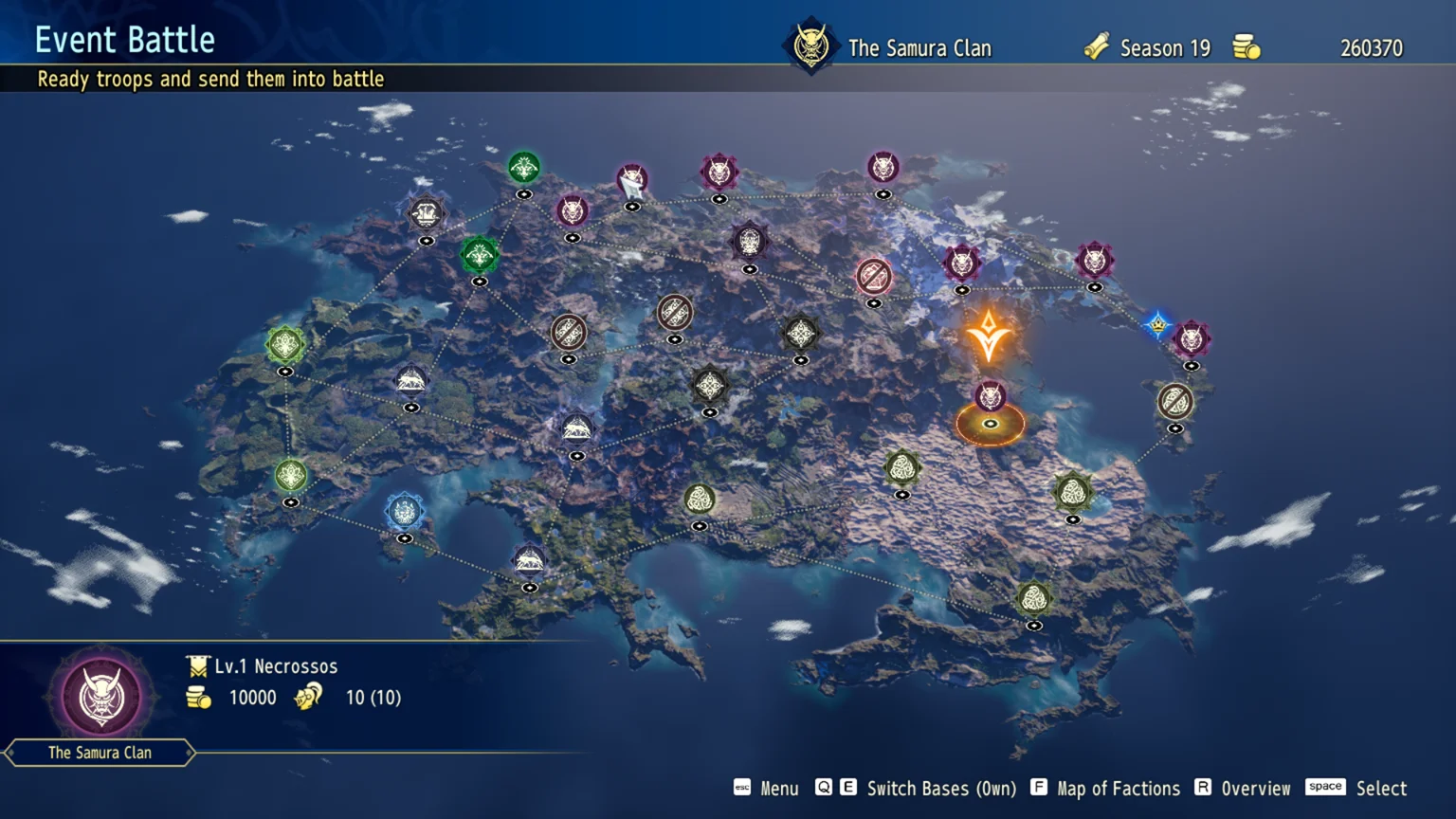
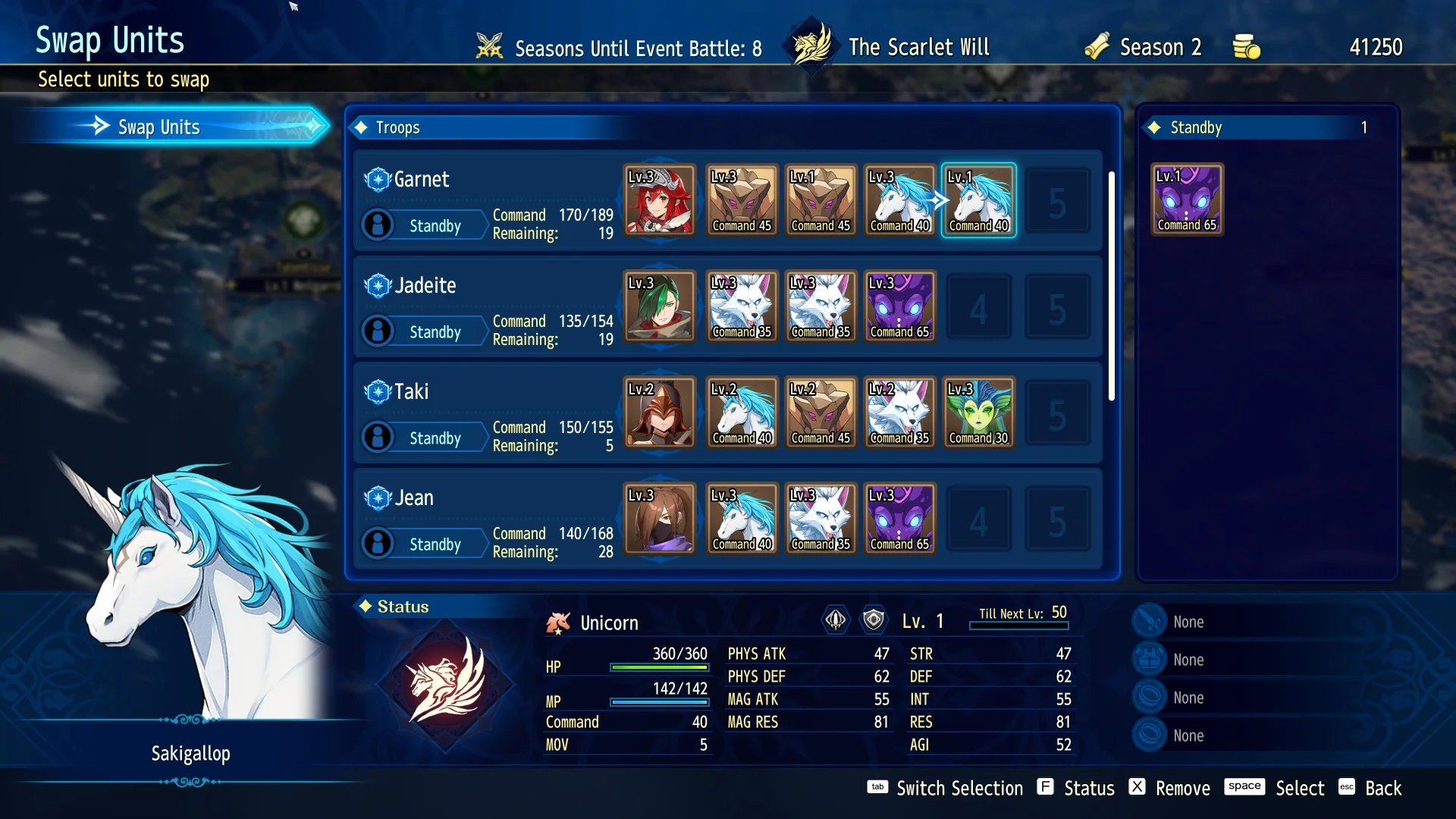
This long-term campaign structure bears more resemblance to Grand Strategy titles like Koei’s Nobunaga’s Ambition or 2K’s Sid Meier’s Civilization series than a traditional SRPG. As you invade and gain control over more territories throughout the campaign, you’ll acquire more units to manage, locations to upgrade and defend, and quests to complete. The NPC factions make their own moves during each phase, and a significant portion of each season is spent watching the NPC moves play out across the map as rival kingdoms conquer & fall. The vast majority of the game’s strategic depth lies within the Organization Phase: assigning monster retinues to your human leaders, planning your troop movements to defend an ever-growing number of locations as you expand your territory, and developing conquered (or newly hired) soldiers added to your ranks. I found Brigandine Abyss‘ Grand Strategy component incredibly compelling, requiring me to pay close attention to the map and how rival nations progressed to shore up my defenses. During each season, I would carefully expand my holdings to claim territory for valuable resources and bring rival nations under my banner. The downside, compared to a pure strategy title, is that everything revolves around conflict; there are no options for diplomacy, alliances, or trade, leaving war the only means of interacting with other factions.
Unfortunately, this open-ended, season-based structure also undermines Brigandine Abyss‘ narrative ambitions. Most story content takes place during Event Battles, which are essentially this game’s version of story missions. Because the overall campaign is so open-ended, these Event Battles occur after an arbitrary number of seasons have passed (typically between 10 and 20), and they don’t account for the state of the map. It doesn’t matter if you’ve spent the last 20 seasons invading and expanding your holdings or kept to yourself; the Event Battles play out the same regardless. Furthermore, even a single season can last an hour or more of playtime depending on how many regions you need to manage and how many invasions you embark on or fend off. This completely undermines the narrative stakes: by the time the Ebony Fang were nipping at my heels, I had already captured half the map and amassed an enormous army; meanwhile, the story still treated the Scarlet Will as a ragtag band of green mercenaries.
Brigandine Abyss attempts to heighten the drama with a handful of cutscenes, but they are so few and far between (and cheaply animated, barely more than motion stills) that they did little to invest me in the narrative. The other faction storylines may be more compelling, but I picked the Scarlet Will because I figured their close relationship to the Abyssloa Empire would give them the strongest narrative connection to the game’s core conflict. My complaints with the presentation don’t end there, as I found the character artwork to be a significant step down from Legend of Runersia‘s evocative fantasy designs (done by Raita Kazama), with Abyss‘ character portraits and monster designs coming across as a hodgepodge of generic modern fantasy anime clichés rather than giving the game a unique visual identity. Most of the leader characters don’t get their own character models on the battlefield to match their character portraits, instead inhabiting generic, class-based models. Only the leaders of each faction have a unique on-field model, which is a huge missed opportunity given the diversity in character portraits. One presentational bright spot is the music, composed by Rei Kondoh of Fire Emblem: Three Houses fame, creating a suitably epic and bombastic soundscape befitting the continent-spanning conflict.
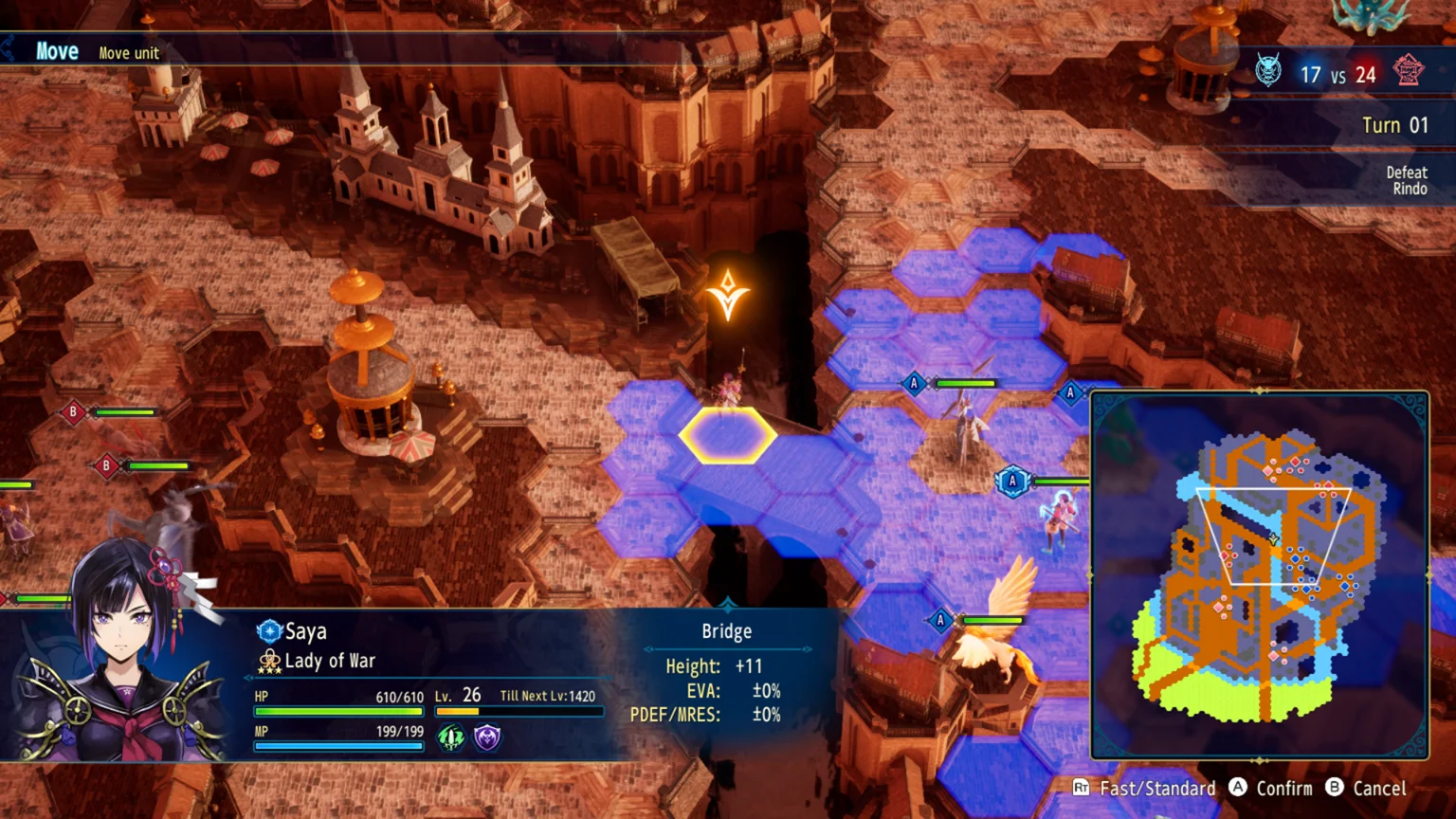
The core combat mechanics are serviceable but lack the depth of the game’s organizational phase and suffer from similar pacing problems. Combat takes place on large maps consisting of many hexagonal grids. Each side may deploy three leader units (human commanders) accompanied by up to six monster companions. Each leader has a command score, and each monster costs a specific number of command points to deploy. In the early game, most leaders can only control two or three weak monsters, but as your leaders level up, their command score rises, as does their potential monstrous retinue. This system works well, and tinkering with each leader and their retinue of monsters is quite addicting. Each monster and leader class fills a different role, and there are upwards of 20 distinct classes with unique abilities. Leaders can Rally a single monster to their side, removing them from the field in exchange for powerful passive bonuses (such as increased movement range, stronger counterattacks, etc). This ensures that even weaker monsters have a role to play on the battlefield if they confer useful bonuses on a leader. I found myself tailoring each platoon of monsters to their chosen leader’s strengths and weaknesses, and upgrading both leaders and monsters across the campaign proved immensely satisfying.
The core issue with Brigandine Abyss‘ combat lies within the game’s structure: success in your campaign across the continent requires fighting battle after repetitive, monotonous battle during Invasion Phases, especially when you’ve captured a lot of territory. During each Invasion Phase, you can choose to invade any neighboring region from an adjacent region you control, while simultaneously fending off invasions from other nations. This means that during a single season, you can end up fighting four or five battles in quick succession, all of which have the same victory condition (either defeating all enemies if you are invading, or defending for 12 turns if you are invaded). Battles are not quick affairs, mostly because the battle maps are large and relatively empty. A handful of memorable maps have unique gimmicks, such as raising and lowering walls to block troop advances or reinforced positions with defensive fortifications, but most maps lack interesting mechanics and take multiple turns to traverse to even reach the enemy force.
Battles are also incredibly easy due to the leader and monster deployment mechanics. Defeating a leader causes their entire monster retinue to flee the map, so the most efficient strategy in every battle is to target the leaders first and ignore the monster units. The game smartly deploys a concept called Zone of Control, which prevents any unit from passing through a hex on the grid if it’s adjacent to an opponent’s unit. This means you can effectively wall off your own leaders from the enemy by using your monster units as human shields. However, the enemy AI rarely utilizes this tactic, eagerly sending their leaders out in front of their monster companions just to get surrounded and slaughtered. The Event Battles rectify this somewhat, employing alternative win conditions such as escaping a map within a certain number of turns or defending friendly NPC units. However, because these Event Battles are so few and far between, you will likely fight as many as 50 extremely repetitive battles during the Invasion Phases before the next mildly interesting Event Battle.
The best strategy RPGs demand consistent mental engagement from the player during each battle, but I found that the vast majority of battles in Brigandine Abyss had me going through the motions. Prior games allowed you to revive fallen units, but made the consumable resurrection items incredibly rare, ensuring every decision in battle carried significant weight. Brigandine Abyss completely neuters the consequences of your tactical decisions by offering plentiful revival items in the shop, such that I never worried about a monster or leader falling in battle.
Thankfully, Brigandine Abyss offers a saving grace for players who want a more demanding experience: Mission Mode. Mission Mode allows you to play any of the 24 factions of Meltitea instead of restricting you to the core six factions found in Story Mode. Each faction has a unique win condition in Mission Mode, with some being fairly conventional: conquering the entire map before 99 seasons pass or completing a series of Event Battles much like in Story Mode. However, some factions have surprisingly esoteric goals, such as amassing a small fortune to pay off a debt, gathering up a specimen from every monster species, restricting you to only a handful of class types or characters, or imposing very strict season limits. Mission Mode gets extremely creative with the core mechanics, forcing you to use bespoke strategies or engage with the core systems in ways that feel fresh and completely unlike the monotony present in Story Mode. If you’re the type of person who fires up a new game of Civilization or Romance of the Three Kingdoms with a series of self-imposed restrictions when you’re bored, then Mission Mode offers hours of remixed content that will strain your strategic muscles.
In attempting to bridge the gap between diehard fans of the cult franchise and newcomers unused to the Grand Strategy setup, Brigandine Abyss ends up watering down the elements that made it unique in the first place. There is still a compelling strategic experience here, particularly in Mission Mode, but the Story Mode becomes so beset by repetition and monotony in its mechanics and cliché pablum in its storytelling that I have no desire to invest another 20 hours to see any of the five remaining story paths. Mission Mode provides the steep, engaging challenge I crave, but it lacks the narrative justification and measured progression loop that makes SRPGs my favorite subgenre of RPG. As a Grand Strategy sandbox with a heavy focus on combat, there is a lot here to enjoy, but Brigandine Abyss ultimately fails to marry these gameplay styles into a satisfying hybrid experience.