
The Culdcept series is experiencing a bit of a renaissance these days. Earlier this year, I had the pleasure of reviewing the most recent mainline entry in the card game/board game RPG hybrid franchise, Culdcept Begins, and found it a great entry point with a compelling mix of card-based strategy and Monopoly-style board game randomness. However, for us veteran Culdcept fans, one piece has always been missing from this niche franchise’s lineage: the first title never made it to the West. Thankfully, publisher City Connection has seen fit to rectify this longstanding injustice with Culdcept The First, an emulated repackaging of the 1997 SEGA Saturn original complete with quality-of-life features and a professional English localization. Some may find the original Culdcept a relic best left forgotten due to its slow pace and relative simplicity compared to later entries in the franchise. However, those who appreciate quirky late ’90s RPGs, or longtime fans of Culdcept’s unique genre blend, will be pleased to find a beautiful antique finally unearthed after two decades and ready to be savored.
Culdcept The First begins with a text crawl across static, low-res backgrounds, recounting the genesis of the world of Bablashca and the origins of the Culd cards, a gift granted to humanity by the Goddess Culdra. Only those known as Cepters can wield these powerful cards, and the dark god Baltias threatens to rise again to challenge Culdra’s power and threaten the land. It is up to the player, one such Cepter, to travel across the land, face off against various Cepters, and gain strength to eventually take on Baltias. It’s a simple narrative, and one that provides little context or motivation beyond what is strictly necessary. In fact, this beginning lore dump is most of the story a player will experience until the end of the game. I was unsurprised to find that the original title had such limited narrative ambitions (something that later entries like Culdcept Saga and Culdcept Revolt rectify), but there really isn’t much here beyond a bit of lore establishing the world and why people fight these magic card battles in arenas that resemble Monopoly boards.
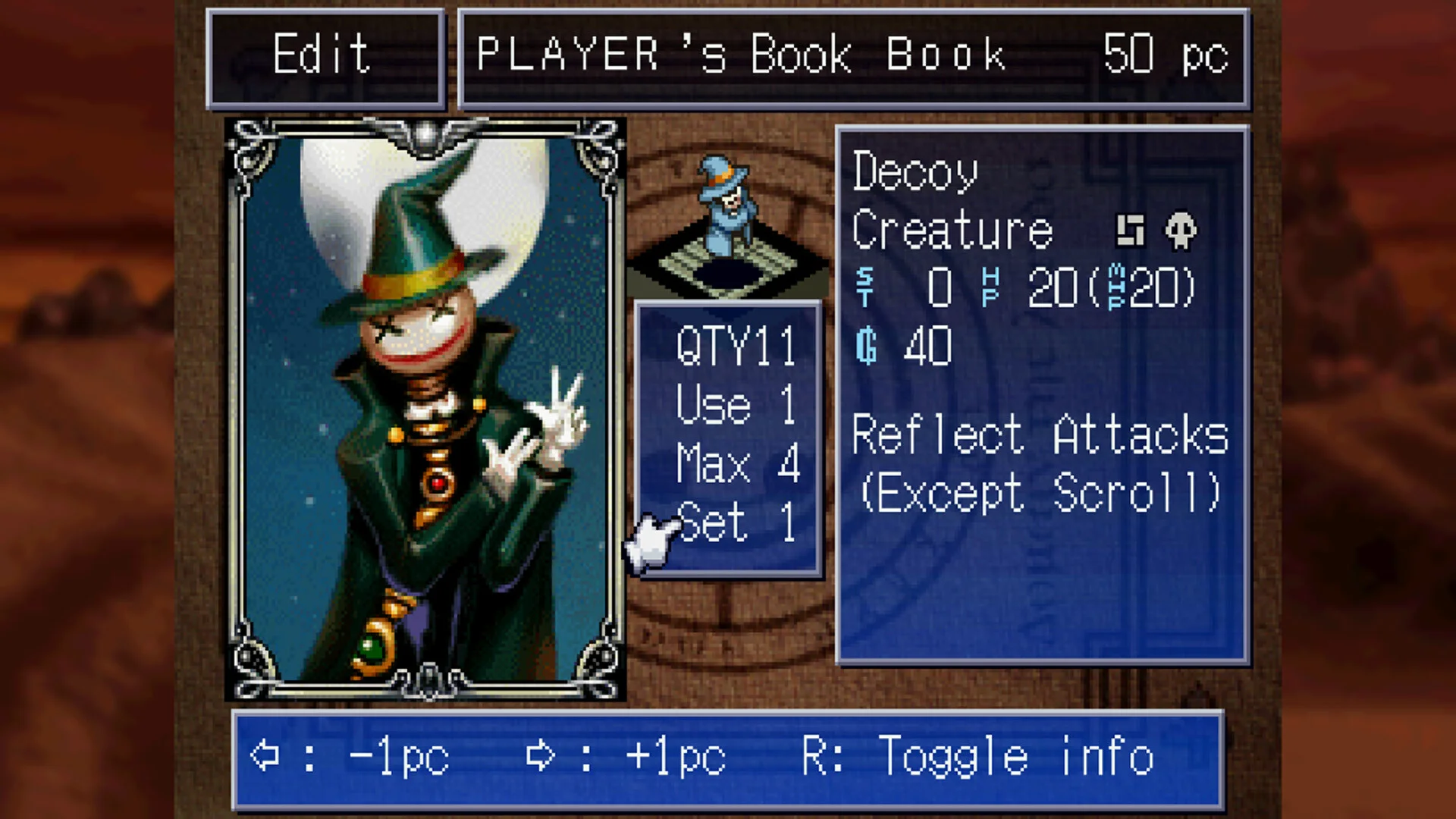
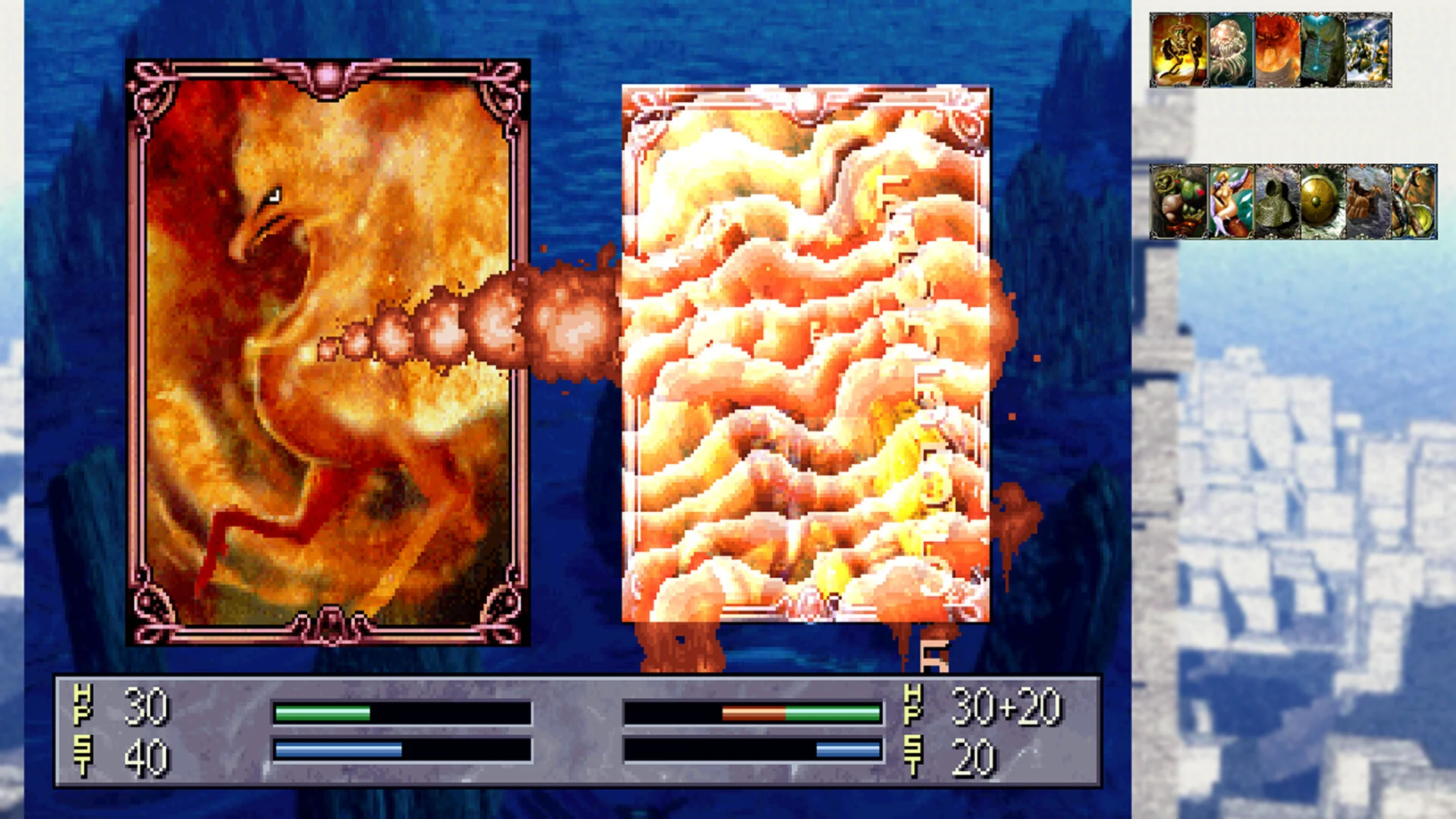
Thankfully, the game more than makes up for this lack of overarching narrative with a strong personality that comes across in both the writing and the aesthetics. Culdcept The First utilizes a mix of 2D battlefields, charmingly animated sprites for monsters and Cepters, and a pinch of animated 3D polygons for spell effects and battle scenes. Equip a sword to your monster, and a low-poly 3D blade will appear during battle and cut through the opposing card. Cast a spell to even the odds, and a 3D model of a set of scales will shine above the battlefield to weigh each Cepter’s weight in gold and cast judgment accordingly. Culdcept The First‘s sparing use of 3D animated visuals, contrasted with well-animated sprite work and low-res yet evocative backgrounds & card art, establishes a visual identity that is quintessentially SEGA Saturn.
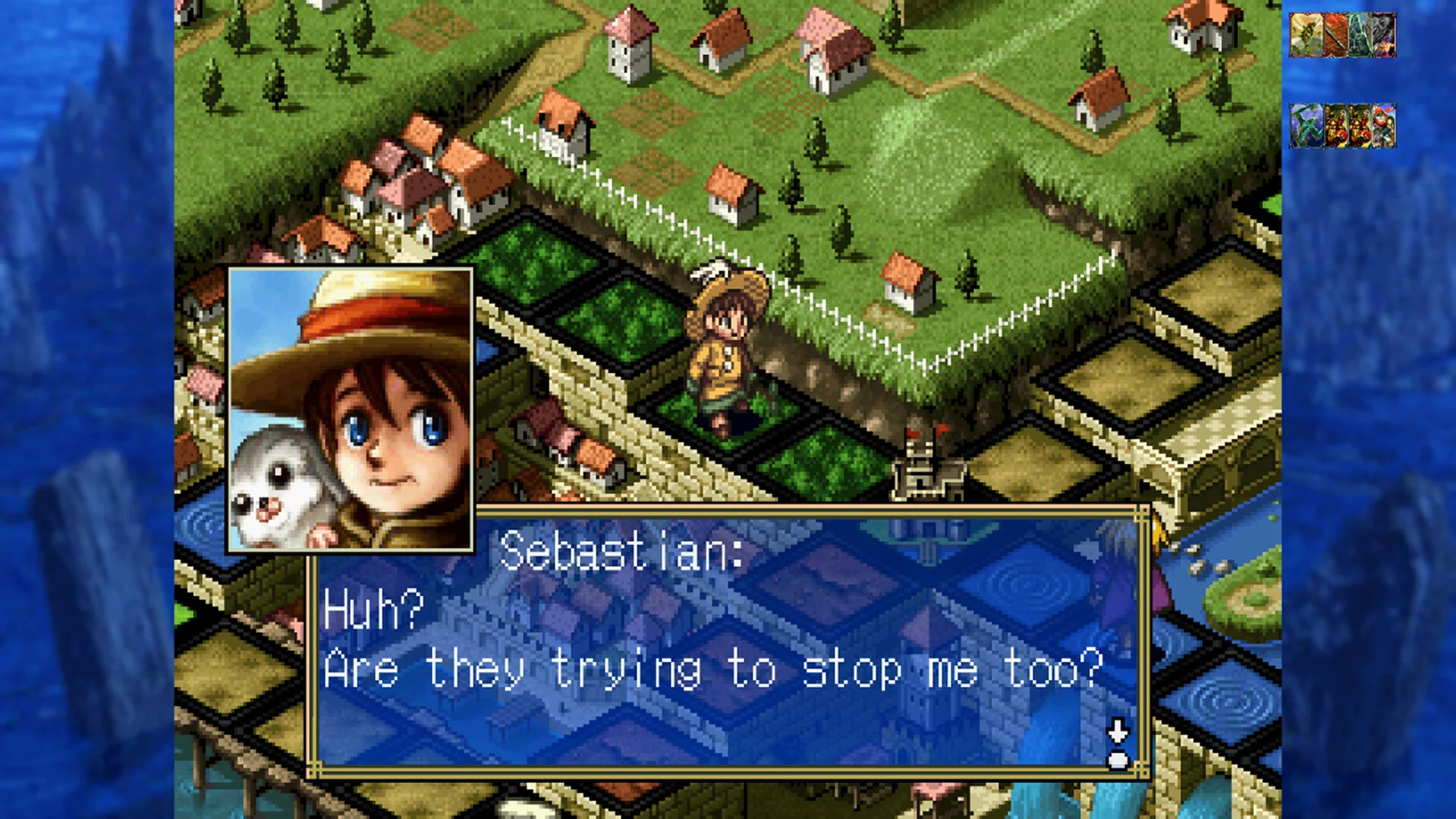
Although the storyline itself is barebones, Culdcept The First is chock full of dialogue between Cepters during the matches. Each location on the overworld map contains a different arena and a different Cepter opponent. These Cepters are the real stars of the show, and where the high-quality localization truly shines. The first (initially) imposing villain, Dragon Eye Zeneth, talks like an anime villain until you easily defeat him and he runs off with his tail between his legs, showing up a few story beats later to crash your battle in an attempt to redeem his reputation. There’s the little boy Sebastian with a cute, cuddly companion on his shoulder named Poco Poco. The unassuming creature turns out to be a dastardly demon manipulating the poor boy into doing his evil bidding! Ape man Kou-Tetsu hangs out in the misty mountains, full of bravado until you give him a card-based beatdown and he admits your superiority. The exiled king Weyden rules the desert wastes with an iron fist…or at least he would, if he could get those damn wooden stockades off his wrists first. This colorful cast of opponents fills the void left by the bare-bones story, and the mid-match banter had me chuckling and rolling my eyes in equal measure at their weird & wacky personalities.
It’s a good thing fighting these goofy opponents never gets old, because Culdcept The First’s progression structure is as archaic as you’d expect of an experimental RPG from 1997. More recent Culdcept titles feature a card shop between matches where you can spend money earned from completed matches to purchase random card packs. These packs quickly fill out a stock of cards to deckbuild with and experiment with strategies. Culdcept The First lacks such a feature, meaning you can only acquire new cards sparingly at the conclusion of a match. To get enough powerful cards to succeed in later matches against more powerful Cepters, you will need to repeat the same battles on the same arenas over and over again.
As the earliest title in the franchise, the level of strategic complexity possible with various card combinations is at its most basic in Culdcept The First. If I had to draw a comparison, it’s like the difference between the early days of the Yu-Gi-Oh! TCG (much slower-paced and focused on tribute summons) and modern Yu-Gi-Oh! (blazingly fast-paced with special summons to the point people joke about the game playing like solitaire). There is still plenty of room for strategy and rudimentary deck building, but the strategic potential for the decks you can build is much more limited and straightforward than what is possible in Culdcept Revolt or Culdcept Begins. The end result is that the board game elements (rolling dice, landing on tiles) are more impactful in each match. In Culdcept Begins, I would enter each match with the same core strategy I built my deck around, then adapt it to fit my opponent and the board at hand. In Culdcept The First, the board and opponent determine your strategy entirely, and the deck builds you bring into the match have limited potential to affect the outcome if you get an unlucky set of rolls. As such, this first entry feels the most like a board game and the least like a TCG of all the games in the series, relying more on luck than strategy or skill.
Although Culdcept The First could take an experienced player a dozen hours to complete (double that if you’re new to the series), there’s only about five to six hours of original content here. The core gameplay loop of making your way along the board, claiming property with monster cards, and stymying your opponents while you try to avoid their lands is as fun and addictive as ever, yet the repetition begins to wear as you fight the same battles over and over to get stronger. This is also the slowest Culdcept title, with no speed-up function included in the handful of quality-of-life features added. Though this release does allow you to view player hands at all times and increase the number of cards you receive at the end of a match to cut down on the grind, but it’s not quite far enough to make Culdcept The First approachable for players without significant patience. My love for the series kept me going even when the game grew monotonous at times, but I fear most players won’t be willing to repeat so much content just to get to the end.
The aforementioned quality-of-life improvements certainly make Culdcept The First more approachable, and the inclusion of quick save and quick load both in and out of matches is a necessity, especially given how long these matches can last. There are a few issues with the port, though, at least on PC. The game bizarrely opens in an initial window, then when you hit start on the title screen, that window closes and a new one opens when the game actually starts. A few times, this second window simply wouldn’t launch, and other times it would launch, and I’d get into the game, only for it to freeze and crash later. I’m not sure if this is a consequence of City Connection attempting to secure the ISO to prevent players from simply extracting and running it in their own emulator, but it’s odd and a little annoying nonetheless. Furthermore, Culdcept The First requires a controller and won’t let you use a mouse and keyboard, which is a bit disappointing. I’d imagine these issues won’t matter on console releases, but they don’t make the best first impression here.
Ultimately, I enjoyed Culdcept The First more as a historical document than I did as a gameplay experience. Experiencing the first iteration of series concepts, card designs, and arena layouts was a joy, as were the charming late ’90s visuals and the excellent soundtrack by Yuzo Koshiro. As a longtime fan of Culdcept games, seeing how much of the formula was established in this first game is fascinating, especially considering how novel the concept must have been back then. I’m so glad that City Connection brought this series back and finally localized this first entry for Western audiences, something I never dreamed would happen outside of fan-led efforts. However, the core gameplay loop is undeniably rough. It leaves a lot to be desired compared to more recent entries, especially given its limited feature set (Culdcept The First lacks multiplayer of any kind). I could only recommend this one to series superfans like myself, or retro game enthusiasts who love experimental RPGs or the SEGA Saturn. For everyone else, Culdcept Begins offers a much more approachable, polished package.