
This review for Deltarune Chapter 5 builds on ones I previously wrote for Chapters 1+2 and Chapters 3+4.
With Deltarune now apparently past its halfway mark and Toby Fox bestowing chapters on what will hopefully continue to be an annual schedule, each drop feels like a monumental event: a consistent and carefully plotted buildup of new mysteries and revelations for a voracious community of fans to devour and overanalyze until most of them are proven wrong by the next piece of the puzzle. There’s no denying at this point that I am one of those fans, and my wholehearted investment in Undertale’s successor has brought me on board with a release style that I don’t think I could get behind to the same extent for any other game.
The most validating aspect of this gradual rollout is how each of Deltarune’s chapters thus far has managed to simultaneously work as contained adventures and essential pieces of a greater whole. However, that’s not to say I haven’t had some lingering reservations about how the episodic releases could impact Deltarune’s overarching sense of cohesion or balancing.
My biggest worry coming out of Chapter 4 was that the game could settle into a more predictable gameplay loop that wouldn’t keep pace with everyone’s sky-high expectations for unwavering creativity. The scale of narrative surprise and gameplay variety has been Deltarune’s strongest aspect thus far, and you’d think the longer the game gets, the more difficult that would be to maintain. Each new chapter must offer something substantially novel—or straight up better—to not be a disappointment that risks undermining the episodic format and breaking the game’s aura.
But what reason has Toby Fox given, really, for us to doubt his capability? None. And I confidently say that Deltarune Chapter 5 is the game’s most fully realized and intricate piece yet. With Chapter 4’s coverage of the lore around The Prophecy checked off, Deltarune Chapter 5 continues to flesh out some important central character relationships. Namely, Susie’s charming yet appropriately awkward budding romance with Noelle, and Kris’s tumultuous yet thus far vaguely told family history.
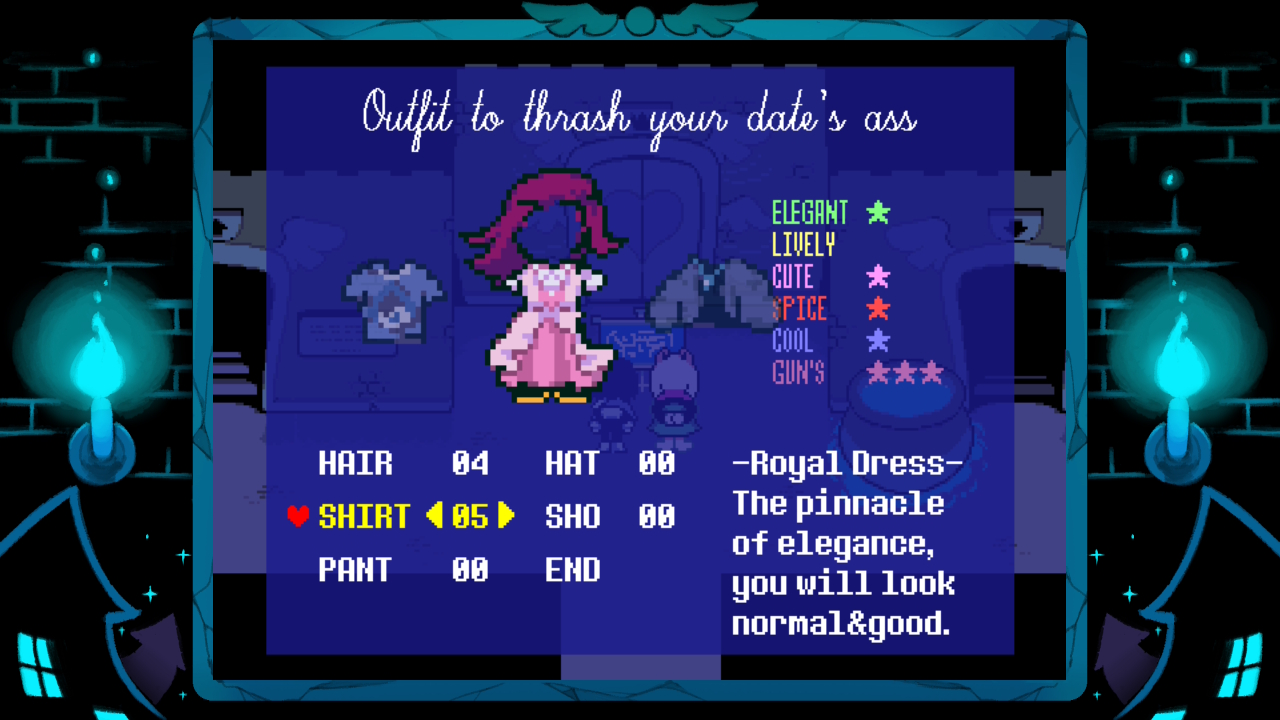
After a bit of the usual housekeeping and shenanigans in Castle Town, the chapter’s first main event is a much-anticipated festival held in the Light World Hometown. Susie has Kris accompany her and Noelle as third wheel on what is supposed to be their first date. It’s a charming little sequence with plenty of character dialogue and fun interactions to discover. I couldn’t help but think of Chrono Trigger’s Millennial Fair, though the happenings here were more personal.
The chapter’s Dark World opens in Asgore’s flower shop this time around. While Asgore, Kris’s dad, has always appeared unshakably cheery in prior encounters, it’s hard not to suspect there is a darkness brewing underneath his fluffy dad-bod exterior. You don’t come out of a messy divorce, loss of child custody, ruined political career, and failing small business without some serious emotional baggage. Chapter 5 decides to air that out.
It’s easily the beefiest chapter with the largest and most ambitious level design. There are three sub-regions here, each with its own challenges and visual flair. In the second region, the Cliffs, a gorgeous perpetual sunset lingers on the horizon with painterly attention to detail in the hues colouring the sky around it. In general, the pixel art and sprite work has taken another notable step up in quality. Deltarune never looked bad. Now it looks truly remarkable.
Out of the first four chapters, the third left the strongest impression on me due to its unique game show-oriented structure and all the minigames built around it. A lot of Chapter 3’s creativity was possible because its premise is largely a side story within the larger plot, and it had the benefit of releasing alongside the more conventional fourth chapter. Meanwhile, Chapter 4 had strong level design but comparatively dragged a bit due to a lack of development around the turn-based gameplay and small enemy variety for its length.
Deltarune Chapter 5 manages to instill levity in a narrative premise that feels integral to our characters—a final peak before the anticipated big drop—while also making some wild and successful swings in terms of gameplay.
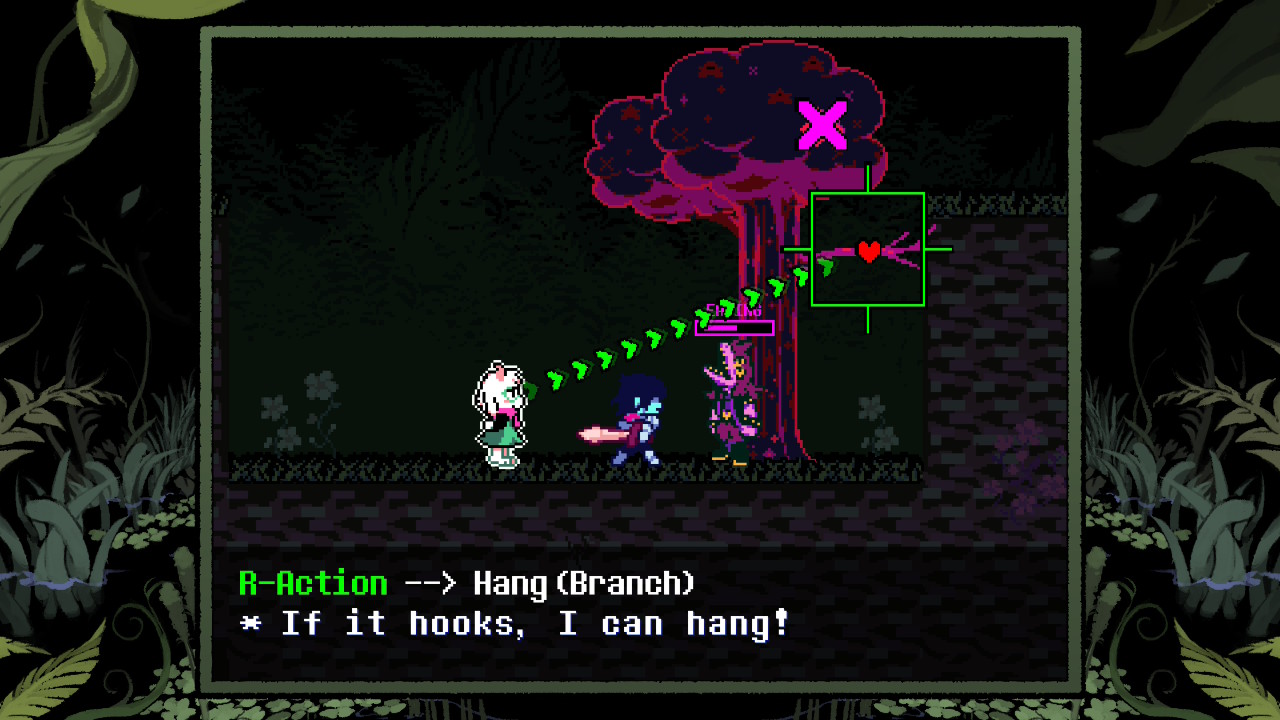
While there’s no “Legend of Tenna” here, Deltarune Chapter 5 introduces a feature that works as a similarly jaw-dropping secondary gameplay mode. After obtaining a special accessory early on, the party is able to interact with statues scattered throughout the level. These will rotate the world perspective from a top-down to a sidescrolling view and, suddenly, you’re playing an action-RPG platformer. The action/cancel buttons now allow Kris to jump and swing their sword in real-time, while another button pauses the action to assign actions to Susie and Ralsei for combat and platforming purposes.
Is it the best action-platformer I ever played? Well, of course not. But the fact that it feels as good as it does is nuts. A lot of it is thanks to the audiovisual flair and smooth controls. Susie and Ralsei glide elegantly behind Kris. Kris’s sword swings have a tasty cronch behind them that, together with the quick menu SFX, feels reminiscent of 16-bit Mana games, which is of course a compliment. Meanwhile, the platforming segments themselves must have drawn inspiration from Hollow Knight. Expect to do plenty of aerial pogoing on small circular nodes.
The transition between the two modes is seamless and helps keep either one from getting stale. Combine this with a bunch of character-driven setpieces, and I felt utterly spoiled throughout the experience. I also appreciated how standard turn-based encounters felt easier to avoid this time around. My party was already swimming in gold going in, so I was able to fight most enemy types only as much as it took to recruit them and enjoy all their unique creative mechanics without ever becoming bored by them.
At the same time, the chapter also introduces two new forms of currency that encourage rewarding exploration and secret-searching, particularly in the novel sidescrolling segments. Perfect. On a very leisurely playthrough where I tried to exhaust every possible character interaction and bit of content, Deltarune Chapter 5 took me almost 10 hours to complete.
A big part of Chapter 5’s setting centers around the seven uniquely colored flowers in Asgore’s shop, who become fully realized animated beings in this Dark World. Without saying too much, this focus on anthropomorphized Flowers and the power of their dreams is sure to make Undertale fans draw even clearer (if still speculative) connections between the two games’ stories. If you know you know.
Each chapter’s Dark World features a main antagonist who is usually too charming to see as a full-blown villain. Chapter 5’s is Flowery, a handsome otome-coded dude trying to pull Asgore’s attention away from his troubled personal and family life. His dialogue is often accompanied by amusing, highly compressed vocal lines, the likes of which you may have heard as commentary in a 16-bit sports game. It’s another case of Toby Fox not only borrowing from the design of retro games but leaning into aesthetics that came from their hardware’s technical limitations. It’s innovative nostalgia.
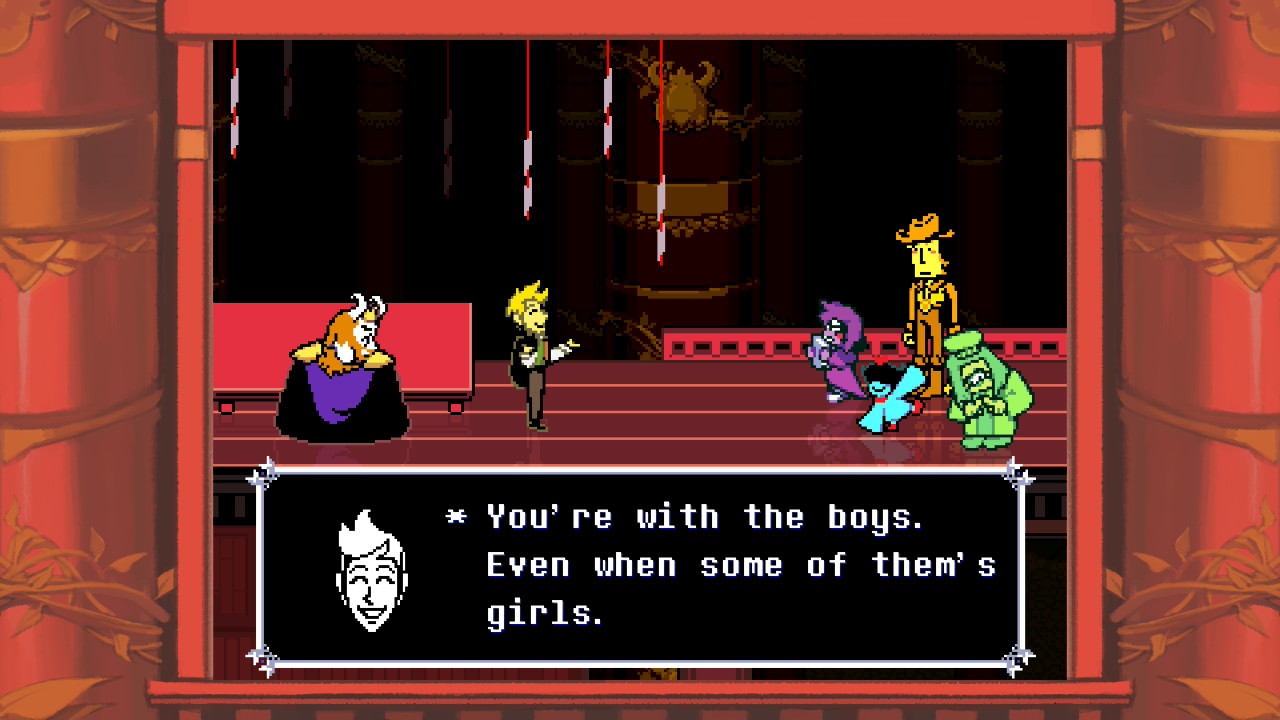
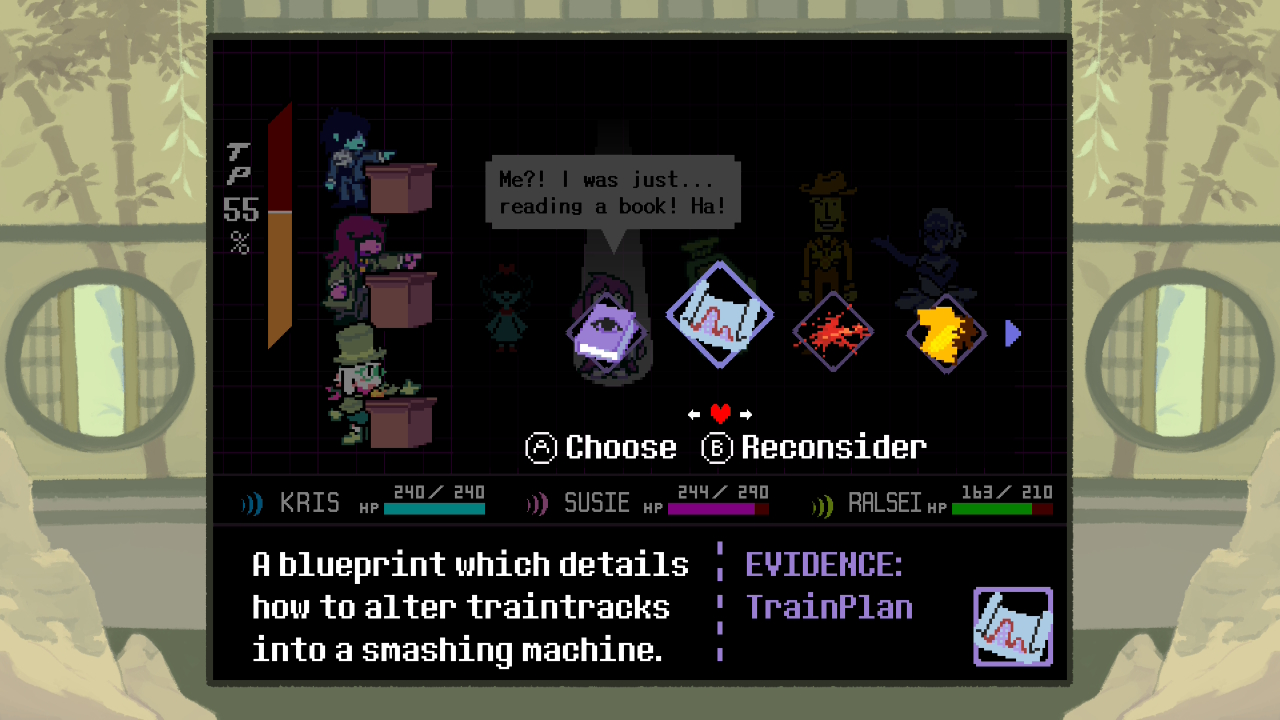
The cast of humanoid flowers is the heart of Deltarune Chapter 5. Each one has a distinct and charismatic personality, and the rivalry your party develops with them makes for plenty of hilarious and dramatic encounters. This includes some of the best mini-bosses Deltarune has offered. My favorite of the bunch culminates in an amusingly ridiculous detective sequence where your party must defend themselves in a trial during the battle.
It’s this meticulous balance of silliness, sincerity, and creativity that might make Chapter 5 go down as the quintessential Deltarune release. Especially when what’s still to come feels like it’s finally going to have to raise the stakes to less certain and darker places lingering underneath this all.
I suppose the score below is a reflection of this single chapter, but how can it not also be another reassessment of the greater whole? As an individual release, Chapter 5 is a new peak for Deltarune. As a follow-up to Chapters 3+4, it offers more in a way that maintains overwhelming expectations for what’s to come. And that’s all this chapter had to do. Once again, Toby Fox has spent more time opening worm-loaded cans than closing them. If there are indeed only two chapters remaining, they have a fascinating yet intimidating onus. Though, again, what reason have we to doubt Fox and his team’s capability?