
In my review of Disgaea 7 last year, I concluded that the series was long overdue for a shakeup. Disgaea 7 addressed many fan demands after the disastrous Disgaea 6, yet in doing so revealed just how stale the series formula had become. After hitting peak mechanical refinement in Disgaea 5, the series has been treading water, removing beloved features to seem different from the last entry without changing the fundamental design template, just to add them back in the next entry and pass that off as meaningful evolution for the franchise. It seems the developers over at Nippon Ichi Software may have felt the same way about the series trajectory as I do. The newest game in the 20+ year old franchise, Disgaea Mayhem, opts for an entirely new genre shift into a hack-and-slash action RPG. Disgaea Mayhem establishes a firm mechanical foundation and adapts the franchise’s most iconic mechanics decently well to a new format, yet ultimately fails to deliver enough variety or depth to justify this new direction.
As far as the presentation, characters, and narrative trappings are concerned, Disgaea Mayhem is a classic Disgaea game through and through. The story follows grizzled mercenary protagonist N.A. (a guy so dark and mysterious his name is literally “Not Applicable”) as he’s hired for a job by the new Overlord of the Netherworld Super Duper, Tichelle. Tichelle explains that Super Duper used to be a Netherworld full of strong and terrible beast demons, who lived by survival of the fittest. However, the previous Overlord, her late father Margraf, united the various warring factions by cooking up the Pristine Gleam Flan, a dessert so delicious it soothed the rage of Super Duper’s inhabitants and turned them into confectionary-loving softies. After Margraf’s death, the various factions (each led by one of six Psychlamates) rebelled against Tichelle, hence why she brought in N.A. to calm them down long enough to feed them her own wacky flan recipes and quiet their rambunctious spirits.
The plot is, of course, quite stupid in Disgaea series fashion, though I appreciated the goofy tone. The constant food and calorie-counting/weight-gain jokes related to overconsumption of flan began to grate after the initial hours, but watching as N.A.’s gruff exterior slowly gets broken down by Tichelle’s youthful, saccharine exuberance and his own budding love of her wild flan concoctions proved fairly entertaining. It definitely feels more like a spinoff narrative, even among standard goofy Disgaea stories, but Tichelle and N.A.’s dynamic is cute enough to carry the narrative across its short five-hour runtime.
Initial impressions from the pre-release demo led many (including myself) to believe Disgaea Mayhem was a musou title ala Dynasty Warriors. From a first glance, it’s clear to see why: hack and slash combat focused around executing combo strings by alternating light and heavy attacks, huge swarms of enemies to mow down, and stage-based level design. However, looks can be deceiving; Disgaea Mayhem is not really a musou title, because it lacks the objective-based design that makes those games compelling. There are no troop movements to manage, no bases to protect or capture, no invading enemy captains appearing to upend your strategy nor allies to direct. All of the strategic, battlefield management gameplay that gives a series like Dynasty Warriors its depth is entirely absent. Instead, Disgaea Mayhem is a very straightforward action RPG with small, contained arenas containing waves of fodder enemies to mow down, and a capstone boss encounter. The overall flow of gameplay is more similar to arena-based action RPGs like Croixluer Sigma or Misturugi Kamui Hikae rather than Koei Tecmo’s flagship franchise.
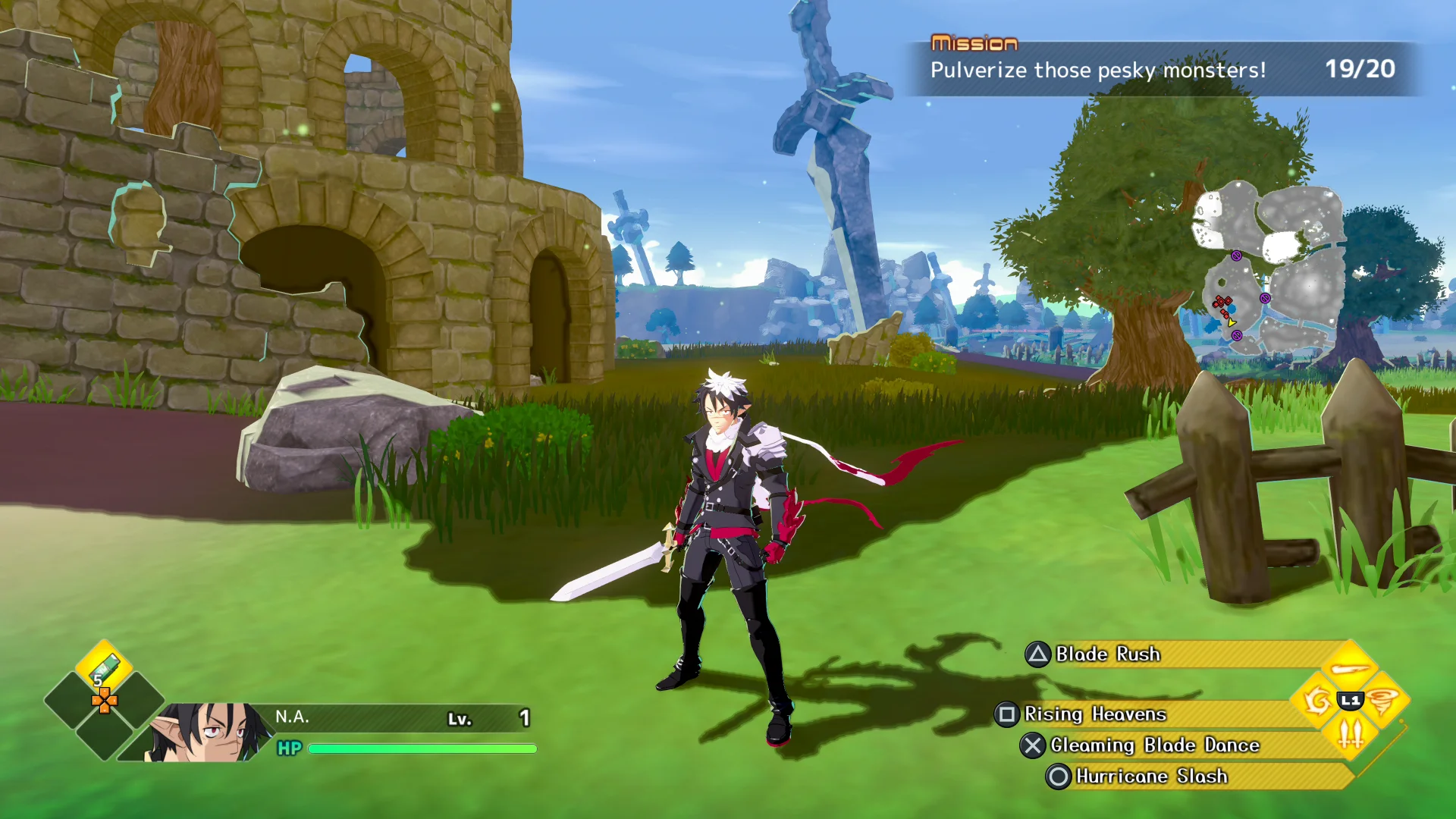
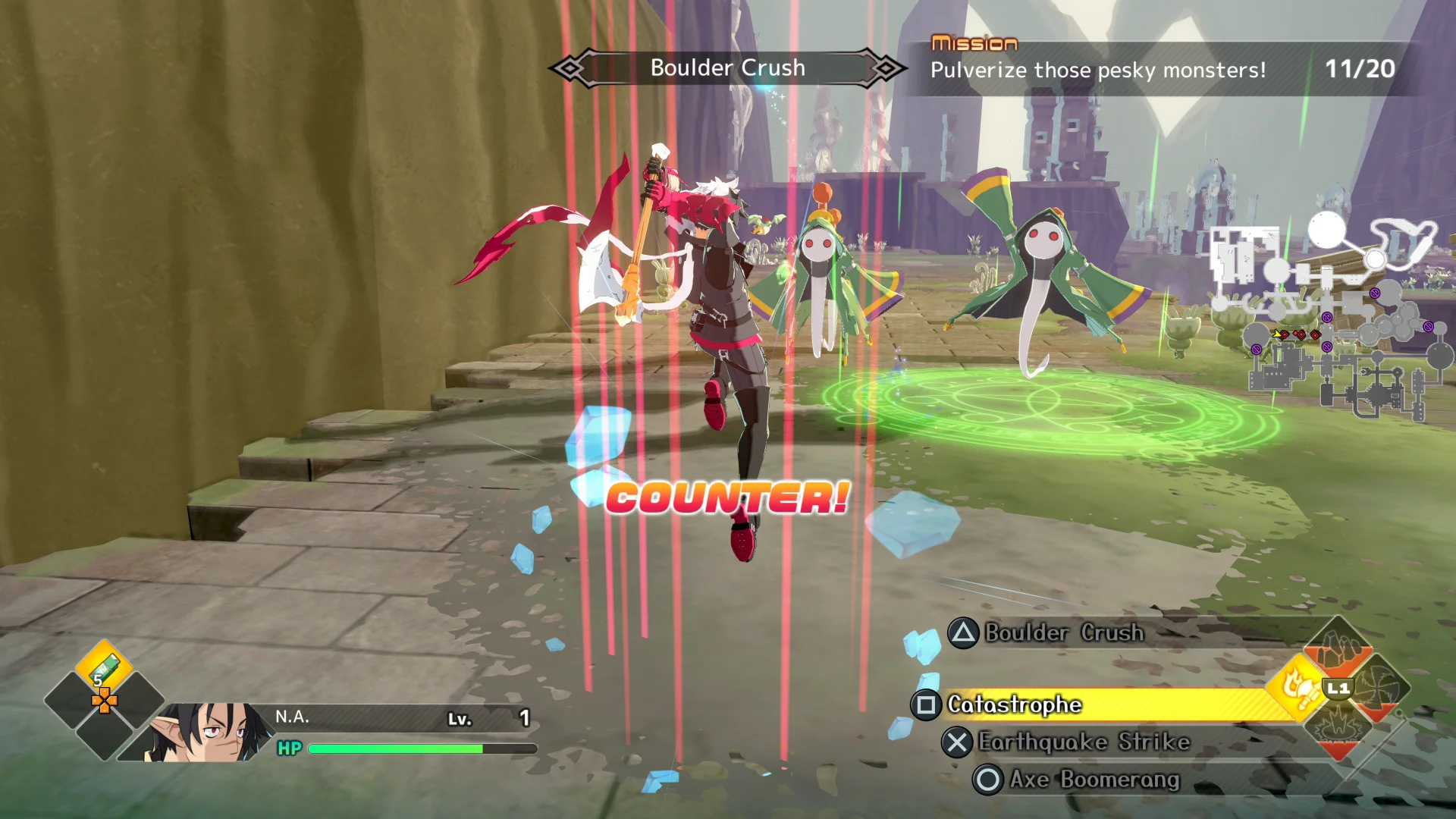
While the story stages are decently large and have varied layouts, most missions are relegated to a small portion of those stages, with monsters spawning in waves of 15 to 20 at a time. Upon defeating those waves, a mini-boss (usually a larger, recolored version of a regular monster with a more complex move set) appears. This makes the variety in stage layouts feels rather pointless. Disgaea Mayhem never really makes use of the layouts in an interesting way, preferring to just ferry you to combat arenas with different backdrops.
The developers seem to have recognized this fact, since entering the Item World grants you stages that are simply tiny arenas without all the pointless traversal fluff of the story stages. Each item category has its own unique arena design (sometimes a flat circular plane, sometimes a narrow ring with a large gap in the center, sometimes a cross shape or one with large pillars) to allay complete monotony, though all of them share the same purple void aesthetic. These more confined stages, despite being visually boring, are actually a much better fit for the combat mechanics, as the small play area means monsters are constantly on top of you, their aggressive behavior keeping you on your toes as you try to mow them down faster than they can spawn and manage your focus on the boss.
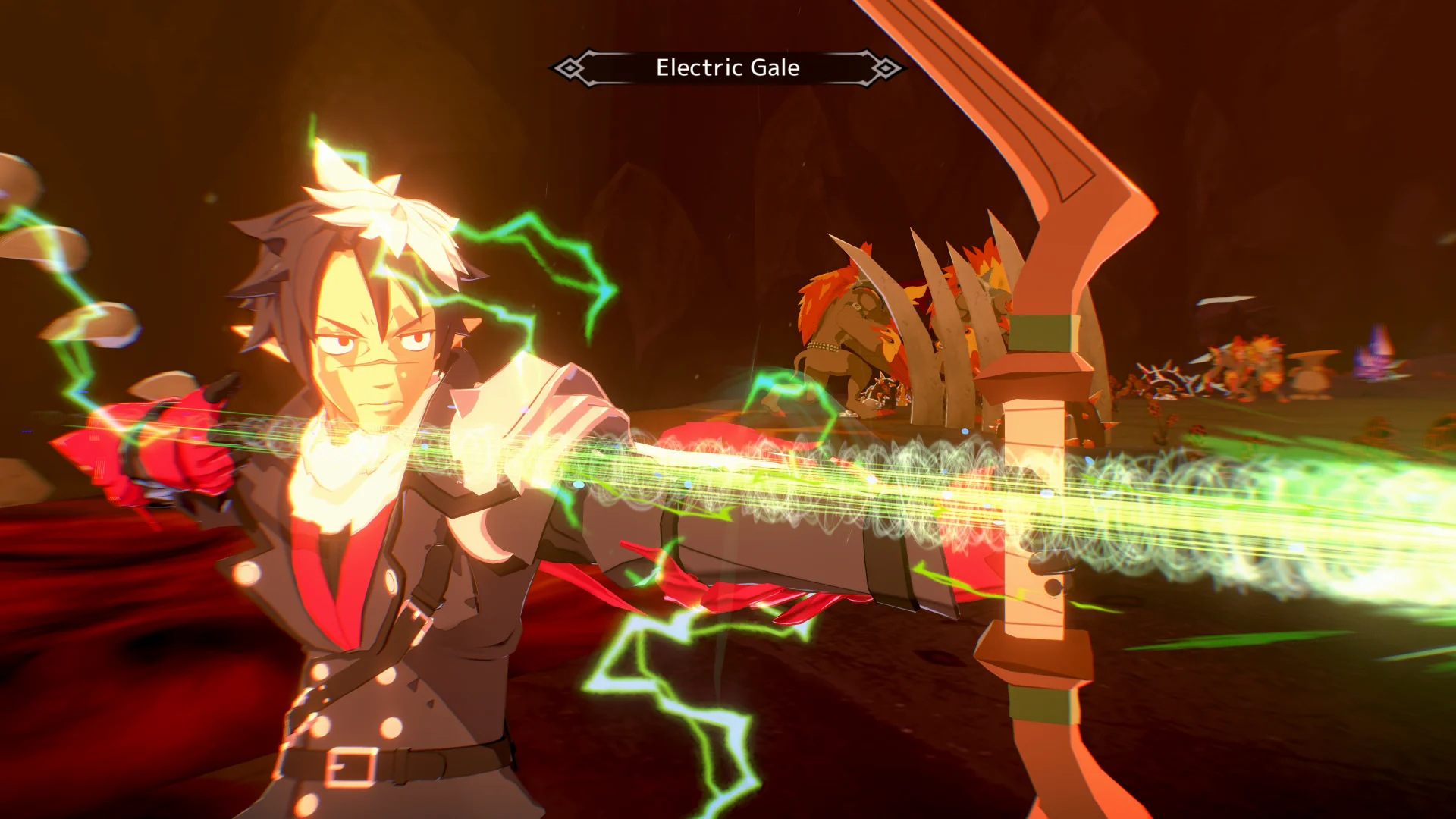
The core combat feels incredibly tight and fluid; N.A. has a quick dodge with invincibility frames you can chain endlessly to avoid attacks, and the various weapon move sets are satisfying. I grew particularly fond of the twin pistols and fist weapons because weapon types had a wide variety of combo strings to pull off that kept N.A. mobile while attacking, allowing me to mow down the relentless hordes of foes while simultaneously staying out of the way of dangerous attacks from the mini-bosses. You can also equip up to four special skills onto a weapon to clear large groups or do large single-target damage to a key foe.
There’s also the Battle Buddy system, where you can befriend monsters after completing a stage for a nominal Mana fee, then train them up by bringing them into battle with you. Their AI is pretty terrible, but the Magichange mechanic makes them useful. Each monster species corresponds to a particular weapon type, and when you engage Magichange, they will take the form of that weapon, allowing you to switch to a new moveset until the Magichange bar runs out. You can also expend the entire remaining Magichange bar for a unique ultimate attack. Furthermore, the Battle Buddies take center stage in the Chara World, a board-game autobattle where you progress along a linear set of tiles, each one conferring permanent buffs to N.A.’s stats, as your chosen party of Battle Buddies fights off the rival monsters encountered along the way. This is the main way to earn new Evilities (passive abilities like a double jump, increased healing, etc.) for N.A., so you need to have a good stable of monster companions to get the most out of these progression systems.
Series fans might be fooled into thinking from my descriptions of adapting Magichange, the Item World, the Chara World, and monster raising into this new framework that Disgaea Mayhem is a successful genre shift for the franchise. Unfortunately, the devil is in the details, and the game misses the mark in key areas. For starters, there is a ridiculous degree of asset and content reuse in a game this short. You see every single enemy type within the first couple hours of the game, with later stages simply recoloring the same enemy types (with the same movesets) to denote their increased strength. From the story stages to the Item World, you fight the exact same enemies the exact same way over and over again ad nauseum. Disgaea has always been repetitive, but never before has the original content been so paper thin and stretched so far, tearing at the seams as it struggles to cover the modest expanse of about ten hours of unique gameplay concepts (including the postgame).
Furthermore, the difficulty balance is extremely lopsided. Disgaea players may be used to breaking the game through repeated Item World excursions and building up a carefully crafted team of battle-hardened veterans, but that usually takes a significant time investment and effort. After unlocking the Item World, I spent less than an hour fooling around with it, upgrading some beginner gear, and promptly destroyed the difficulty curve for the remainder of the game. I’m not exaggerating when I say that every single story boss after this point died within about five hits. Disgaea Mayhem employs a simple stagger system for enemies that worked well in the initial hours but was entirely obviated by a weapon that took me only fifteen minutes to upgrade. I demolished everything the game could throw at me (including the final boss) in seconds. This is a shame because the story bosses have the most complex and involved movesets, and would be fun to fight if they didn’t die from so much as a dirty look thrown in their direction.
I would say this is a cautionary tale to avoid the Item World until after you’ve finished the story, but because the Item World is necessary to outfit N.A. with a full kit of combat abilities, doing so would leave you feeling significantly handicapped without the full suite of combat options the game clearly intends you to access. The postgame challenges do require some significant time investment in the Item World to become strong enough to complete, but the journey to get there becomes interminably boring before you even unlock the Postlude content.
It’s a real shame, because there is a diamond buried deep in the rough of Disgaea Mayhem. N.A. feels great to control, and using the musou-influenced movesets to fend off large swarms of monsters you blow up with over-the-top special attacks remains fun throughout. That solid foundation is let down by a significant lack of content, dearth of meaningful objectives in the stage designs, and a difficulty curve that immediately flops like a wet noodle. Disgaea Mayhem feels more like a spin-off proof of concept than an evolution or new direction for the series, and a proverbial monkey’s paw that will make me careful what I wish for in the future.