
From the ashes of Telltale Games and their bevy of beloved narrative adventure classics such as The Wolf Among Us, The Walking Dead, and Tales from the Borderlands, comes Dispatch, a superhero workplace comedy from AdHoc Studio, built by many of the former Telltalers behind those same classics. Can Dispatch match up, or have the Telltale talents gone from hero to zero in the time since they sadly closed down?
Thankfully, it’s the former, and Dispatch is very much a heroic return to prime form for both the team and the narrative adventure genre itself. Impressively so, since Dispatch has seen a meteoric rise in popularity over the course of its episodic rollout and after the full release.
You play as Robert Robertson III, better known as Mecha Man, a superhero who pilots a giant mech suit to fight crime. Well, it’d be more accurate to call him an (extra)ordinary citizen, since Robert doesn’t actually have any powers of his own besides his deft engineering skills and technological know-how. His power-less nature makes him a bit of a black sheep in the superhero world, so when a battle with his archnemesis Shroud goes awry, Robert is put out of commission from hero work and forced into early retirement.
That is until fellow hero Blonde Blazer arrives to offer him a unique and lucrative opportunity to work at SDN—the Superhero Dispatch Network—where he’ll be put to work dispatching local superheroes to crime around the greater Los Angeles area. Robert soon finds, however, that he’s been specifically chosen to lead the Z-Team, a new initiative that takes recently reformed supervillains and turns them into productive members of super-society.
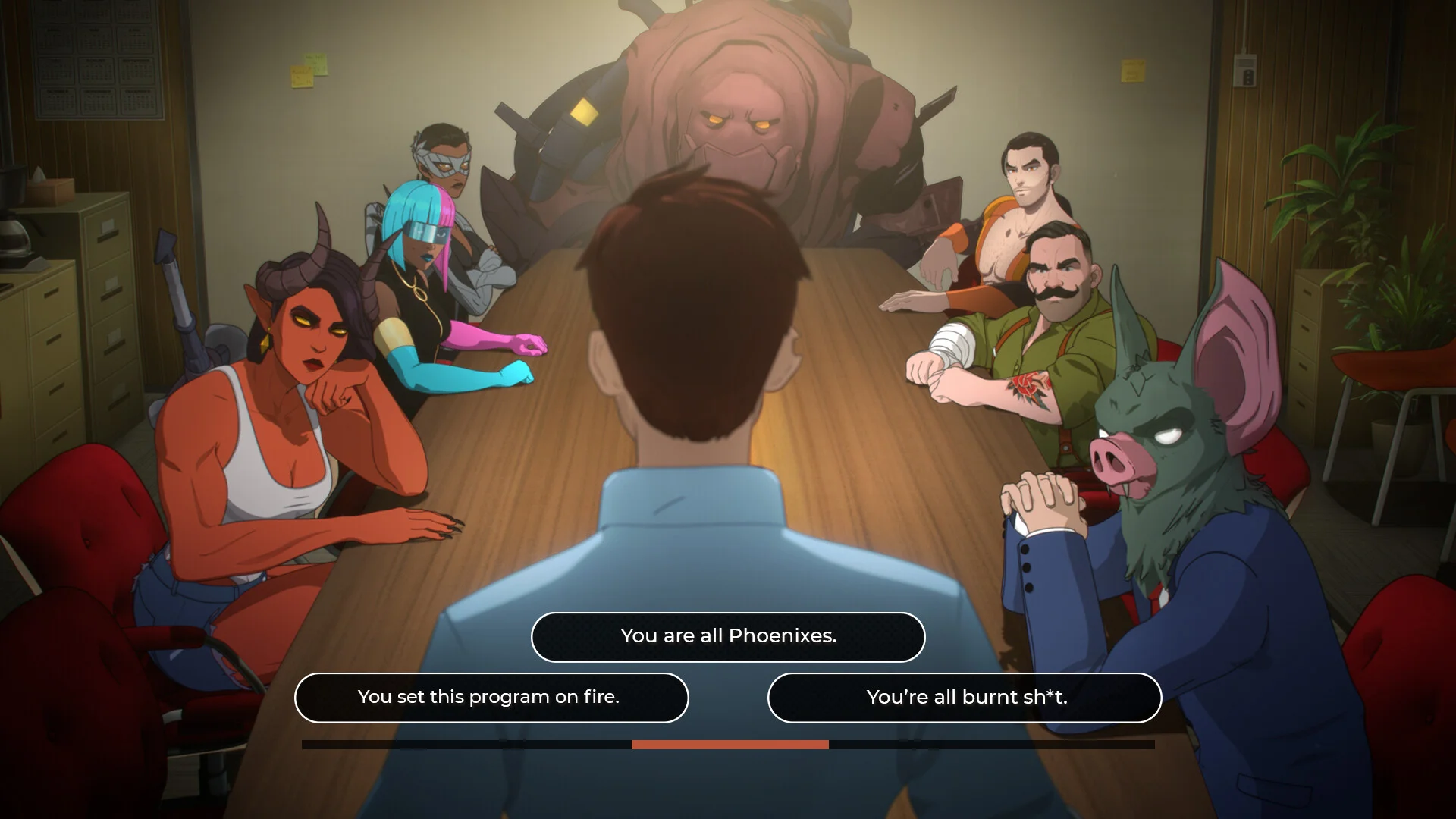
It’s from here that Dispatch‘s story begins in earnest, with Robert getting acquainted with his Z-Team and all of them building up a rapport and learning to trust each other in sticky situations. It’s a great zero-to-hero narrative, with Robert’s arc in particular demonstrating that, despite his lack of powers, he really is the best person to be leading this team.
Robert and the Z-Team are easy to fall in love with thanks to Dispatch‘s bouncy, genuinely funny writing and its stellar voice cast. Leading the pack is Aaron Paul as Robert, who plays him perfectly despite this only being his third-ever voiced role and first-ever video game appearance. He deftly conveys Rob’s sardonic wit and snarky attitude in tandem with his genuinely good nature, while bringing gravitas and depth when the occasion calls for it. All in all, it’s an impressive, nuanced performance. Naturally, he’s no stranger to those kinds of roles, but Robert truly feels like his own person, rather than a player avatar with Aaron Paul’s voice attached to him.
The rest of the cast of Dispatch is similarly excellent, with nary a weak pick amongst them, which is kinda surprising given that the reveal trailer had me very skeptical of some of the choices of actors. There are proven talents like Aaron Paul, Jeffrey Wright, Laura Bailey and Erin Yvette, alongside YouTubers MoistCr1tikal and JackSepticEye, rappers THOT SQUAD and Yung Gravy and games writer/journalist Alanah Pearce (though in fairness she has done a fair bit of acting over the years).
No disrespect to their individual talents or previous works at all, since I was already a fan of some of them, Alanah especially, but it seemed like some of the names on the cast had been picked from a hat for recognition mainly.
I’m very happy to say that my cynical skepticism of those particular casting choices was unfounded, and they all turn in at the very least decent performances all around. By the end of the season, it felt as if the characters were written and designed for the actors specifically, rather than the other way around. Their voices, cadence and overall performances fit each of their characters wonderfully.
Of course, like Telltale games of old, Dispatch involves making dialogue choices and story decisions that affect character relationships and future episodes. However, that’s not all you’ll be doing. You’ll also have to handle the actual superhero dispatching itself. This isn’t just some arbitrary minigame to hold your attention either. This is a fully fledged system with mechanics and perks and upgrades. Each member of the Z-Team comes with their own proficiencies and passive skills. Some are better at stealthy situations, others you can rely on for brawls.
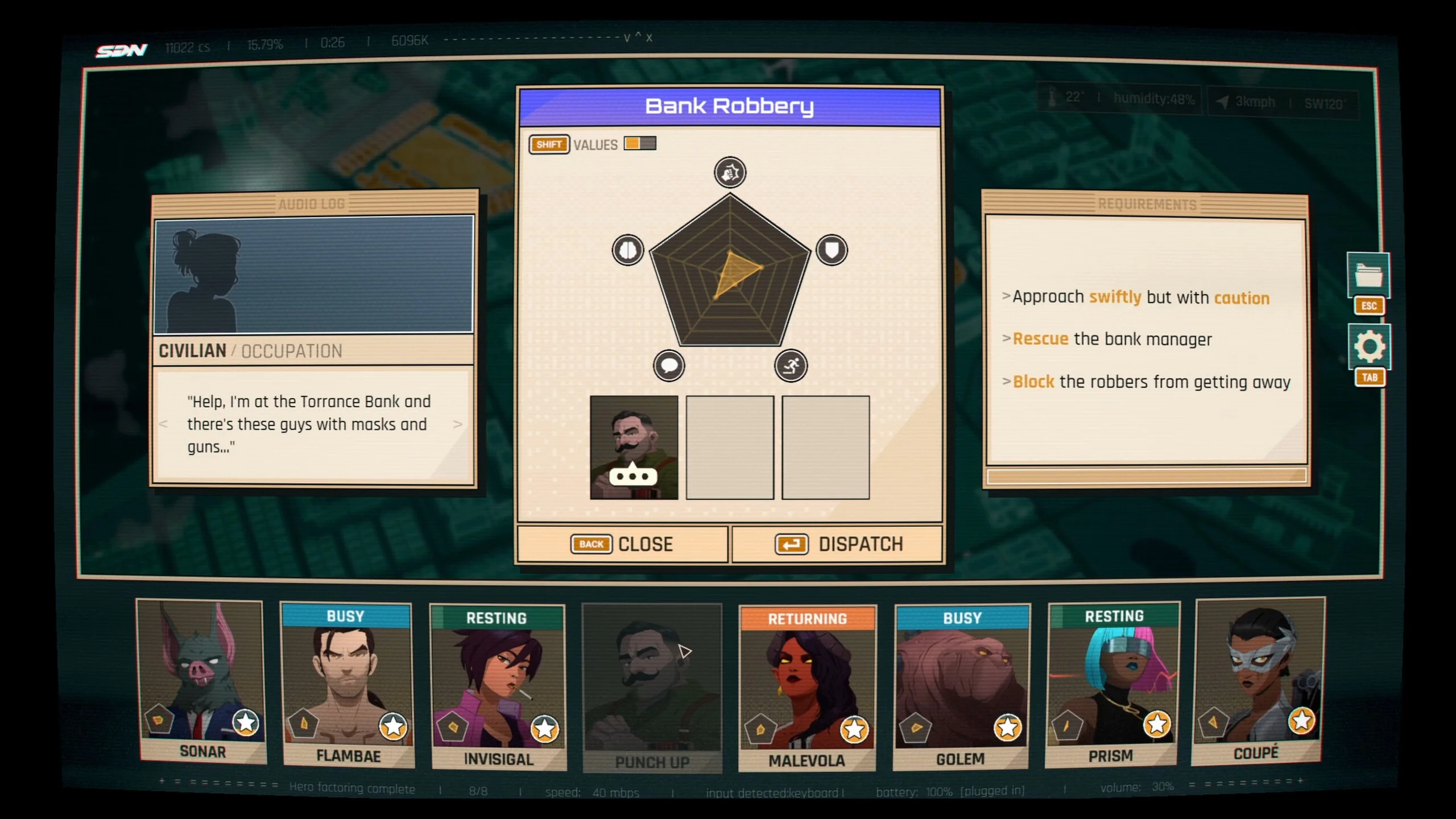
Whenever an active crime shows up on your map, you select it and receive the scenario, along with a list of requirements for that particular job, with certain words bolded to clue you into what skills are required for that mission.
Using the above image as an example, you can see that the mission is a bank robbery, requiring a swift, cautious hero to rescue the bank manager and block the robbers from getting away. For this particular mission, you might want to send Invisigal (played by Laura Bailey). As her name suggests, she can turn invisible at will (as long as her breath is held) and she happens to be quite agile and decent enough in a fight too, making her a perfect fit for such a scenario.
Once your chosen hero is selected, the game generates a success rate. The better your hero is, or the more heroes you send out on a single job, the better your chance of success. Frankly, as XCOM fans, or fans of any strategy-based game where a success rate is factored into play will readily tell you, the RNG can sometimes be a source of frustration. Your roster for a particular call may have a 95% success rate, but it can still be failed. In fairness, though, the consequences for failure in Dispatch are not quite as daunting as in a game like XCOM.
Indeed, while dispatching itself may not be a superfluous minigame, the same can’t be said of a few other facets of Dispatch‘s gameplay.
For one, there’re the quick time events. In fairness, this game, unlike the other Telltale series, has a setting that gets rid of all the QTEs and just lets the scenes play out as normal. However, this solution speaks to how completely needless those QTEs are. Almost none of them actually affect how the scene plays out if you fail them, and the ones that do are incredibly minor changes to animations. It’s up to you of course, but I would genuinely recommend you play without them enabled (“Cinematic Mode” as this game calls it), since you’re not really missing out on anything spectacular by not engaging with them.
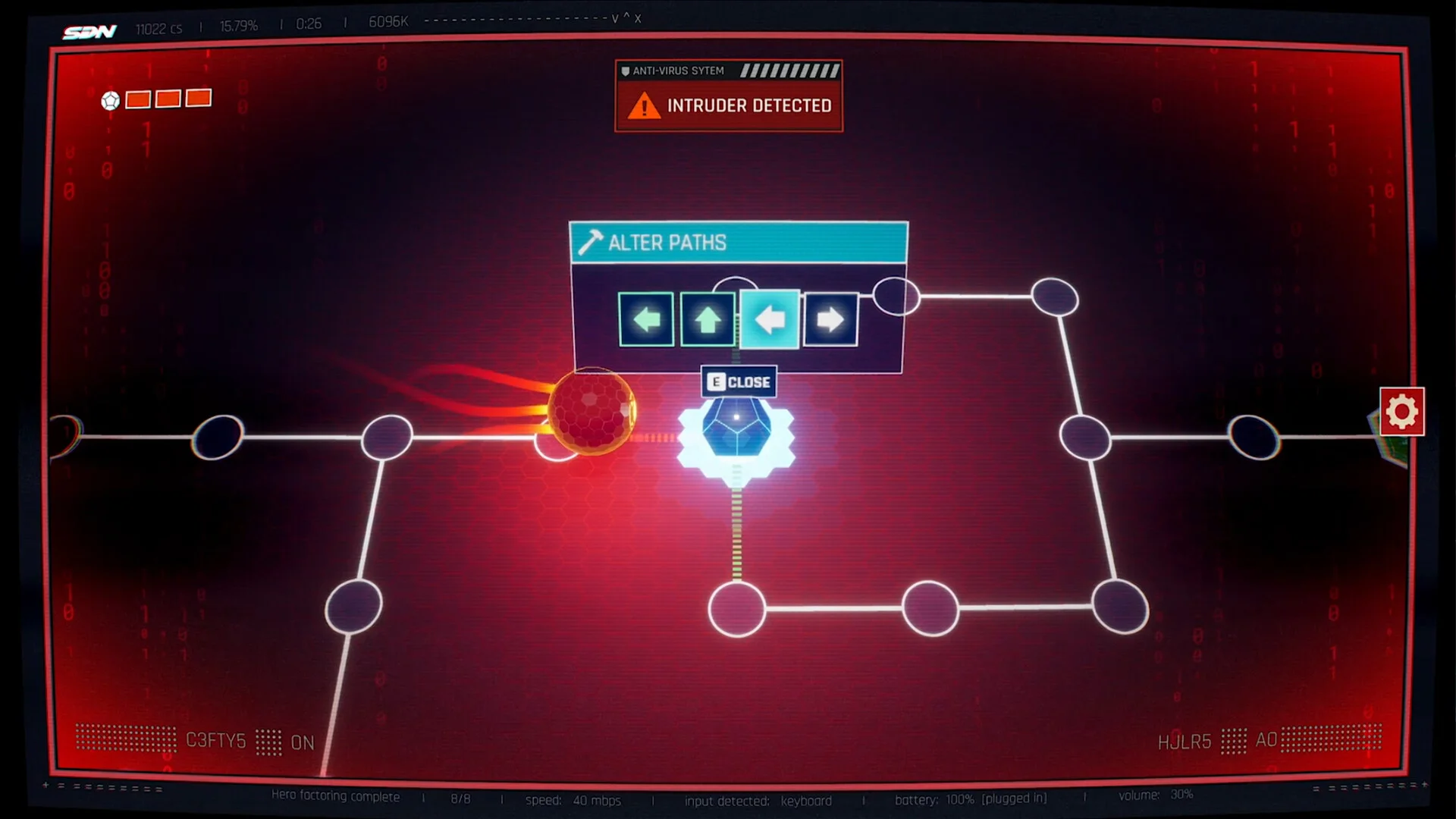
Another superfluous minigame comes in the form of hacking, something that Robert, as a genius engineer, is particularly proficient at. These segments are at least somewhat interesting, especially during later episodes where they actually play into the dispatching gameplay in some instances. To hack, you control a small cube rolling around a set path (occasionally with some deviations), completing button-mashing sections along the way to unlock new sections. They’re cute distractions now and then, but not exactly fulfilling for the palate. Compared to the QTEs, hacking isn’t too egregious on the scale of superfluity, but you might be wanting more depth out of it than Dispatch is willing to give you.
The fact that Dispatch is so compelling despite conversations in the cultural zeitgeist around “superhero fatigue” is why it’s a shame that doesn’t quite stick the landing with the first season’s finale, Episode 8. Don’t get me wrong, it’s still a good story overall, but there are certain decisions that the writers (not necessarily the player) make with the events of this episode in particular that don’t quite click with the rest of the story. Although I’ll delve into some spoilers with this review, I still want to be delicate with the details since, due to the nature of this game, the story might not be exactly the same for one person than it is for another.
Mainly, my issues with this particular episode are due to two characters: Invisigal and Shroud, the illusive main villain (played by the wonderful Matt Mercer). Invisigal is pitched as the most problematic member of the Z-Team and is frequently on the cusp of being kicked out of the program. You basically take her under your wing and form a rapport and even a relationship with her over the course of the season (whether platonic or romantic is up to you).
Through Episode 8, her true motivations for joining SDN are revealed, and she distances herself from the others as a result. Through these motivations, and her actions both before and after she reveals them to you, she oscillates between helpful and hurtful towards Robert, regardless of the type of relationship you try to pursue with her.
To be honest, it felt less like her just being a complicated, nuanced character with a lot of baggage and more as if the writers weren’t entirely sure what to do with her. She’s kind of all over the place. One moment she’s reverting back to her villainous ways, another she’s wanting to reform herself—and so it goes throughout the season and particularly the last episode.
My Robert did romance her, which made her overall softer towards him, but her character arc was still unclear. I did really like her overall, much of that thanks to the ever-reliable talents of Laura Bailey, which is why these issues with her writing were all the more frustrating at times.
As for Shroud, he’s unfortunately just a generic villain through and through. With the way the game builds up his aura as this enemy of Robert’s family who murdered his father and seeks to take his suit’s power core away for nefarious purposes, it seems as though they’re going for a subversive, nuanced kind of villain with a few narrative twists along the way. But no, turns out he really is just a generic evil man.
Still, it’s clear that AdHoc plans to continue telling stories in this universe, and the end of this game sets up a potential future season or two, so despite the occasional questionable narrative choices, when and where it counts, Dispatch does not disappoint, standing proudly amongst Telltale’s titans with good storytelling, an excellent cast of characters (propped up by equally excellent performances from the cast) and a truly fantastic soundtrack, both from the licensed songs in-between each episode, as well as the original score by Andrew Arcadi & Skyler Barto.