
The Mystery Dungeon series occupies a unique position in the RPG landscape. Better known for its crossovers with bigger RPG franchises like Final Fantasy and Pokémon, the mainline entries floundered in obscurity for years (despite being mechanically ahead of their time), with the occasional re-release but no new original titles. That is, until 2024’s Shiren the Wanderer: The Mystery Dungeon of Serpentcoil Island, a title that broke franchise sales records and revitalized interest in the traditional turn-based roguelike.
Series producer Hideyuki Shinozaki encouraged fans to make their desire for older games in the franchise known, and those pleas have finally borne fruit! Last week’s Nintendo Direct presentation revealed (and simultaneously released in a shadow drop) Dragon Quest Heroes: Torneko’s Mystery Dungeon -Classic HD–, the series’ initial crossover with the Dragon Quest franchise and the original title that kickstarted the Mystery Dungeon franchise, officially localized in English for the very first time. As an HD remaster of a beloved classic, it leaves a lot to be desired, but the core Mystery Dungeon mechanics shine brightly enough to make it a worthy return to the series’ roots.
Torneko’s Mystery Dungeon follows Torneko Taloon, one of the main protagonists of Dragon Quest IV, after that adventure ends. The portly merchant returns home to his devoted wife, Tessie, and young son, Tipper, and resumes running his humble shop. Soon, Torneko catches wind of a treasure hidden within a mysterious, ever-changing dungeon. He petitions the king for permission to delve into the murky depths in pursuit of riches and glory. The king agrees only if he can prove himself by tackling a much smaller dungeon and retrieving a royal artifact.
This initial ten-floor dungeon serves as a tutorial for the game’s structure and mechanics. Each dungeon floor is a procedurally generated set of box-like rooms connected by corridors. These rooms are randomly populated with familiar Dragon Quest foes (Slimes, Drackies, & Funghouls galore) and a wide variety of items with unique & useful properties. Torneko must enter the dungeon fresh each time, always starting at level one with an empty inventory, progressing using the tools gathered along the way and the knowledge gained from multiple runs. This may be familiar to fans of the series or roguelikes in general, but this was one of the earliest attempts to replicate the formula pioneered by Rogue in 1980, particularly on console. Torneko’s Mystery Dungeon may be cast in a friendly Dragon Quest skin and with a relatively straightforward goal by genre standards, but it’s no walk in the park.
The turn-based structure and item variety are where Torneko’s Mystery Dungeon‘s true strategic depth lies. As you move through the grid-based dungeon floors turn-by-turn (all actions take a single turn), the enemies move simultaneously. Once an enemy reaches you and combat begins, these turns become consecutive, with Torneko and each enemy taking turns in sequence. Torneko’s options are rather limited: he can attack with an equipped weapon, move one tile in any direction not blocked by a monster, or use an item.
That last part is where the real strategy is, as Torneko finds a wide selection of weapons, herbs, rings, wands, and scrolls with various effects. Find yourself cornered by a particularly powerful monster? Throw a zoom herb at it and watch it teleport to a random part of the dungeon. Alternatively, that same herb can be a valuable escape hatch if you find yourself surrounded and have Torneko eat it instead to warp out of danger. Every item has some sort of dual purpose like this, and combines with other items or enemy behaviors in a novel way. Mastering when and how to use these items makes the difference between success and failure. This incremental mastery of systems ensures the journey remains engaging despite the simple, repetitive premise.
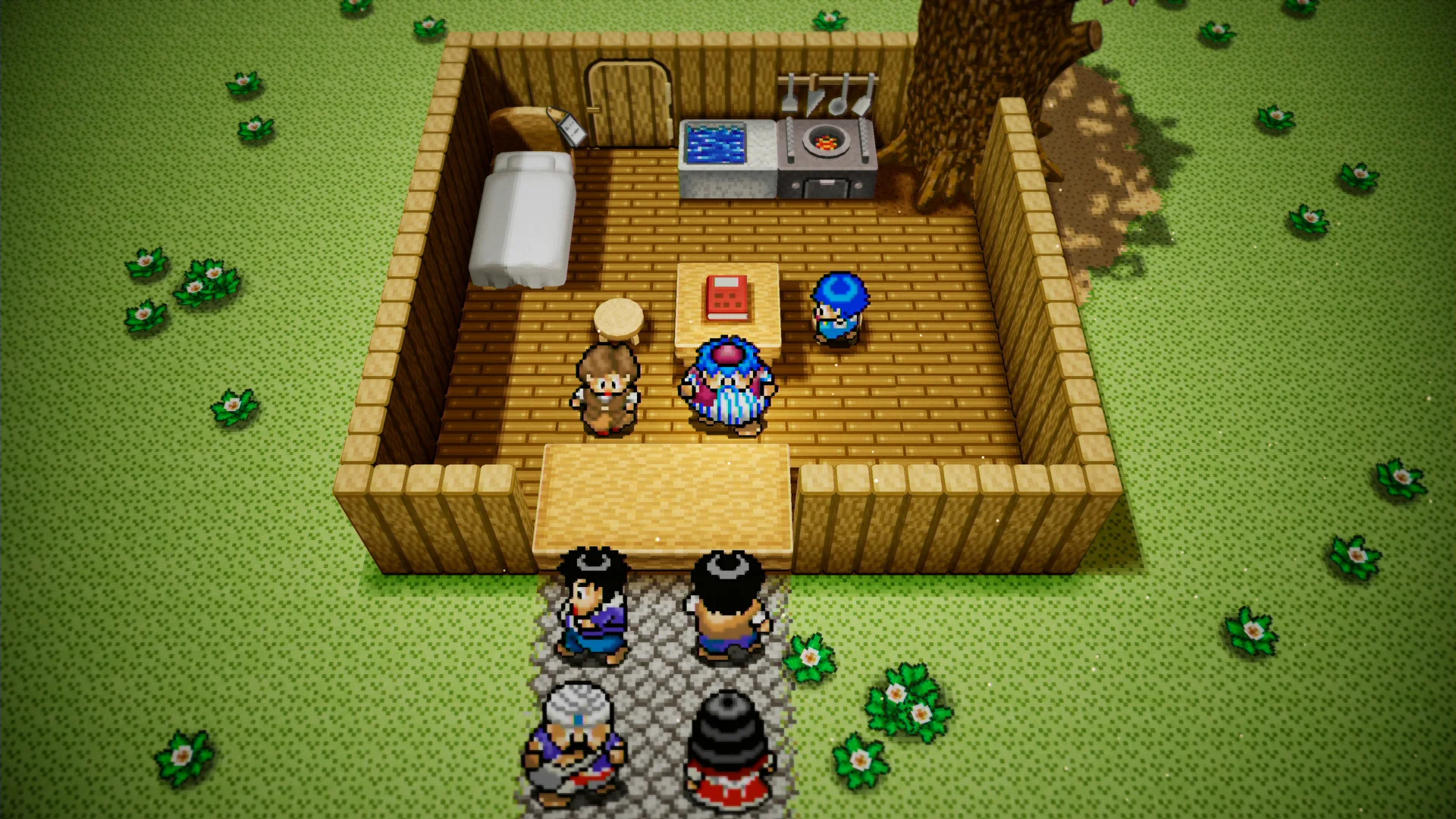
Once Torneko obtains the jewel for the king and makes his way back up the ten floors to the exit, the real game begins. Here, Torneko’s Mystery Dungeon reveals its modest innovations compared to Rogue: a meta-progression layer established through Torneko’s role as a merchant. When Torneko heads into the main 27-floor dungeon in search of the Chest of Cheer, his wife Tessie hawks the wares he obtained from the last dungeon delve in their shop. After each run, Torneko brings back a portion of the gold and value of his inventory to his wife, even when he fails, which she slowly invests back into the business.
Once you hit particular gold milestones, Tessie & Torneko can expand their business, rewarding Torneko with storehouse space and carrying capacity to keep powerful items between dungeon runs and, in turn, take that equipment back into the dungeon for successive runs. Torneko can only stockpile items if he escapes the dungeon with an evac scroll; accordingly, the tension in each run is significant when you lack said scroll, as one wrong move could leave you with nothing. Even when you do have one, the pressure of when and where to use it remains. Should you hightail it out of the dungeon at the first sign of trouble, or rely on your wits and meager supplies to press onward for the chance at even greater rewards? Almost every time I lost progress and valuable items in a run, I had an evac scroll in my possession and didn’t make the correct call on when to use it. Although you can occasionally end up in an impossible situation with no way to escape due to the procedural generation, the vast majority of my failed runs resulted from overconfidence or picking the wrong strategy rather than factors outside of my control. This is the heart of Torneko’s Mystery Dungeon’s addictive nature: it tests your knowledge and how you apply it to unpredictable scenarios, rather than blind luck.
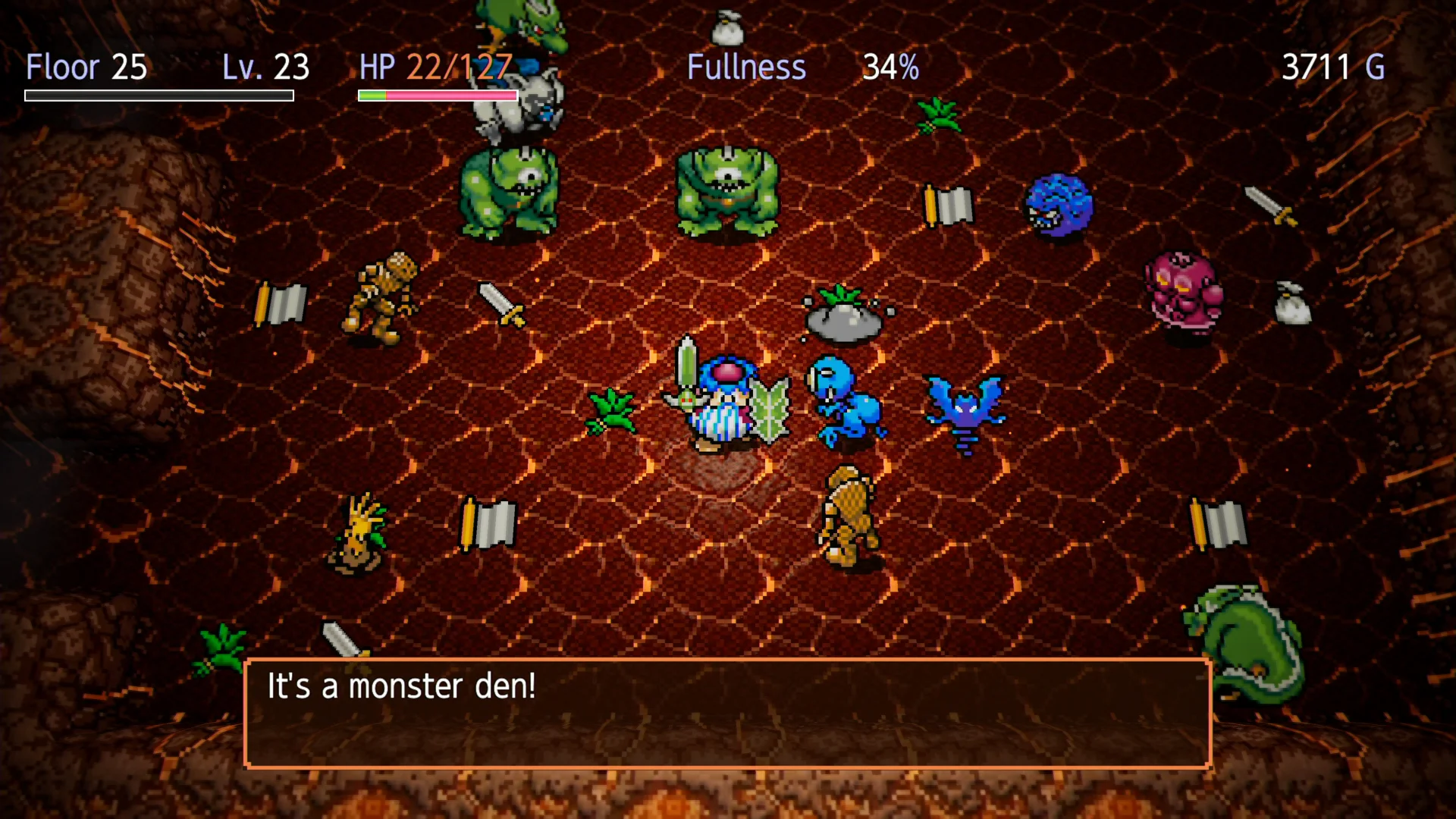
Equally important to maintaining this tension is the rogues’ gallery derived from the Dragon Quest series. Each monster has unique behaviors that require their own approach. Early monsters like Slimes, Drackies, or Mauluscs are simple: they just run at you and attack. As Torneko progresses deeper in the dungeon, more devious foes appear. Each set of dungeon floors has its own monster table for potential spawns, and over successive runs you develop a sense of which monsters are the most dangerous in particular combinations. An early formidable foe is the Legerdeman, a hooded spellcaster who can put Torneko to sleep for many turns while wailing on the hapless merchant with its staff. The Drooling Ghouls are individually weak, but every attack that fails to slay one carries a chance that the ghoul will duplicate itself, rapidly outnumbering poor Torneko. Some enemies simply hit hard while others poison Torneko, steal his gold, drain his character level, or inflict a host of other adverse effects. Even more terrifying are the monster dens, dungeon rooms chock full of monsters lying in wait to ambush Torneko. These dens also contain a stockpile of helpful equipment, so while running away may be the safest choice, standing and fighting leads to greater rewards in exchange for greater risk.
Since Torneko’s Mystery Dungeon is the first entry in the franchise (and this release is a mechanically straightforward conversion), the monster menagerie and item variety are relatively simple compared to later series entries. The game has the tutorial dungeon, the main 27-floor dungeon, and one additional postgame dungeon upon completion. Elements added in later games, like abilities, day/night cycles, and companions, are all absent. As such, Torneko’s Mystery Dungeon can feel rather simple compared to other games in the series or other roguelikes in general. However, I found this simplicity part of the game’s charm. With all those superfluous mechanics stripped away, the core foundations of the Mystery Dungeon formula get their time in the spotlight, remaining compelling across the 30-odd runs it took me to complete the main dungeon.
This simplicity makes the game approachable for newcomers, since you have one clear goal to work toward rather than juggling multiple progression routes, side quests, and a detailed narrative alongside the dungeon delving. Although the game is sparse on narrative content, watching Torneko & Tessie’s empire slowly grow from a modest one-room shop into a grand bazaar and mansion complex complete with its own bar is immensely satisfying, and the dialogue from shoppers and townsfolk is entertaining and occasionally helpful. Ah, the fantasy of ethical capitalism driven by an ever-replenishing dungeon of treasures!
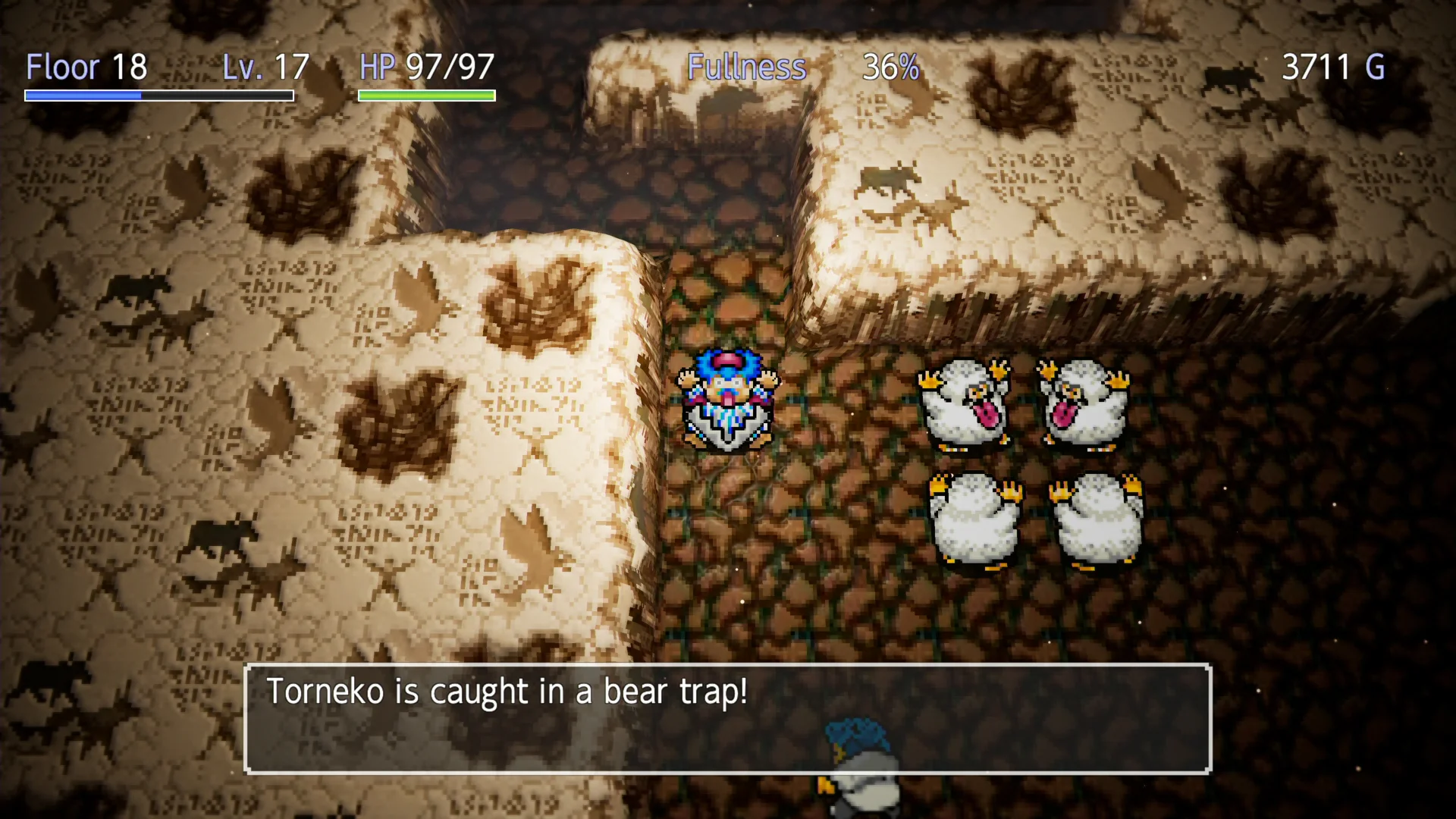
The only major downside to this release of Torneko’s Mystery Dungeon lies not within the fundamental game design (which remains exquisite and translates well), but in the overall audiovisual presentation. It’s obvious this remaster was done quickly and cheaply, judging by the fact that this is the most lackluster execution of the HD-2D visual style from Square Enix to date. The 2D sprites remain faithful to their Super Famicom counterparts and animate well; unfortunately, the sprites have a filter applied over them, resulting in an odd, artificial look. The 3D environments and pulled-back, isometric perspective pop visually and help distinguish dungeon areas from each other, but they lose some charm inherent to classic pixel art in the transition.
The worst aspect is the strange delay when loading text descriptions into the dialogue box. At first I thought this was input delay, but there’s no lag between pressing a directional button and when Torneko moves on screen. Rather, the game takes a moment to load text into the box describing whatever action Torneko or the enemy just took during combat. This combat log is necessary to track actions in the turn-based format, but the delay in loading text can be very annoying at first. Actions that require an associated audio cue to play have even more delay, like when Torneko levels up. There is an option in the settings to display four lines of text instead of the default two, alleviating the issue somewhat, but I eventually got used to the delay. It’s not a dealbreaker by any means, but for a series known for snappy controls, it’s a noticeable downgrade. I’m still glad to have an official release of the game on modern platforms, even with minor caveats.
Although I played Torneko’s Mystery Dungeon on Switch 2, this release adds one new feature exclusive to the Steam version: streaming functions. Downloading an optional free DLC allows streaming viewers via YouTube or Twitch to interact with the game while you play. Random events will pop up, and viewers can vote on the outcome for the streaming player to contend with. Unfortunately, I cannot test this feature as it’s not available on console platforms, but it’s a novel idea for those who can take advantage of it.
Longtime series purists may scoff at this release as a lackluster treatment of a genre classic and stick to the fan translation of the Super Famicom original. As a longtime series fan that’s played many hours of the original, I can relate to that perspective. However, I think that even in its slightly compromised state, an officially localized version of Torneko’s Mystery Dungeon on modern platforms is worth playing despite minor downgrades, especially since it massively expands the potential reach of this title beyond the admittedly niche community of retro fan translation enthusiasts. Not a triumphant return, but an appreciated revisit to Torneko’s first outing nonetheless.