
If imitation is a form of flattery, Esoteric Ebb is to Disco Elysium what Lock, Stock, and Two Smoking Barrels was to Pulp Fiction. Simply put, Guy Ritchie’s directorial debut wouldn’t exist in its final form had Tarantino not carved such a strong stylistic claim on the film industry at the time, yet Ritchie managed to run with the inspiration without letting it overrule his own creativity—which is more than you can say about a lot of other movies that tried to do the same. Nevertheless, if you try to replicate a monumental work’s style too eagerly, the best recognition you can hope for rests at the tip of its shadow.
While I’ve seen the term “Disco-like” pop up lately to categorize games that mimic Disco Elysium’s presentation or generally choose the pen over the sword in their design, Esoteric Ebb is the first that I’ve seen openly market itself as such. Even if it hadn’t, it’s clear within minutes that this game is trying the hardest to be the most Disco disco-like. Internal monologue “Chimes” based on your character’s stat distributions? Check. A bunch of ideologically charged dialogue choices with a strong basis in our current political moment? Oh yeah. A psychological mess of a protagonist who bonds with an endearing sidekick? That goblin’s name is Snell, and he’s pretty swell.
At its best, Esoteric Ebb is a revelatory iteration on what made Disco Elysium work, applied to an intriguing Discworld-esque homebrewed DnD setting. At its worst, it overwhelms you with text while retreading its core inspiration’s structure and themes. Though let’s not forget that, as much of an artistic achievement as Disco Elysium was, it was also firmly rooted in the tradition of text-heavy, tabletop-inspired isometric CRPGs. Its spiritual indebtedness to Planescape: Torment in particular shows for anyone familiar with the genre’s history. Esoteric Ebb looks to connect the two classics in an undeniably clever, mostly successful way: taking the presentation format and inventive roleplaying of Disco Elysium and applying it back to the DnD-style adventures that paved the way for it.
Esoteric Ebb’s world is one where DnD 5th edition systems and conventions are playfully rationalized in the context of its events and laws as well as creature roles and relations. The delightfully imaginative worldbuilding thus explains the social customs that keep spells like “Charm Person” and “Speak with Dead” in check. Esoteric Ebb’s writing is most engaging and amusing when it’s dissertating about the metaphysics of the alignment system, has you conversing with a legal assistant who is a literal devil, or showing your Strength and Wisdom stats arguing about the lonely, sacrificial nature of chivalrous manhood versus the plea to just be an empathetic person.
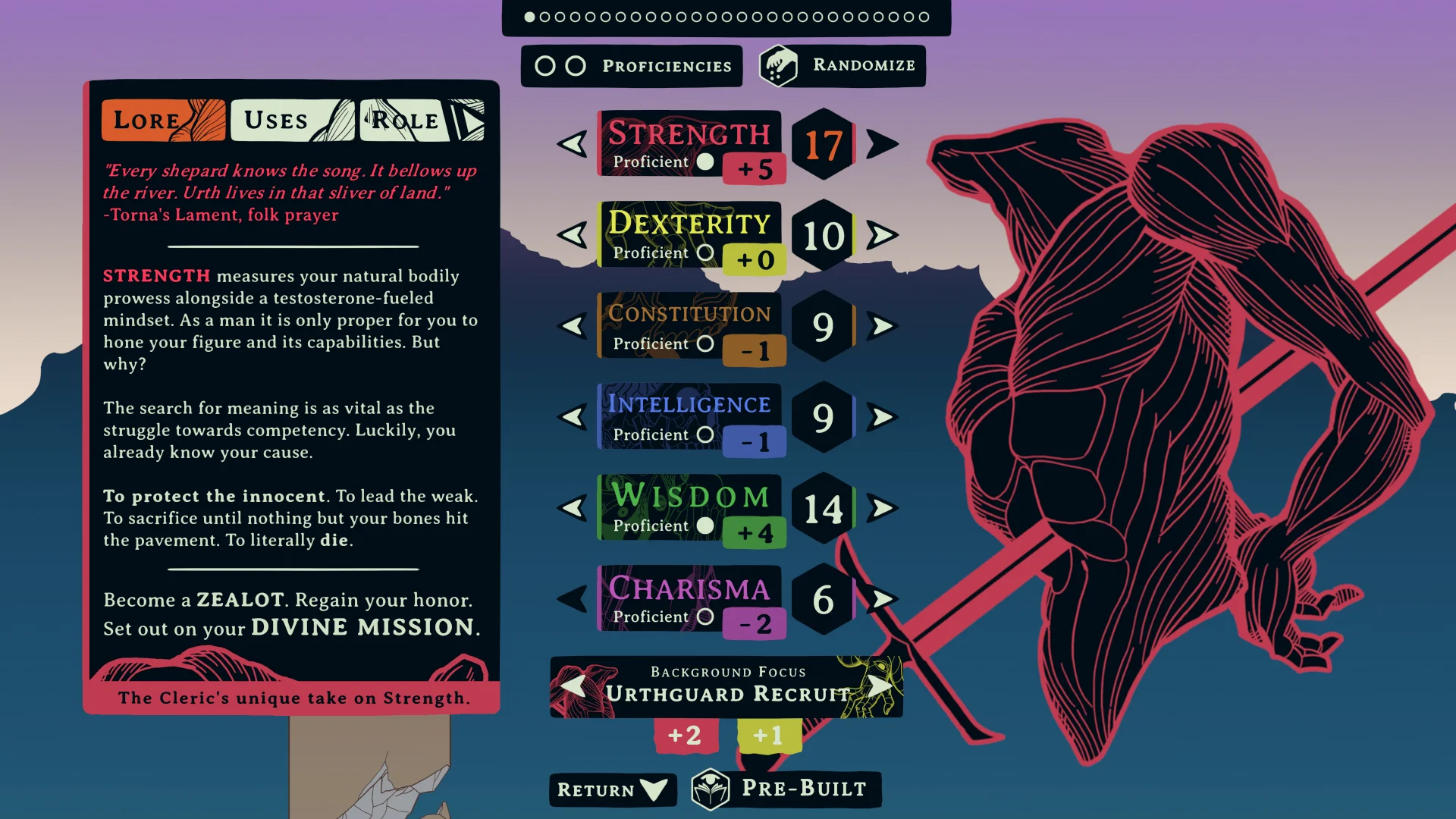
Character creation lets you choose your stat distribution across the standard six DnD stats. You are a cleric named Ragn, who somehow wakes up alive in a morgue after drowning in the river that runs through the city of Norvik. “Cleric” is your job title as a magically endowed official of Norvik’s fading Nationalist government, although you can start to internalize an aspirational character class through conversation. The circumstances of Ragn’s history, death, and apparent resurrection are a mystery, as is an exploded tea shop that he is responsible for investigating.
On top of that, the story also builds towards Norvik’s first-ever election! Politics is in the air, and radical change is (potentially) on the way. Expect your roleplaying experience (including Ragn’s ideological proclivities) to be heavily shaped by your initial stat distribution. This makes the game beg for experimentation with specific proficiencies and deficiencies across multiple playthroughs. I tried out two builds: one focused on Strength/Wisdom and another on Dexterity/Charisma, both of which felt like playing significantly different clerics plagued by their own internal turmoil.
The former build was torn between traditionalist values and revolutionary ideals. The latter was an obnoxious rogue-ish sociopath. Ragn doesn’t have the strongest identity on his own, especially early on, but that allows you to shape him into whatever flavor of adventurer you’re looking for. While he does have a fixed, personal backstory to uncover, the game locks many of these details behind skill checks, so you generally learn about the ones relevant to your build. For a more chaotically entertaining roleplaying experience, I recommend going all-in on a few stats while neglecting the others entirely. Failing checks is often as fun as succeeding on them.
Adding to the character building, completing certain questlines opens the opportunity to take on a Feat after reflecting on what took place. Here, at least two of your stats engage in a debate about what the ideological takeaway behind the quest could be. I saw one such debate revolving around the conflict between idealistic leftist activists and some young men disillusioned with all manner of authority, demonstrating the game’s interest in explicitly mirroring contemporary political issues. After entertaining the multiple perspectives, you must choose one to internalize—with each potential Feat also offering a different gameplay bonus.
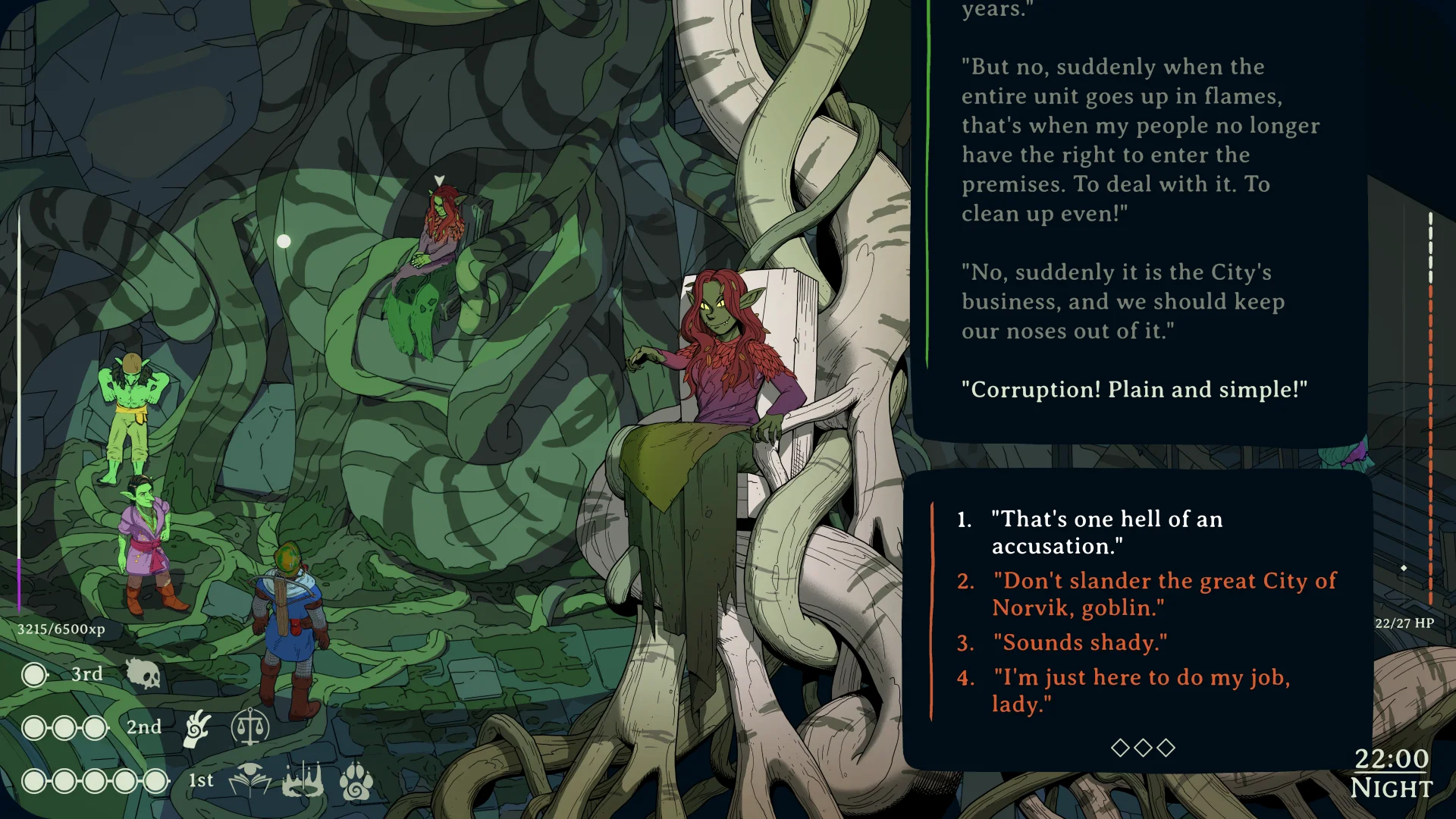
Like Disco, the ideologically infused dialogue successfully balances progressive leanings with doses of satirical irony and sincere empathy alike for different perspectives and the life experiences that shape them. My biggest gripe here is that it can feel overly derivative of Disco’s core narrative and thematic function, which occasionally pulls me out of appreciating the ways that the game successfully differentiates itself.
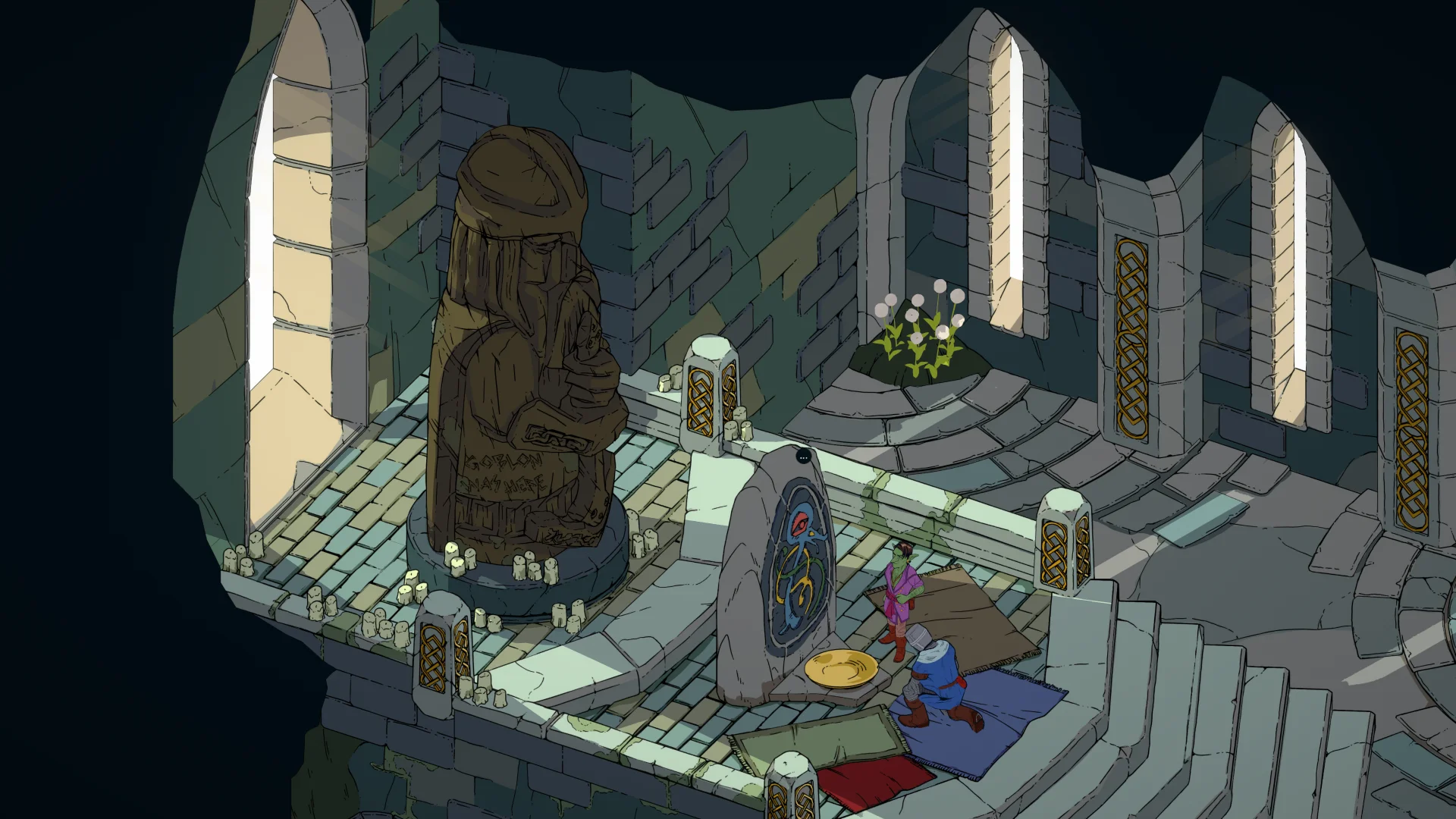
If Esoteric Ebb’s gameplay only revolved around walking through Norvik and navigating external and internal conversations through dialogue choices, it would be a tad tacky. Fortunately, this is not the case. Many of the game’s quests push you to dungeoneer through the area below Norvik, into an expansive ruin of the setting’s past. Exploring this City Below impressively captures the eventful, dramatic feel of tabletop DnD adventuring.
There are secrets to discover, puzzles to work through, and even combat encounters to conquer. It takes a while for the game to push you deep into these dungeons as stats (and equipment that boosts them) become essential to boost your odds for crucial dice rolls. When I felt confident enough to dive deep, I started appreciating Esoteric Ebb in a new light.
The way the game integrates combat is a highlight, if unfortunately underused. Each encounter is a curated piece of the larger story or worldbuilding. In these moments especially, the narration sucked me into the situation and effectively amped up the dramatic stakes. Choices on how to navigate the encounter are tied to whatever stats fit the situation—which you may or may not have invested in. Spells that you’ve memorized can offer increased survivability or create advantages on offense. Any companions with you also have turns that can shift the tide in combat, though I wish their actions also worked through dice rolls for more mechanical variability.
I enjoyed my time in the City Below so much that I wish more of the game leaned towards this sense of adventure over the dense, extensive discoursing that makes up a significantly larger portion of the overall playtime. I would love a sequel that spreads out the density of the NPC dialogues to provide a more eventful journey through this charming fantasy world. More companion interactivity. More locations to explore. More potential in the spell mechanics. This would help leverage what makes Esoteric Ebb unique and disperse what makes it redundant.
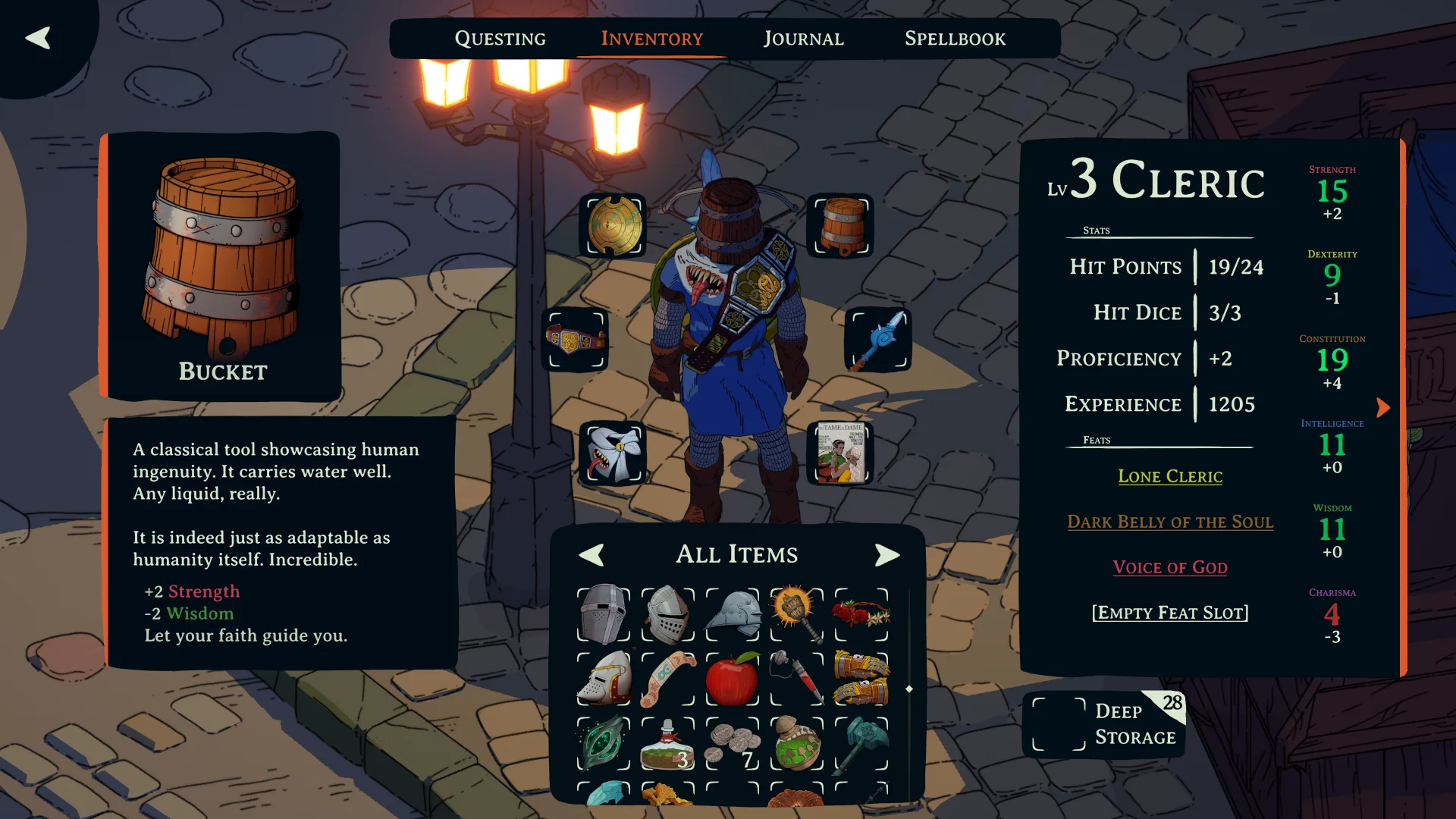
The game features over a million words of text by a single writer—and most of it is enjoyable and pleasantly reactive. That’s an incredible achievement. At the same time, it’s hard not to see the potential here for a more dynamic game and wish some of that Herculean effort went into seeing it through. Across all the quests and exploration I invested myself in, I amassed a huge stash of cool equipment and trinkets that I anticipated an opportunity to make use of, only for it never to come.
Disco Elysium’s gameplay was only as engaging as it was because of the quality of the writing. Esoteric Ebb’s sole writer/designer, Chrisoffer Bodegård, is clearly a captivating GM, but his brand of zany writing started to wear thin on me in the later portions of the game simply due to its sheer quantity. There’s no shame in not living up to the Best Writing that’s Appeared in a Videogame, but placing the same emphasis on reading with several of the same thematic concerns (and without the extra advantage of impeccable voice acting) is a gamble with some negative modifiers.
Despite my nitpicks, the writing supports the overall tone the game goes for quite well, as do the other stylistic elements handled by Bodegård’s collaborators. The distinct art style paints Norvik and the City Below with eye-catching color that could pop out of the pages of a comic book. The game space isn’t huge, yet what’s there is rich in detail. The character models look better than most isometric CRPGs, and the art that appears when you’re chatting with an NPC is always charming and made me want to get to know the diverse cast. What’s more, many small spaces and characters have unique songs as background, which keeps things consistently fresh for your eyes and ears.
I hope this review doesn’t sound overly critical because I am genuinely pleased with most of what Esoteric Ebb achieves. I just think the game could have been significantly improved, had it the confidence to shed its most conspicuous Disco-isms and dance to its own tune. Given everything that happened at ZA/UM and its creative core’s dissolution, we will likely never get a true successor to Disco Elysium. I am at peace with that. But if developers like Bodegård can iterate on its systemic expressiveness with the type of passion and intelligence that Esoteric Ebb manages, its legacy is in good hands.