
Love may be a battlefield, but does throwing kissing willy-nilly into the mix make it more memorable? The remastered version of EXSTETRA (2026), a title originally released on the PlayStation Vita and Nintendo 3DS but never localized into English, reflects on this. While this new HD remaster is a tad messy and comparatively dated now, it contains that inherent oddly likable and charming element found in many of FuRyu’s outings. Whether it’s worth the investment to get to some surprisingly decent moments wholly depends on your personal gaming preferences, though.

EXSTETRA finds a Japanese teenager named Ryouma transported to the fantasy wasteland world of Amazia. He soon encounters Selene, a white-haired priestess wearing what looks like futuristic battle swimwear. She promptly informs the amnesiac Ryouma that he’s the Prisma, the chosen one summoned to Amazia to save it and his own reality from destruction. But the understandably overwhelmed Ryouma isn’t meant to do this alone, as six others from Japan have been summoned to Amazia to aid him. They’re shall become warriors known as the Prisma Knights, but the only way to awaken their transformative warrior powers is through sharing kisses with them. It’s as awkwardly messy as you’d expect. Still, after the initial hesitation and in light of the very real dangers they’re facing, everyone quickly gets on board with the smooching aspect, albeit with the two male party members taking a slightly longer time to warm up to the concept.
To be sure, the kissing mechanic is a central gimmick to this turn-based RPG, with special, devastatingly powerful moves only available once characters lock lips to access them. There’s even an oddly timed button-pressing minigame requiring the perfect overlap of two hearts on the screen while Ryouma and the selected Prisma Knight share a lengthy kiss. However, you have the option of turning the minigame off in normal battles if you prefer. Given how long the turn-based battles run, I actually found the kissing mechanic to be an oddly welcome diversion that I eventually warmed up to, even if it did take some adjusting to.
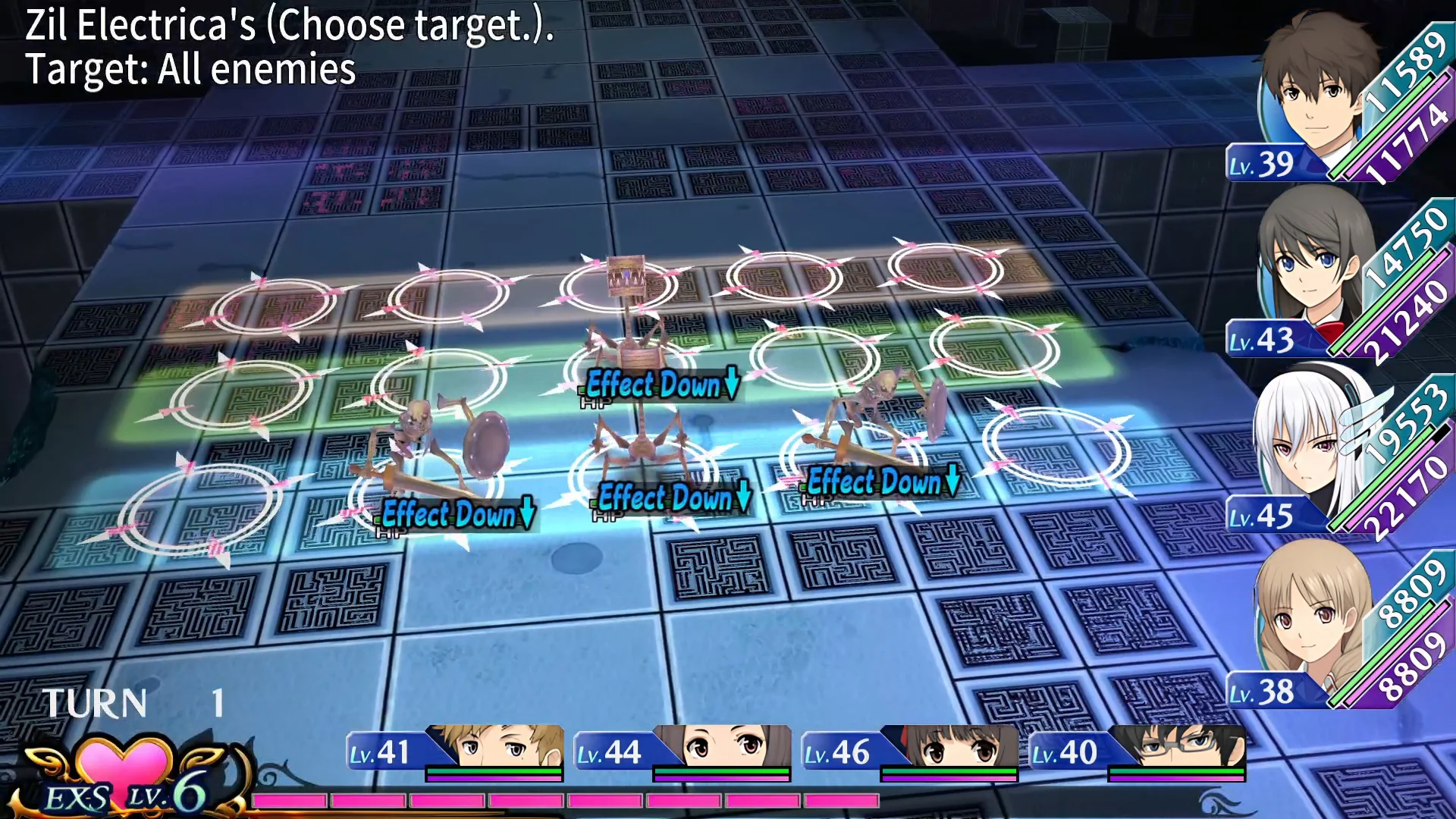
At its core, EXSTETRA is a traditional turn-based RPG with its combat setup. Ryouma, alongside Selene and the Prisma Knights, gain access to weapons and armor to equip, as well as specialized orbs that grant them personalized magic. As they gain experience and level up, they also gain uniquely specialized attack and support skills. You can upgrade weapons and armor further through items, strengthening them and maintaining their utility during lengthy dungeon runs. Party members can also add Runes to equipment; these Runes grant characters access to several passive and active skills when maxed out. For example, Add Amnesia increases the likelihood of an attack causing that status effect when landing, while Extra Attack could cause a character to strike an enemy multiple times. By utilizing Runes, you can greatly tailor characters and create powerful fighters that can devastate the battlefield even in the game’s later stages.
The most unique aspect of combat outside of Runes is easily the thorough implementation of rows. A front-range fighter getting pushed into the back row may very well lose their turn in a round, and getting rid of all of the enemies in the front row of the opposing side will result in your shorter-range characters being unable to attack the remaining back row foes until the turn ends. The party moves up rows to get within acceptable range. It’s an interesting system that opens the door to more strategizing. However, the main issue with fights is that they can run incredibly long, as characters either lose turns for a whole round or their Rune sets trigger chained attacks that stretch on indefinitely. This is even worse in the later dungeons when several enemies possess the Blessing skill that causes them to revive several times over after being initially defeated. Fortunately, you can speed up battles with a button press, but even with that feature it still feels like they take forever.
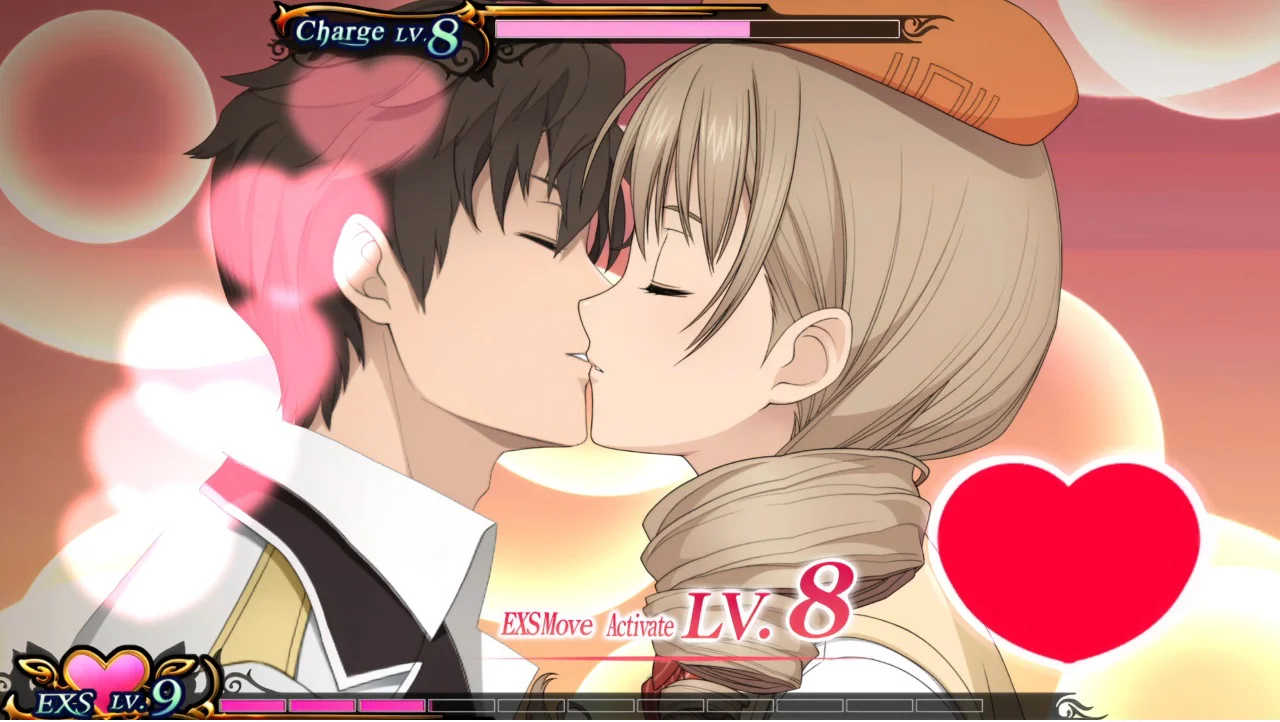
EXSTETRA has an oddly implemented relationship-building mechanic. Generally, fighting in a party together and emerging victorious will increase a character’s affection with Ryouma, especially if the kissing mechanic occurs, though running from combat or having a character get knocked out during combat decreases it. I generally kept the same three party members (Shiho, Jin, and Masaru) in my four-person party because I found their skills the most versatile for my battle strategies, so I rarely had trouble keeping their affection high. However, the other characters’ affection often dropped unless I used a special affection-increasing item on them.
Engaging in the game’s simplified cooking feature can also raise their affection, and I generally found it easy enough to keep the levels high enough for all the Prisma Knights to see their optional story scenes and extra dialogue outside of dungeons. At a certain point during the final dungeon, you’re tasked with choosing between the three Prisma Knights you have the highest affection with, and that ultimately determines whose ending you see. I do give the game credit for being equal opportunity with its male and female characters in that regard, as the endings are quite heavily romantically tinged regardless of your choice, something I noticed when I picked Jin for my first playthrough.
From a story and character standpoint, EXSTETRA has both silly moments and narrative reveals of surprising depth. The quick acceptance of the circumstances that brought everyone to Amazia and the idea that kissing leads to magical transformations is rather amusing if not taken too seriously, and Ryouma generally seems like a good sport about his amnesia. It isn’t until later that Ryouma gets a bit more depth regarding his feelings about being the only one suffering memory loss and what that might mean. The Prisma Knights all have interesting backstories and circumstances if you manage to raise their affections enough to uncover their additional story scenes, though beforehand they largely appear as character archetypes. I genuinely enjoyed most of their plot developments even if I felt they could’ve explored them more. Selene also has some interesting twists later on concerning her role in the story, but reaching these story payoffs is a matter of patience and personal preference.
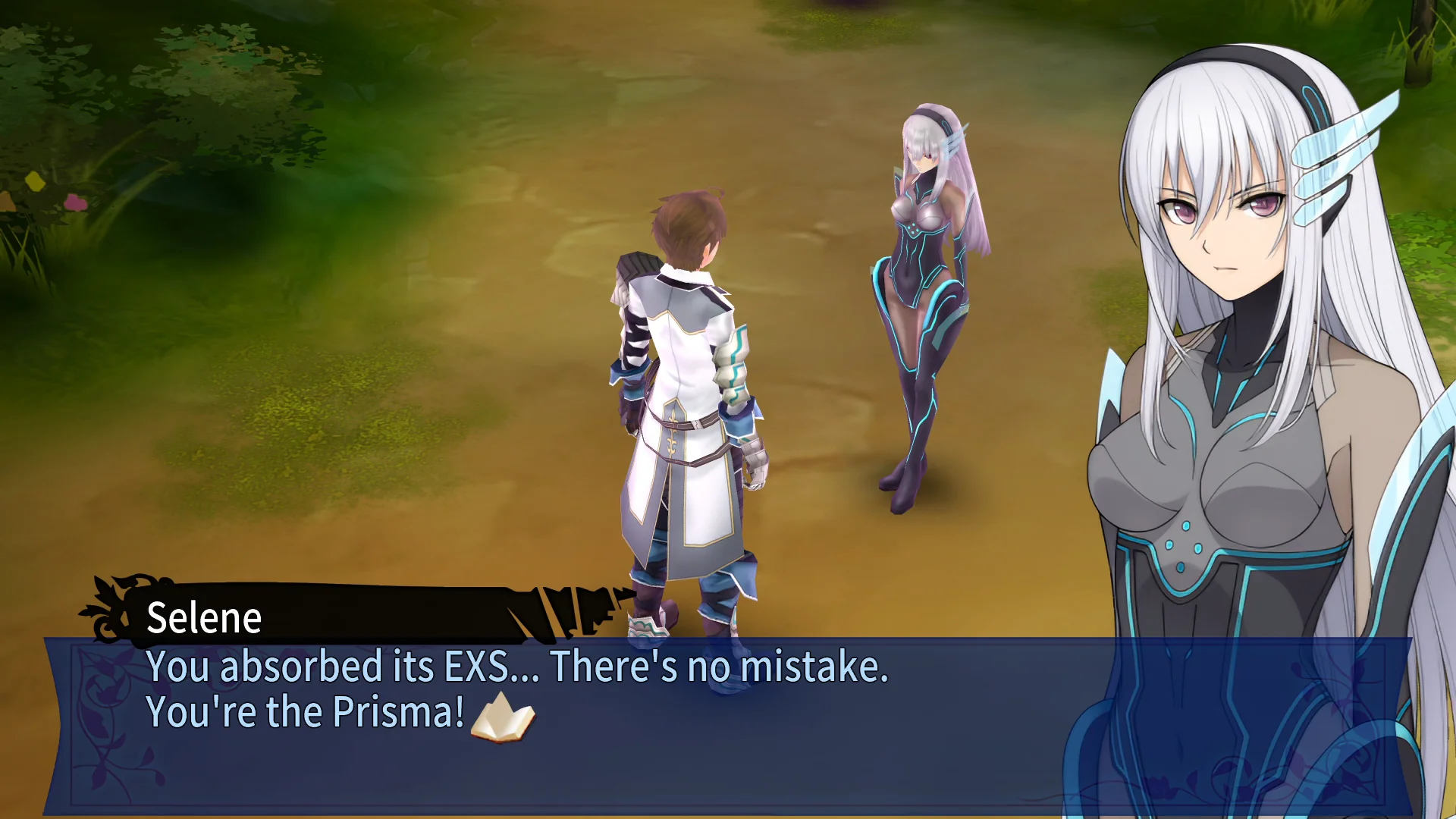
The game does show its age, even with HD remastered visuals. I like the anime cutscenes and the character designs in general. Still, the story’s more limited, visual-novel-esque presentation reminds you that this was initially a Vita and 3DS title. There are some optional “voyeur” images of the female characters at times, though I give the game credit for making it easy to opt out of those segments if you wish. Dungeon and enemy designs also tend to be unvaried, making the long treks feel even longer. The UI is effective but ultimately simple in appearance and, while the localization is largely decent, there’s the occasional dialogue spelling or grammatical error. I do love the game’s partial voice acting and the perfectly fitting atmospheric music for the story, though. One of my favorite scenes used one of the more intense battle themes during a predictably comedic outcome to the obligatory hot springs story scene, to great effect!
All in all, I was quite satisfied with my playthrough of EXSTETRA (2026) when the credits rolled and I saw my chosen ending scenes. I’m not sure I’d play the game again anytime soon, given its tendency to drag out fights and long narrative development, especially since I was satisfied with my ending. Yet, it has traces of that inherent potential and charm so often hidden in FuRyu titles. There’s something to enjoy here, at least for a little while, if you can get past the dated visuals and mechanics. I’m glad that EXSTETRA was finally localized, at least as it has me hopeful that later on down the road FuRyu might experiment with another RPG, kissing mechanic or no. If nothing else, EXSTETRA could be a good discount purchase for anyone curious and patient enough.