
Hey there, sports fans. I have played a sports videogame before; my first was Baseball for the Nintendo Game Boy, a remarkable game for its time because it let you simulate playing baseball outside, you know, where they play baseball and stuff. But this isn’t a review of Baseball on the Nintendo Game Boy. This is a review of Final Fantasy VII Remake Intergrade for the Nintendo Switch 2. Though Baseball on the Nintendo Game Boy is relevant here, for precisely two reasons.
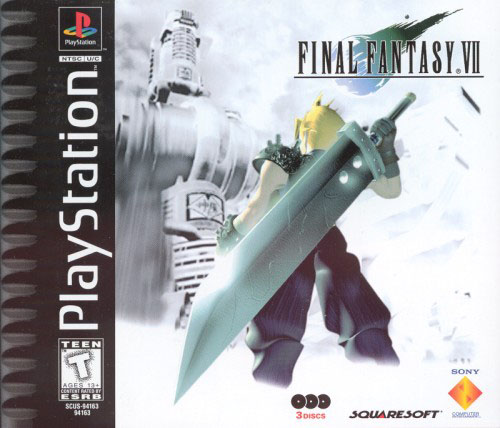
First, because of dissonances: just as I worked out the cognitive dissonance of playing outdoor sports videogames in the outdoors on a handheld game console circa 1997, FFVII Remake now affords me an opportunity to resolve a different, longstanding dissonance I have with 1997’s Final Fantasy VII (the OG). Namely, based on the game’s jewel case, little me once thought it would be set in a snowy locale.
However, to my great disappointment, Final Fantasy VII is almost exclusively not snowy; the cover is just hella washed out, like me after I peaked in life as a high school Baseball star—the videogame for the Nintendo Game Boy, not the famous outdoor sport (I mean, who are we kidding, I am a writer for RPGFan, I can’t hit the broad side of a barn with a baseball bat).
But now, thanks to the impeccable timing of winter storms in the northeast United States and the portability of the Nintendo Switch 2, I can finally live my dream of a snowy Final Fantasy VII playing experience by once again going outside to play erstwhile inside videogames. That is, until my fingers get frostbite or my Switch 2 short circuits.
The second/real reason I bring up sports games is because I am going to give ya’ll some inside baseball: I got this review code a week ago. Now, that is plenty of time to review something like, say, Baseball on the Nintendo Game Boy, but Final Fantasy VII Remake is a downright chonky role-playing videogame. So, at first I cursed the Squenix gods for this—why have you forsaken me!—but then it dawned on me.
This was quite suitable, in fact, as this is no mere port of Final Fantasy VII Remake to a portable console. This new version appropriates the ideas of 2015’s FFVII (OG) PS4 console rerelease: you can fast-forward through dialogue, apply handy “cheats,” equip difficulty-modifying items, and experience the story of Final Fantasy VII Remake much quicker this time around.
Or, if this is to be your first time around Midgar, it may come as a relief that you are no longer shackled to the time constraints of a humongous, sprawling, operatic, and unabridged role-playing videogame. In fact, I’d wager the time-to-completion of this new version of the game is roughly half what it was for a casual/story run in the past, which may be welcome news for folks who want to crush the former two thirds of the Remake trilogy in time for Final Fantasy VII 3 & Knuckles, or whatever they end up calling it. This version, especially with its portability, is ideal for anyone looking to catch up in time for the trilogy’s conclusion.
But it is not just because the game can now go Sonic the Hedgehog superspeed mode that it is an ideal way to play. The Switch 2 version is ostensibly Final Fantasy VII Remake. It looks, sounds, and plays at least as well as the original PS4 version, and it is even better in things like loadtimes, sidequest dialogue (fast-forward is a godsend, and it is surprisingly performant on Switch 2), and content—Intergrade, with its various PS5 retoolings and Yuffie side-episode, is included. Yeah, textures are less consistent, polygons are choppier, and the resolution is lower, but honestly I am almost nostalgic for those artifacts from the 1997 original, so I was unbothered by this.
The framerate is 30fps on Switch 2, but it is stable at that framerate. Of course, 30fps is tough for high-octane action games, and this is an action RPG, technically. But the motion blur of full-HD 30fps did not bother me while I was playing—even in handheld mode on the Switch 2’s already blurry LCD screen—because Final Fantasy VII Remake is still oriented to story and strategy. Now, if you are sensitive to that sort of thing, I will note that black frame insertion, if your tv has it, helps quite a bit with this.
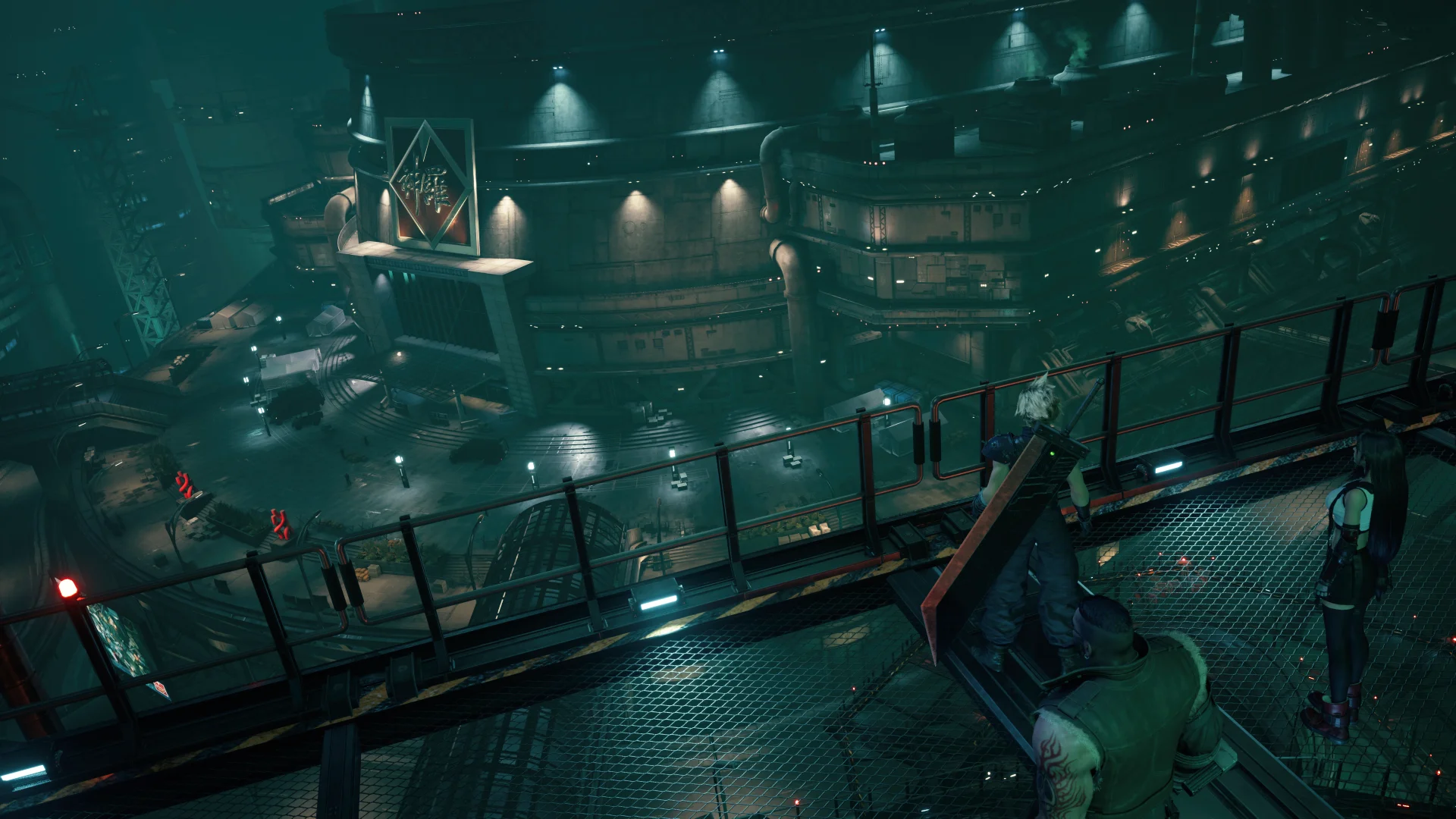
I am not a tech genius, but I imagine the Switch 2 version performs so well and looks so good due to a combination of DLSS technology, like we saw with Cyberpunk 2077, and the sheer willpower of Square Enix’s QA department. Their devotion and commitment to the game is clear in how solid this port is, and there is real synergy with Nintendo’s new hardware. Square Enix likely could have ported the original Final Fantasy VII Remake on PS4 to Switch 2 with lower fidelity for a $40 cash grab, but they went the extra mile to make this version worth it by adding all the PS5 Intergrade content, a heap of graphical trickery, and those new accessibility options.
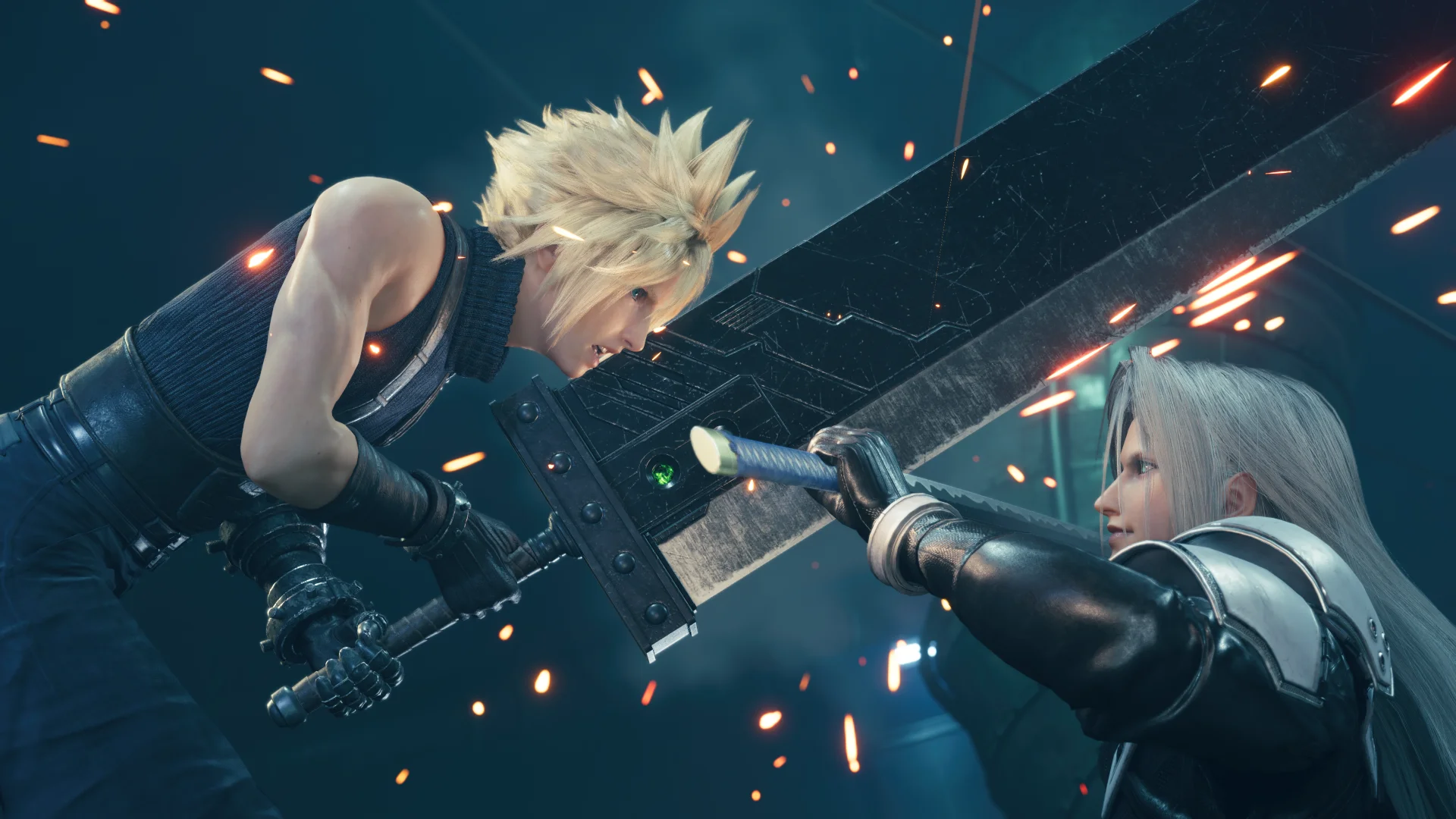
And, all told, this is exactly the Final Fantasy VII Remake I remember. It sees Sephiroth traverse the space-time continuum to rewrite history—not just that of FFVII‘s world of Gaia, but of our world as well, the real world with snow and baseball (and, of course, Baseball). Remake somewhat tinkers with the original’s vision to suit the trials and foibles of the 2020s, which are similar but still different to those of the 1990s.
Remake sees the vision of FFVII’s spectacle on life, death, and change realized under new, more focused lenses of propaganda, fate, and control. Shinra is bigger and badder, and more determined to do said bad. The world has more visual heft to reflect its underlying lore. And, most importantly, the game’s characters are more fleshed out, and rather than experiencing character growth based on world events, they primarily grow in relation to each other.
The characters and story are thus more rhizomatic in Final Fantasy VII Remake, meaning there is a persistent interconnectedness to the game’s storytelling elements. And its thematic mycelia expand into every aspect of the game, from gameplay (particularly Materia and other weapon upgrades) to story via dialogue, side quest missions, and background noise such as TV broadcasts, NPC pitter-patter, and even unlockable music themes. There are more dialogue choices to be made here, more character interactions and backstory, and even main quests devoted to side characters. My favorite quest in the game, for example, centers around the peppy and sweet Jessie, a character who was sparsely developed in the original (see ‘fridging’) but is pivotal to Remake’s core narrative.
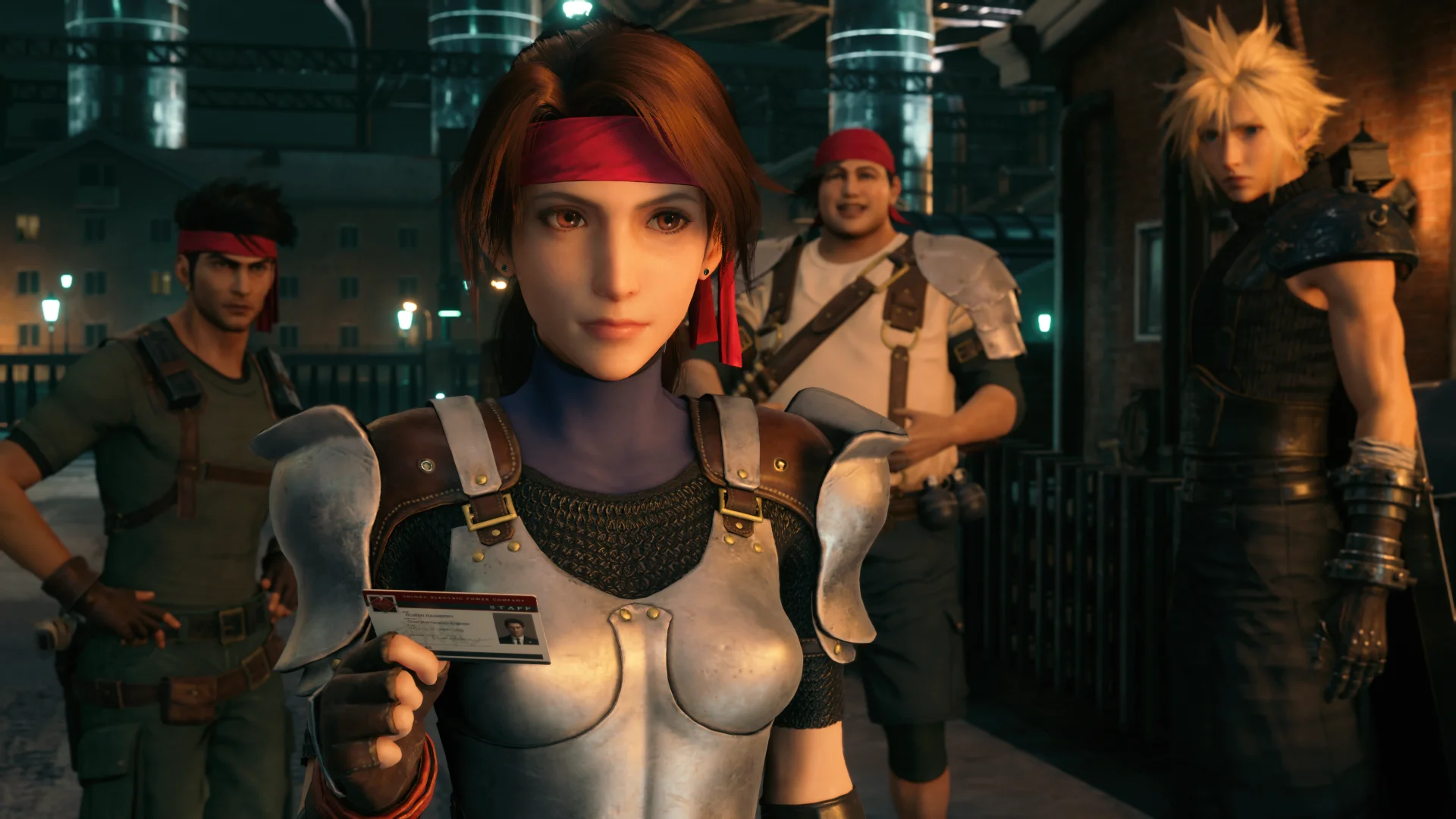
With Final Fantasy VII Remake, Square Enix weaves together a richer tapestry of Midgar, softening the edges of the PlayStation original while also stiffening the impact of Shinra’s destructive fatalism. I tell ya, that damn pizza in the sky hit me like a freight train when I saw its overwhelming vastitude overhead for the first time, and it continues to hit hard over five years later. Square Enix managed to take what is perhaps the best linear story this genre has to offer, and crafted a grand slam trilogy (er, two thirds of a trilogy so far) out of it, one which integrates the present technical and phenomenal moment gracefully.
Which is why the Switch 2 version is so on-theme. It fills in the gaps that half-blank page jewel case cover represented in 1997, now using the technology and perceptive affordances of the present. It richly treats its inspiring material, both generally speaking and with this well-optimized—hell, frankly impressive—portable version. And, most importantly, it affords me the opportunity to frolic in the snowy Midgar I perceived from that half-blank page jewel case, as I carry it outside into the snow (for, like, two seconds—brrr!).
The stories of art and media shift over time, but when treated with care their impact remains the same. Final Fantasy VII Remake is a stunning example of this, and this portable, more accessible version reflects that same level of care. Which is good news for all you sports fans RPG fans out there.