
Nearly a year ago, when Nintendo announced the impending release of the Nintendo Switch 2, one of the big announcements was the arrival of GameCube titles to the Nintendo Classics online service. Eagle-eyed RPG enthusiasts may have noticed that during the trailer, a handful of boxarts were shown for upcoming titles, including Fire Emblem: Path of Radiance. This was a big deal for Fire Emblem series fans and RPG aficionados alike; up until now, Path of Radiance had not been re-released in any form, and commands notoriously high prices on the secondary market.
As a lifelong fan of the series in general, and a huge fan of Path of Radiance in particular, I was ecstatic for the game to be available to so many new players and jumped at the chance to review what I consider to be a high watermark for the Fire Emblem series.
Path of Radiance is set in a new continent called Tellius, populated by two major races: the Beorc (humans) and Laguz (shapeshifters who can transform between human and beast forms). The game follows the story of Ike, a young man who belongs to a mercenary troop led by his father, Greil. The Greil Mercenaries reside in the countryside of the nation of Crimea, doing odd jobs for local villages and magistrates. The early game consists of simple jobs, clearing bandits and fending off pirates, where Ike (and the player) learns the basics of combat and mercenary work.
Things take a dark turn when the neighboring kingdom of Daein invades. Daein is ruled by the ruthless, warmongering King Ashnard, who believes in strength and, above all, advocates for Beorc supremacy over Laguz. This hatred of Laguz is what (supposedly) drove Daein to invade, as Crimea’s King Ramon allied with the Beast Laguz nation of Gallia. The Greil Mercenaries end up caught in the middle after they stumble upon the secret Crimean Princess Elincia in her flight from Daein’s armies. Greil decides to safeguard the princess, and his company agrees to escort her behind enemy lines to refuge in Gallia.
Fans of previous Fire Emblem titles will notice that this plot differs significantly from other games in the series. Typically, the main characters are members of the nobility, not common mercenaries forced into extraordinary circumstances. This shift in perspective helps differentiate Path of Radiance and provides a strong foundation for the narrative and characters. Ike is not your typical protagonist; he is blunt, straightforward, and unaccustomed to the stuffy rituals and concealed motives of the ruling class.
His company is staffed by a ragtag group of orphans, former knights, and outsiders joined by circumstance and mutual respect. This found family vibe is in stark contrast to the chivalry and duty that normally dictate character motivations in the series; many scenes show characters disagreeing on how to proceed or even certain characters leaving the company altogether based on decisions made by the majority.
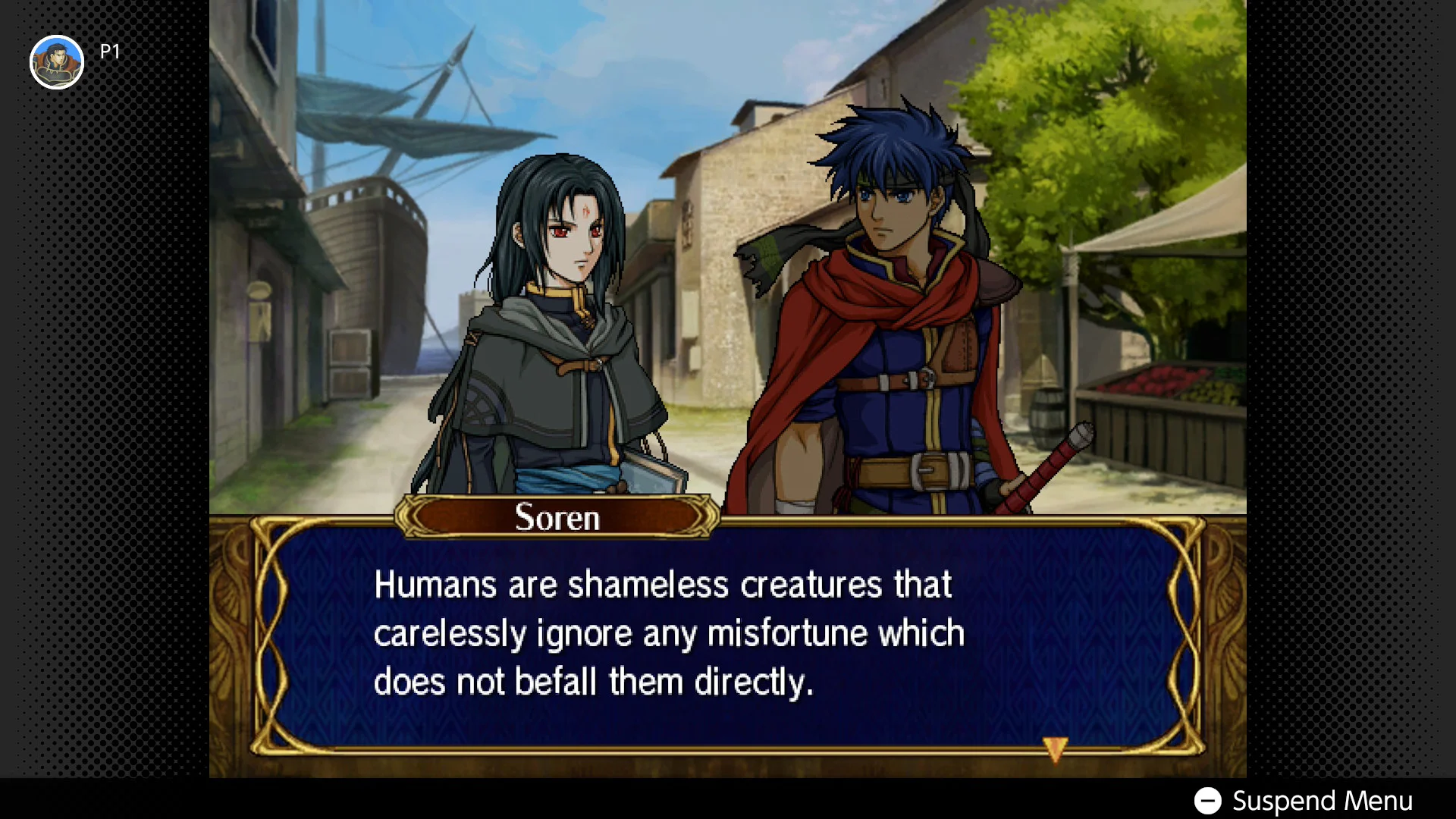
This shift in focus gives each of the various characters more time in the spotlight, and as a result, each member of Ike’s growing company feels more fully realized than characters in prior games. Path of Radiance introduces some of the franchise’s most memorable characters, from Ike’s sardonic and calculating staff officer Soren to his dutiful yet firm-handed mentor Titania. While one or two traits like this used to define a character entirely in prior Fire Emblem games, this cast is given ample opportunity to showcase depth and complexity, such as the way Titania plays a surrogate mother role to Ike and his sister Mist, or how Soren’s loyalty to Ike clashes with his own cold cynicism.
Characters have room to grow, and Ike’s responsibility to his company leads to more chances to illustrate character development. The Greil Mercenaries’ journey sees them travel across Tellius to the powerful Begnion Empire, and eventually take the fight into Daein. Ike seeks out characters like Marcia, a former Pegasus Knight of Begnion, and Jill, a Wyvern Rider from Daein, and explores their feelings on returning home under adverse circumstances.
These conversations flesh out the world and the characters, making Tellius the most well-realized setting the series would see until Three Houses’ Fodlan. The fact that it manages to do this while maintaining the linear chapter structure and tight pacing of a classic Fire Emblem title (no laborious, repetitive Garreg Mach school tasks found here) illustrates that brevity is the soul of wit. Path of Radiance’s writing is economical yet purposeful, with not a line of dialogue wasted nor a plot detail introduced without payoff.
Mechanically, the game is a return to form, reintroducing classic staples to the series and introducing some innovations of its own to the Fire Emblem formula. Chief among these reintroductions is the return of the skill system seen in Genealogy of the Holy War and Thracia 776 that was sorely missing from the Game Boy Advance titles. Each character can equip skills carrying point values roughly in line with their relative power, with a cap of 25 points.
Some skills, such as Canto or Shove, allow modifications to a character’s movement potential, allowing for hit-and-run tactics or to manipulate the positions of allies or foes. Others, like Wrath or Vantage, give additional critical hit chance or can turn the tables in battle by letting the unit attack first when engaged by the enemy.
Some characters join with skills already equipped, and some skills can be taught through scrolls looted as treasure or dropped by enemies on certain maps. These skills bring a lot of variety to your units and allow for significant customization and potential strategies with your army. Such variety is what makes the game so replayable, and I find that every time I revisit the game, I’m able to employ new strategies and skill combinations to take characters in novel and interesting directions.
Contributing to this additional complexity are the map designs and the bonus experience system. Maps take influence from the varied win conditions of Blazing Blade and Sacred Stones, offering alternatives to simply defeating a boss or seizing a throne, such as defense, escort, and escape missions. Most chapters have additional objectives (safeguarding allied units, leaving certain enemies alive, or completing the chapter in a certain number of turns) that, upon completion, grant bonus experience at the conclusion of a chapter. This bonus experience can be spent on your units at the base, allowing additional freedom in how you train or raise your units.
Having multiple, oftentimes competing, objectives ensures each map challenges your wits, and the late game maps often employ gimmicks (a bridge full of siege weapons that crumbles beneath your feet, a mountainous ascent where the enemy rains boulders down atop you, etc.) to keep even an experienced player on their toes. The game’s difficulty never approaches insurmountable, even on the hardest difficulty, but the varied objectives and clever design elements keep each chapter engaging throughout the 30-hour journey.
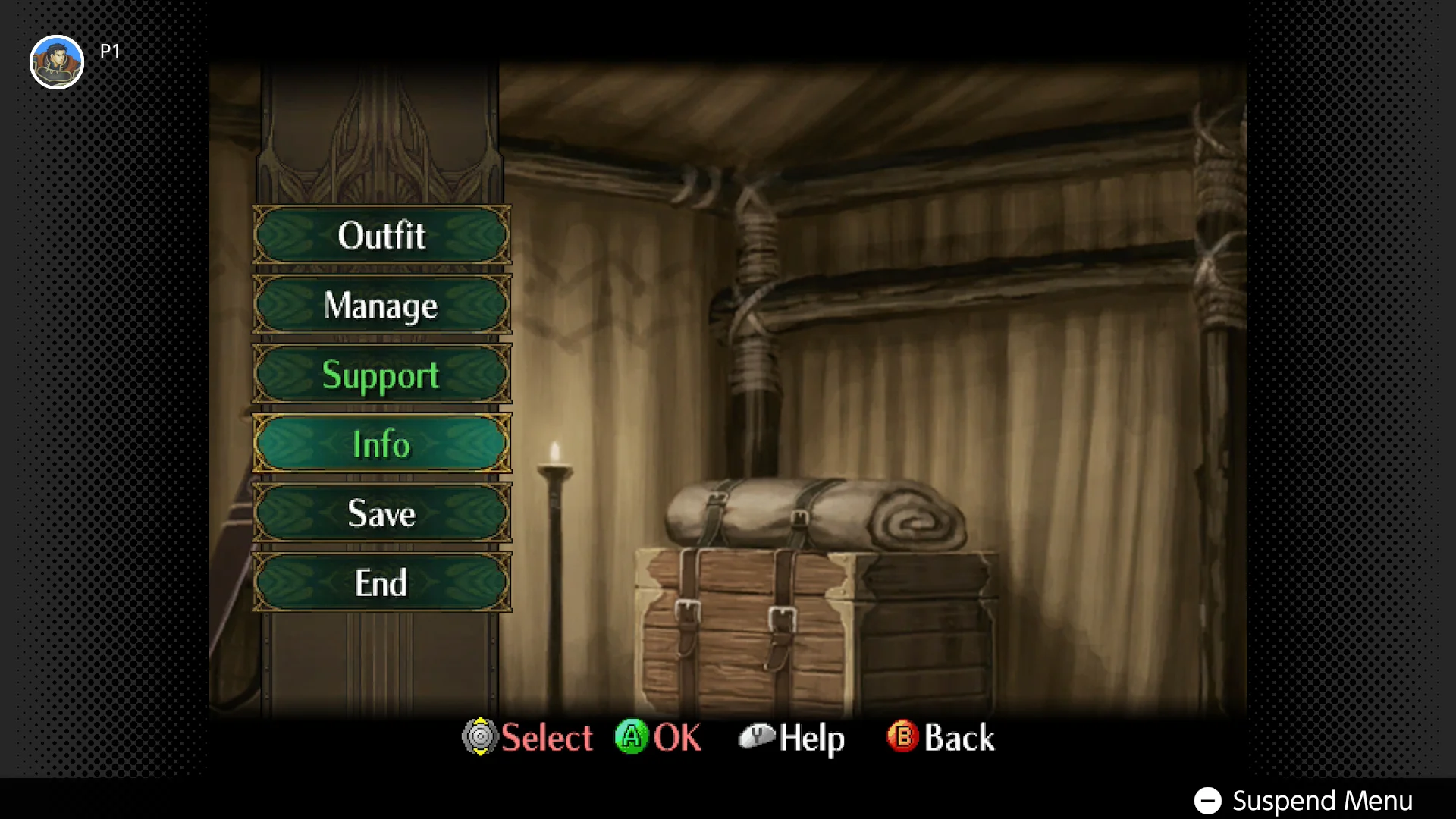
The base I mentioned above is probably the most impactful innovation Path of Radiance brings to the franchise. In previous entries, chapters proceeded linearly with little respite. You’d have a chance to resupply during the preparation phase before the next battle, but that was it. Any shopping or support conversations between units had to take place on the battlefield. Path of Radiance introduced the base between chapters, giving the player room to breathe and prepare, and giving characters a bit of downtime between conflicts.
Instead of support conversations taking place in the heat of battle (and wasting precious turns), they are accessed through the base, where it makes much more sense for characters to be pouring their hearts out to one another or delving into their backstories. There is an additional Info tab, which offers hints about the upcoming chapter or unique base conversations with characters or NPCs specific to your progress in the narrative. Oftentimes, these conversations reward you with items or even recruitable characters, so it pays off to view them.
Furthermore, you eventually unlock the ability to forge specialized weapons with custom parameters. You can only forge one weapon per base visit, and they are quite expensive, but forged weapons are a handy way to give a favored unit a boost in combat.
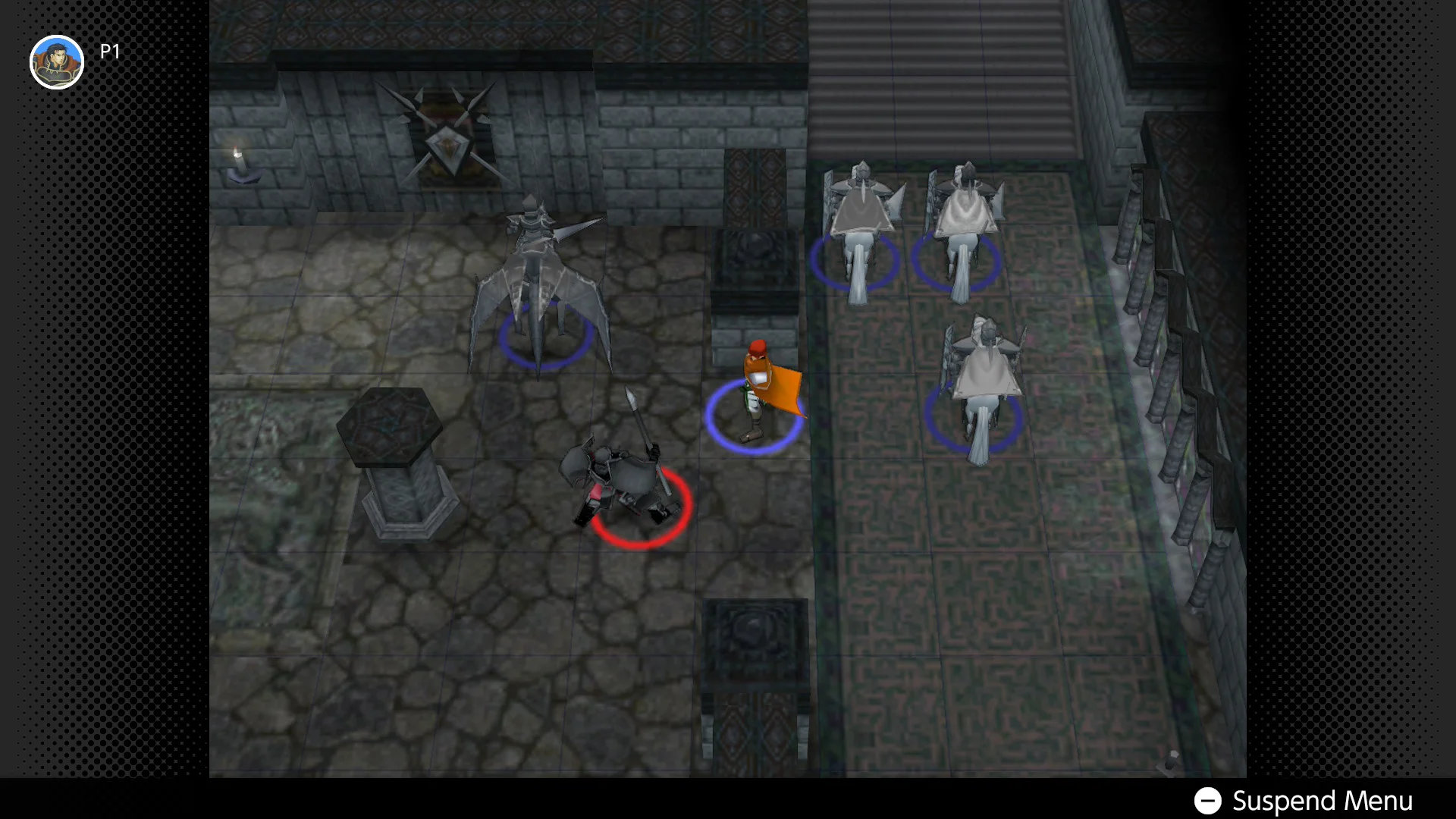
While I’ve mostly been heaping well-earned praise upon the game, Path of Radiance is not without its flaws. Intelligent Systems previously set a high aesthetic standard, as past titles were visually spectacular games on their respective platforms. Even the most casual Fire Emblem fan has seen clips of the impressive sprite animations from Blazing Blade. Path of Radiance, on the other hand, has a lackluster visual presentation. The character designs and 2D portraits (contributed by veteran SNK character artist Senri Kita) are some of the best in the series, but the 3D models for characters, maps, and animations leave a lot to be desired.
Textures are muddy, on-field character models are blocky and simple, and the transition to 3D in the battle scenes is rough. In fact, the battle scenes are so interminably slow and unimpressive that I tend to turn them off and stick with the snappier on-field animations, which aren’t flashy but get the job done. Some newly introduced mechanics disappoint, like the Biorhythm system. The idea sounds good on paper, featuring fluctuating character moods influenced by fatigue from repeated deployments affecting battle performance. In practice, the actual impact is negligible ( measly +/- 5 to avoid and hit), and you can safely ignore it entirely.
Despite these minor flaws, revisiting Fire Emblem: Path of Radiance on Switch 2 made me fall in love with it all over again. As a longtime fan of the series, I think Ike’s journey from humble mercenary to leader of the Crimean Liberation Army strikes the perfect balance between compelling narrative and engaging mechanics. Each member of the cast is incredibly memorable, and the game establishes the world of Tellius perfectly, setting the stage for the world-shattering climax in Radiant Dawn. If you enjoy the Fire Emblem series, or just strategy RPGs in general, you owe it to yourself to play Path of Radiance.