
There is no shortage of Earthbound-inspired games that seek to grab the attention of nostalgia-filled RPG fans. This only escalated with the release of Undertale in 2015, which is now so horrifyingly long ago that it apparently qualifies as retro itself. Console gamers have long been deprived of a key title in this movement, Jimmy and the Pulsating Mass, first released on PC in 2018. Now, Jimmy and the Pulsating Mass is free from its desktop slumber, and a whole new class has the opportunity to wander its colourful lands.
Jimmy and the Pulsating Mass takes place in the dreamworld of an eight-year-old boy, which provides an apt framing for the game’s visual presentation. This is a world brought to us in full 16-bit glory, which sits well next to beloved classics of the 90s. The game begins as Jimmy wakes up in his mother Helga’s lap, and soon we’re racing home, encountering Jimmy’s extended family on the way.
We meet Andrew, Jimmy’s scientifically-minded father. Soon, we find Lars, Jimmy’s bearded bum of an uncle. We also have our first meeting with Buck, who is the archetypal mean older brother, dressed in black, with an attitude to match. This initial journey is striking in that it drops you immediately into the comfortingly familiarity of a grassy glade, but soon we are crossing cloud bridges, signalling that we aren’t in anything like the waking world. The walk ends in a recognisable house, which primes us for the cadences of this experience, where the everyday is constantly subverted by the strange directions that Jimmy’s mind takes us.
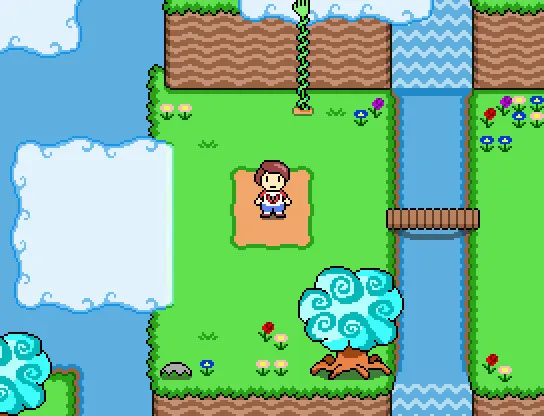
At its heart, Jimmy and the Pulsating Mass styles itself as a golden-era JRPG, complete with traditional, turn-based combat and all that entails. It’s your standard fight, magic, items affair, except that the “magic” abilities have thematically appropriate names, such as “Mothering” for Helga and “Nerd Bash” for Buck. Jimmy also requires that you stay alert at all times, as enemies display “tells,” which indicate that you better guard yourself quickly, or Jimmy and his family will suffer. Your foes are static images, completing the retro feel.
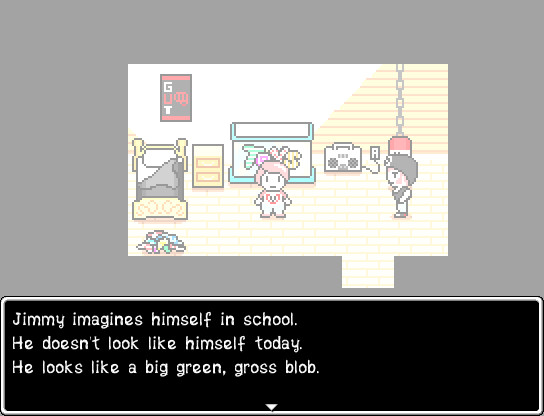
Early on, we have to battle something sticky and icky that lurks within Buck’s room, and it is here that Jimmy and The Pulsating Mass introduces us to the reason Jimmy’s abilities are labeled as “Imagination.” Jimmy is an empathetic little boy, and by experiencing the world from the viewpoint of the creatures he defeats, he can shape himself into their form. On this occasion, that’s a “Revolting Blob.”
On the field, you can change instantaneously into any of these. You can still transform during combat, albeit at the cost of a cooldown period if you want to change again. Each form has a specific set of abilities, such as the Blob poisoning opponents with toxic sludge, or solidifying itself to raise its defence.
Jimmy and the Pulsating Mass starts small, with the initial objective of gathering honey from a beehive. The creatures you encounter are cute at first: fun designs that would not be out of place in a children’s cartoon. Things soon take a dark turn, though, and we find ourselves battling disturbing monstrosities that evoke as much sympathy as fear. It’s the first sign that not all is well in this dream kingdom, a feeling that only increases as the game proceeds.
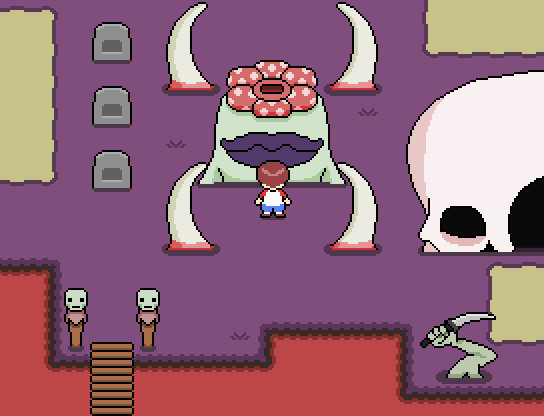
From here, the world of Jimmy and the Pulsating Mass expands exponentially, with each transition feeling natural despite the potentially jarring difference in settings. Along with Homeflower, you also visit medieval castles, blood-soaked marshes, a world made out of maths and equations, and futuristic cityscapes. None of it is ever as simple as it appears here, though. There is always a twist or some unique spin to the locale linked directly to how Jimmy interprets the world.
The scope of this project is even more impressive when you consider that the entire thing (barring a few coding assists) is the work of one person, Kasey Ozymy, using RPGMaker. It almost beggars belief that such an ambitious project as Jimmy and the Pulsating Mass could be created with barely any help, when large studios would employ dozens of people for similar projects. Jack-of-all-trades is underselling it somewhat. While it must be a difficult approach to take, it resulted in the execution of Ozymy’s creative vision in a more coherent way than could otherwise have been possible.
I must be clear, though; the gameplay is pretty brutal. This is no entry-level title. On the standard difficulty, Jimmy and the Pulsating Mass expects you to pay attention at all points, looking for enemy weaknesses and optimal strategies. You must change Jimmy’s form at just the right moment, hopefully not locking yourself into a downward spiral through one wrong decision—a frequent occurrence if you’re not careful.
The high encounter rate matches this difficulty, in an equally old-school way. I’m no stranger to either, having started my own JRPG journey in the 90s, but even I found it grueling on occasion. This sort of decision is more tolerable in a short game, but Jimmy and the Pulsating Mass easily clears 30 hours, maybe more if you’re taking your time. The variety in the enemy types helps, but the balance is a bit off in my opinion. Additionally, new equipment, healing, and recovery items are often prohibitively expensive, so you cannot rely on frequent upgrades to help you out.
Luckily, Ozymy includes the option of an easy difficulty mode, which doubles experience, lowers enemy stats, and, most importantly, lowers the encounter rate. There’s still a challenge here, and fights remain frequent, but this might be a more tolerable way of playing for some, offering a tighter, less drawn-out playthrough that can be beneficial.
This is important, as Ozmy’s narrative is ambitious, with an interesting throughline up to the finale. The childish imagery belies a darker subtext, and we are aware at every moment that the events of the plot are informed by Jimmy’s own experiences. It is an open-ended story that does not give every answer, and this only serves to strengthen its impact. There are some rare but powerful moments when the game steps outside of its established style and format for dramatic impact.
These are the thoughts of a child, though, and I don’t want to imply that Jimmy and the Pulsating Mass is unremittingly grim or serious. There is a lot of joy to be found in the places Jimmy visits and in the people he meets. The Petty Thugs, consisting of characters like Dee Dee and Johnny Knives, and led by the irrepressible Punch Tanaka, provide comic relief, acting as both antagonists and occasional aids to Jimmy.
The Princesses in Everchip are named Honeysuckle and Rasberry, as you might expect, but also Stinkweed, as you might not. Of course, there is also the ever-present influence of the Pulsating Mass itself, a villainous figure taking many forms, all explicitly hostile to Jimmy. However, even the Mass is not treated completely dourly, its many appearances often leveraged for humour as much as threat.
The true heart of the game resides in the depictions of Jimmy’s family. The choice to make Jimmy’s family members form the majority of the playable characters in the game is well-made and serves to emphasise the personal nature of the story, as we explore how Jimmy views his kindred. This includes serious analysis of Buck’s casual disregard for Jimmy, which masks his true feelings. It also includes finding out the hilarious truth behind Helga and Andrew’s “Adult Fun Time.”
An exceptional soundtrack supports Jimmy and the Pulsating Mass‘ framework. The sound has a 16-bit chip tune aesthetic, but Ozymy uses modern technology to subvert this, with occasional use of vocal samples and other effects that would have been more difficult to achieve on original technology. The end result is an adventurous ensemble with great variety, supporting Jimmy’s hopeful moments with upbeat tunes, but also delivering melancholic themes with equal skill.
Moments where synthetic notes simulate the lyrics of songs are orchestrated impeccably, especially the tracks “I Won’t Come Back,” which has more meaning than is immediately obvious, and “Jonathan Bear’s Theme.” Some pieces that accompany the most disconcerting areas are actively oppressive and difficult to listen to, in a way that is entirely deliberate.
Jimmy and the Pulsating Mass‘ release onto consoles allows new players access to Jimmy’s dream, which I would recommend most do, with the caveat that this is not for everyone. Those who like the sub-genre will have a blast, but others may find some aspects of the gameplay offputting, so keep that in mind before getting yourself tucked into this nocturnal novelty. Existing fans are promised the most complete version of the game available to date. Either way, you’re unlikely to find a more distinctive digital journey this year.