
Revisiting older games can be sobering. Sometimes they age gracefully. Sometimes they reveal ideas ahead of their time. And sometimes they expose every compromise that once hid behind a smaller screen. Mega Man Star Force Legacy Collection stands firmly in that last category. This was my first time with the Star Force games, and I came in expecting a lost corner of Mega Man history. What I found instead was a trilogy that feels at odds with its new home.
As mentioned in my hands-on preview, there are technically seven Star Force titles included, but functionally this is a trilogy with alternate versions: Pegasus, Leo, and Dragon; Zerker x Ninja and Zerker x Saurian; and Black Ace and Red Joker. Just like different versions in the Pokémon series, the core progression and story within each pair and trio remain nearly identical.
These were Nintendo DS games built around two screens, stylus input, and the cadence of handheld play. On a large display, especially on the PS5, the translation is rough. One screen sits tucked into a corner, adjustable but never comfortable. Swapping focus between the two becomes a constant chore, and the interface rarely feels at home on a television. Even when the layout technically works, it does not feel natural. The friction never disappears. It lingers in every menu, every transition, every attempt to read information that was clearly designed for two tiny screens.
Playing this way turns what should be simple interactions into small annoyances that pile up. The UI and combat information live on one screen, environmental and story context on another. You toggle, resize, and re-center, always managing the presentation instead of simply playing. This kind of compromise might feel acceptable on a dual-screened portable device, but on a large screen, it becomes exhausting. I keep wishing I had a PlayStation Portal to try it on, though I’m not convinced even that would solve all the headaches.
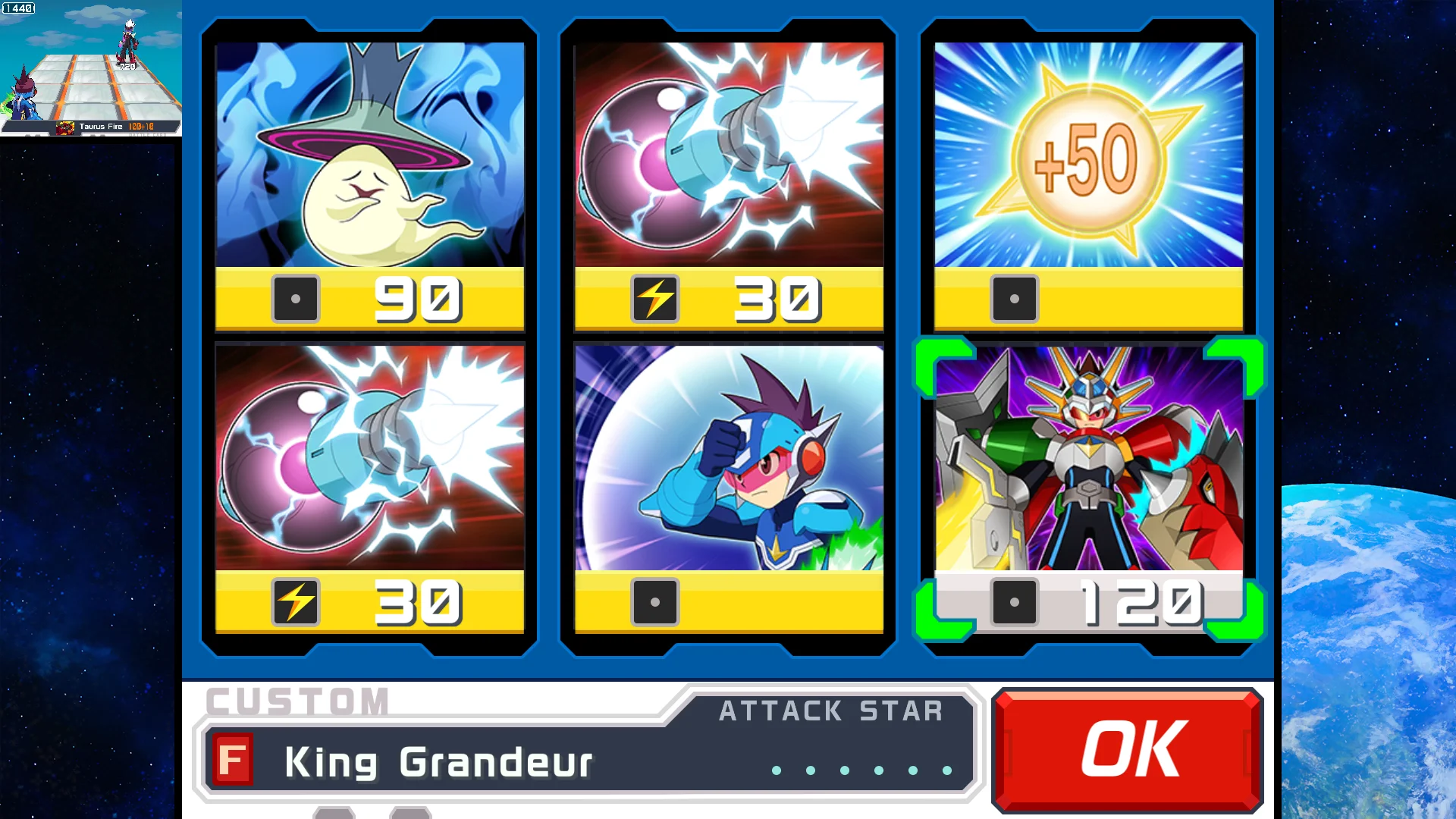
Underneath Mega Man Star Force Legacy Collection‘s awkward presentation sits a gameplay loop built around exploration, encounters, and deck-driven combat. You move between real-world locations and a parallel digital “wave” layer that overlays the environment, talking to characters, triggering objectives, and advancing the story. Battles take place on a compact three-panel grid viewed from behind Mega Man, with enemies occupying the space ahead. Movement is limited, and the focus shifts toward timing, positioning, and reading attack patterns.
Folder building remains at the heart of all three games. Cards collected from enemies and shops form your Folder, Star Force’s term for its deck, dictating your offensive and defensive options. During combat, a gauge fills, time pauses, and you draw a hand. Matching columns or duplicate names lets you string attacks together before returning to real-time movement: dodge, wait, draw, strike, reset. It is a clever idea, but it quickly becomes monotonous given the limited enemy variety.
The first game, Mega Man Star Force, establishes the series’ foundation. Its sci-fi framing leans heavily into wave technology and digital overlays, giving the world a distinct identity compared to other RPGs of the era. The story follows Geo and his transformation into Mega Man through contact with an extraterrestrial entity. The premise has potential, but the execution rarely capitalizes on it. Story scenes come and go without much impact, and the pacing often stalls between plot beats.
Mechanically, the first Star Force feels the most rigid. Folder building exists, transformations provide some customization, and enemy patterns encourage learning, yet encounters blur together quickly. Navigation can be unclear, and the game revolves around repetition. The three versions primarily shift elemental affinities and form changes, but the overall structure remains unchanged. By the midpoint, the sense of discovery fades, replaced by routine.
The sequel, Mega Man Star Force 2, attempts to expand that foundation through the Tribe system and Zerker combinations. On paper, there is more to engage with. There are more transformation options, and Folder experimentation becomes more viable. In theory, it’s a meaningful step forward, but in practice, the changes feel so minor that I spent much of my playthrough fighting a persistent sense of déjà vu. Encounters remain repetitive, and the structure still relies on moving between spaces, triggering events, and fighting waves of similar enemies. The story pushes toward a more global scale, but like the first game, its major plot points struggle to land.
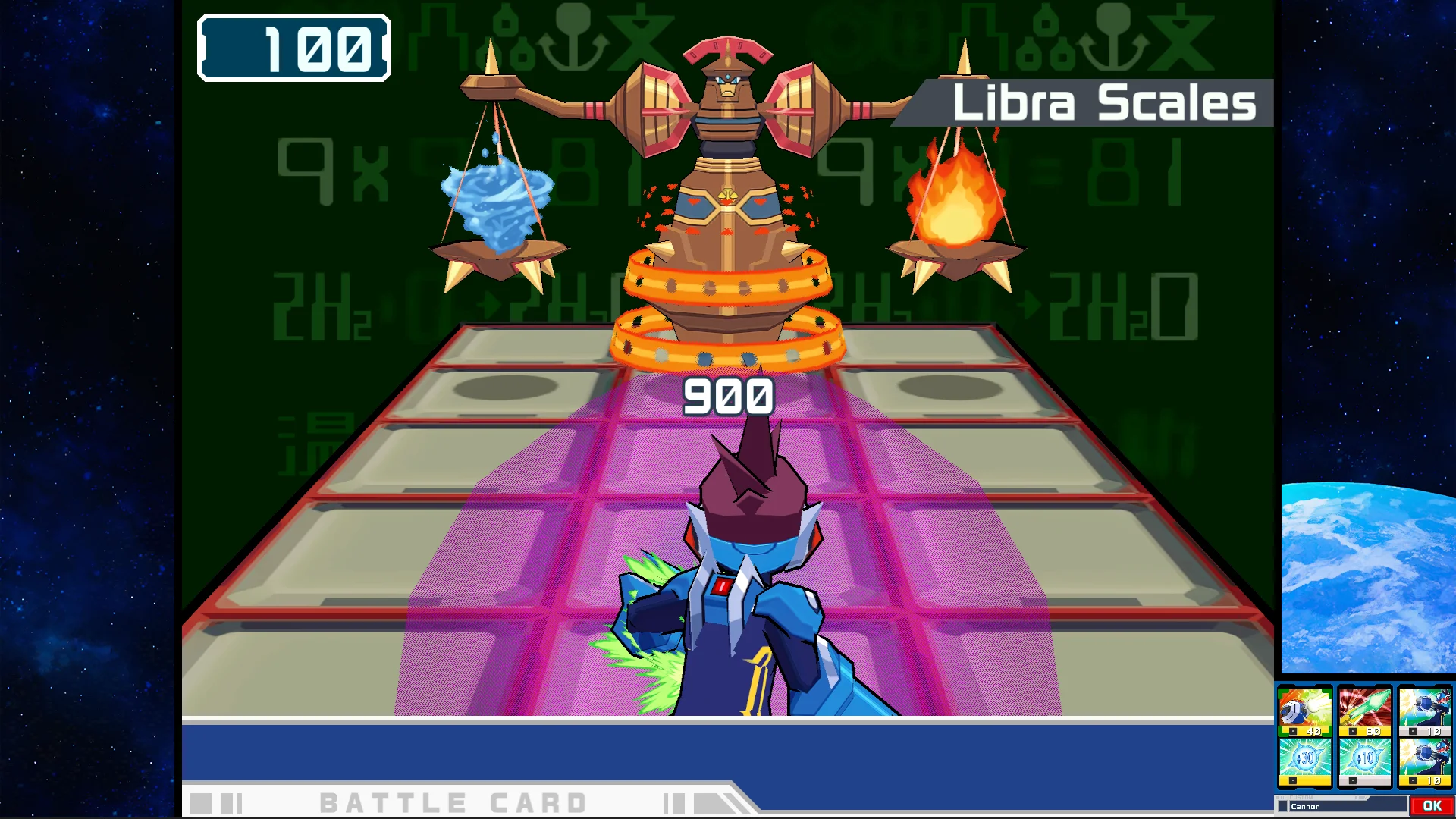
The third entry, Mega Man Star Force 3, is the most refined mechanically. There is a clearer attempt to give players more control over their playstyle, with expanded Folder options, slightly smarter enemy patterns, and more varied transformations that let you experiment with different approaches. Even here, though, the improvements sit atop the same dated structure.
The stakes escalate in familiar fashion. A new threat emerges, shadowy figures maneuver behind the scenes, and Geo once again finds himself bridging the human and Wave Worlds in an effort to prevent catastrophe. The game grasps toward larger ideas about trust, reputation, and the consequences of power, and there is a greater sense of an overarching conspiracy tying events together. Yet despite the heightened scope, the story follows a familiar pattern: investigate an anomaly, enter a corrupted network, defeat a themed boss, repeat.
The pacing in Mega Man Star Force Legacy Collection swings between slow stretches and sudden spikes of activity. Black Ace and Red Joker introduce meaningful tweaks to abilities and builds, but they remain variations within a familiar mold. The core experience still revolves around the same loop established in the first game. It doesn’t help that common enemies are recycled across all three games.
The combat shows flashes of potential. Timing attacks, managing card draws, and adapting to enemy patterns can be engaging at times. Folder building, in particular, hints at a deeper layer of strategy. Transformations add flair, and late-game encounters occasionally push you to think more carefully about your approach. But for every encounter that clicks, countless more pass by without leaving an impression. Instead of building tension, the games often settle into a predictable cadence.
Star Force aims for emotional weight but struggles to sustain it. Themes of isolation, identity, and connection run throughout, yet the writing rarely develops them beyond surface-level gestures. Scenes introduce ideas, then move on before they can register. While the sci-fi setting provides a distinct tone, the execution never creates the momentum needed to carry it.
The presentation does little to help. These were originally DS games, and in that context, the visuals were fine. On modern platforms, though, they just look like a blown-up DS game. The adaptation preserves the structure, but not the comfort of playing on a handheld. Audio fares a bit better, with energetic battle themes and familiar Mega Man motifs. Even so, monotony sets in quickly. Tracks loop constantly, and the soundscape rarely evolves alongside the gameplay. Many tunes also feel distinctly low-fi, as if copied straight from the DS releases, despite the touted rearranged and remixed soundtracks.
There are a few ideas in the Star Force series worth appreciating. The card-based combat framework shows promise. The transformation mechanic adds some identity. The sci-fi premise sets the trilogy apart from other RPGs of its era. But potential alone cannot carry an experience, especially across three full-length games that lean so heavily on uniformity.
Playing through the Star Force games in 2026, the sense of their era is unmistakable. Objectives feel unfocused; wandering is without purpose. Encounters stack without evolving, and combat rarely feels connected to exploration. Instead of building toward something cohesive, the trilogy circles the same concepts, refining them incrementally without ever introducing anything new.
What ultimately defines this collection is friction. Friction between hardware and design. Friction between ambition and execution. Friction between systems that hint at depth and a structure that never supports it. The more time I spent with Mega Man Star Force Legacy Collection, the more exhausting it became. Not challenging. Not demanding. Exhausting. The constant screen management, the repetitive encounters, the clunky navigation, the slow pacing, the friction layered on top of friction. It all adds up.
Capcom deserves credit for preserving these games in a complete package. All versions are here, faithfully presented. For longtime fans, that preservation alone may justify the collection. But I cannot, in good conscience, recommend it to newcomers. The games are intact, and with them come all of their limitations. Once, it felt like an ambitious handheld experiment; now it plays like a trilogy stuck between ideas. Mega Man Star Force Legacy Collection is an honest time capsule, capturing a series that never found its footing.