Back in 2020, my three oldest friends and I sat on the phone to play the then-new Minecraft Dungeons. It was another Diablo-like action RPG, so why not? We had a blast, though perhaps too much of one, as we blasted through the campaign in one evening. Great fun; lamentable length. It wasn’t until, on a whim, I replayed the game later that year with my wife that I realized the surprising depth behind Minecraft Dungeons, and all the ways you can break the game with your equipment builds (and how the game needs you to break it when replaying missions at higher and higher difficulties).
It was surreal to see my wife, not typically a gamer, min-maxing her gear for quicker cooldowns and ridiculously high crit rates, and then delightful for the two of us to roll through familiar levels with our twin pet llamas, affectionately nicknamed “Joe” (that’s “Joe Llama” to you). It ended up being one of our favourite, most-played games together.
Naturally, we were jazzed at the announcement of Minecraft Dungeons II. Jumping back into its colourful and cubic world was like putting on an old (boxy) glove—it’s everything I would have expected, for better or worse. With more consistent action difficulty and more polished RPG mechanics than its predecessor, though lacking some of that game’s grander set pieces, Minecraft Dungeons II raises the floor and lowers the ceiling of its experience into a straight and sturdy box.
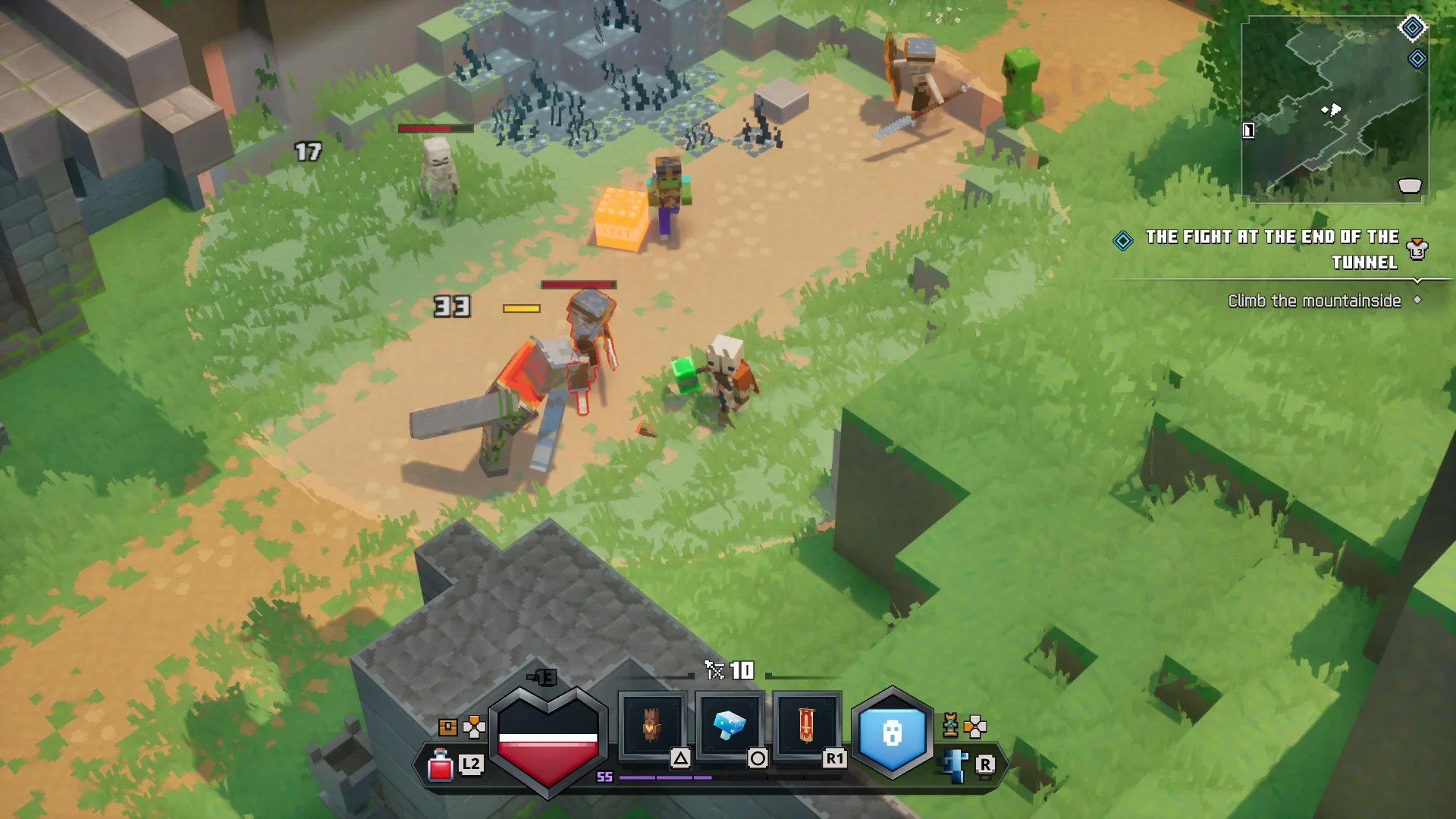
Led by a mysterious and malevolent High Council, the illagers are back, seeking domination of the Overworld. As if their legions of foot soldiers and golems weren’t bad enough, they’re wielding soul magic ripped from the newly discovered alternate dimension of The Sift, a phantasmagoric world of strange creatures and world-altering music. With the first Minecraft Dungeons’ hub town of Squid Coast in flames, our blocky heroes must move on to new horizons and garner new strength to stop the illager hordes.
I don’t think many people, kids included, care about the story of Minecraft, though I was disappointed that there was no standout villain in Minecraft Dungeons II as charming as the first game’s oddly shaped Arch Illager who goaded players along. Here, as I made my way through semi-familiar biomes—green hills, shaded woods, dark caves, snowy plains—I kept waiting for the game to wow me. I suppose I’ve been spoiled by the late-game levels of the first Minecraft Dungeons and its creative DLC expansions, what with its undersea kingdoms, mountain temples, the Nether, and the End. Minecraft Dungeons II has two planned DLCs, but of course I’m here to judge the game’s initial release.
What really sets Minecraft Dungeons II apart from its predecessor, while placing it in closer leagues with action RPGs like Diablo IV or Titan Quest 2, is its semi-open-world structure. You and your potential crew of four march and hop around, expanding your map through story quests while picking up handfuls of side quests along the way. You can swap quests through your log, and with a push of a button you can see a trail moving towards your current objective.
Also marked on your world map are Sift rifts and various dungeons (caves, spider dwellings, and so on). These are semi-random, meaning when you enter them, the game generates a dungeon from a fixed pool of map elements and encounters. Admittedly, that pool is small, so dungeoning never feels as fun as traversing the Overworld.
The Overworld in Minecraft Dungeons II is large, but less than the deceptively huge in-game map makes it seem. In fact, huge chunks of the map remain obscured after the game’s end—really, you tear a horizontal line right across the map’s middle as you mainline the eightish-hour story.
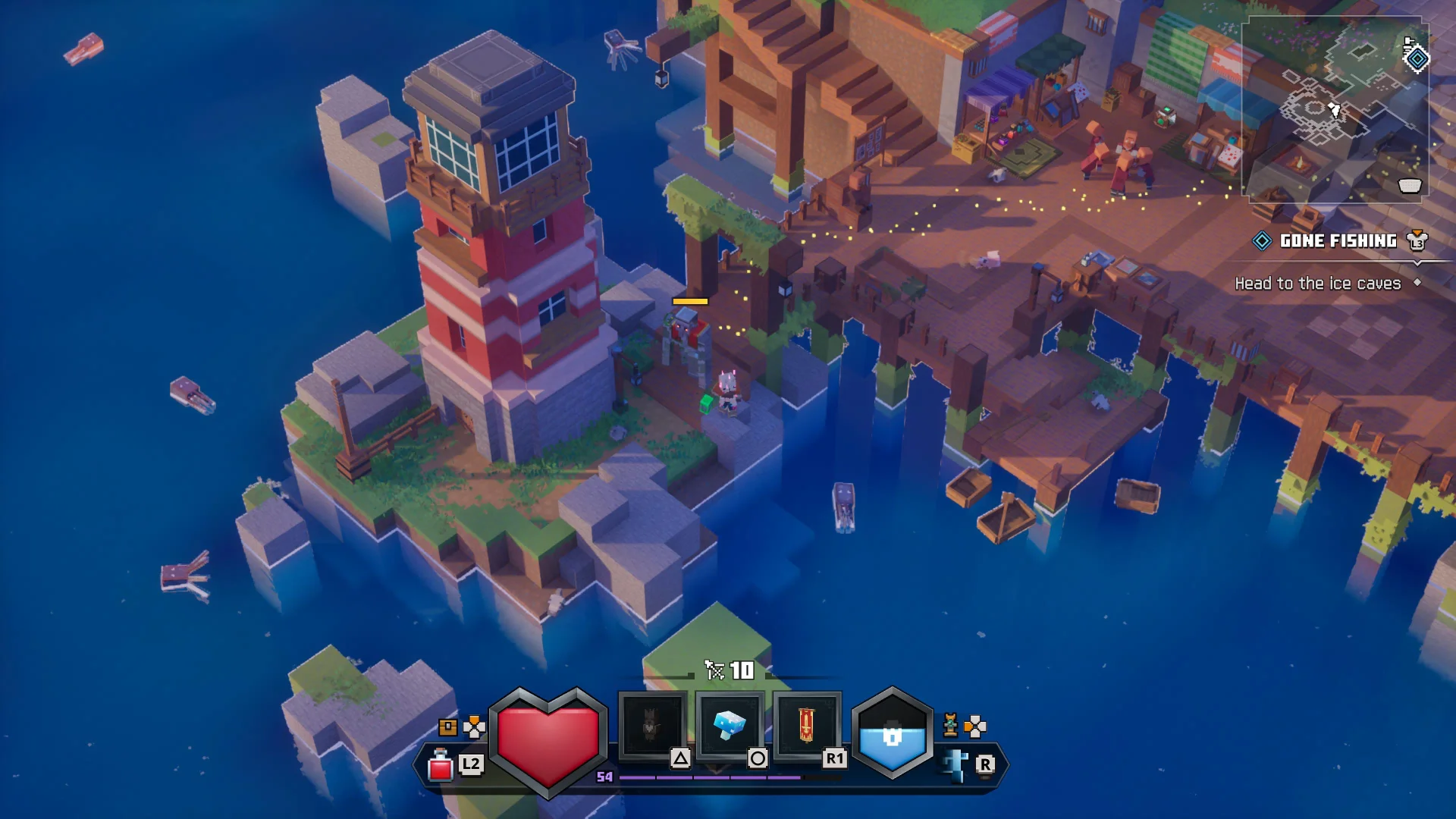
What is here, though, looks absolutely beautiful in ways you may not expect. The dense amount of detail layered onto the standard Minecraft voxel style and the eye-popping mix of colours no M-rated game would dare employ make exploring the map a joy. The soundtrack, composed again by Peter Hont, captures the high adventure alongside the reflective moments of calm fans love in the original Minecraft, with some experimental tracks (“Witch”) and Overworld tracks that shift with the sunrise/day/sunset/night cycle.
The new jump button opens up so much verticality and light platforming in each area. Jump across those lily pads or up that cliff face and you may spawn a chest with a random item inside! It’s a shame the dungeons in Minecraft Dungeons II feel bland in comparison, but completing them is almost a must, given the weapon and armor enchantment effects that you receive in them.
Someone who missed out on the first game may marvel at how solid Minecraft Dungeons II’s combat feels. Enemy zombies, creepers, skeletons, and illagers go down in just a hit or two, but you are absolutely swarmed the entire game, making each encounter quick, punchy, and extremely satisfying. You have one attack button (plus a new jump attack), and you can shoot various bows or crossbows, now with auto-reloading ammo on cooldown, unlike the first game’s pickups.
The three slottable artifacts also return, mapped to the face and trigger buttons. These could be bombs, buffs, shields, healing circles—you name it. Whereas in the original Minecraft Dungeons these worked on cooldown, here they have shorter cooldowns but cost souls, a sort of MP you primarily gain by killing enemies. If one attack button sounds too simple, you can really switch up your playstyle by which artifacts you use, making the combat always engaging and the loot dropping always addictive.
Nearly all the weapons, bows, and artifacts from the first game return in Minecraft Dungeons II, with some of the more overpowered equipment now retooled so that more playstyles feel valid—the power bow, say, can no longer be enchanted to 4x damage to one-shot bosses.
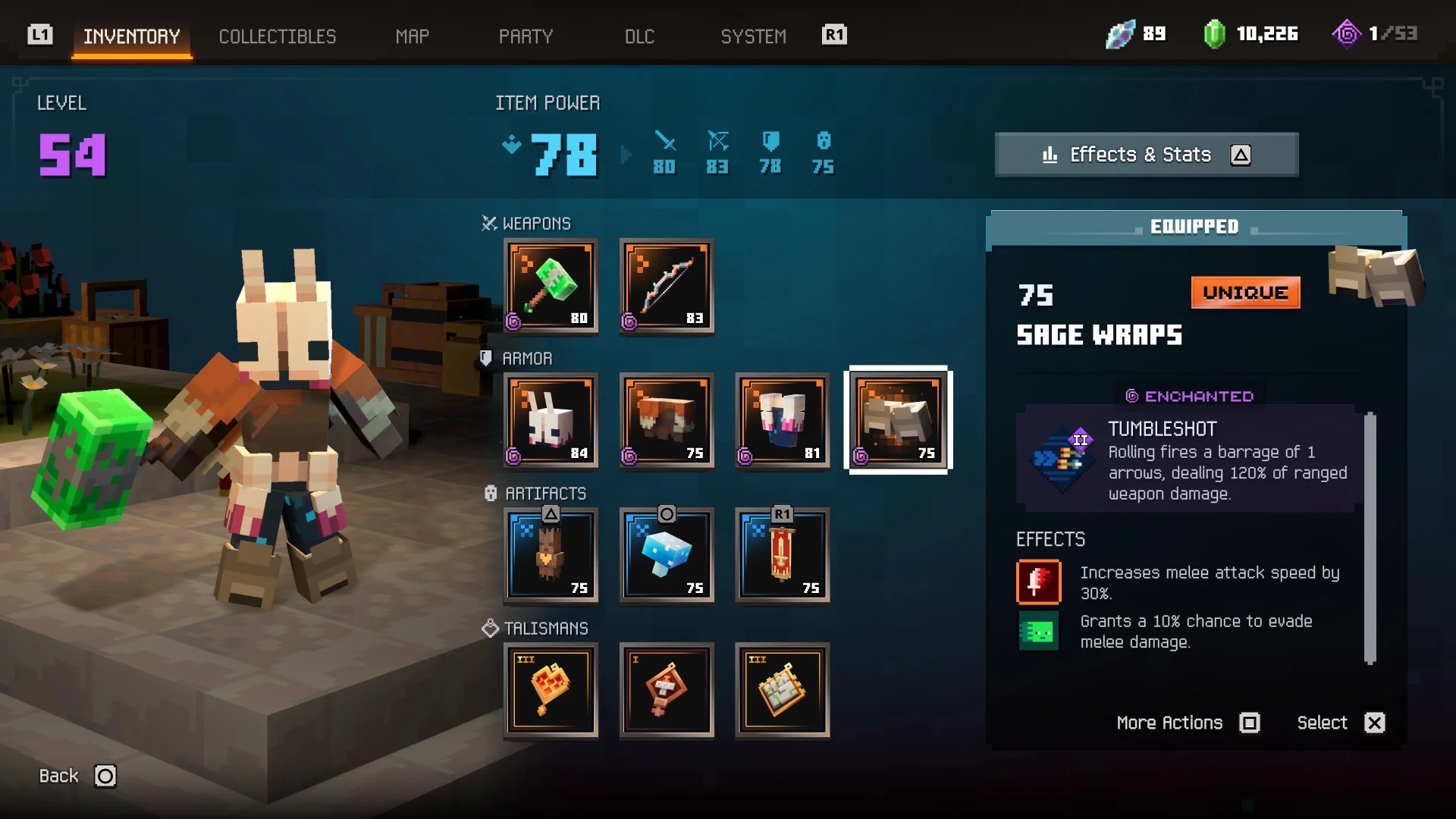
The revamped enchantment system lets you affix one property to each equipment slot, such as chain lightning attacks or elemental waves on weapons, to speed bursts or auto-arrow rolling on armour. These are pivotal to your builds and playstyle. The only downside is that, with all the loot that enemies drop, you’ll want to keep teleporting back to the nearest enchantsmith to rework your items. With that in mind, it would’ve been great for the game to include a loadout system of some kind. Thankfully, your inventory pockets are huge now, with 80 open slots per equipment type, so you rarely need to return to town.
Also important to the game’s consistent balance is how, rather than embark on missions at set difficulties and recommended power levels, you play everything on Easy, Normal, or Hard and the game scales levels with you, periodically warning you that, though item rarity in drops is increasing, so too is enemy difficulty.
Playing solo on Normal, Minecraft Dungeons II can be surprisingly tricky, given how small your health pool is. Death sends you back to the first hub town, but after re-outfitting yourself, you can return to the nearest checkpoint to your death. I thoroughly enjoyed my solo playthrough, though managing health via slow potion cooldowns or occasional artifacts proved difficult when the random super-powered properties of glowing “corrupted” mobs — such as regenerating enemy health —were not rolled in my favour.
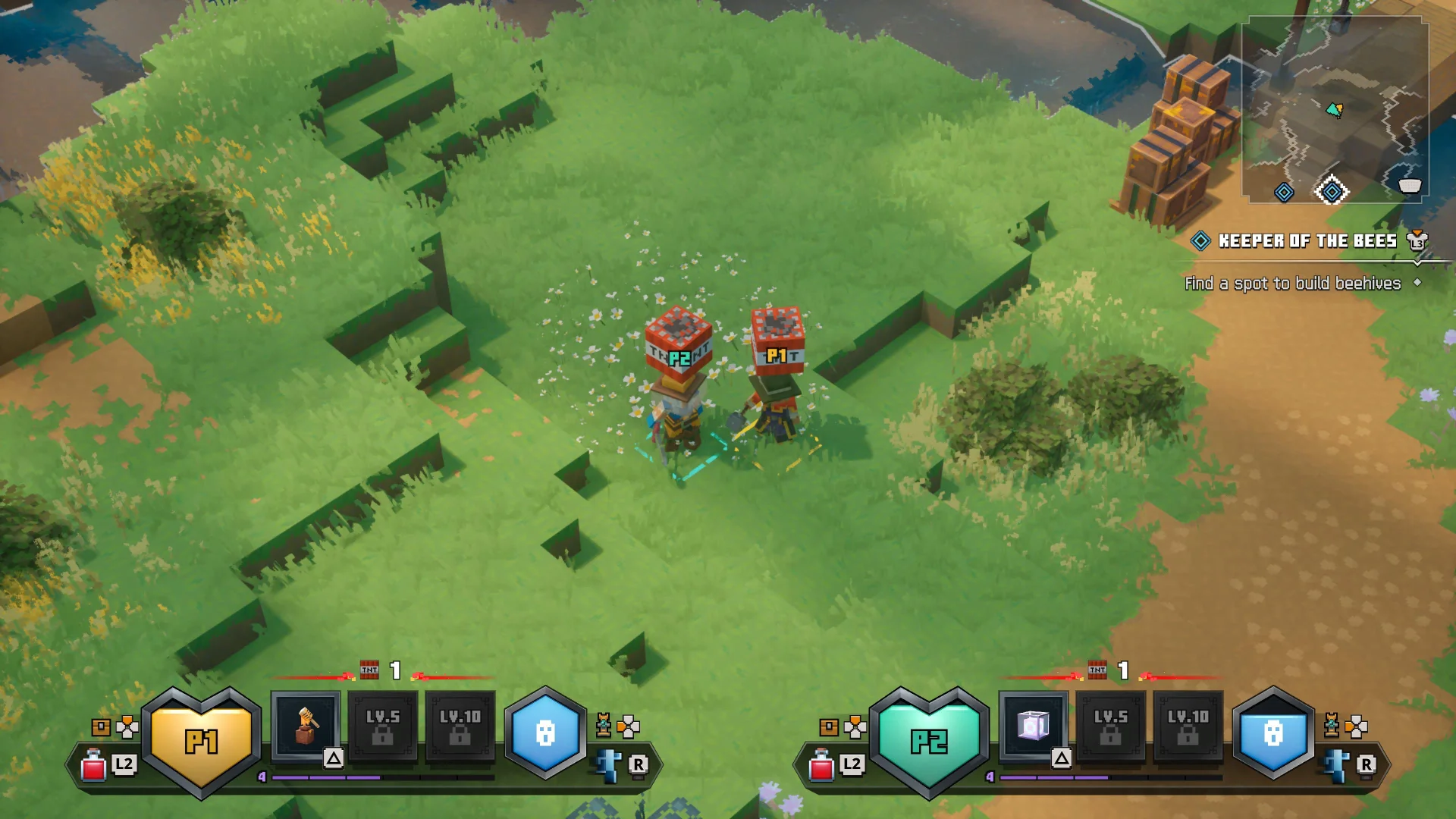
Playing on new co-op characters with my wife tempered the difficulty greatly, to the point where we’re breezing through Hard difficulty now. Many enchantments and even item passives affect your whole party, making for some very strong team comps. Players can now open a small inventory window mid-game, letting you sort and salvage your goods at the same time—which sounds like a godsend for four-player.
Couch co-op forces you to share a screen, though the camera is pulled back enough that navigation is rarely a problem. Playing with others online gives you full control of your own screen and which objectives you tackle. You can even play online with a buddy on the couch beside you, with the strange caveat that you must lock your custom characters into either Online Mode or Offline Mode.
After tons of time on the game’s Hard difficulty together with my wife, she loves reading all the passive ability descriptions and tweaking her builds with me. However, she misses how the first game let you replay levels to umpteen difficulties, since the power scaling gave us a goal to work toward. Oh, and she loves the honey bomb item because the bees are cute.
It’s worth saying that beyond aesthetics, there’s little of Minecraft’s DNA in Minecraft Dungeons II. Harvesting, mining, crafting, and building don’t come into play at all. As a teacher, I appreciate how Minecraft‘s variety of experiences can appeal to the survivalist and adventure-loving child as well as the creative, LEGO-loving kid. Minecraft Dungeons II, on the other hand, is very intense and stimulating to the senses. I’d liken it to giving your kid a Coca-Cola. Delicious, but maybe don’t leave your kid with a fridge full of 2 litre bottles.
At the end of the day, Minecraft Dungeons II is a family game everyone can enjoy. Developer Double Eleven has cut their teeth on porting or remastering other great family games, such as the LEGO Harry Potter collections and the PixelJunk series, and that experience shows across both Minecraft Dungeons games. Minecraft Dungeons II is a fantastic entry point for inexperienced gamers into more hardcore action and RPG elements, without ever feeling like it plays to the lowest common denominator. Its gameplay loop of explore, smash, and loot is easy to pick up and hard to put down.