
Disclaimer: Planet Laika deals with traumatic themes including multiple forms of abuse, suicide, and genocide. If you are currently experiencing mental health struggles, it may not be a good time to play this game. This review does not contain any graphic details on this subject matter.
Quintet was one of the most creatively distinct Japanese developers of the 1990s. ActRaiser broke genre boundaries by having us play God instead of kill God in a hybrid city sim/action platformer. The action RPG trilogy that followed, Soul Blazer, Illusion of Gaia, and Terranigma, all balance solid gameplay with increasingly complexly layered themes about the world’s light and dark duality, the realities of the human condition, and life itself. Sure, you could say other games of the 16-bit era were trying to deal with similar nebulous-sounding themes, but there’s a degree of earnestness and directness in tackling them that makes Quintet’s games unmistakably Quintet.
Planet Laika was the last real Quintet game before they started developing some licensed games until they finally folded. Only released in Japan on the PSX in 1999, it’s the swan song that got away. It’s a shame, too, because Planet Laika is Quintet’s most original and thematically dense work—which is saying something. Blessedly, translator Cargodin released an English translation patch in 2022, making this singular adventure/JRPG/psychological horror game accessible to a wider audience for the first time.
The Horror, The Horror
Planet Laika has some simple adventure game progression with occasional (and unusual) combat to give the gameplay substance, but the main draw here is, without a doubt, the mind-bending trip of its narrative presentation. If Terranigma is an interactive creation story, Planet Laika is an interactive psychological breakdown. Whereas the previous games I mentioned explore our world on an epic, terrestrial scale, Planet Laika turns inward to explore the human psyche. The way it does so is hauntingly original and unlike any other video game I’ve had the pleasure (or horror) of experiencing.
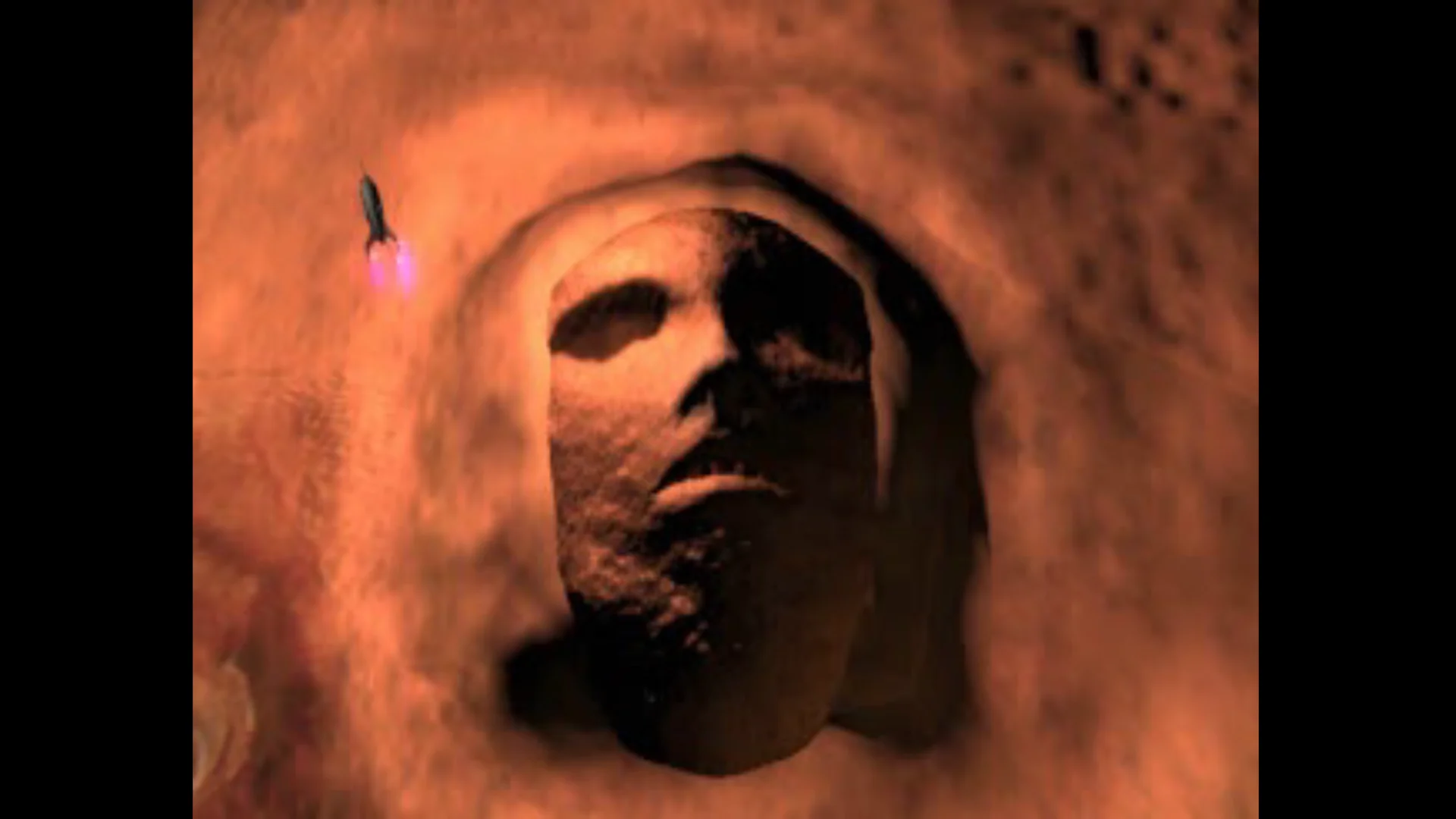
For, you see, Planet Laika starts by introducing us to a group of four astronauts flying to Mars. They’ve been sent to investigate the emission of a force called Evil Mind from a giant face carved into the planet. Humanity colonized Mars and its inhabitants a while back. The face was built as a symbol of the Martians’ supplication before they immediately became extinct after humans gave away their faces. Oh, and humans now have dog faces. Evil Mind seems to be an intangible force related to this genocide that is affecting colonies on Mars and even people on Earth. Are you following? Don’t worry about it. Part of the intrigue here is figuring out the symbolic meanings of this twisted reality and how they relate to our main dog, Laika.
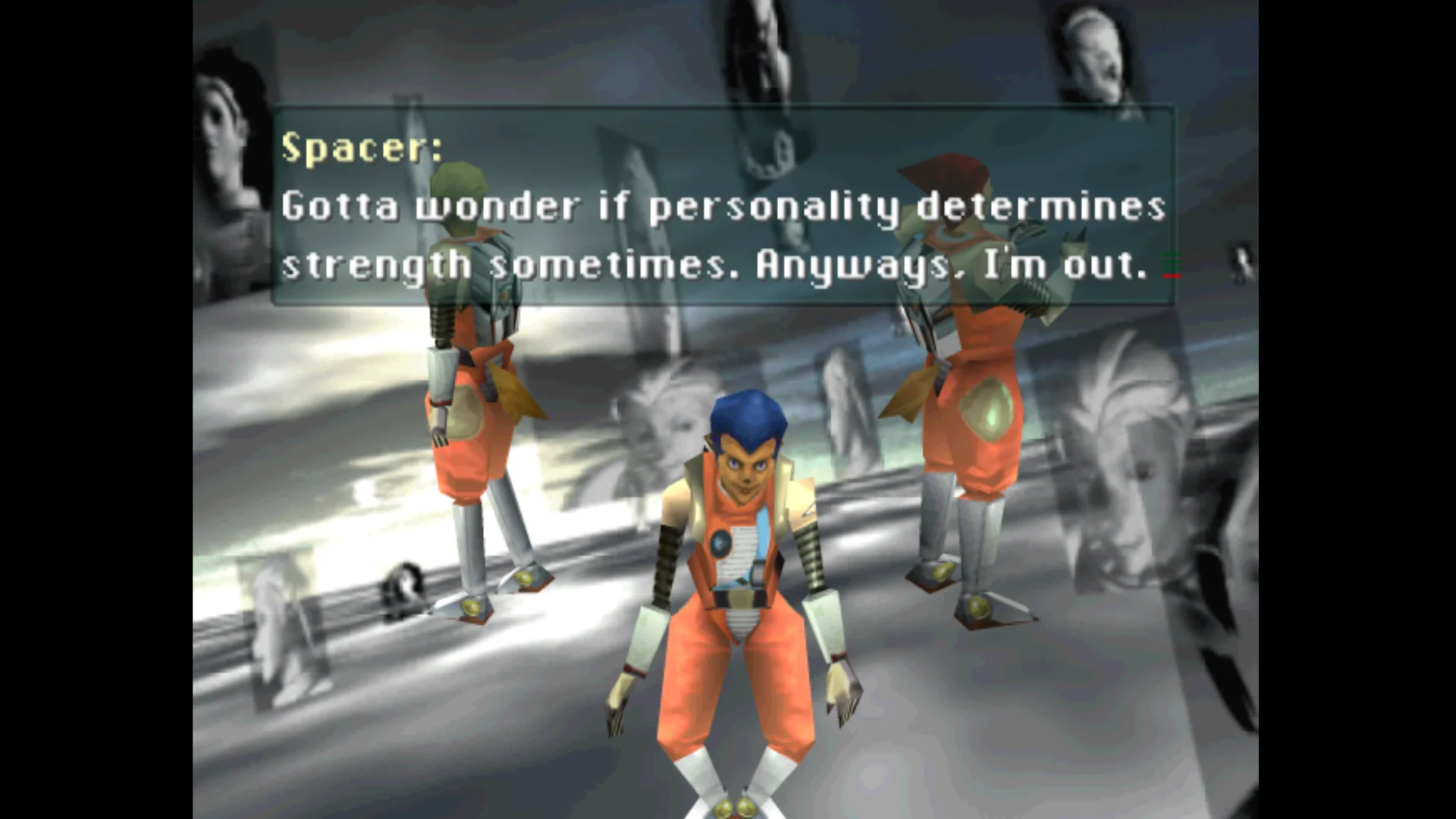
Yes, Laika, our protagonist named after the tragically famous Soviet dog that was launched into space with no hope of return. Laika’s fellow astronauts all have varying degrees of importance to the game’s story, but this is The Laika Show. You soon discover that Laika isn’t a single person or self but a conglomeration of multiple personas. Each persona is associated with one of the three ‘evils’ that encompass the influence of Evil Mind and are fully fleshed-out characters of their own. Each evil is associated with a color. Ernest is Laika’s red persona, tied to power or wrath. Yolanda is the green persona, tied to desire or envy. Spacer is the blue persona, tied to knowledge or pride. That’s right: Quintet’s love of Judeo-Christian symbolism is back!
This system implies that Laika suffers from multiple personality disorder. The game frames this condition as a consequence of the truckload of traumatic baggage they carry. Laika’s trauma is slowly revealed throughout the game as part of the narrative’s main puzzle. Although Laika is a silent protagonist, their personalities can speak. You can transform into one of the personalities by looking in a mirror once you’ve accumulated enough of that type of evil. You can build up each type of evil by talking to NPCs associated with the corresponding evil, finding Evil Mind draw points (think Final Fantasy VIII, but more evil), or using certain consumable items.
Mind Games
Switching between personalities is the key adventure game mechanic here. While Planet Laika is neither quite adventure game nor JRPG, the moment-to-moment gameplay feels more like Grim Fandango than any PSX Final Fantasy. The game world is small but full of wacky yet interesting dog-faced characters to chat up. These characters will frequently move around and have new dialogue as the story rushes forward with each progression-related interaction, making it feel like there’s far more going on off the screen than Laika is aware of. The game’s puzzles are light and vary from direct to more riddle-like instructions from these NPCs.
For the most part, progressing the game will involve being asked to find and talk to a particular character. The script generously tells you where to find that person, which is welcome since there are plenty of names to keep track of. At its most complex, the instruction will be slightly more vague and asks that you figure out which of Laika’s personalities you must transform into before going to a particular location or interacting with a specific NPC. I was rarely stumped, and the light puzzle-solving felt like a fitting and unobtrusive way of adding variety to the mainly story-driven gameplay.
There’s even a battle system here—although combat is infrequent. Battles take place only in certain parts of the story or by running into an enemy (called a “Phase”) on the map in hostile areas. They feel more like an arcade-y mini-game than anything traditionally found in an RPG of the time. There are no random encounters, leveling, equipment, or turn-based combat here. These are real-time battles against psychic forces that shoot “mind bullets” to whittle down Laika’s Evil Meter/HP.

The battles unfold on a 2D plane with Laika and the enemy on opposite ends. Laika’s Mind Core, a little glowing spirit, moves up and down on its own as your enemy’s mind bullets shoot horizontally toward you. Hold the action button to push the Mind Core forward and collide with the projectiles to deflect them back at your enemy. Hit the cancel button to recall the Mind Core towards Laika and make contact with any bullets on the way back. It’s simple but surprisingly satisfying and happens rarely enough not to grow tedious. I only wish the bosses were a bit more challenging, as I never came close to dying after I had a firm grasp on how to work it.
Planet of the Dogs
The show stealer here is Planet Laika’s audiovisual presentation. It’s flawless for what the game’s going for. Game fans have realized just how suited low poly visuals are for evoking a horror-like atmosphere. Planet Laika may not be horror in a mechanical or even overtly narrative sense, but it delves wholeheartedly into the uncanny, the absurd, and the traumatic. Having polygonal models of these dog people doing things like spinning around the screen overtop hallucinatory renders of faces, shapes, and colors creates an almost humorous morbidity that defines this game’s aesthetic. It screams Video Games proudly and with artistic purpose. If you want a quick summary of the game’s sense of style, look no further than its title screen cinematic.
While Planet Laika ostensibly takes place on Mars, most of its environments are detached from that context. The game’s world is a dreamy—often spatially incoherent—industrially failed ruin. Shades of green, blue, and red play across the dilapidated pre-rendered backgrounds, externally projecting the same emotional color palette throughout the environments that make up Evil Mind. This world feels like Star Trek injected with Haruki Murakami’s most feverish work.

The world’s central hub is the Colony, a decrepit little town you will return to frequently to chat with its residents. At first, the number of dog-people you meet (including their differently named alter egos) is difficult to follow, but their characterizations become fleshed out as you learn of their reputations from others and get to know them directly. The Colony is a haven of gossip, interpersonal dramas, and personal trauma. This includes situations like a child forcibly being given plastic surgery by his “caretaker” to look more human. Another NPC storyline follows the escapades of two conspiracy hounds trying to make sense of energy waves coming from Venus. The Colony’s happenings are a masterful blend of the absurd and the all too real.
Planet Laika’s soundtrack won’t worm its way into your ears and heart like Uematsu and Mitsuda’s work from this era do. But beautiful orchestral instrumentation isn’t the play here. Instead, you get some jazzy swing, some uneasy synths, and the occasional horror soundscape with disorienting vocalizations. The variety is outstanding. More impressive than anything, though, is how the right tune always plays at the right time. A single conversation with an NPC can weave through multiple musical and visual shifts that consistently makes brief exchanges of dialogue feel like a profound narrative development. I can’t remember ever seeing videogame dialogue presented in such a novel and beguiling way.
The Interpretation of Laika
Quintet’s co-founder and core creative anchor, Tomoyoshi Miyazaki, is credited as Planet Laika’s lead game designer, while company newcomer Nakaji Kimura was the game’s writer and director. While his previous credits list him as a creative director on some PSX mech action games, Kimura would follow his work here as a scenario writer on Shin Megami Tensei III: Nocturne before vanishing from the industry. Still, these two credits alone should give the guy some clout as a video game writer.

The writing in Planet Laika is as elusive and infectious as Evil Mind itself. Much of the game’s appeal is in the writing, after all. Chances are, if you’re not exploring the relatively small game world, you’re reading some dialogue. I’m already partial to cryptically playful postmodern fiction, so it’s an easy sell to me. But, honestly, Planet Laika has some of the most philosophically stimulating writing I’ve ever encountered in a video game. Kudos to Kimura’s script and translator Cargodin for capturing such distinct personalities with each character and asking players to wrestle with the game’s themes in how lines are delivered.
Some characters are vulgar and straightforward, some are airy and ambiguous, some are paranoid and tortured. There’s a distinct voice to each character and the world at large. Planet Laika is itself a character that wrangles this mess of meaning together. Introspection and delusion are key motifs here, so whenever a character refers to “yourself” it is instead written out as “your self” to establish a thematic connection with psychoanalytic theory. A lot of thought and effort clearly went into this localization, significantly contributing to making Planet Laika an unforgettable experience.
I can confidently say that I did not “get” everything that was going on in Planet Laika by the end. Still, things tied together enough that I came away more than satisfied, and the less tangible aspects linger in my mind and will almost surely entice me back one day. Like any ambitious, substantial work of fiction, this is an experience you revisit and reinterpret to get the most out of it. And at around 12 hours of playtime, it’s not too daunting an ask.
A Christmas Miracle!

I almost forgot to mention: Planet Laika is (kind of) a Christmas game! It takes place around the holly jolly day, and you’ll see Christmas trees and lights strewn around the Colony. You also see Laika get berated by a shadowy figure in a dark room full of presents, hinting that the holiday may somehow be tied to their trauma. So, uh, it’s not the most pleasant Christmas vibe. But if you’re looking for a psychologically challenging, philosophically stimulating gaming experience to work through this holiday season, look no further than this unsung Quintet masterpiece.
Fan Translation Disclaimer: Over the last two decades, fan localizations of titles unreleased in the West have opened up exciting new experiences for gamers around the world. However, it’s important to note that fan translations are NOT endorsed by the original developers or publishers of these games. As the story and dialogue in fan localizations are unofficial interpretations of the original text, our “Story” score may not accurately reflect the genuine intent of the developers. RPGFan only reviews fan translations if there is little to no evidence of an official localization in the immediate future.