
Pokémon is a franchise near and dear to my heart and my initial gateway into video games, RPGs in particular. Although my first Pokémon title (and video game) was Pokémon Yellow, the specific titles from my childhood that stand tallest in my memory are Genius Sonority’s GameCube duology: Pokémon Colosseum and Pokémon XD: Gale of Darkness. This pair of battle-simulation/traditional RPG hybrids hit at the perfect time in the mid-2000’s, when I was in my preteen years and beginning to feel I had outgrown Pokémon altogether. I was hungry for experiences with more mechanical depth, a harsher world, and a more mature vibe than what traditional Pokémon games offer. Genius Sonority, a veteran group of RPG developers formed by Manabu Yamana (who cut their teeth on Dragon Quest titles at Heartbeat), tailored Colosseum & XD for an audience that was growing up and demanding more from games, yet not quite ready to let go of their childhood passion.
Set in the new region of Orre, Pokémon Colosseum and Pokémon XD: Gale of Darkness present a harsher, grittier world than the mainline titles. Most of Orre is desert wastes, and the human residents eke out a living in ramshackle shanty towns, massive technologically advanced structures, or in towns built around the handful of oases that can sustain life. The desolate nature of this world means wild Pokémon initially do not appear (Colosseum) or only appear under very specific, man-made conditions (XD), and the lawless Western Frontier-influenced society revolves around Pokémon battling using creatures native to other regions. The games serve a dual purpose as spiritual successors to the Pokémon Stadium battle simulation titles and the first full-length Pokémon RPG adventures for home consoles. There are times when straddling that line undermines either pursuit, but the combination offers a unique experience no other Pokémon title has been able to match.
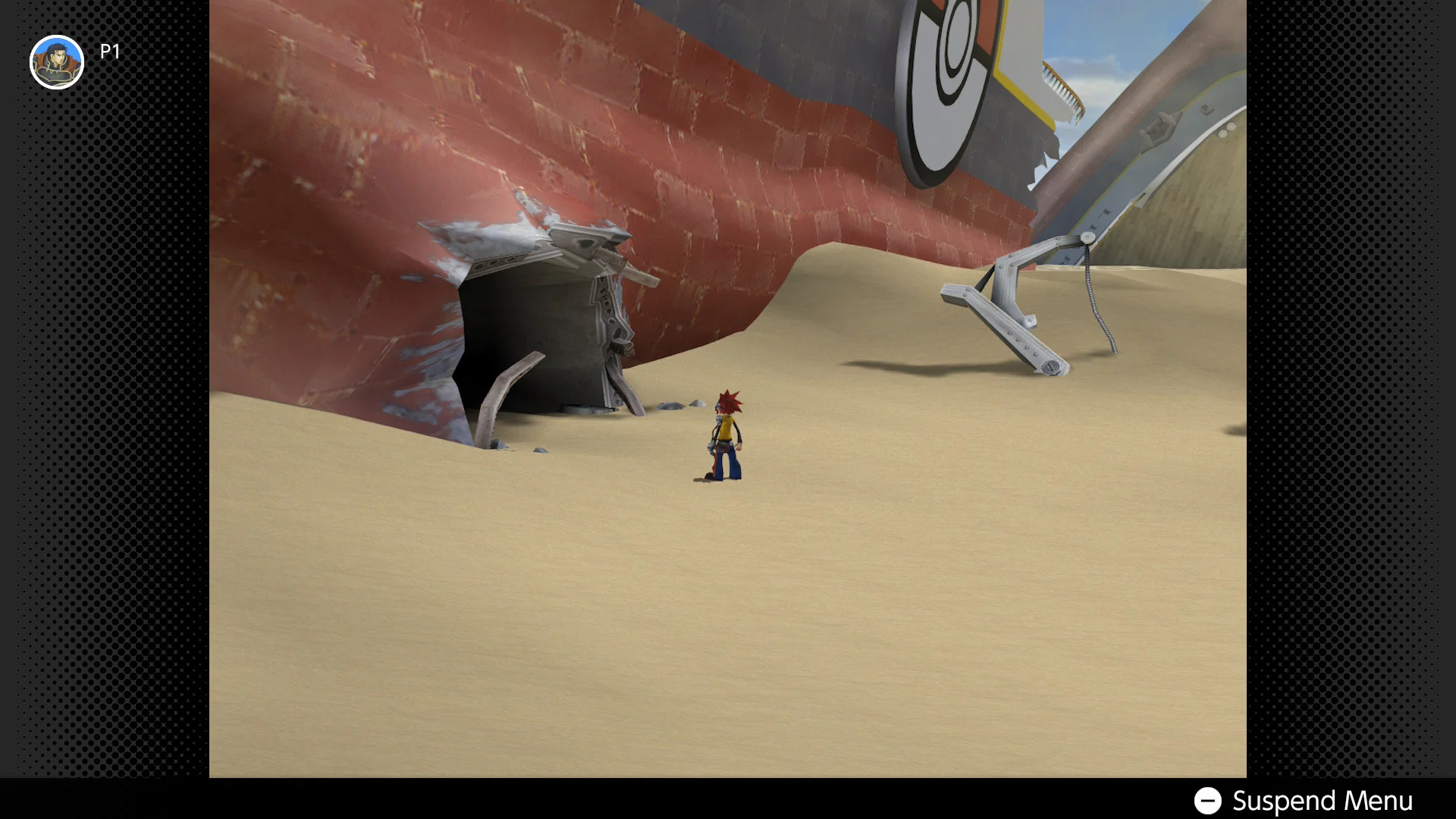
I’ve been speaking about both games in tandem because they share the same world, many of the same characters, and the same foundational structure and mechanics. However, Nintendo made the odd choice to release Pokémon XD: Gale of Darkness on the GameCube Classics service before its predecessor. XD is a direct sequel to Colosseum, after all, and many characters, locations, and plot points operate on prior knowledge of Colosseum‘s events. That being said, XD also introduces a bevy of mechanical tweaks and improvements over its predecessor, and a general premise and structure more in line with the mainline titles. In that sense, XD is a bit more approachable to newcomers who are fans of the main series.
Instead of playing as older teen anti-hero Wes from Colosseum, who went rogue from a team of villains (appropriately named Team Snag’em), Pokémon XD: Gale of Darkness places you in the shoes of Michael, a young boy whose mother works at a lab dedicated to studying the purification of Shadow Pokémon. Shadow Pokémon are Pokémon corrupted through experiments meant to increase their power, leaving them agitated and dangerous. It’s Michael’s job to don the Snag Machine and “snag” shadow Pokémon from the trainers misusing them and bring them back to the lab for purification. Although Wes defeated Team Snag’em (the group stealing Pokémon) and Team Cipher (the group turning stolen Pokémon into Shadow Pokémon) five years ago, they’ve come back with a vengeance and attack the lab, kidnapping Professor Krane to prevent further development of the Pokémon Purification System.
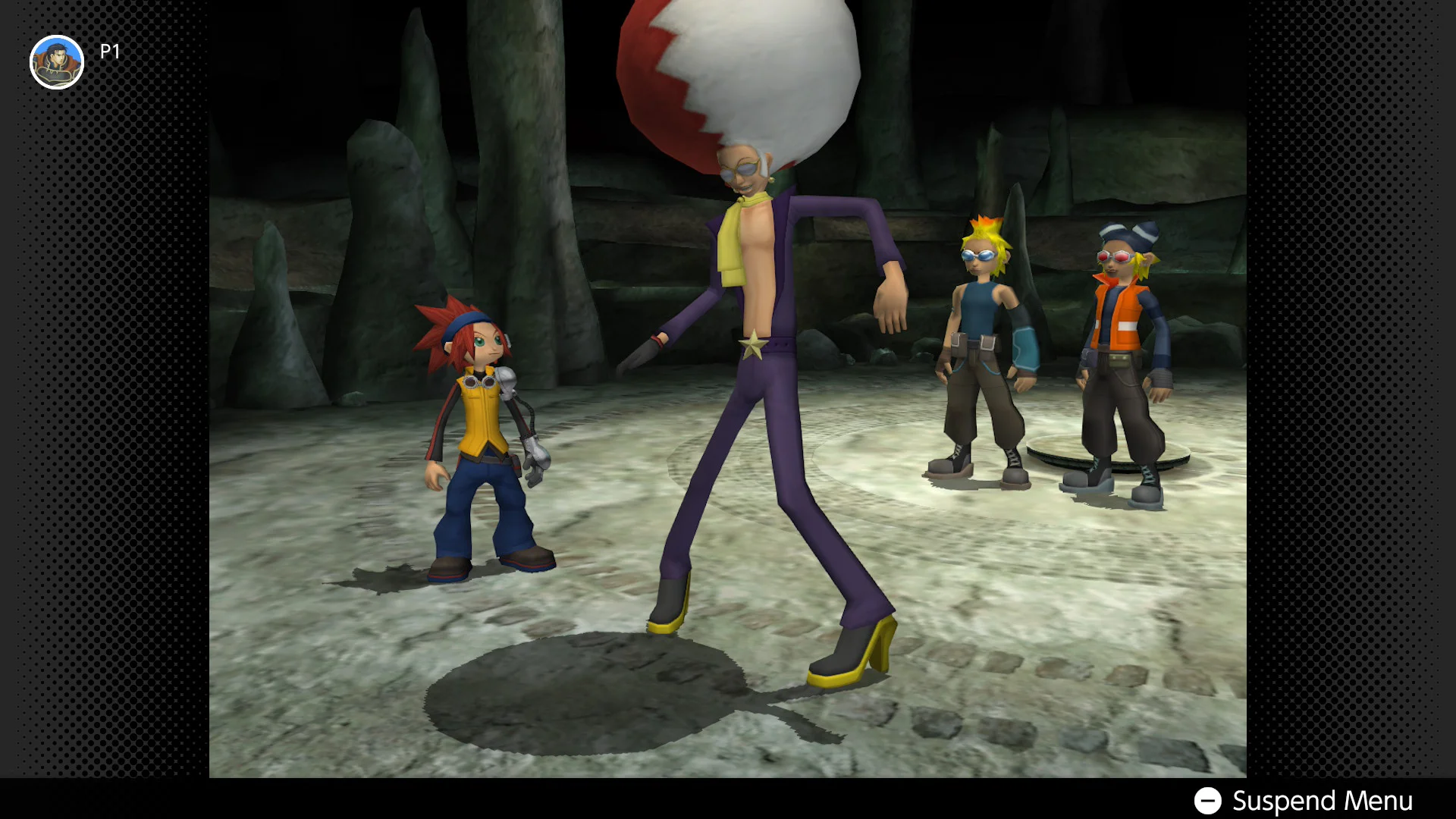
Michael sets out to save the professor, obtain as many Shadow Pokémon as possible, and defeat Team Cipher once and for all. A good premise, and although the game strikes a darker tone, it doesn’t take itself too seriously. There are many humorous moments in the writing, and fan-favorite characters from Colosseum, like disco-enthusiast Miror B., return to put a smile on your face. I particularly enjoyed old man Eagun’s attempts to send Michael emails, repeatedly cutting off mid-sentence as his old fingers fumble around and hit the “send” button by mistake.
Pokémon Colosseum was notorious for throwing the player into the deep end immediately: your starter duo (Espeon and Umbreon) begin the game at level 25, and most trainers have full teams of four to six Pokémon with good type coverage and movesets from the outset. Pokémon XD: Gale of Darkness eases the player in a bit more, starting Michael out with a level ten Eevee (which you can evolve into any one of the five evolutions available in Generation Three) and filling the starting location of Gateon Port with trainers who have low-level teams of just a couple of Pokémon each. This friendlier beginning quickly ramps up once you hit seedy Pyrite Town, and doesn’t let up from there.
Something that makes Pokémon XD: Gale of Darkness (and its predecessor) more challenging than a typical Pokémon title is that they adapt the double-battle format of competitive Pokémon into the single-player RPG framework. You always have to contend with two Pokémon at once, and trainers have team compositions and move sets to match. It’s not uncommon for NPC trainers to set up simple combos, like pairing a Pokémon using Earthquake (a move that hits the entire playfield) with an immune Flying-type Pokémon, or deploying a Pokémon with the ability Lightning Rod to soak up electricity damage aimed at their more offense-oriented Water-type Pokémon. Some NPCs will use Pokémon defensively, setting up barriers like Reflect and Light Screen for their entire team, or employing weather moves and stage hazards to boost their team or hinder yours throughout the match. These tactics are common in competitive Pokémon battling between players, but rarely exhibited by NPCs in the mainline games.
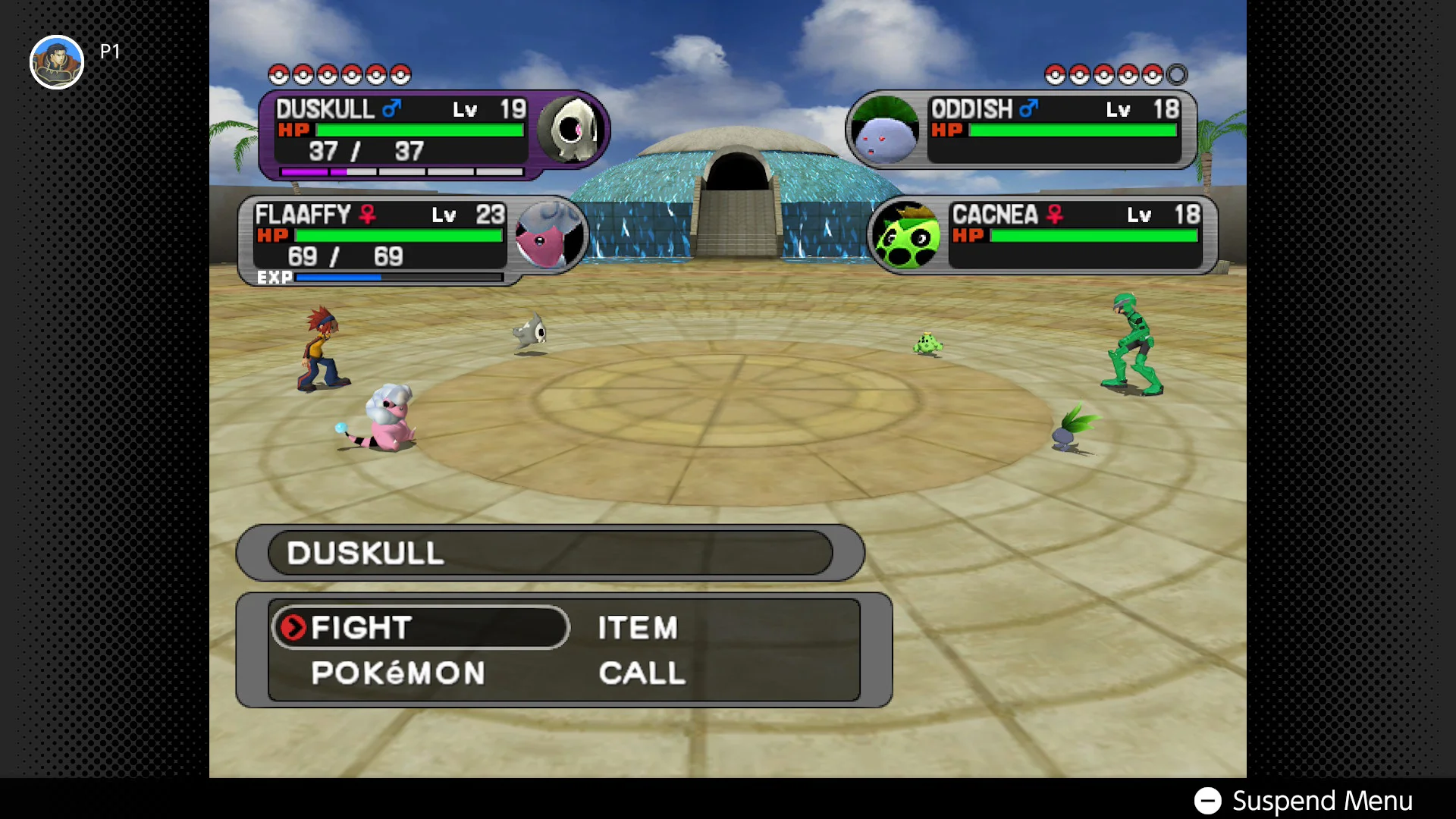
The downside of this added complexity is that the pace of battling in Pokémon XD: Gale of Darkness slows to a crawl; it’s not uncommon for a battle against particularly tough trainers to last as long as 20-30 minutes. However, what the game sacrifices in concision it more than makes up for in strategic engagement, as every battle demands your full attention, and trainers won’t hesitate to capitalize on even the smallest mistakes. Furthermore, switching is never “free” like it is in the mainline games: any time you swap one Pokémon out for another, you risk swapping into an attack from the opponent. These changes ensure that battles remain engaging throughout the journey and illustrate the depth and complexity of battle mechanics the series is capable of.
Perhaps the most ingenious wrinkle added to the formula is Shadow Pokémon. Shadow Pokémon are locked out of their normal move sets and instead have shadow moves that are super effective against all non-Shadow Pokémon. In Colosseum, all Shadow Pokémon had one shadow move (Shadow Rush), a physical attack with recoil damage. Pokémon XD: Gale of Darkness introduces a wide variety of different shadow moves tailored to each Pokémon’s stats and capabilities, including moves that hit multiple opponents, status moves, stage hazards, and debuffs. This change makes Shadow Pokémon much more useful from the player’s perspective, but also much more dangerous in the hands of a rival trainer.
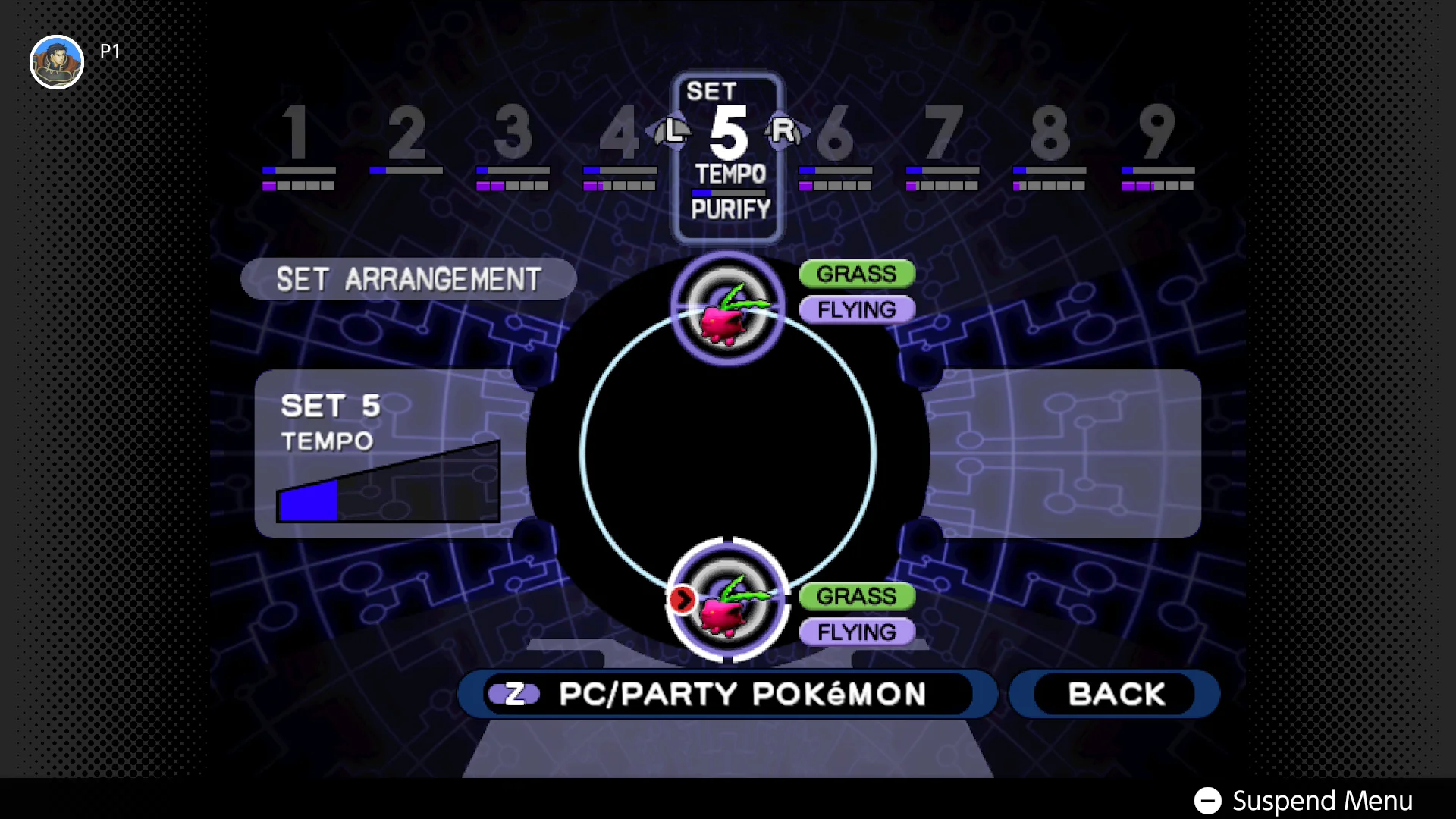
Shadow moves also mark the first introduction of the physical/special split, as some shadow moves scale off the special stat or physical stat despite sharing the same typing, an improvement carried into the mainline games for Diamond and Pearl. XD also improves the purification process: you can access the Pokémon Purification System from the PC, and direct already purified Pokémon to passively reduce the corruption of stored Shadow Pokémon instead of reducing their corruption through repeated battles.
Needing to “snag” Shadow Pokémon further complicates these encounters, as you need to weaken Shadow Pokémon mid-battle without knocking them out, all while they pummel your own team with super-effective attacks. This transforms the act of catching Pokémon for your team from a perfunctory cycle (weaken a single wild Pokémon, put it to sleep, throw a Poké Ball, rinse and repeat) into a delicate dance that demands a complete shift in strategy and planning. Status moves become immensely important to limit damage from Shadow Pokémon while eliminating the rest of your opponent’s team, freeing you up to focus on capturing that prized new addition to your roster. Late in the game, some opponents will have teams entirely comprised of Shadow Pokémon, forcing you into battles of endurance and damage mitigation where the smallest mistake causes a valuable Pokémon to slip from your grasp.
Perhaps the greatest benefit from the shift to a home console is the massive upgrade in production values compared to the main series. Each location is fully polygonal and full of fine details, breathing life and vibrance into the otherwise harsh, semi-dilapidated setting. The presentation in battles is particularly impressive, each Pokémon showcasing lively animations and pulling off moves with full articulation and flashy particle effects. Although the generation one and two Pokémon models are cribbed from Pokémon Stadium 2, and thus look a generation behind, all the generation three Pokémon models look fantastic, and the overall quality of the presentation rivals even the Switch Pokémon titles, in many cases even surpassing them. This level of polish extends to the trainer animations as well, with some of the most entertaining defeat animations in the series. The music shifts appropriately from bombastic to moody and eclectic, with a sound much closer to the Square Enix RPGs on the PlayStation 2 than to the bubbly, triumphant soundscape of the Game Boy Pokémon titles.
The main downside to this GameCube Classics release is that it is not compatible with Pokémon Home, so it loses one of the major features of the original (bringing in your Pokémon from the mainline games to duke it out on the big screen). However, this does force you to rely on the smaller roster of available Shadow Pokémon (83) and the handful of catchable wild Pokémon species (9), which provides a unique challenge and encouraged me to use Pokémon on my team I might otherwise never give a second glance.
Revisiting Pokémon XD: Gale of Darkness gave me a new appreciation for this pair of GameCube spin-offs. While XD lacks the grimier edge of its predecessor, the host of mechanical improvements and continuation of the Orre Region’s storyline more than make up for the slightly lighter tone. If high prices on the secondary market or apprehension around emulation have put you off trying this Pokémon spin-off before, now is the best time to jump in. Pokémon is at a bit of a crossroads after the Switch entries left many disappointed; Pokémon Champions seeks to cleave the competitive scene from the mainline franchise entirely rather than integrate the potential depth of its systems with the demands of a single-player RPG accessible to everyone. Pokémon XD: Gale of Darkness took the opposite approach, melding the fundamentals of competitive battling with the structure and progression of a traditional RPG, and ended up one of the most compelling games in the franchise despite its flaws. A glimpse of what could have been, and a reminder that the core mechanics of Pokémon remain strong today.