FromSoftware’s Souls franchise has grown from scrappy underdog with Demon’s Souls to towering RPG juggernaut with Elden Ring, catapulting the veteran studio from cult classic status into one of the most acclaimed RPG developers in the industry. That overwhelming level of success encouraged a flood of similar action RPGs from developers all over the globe, from studios big and small, seeking to get a piece of that Soulslike audience. Yet another movement has been building, smaller and quieter but nonetheless persistent, of indie developers. These developers draw inspiration from FromSoftware’s lesser-known yet monumentally important original foray into RPGs with their first-person dungeon-crawling franchise, King’s Field.
Rather than focusing on the build crafting, expansive scope, and complex, animation-heavy action combat system that defines FromSoftware’s current work, these developers seized on the more modest scale and limited yet atmospheric presentation of their earliest work. It’s an attainable goal, but also a rich canvas for exploring the genre’s most fundamental adventure: the deep, dark dungeon crawl. Queen’s Domain is the latest attempt to recapture and revitalize FromSoftware’s early formula for a modern audience, and it is as much a loving homage as it is a successful reinvention of the concept.
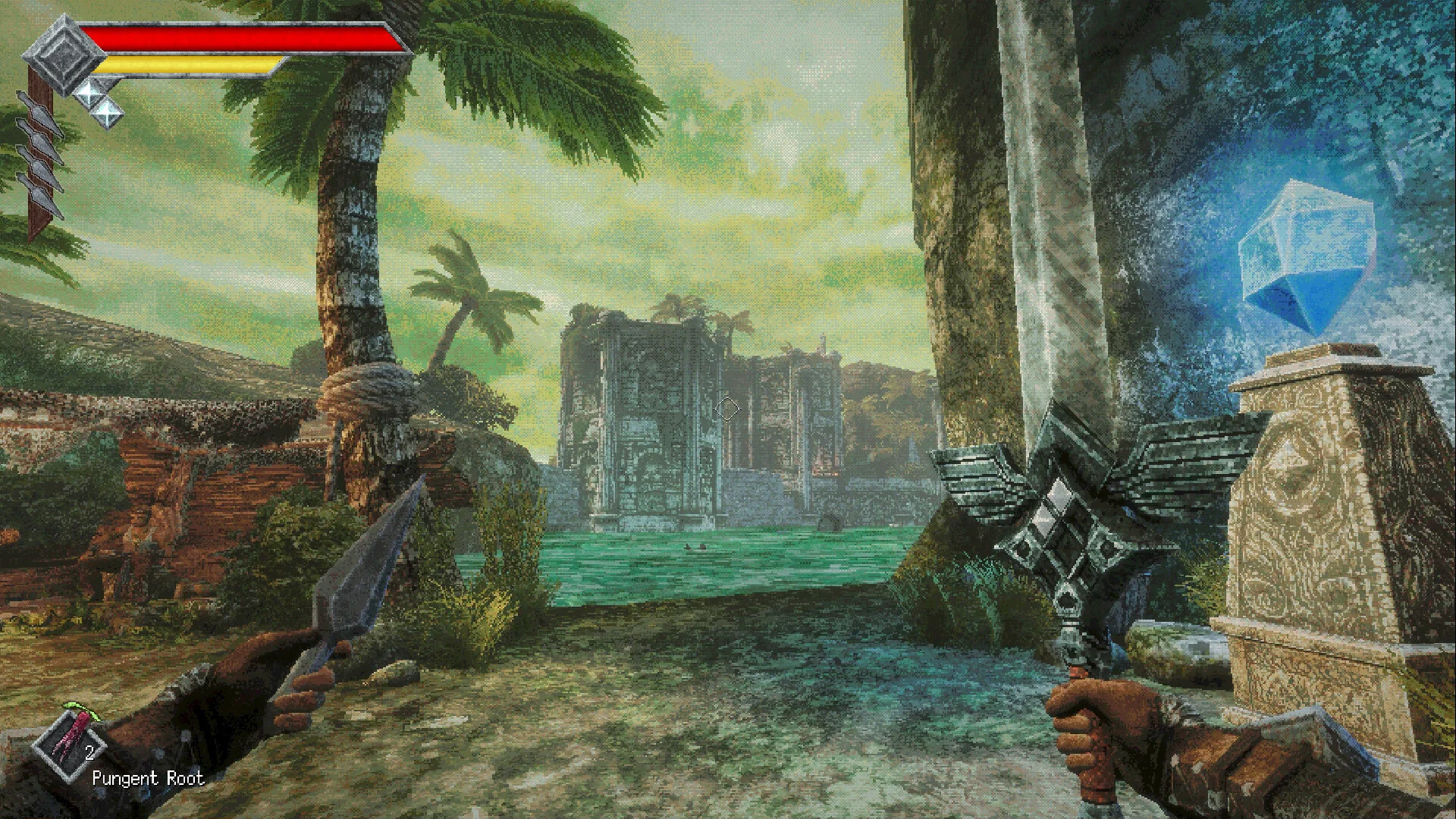
Queen’s Domain puts players into the shoes of a prince who has washed up on the shores of the mysterious Isle of Neasied in search of his father and the retinue of knights who embarked on an expedition to the island. The island remains uncharted, covered in decrepit ruins that hold untold secrets, tempting many a traveler to its remote shores in the pursuit of treasure or discovery. Exploring this island, both to find the whereabouts of the king and eliminate the dark evil he came here to vanquish, is your ultimate goal, borrowing heavily from the setup of the first King’s Field title. Despite the familiar narrative setup, Queen’s Domain offers little direction on how to move forward. The game trusts your ability to experiment, explore, and find your own path, even if that means getting a little lost in the process. That sense of freedom is key to King’s Field‘s enduring legacy, and Queen’s Domain displays a fundamental understanding of how vital it is to let you stumble around, get lost, and eventually feel triumphant when you find a new path.
Queen’s Domain‘s greatest strength is the carefully crafted level design. The Isle of Neasied is made up of a broad range of lush outdoor environments and dark, foreboding interior locations that meld together seamlessly. Queen’s Domain rejects the wide-open flat spaces of King’s Field III in favor of the vertically labyrinthine structure FromSoftware employed in King’s Field: The Ancient City, Shadow Tower Abyss, and (most famously) Dark Souls. Your path forward often involves traveling up toward towering structures or deep down into the murky depths impossibly deep beneath the tropical island, connecting each area logically through a vast network of organic shortcuts that loop back to the island’s surface in one way or another.
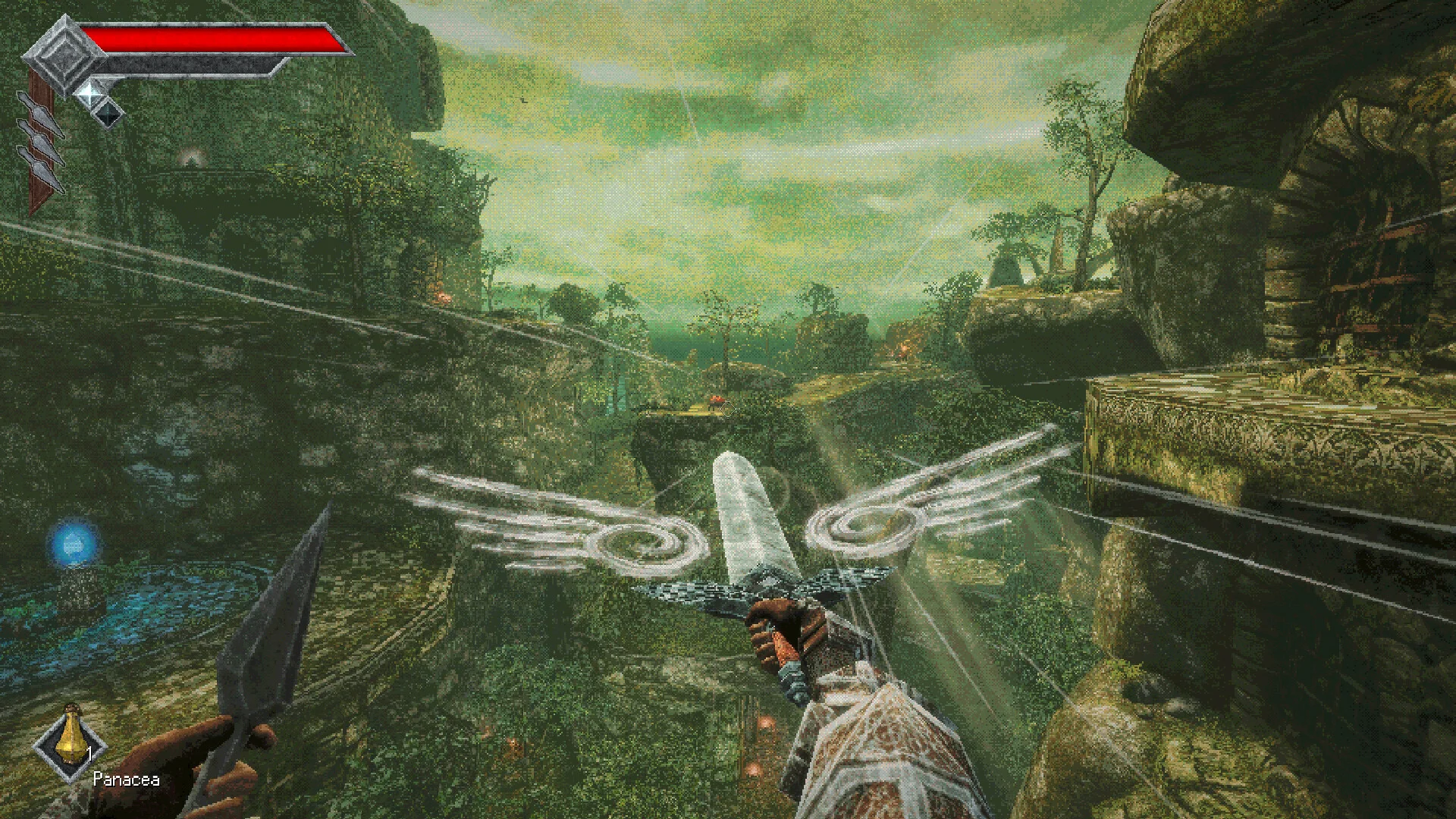
Queen’s Domain sports some truly inventive traversal mechanics. The game does away with the slow, plodding footsteps of past King’s Field protagonists, establishing a quicker pace and more interaction between you and the world. Furthermore, the Holy Sword of Endu (an ancient weapon pulled from a stone in a shrine not far from the start of your journey) proves itself a powerful weapon and your most important tool. Using the sword’s special attack, you dash forward while on the ground or glide forward when in the air. As you acquire more Wind Stones hidden across the island and slot them into the sword’s hilt, you can chain more dashes together to span gaps or glide down from cliff faces. There’s no fall damage, so the game encourages you to take these massive leaps of faith, trusting in the sword to see you safely to the other side.
The level design is built entirely around this key mechanic, and that fluidity of movement and expanded environmental scope coordinate, turning what could be a ponderously slow dungeon crawl into a snappy acrobatic tour de force. Every piece of level geometry becomes a possible ledge to land on, every solitary outcropping a chance to find a new piece of treasure. During most of my explorations on the island, I found myself scanning every outcropping and ruined structure, internally measuring the distance against my current reach, and trying new maneuvers that in any other game would be unintended sequence breaking.
One example came early in my journey, when I faced a locked gate to a shrine. Peering through the gate’s iron bars, I realized the back wall of the structure had fallen, leaving an opening just big enough to squeeze through. Unfortunately, this wall abuts the open sea, so there was no clear path to enter as long as my feet remained on the ground. Using a couple quick lunges with the Holy Sword, I was able to fling myself above the open ocean and dash back inside through the opening. Not only did I gather the healing items contained within, but activating the mechanism pulled back a stone slab outside the shrine to reveal a stone staircase. Queen’s Domain consistently rewards this risky exploration through well-placed secrets and compelling loot, and the complexity of these traversal puzzles only increases as you gain more dashes.
Queen’s Domain‘s approach to combat is initially quite derivative of the classic King’s Field titles, but adds just enough to differentiate from its inspiration. Most combat encounters see you swinging away with a melee weapon in your right hand. The stamina system matches King’s Field, placing an emphasis on deliberate charged strikes rather than slashing away at enemies wildly. The tried-and-true circle strafe maneuver that brought success in every King’s Field game only works on the initial set of enemies on the Isle; later foes are faster, employ ranged attacks, and inflict a myriad of status ailments to keep combat engaging throughout Queen’s Domain‘s lengthy journey. This vertical level design focus applies to the encounter design, as many enemies are placed in high, hard-to-reach locations alongside beefier foes on the ground, forcing you to remain mobile while prioritizing multiple threats at once.
However, Queen’s Domain grants a few unique tools to even the playing field: throwing weapons and magic weapons. You acquire a throwing knife belt early on, providing a means to fight back against the laser-firing Eye flowers that reside on the Isle’s various cliffs and ruins. These throwing weapons serve a dual purpose, activating hard-to-reach mechanisms or inflicting status effects on enemies from a distance. The choice to include ranged weaponry illustrates Freshly Baked Games‘ familiarity with deeper cuts like Shadow Tower Abyss without neutering the difficulty. Ammunition is limited, and weaving between melee strikes and flinging projectiles from afar makes encounters more dynamic and allows the enemy behavior to be significantly faster and more aggressive than FromSoftware’s classics.
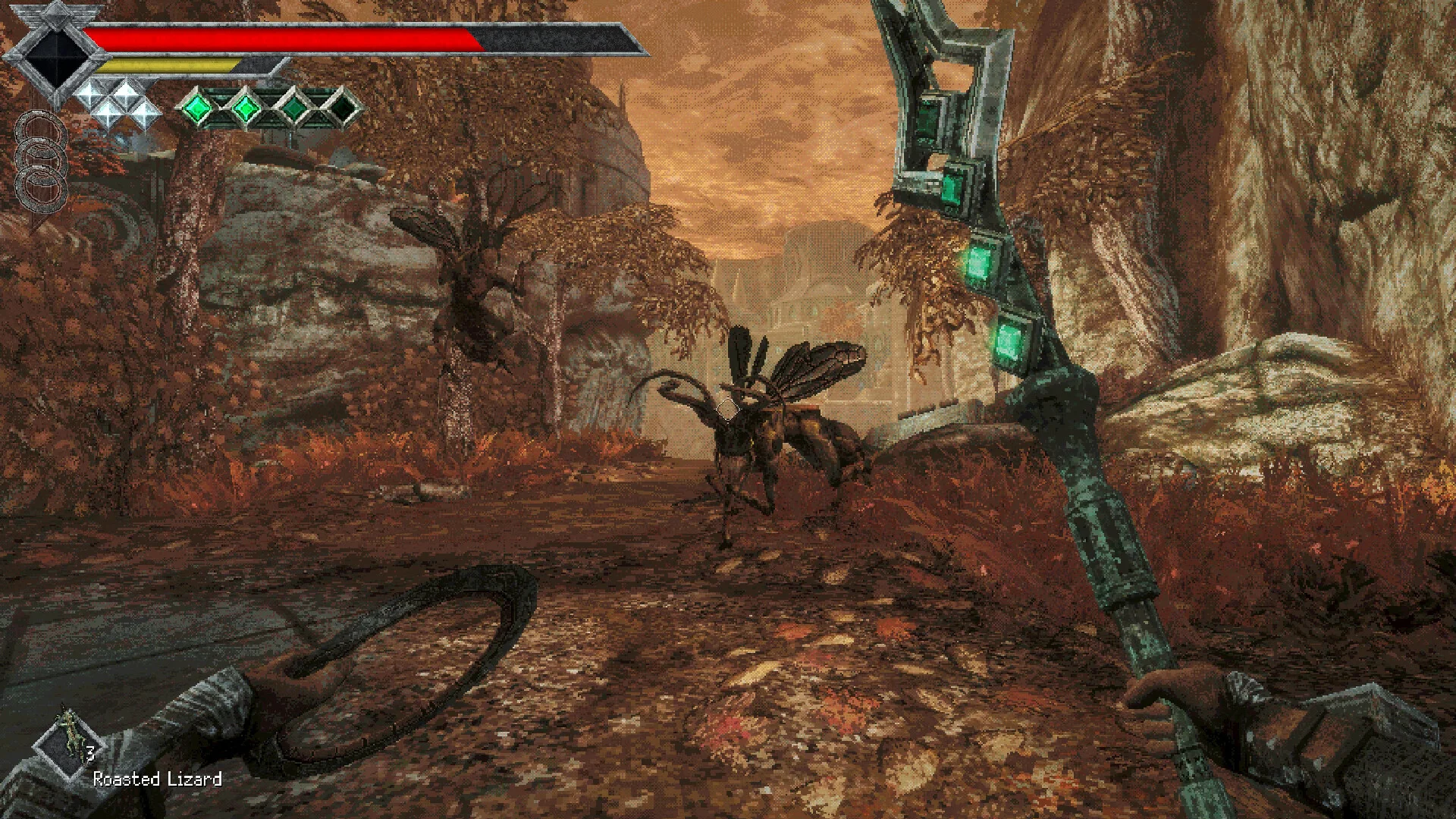
Magic weapons are one of King’s Field‘s defining elements, and Queen’s Domain grants you an extremely varied armory with unique effects and clear identities. Returning to the exploration sequence I detailed above, my descent down the stone steps put me face to face with a giant skeleton mini-boss wielding a magic blade of his own. After a tough battle, I emerged victorious and looted the chest he was protecting. Inside was a rusted pole hammer with no special properties, an initially anticlimactic reward. Only after wielding the hammer enough (weapons level up when used) did it evolve into its true form: a black pole hammer fitted with magical gems that summon homing void orbs that track the enemy and explode into a destructive black hole. Nearly every weapon in the game has some special property or attack like this, encouraging experimentation in combat encounters. Most of these weapons start out in an underwhelming rusty state, allowing Queen’s Domain‘s loot to remain surprising throughout the game’s prodigious runtime.
The significant game length is the only dulling aspect of an otherwise shining homage. There are over ten distinct areas, and most locations are unique in their visual style, topography, and monster menagerie capstoned by inventive boss designs. Only in the middle does the otherwise brisk pacing start to drag, as the Deimpo Mausoleum forced me to backtrack through the dungeon I had just thoroughly explored in search of arbitrary glowing spots only visible with a mask found at the end of the dungeon. Activating these glowing spots opened the way to the Queen’s Domain‘s most underwhelming boss encounter, an attempt at an Ornstein and Smough duo that falls flat since they are just overgrown versions of the bat and spider enemies I had already vanquished hundreds of times. The circular arena exacerbated their lack of threat, as walking backward and pelting them with knives was enough to emerge victorious.
Thankfully, the later game areas are all fantastic, bringing in a mix of fantasy staples and science fiction elements that call back to FromSoftware’s past forays into other settings. These late game areas are laid out non-linearly compared to the Isle of Neasied’s initial regions, similar to Lordran’s open-ended layout after Anor Londo, and I appreciated the greater degree of player agency for the last legs of the journey. Queen’s Domain clocks in between 30-40 hours depending on how thoroughly you explore, two times the length of the longest King’s Field title, leaving the middle section of areas like the Mausoleum feeling more like padding than the rest of the game.
The amateur attempt at more traditional storytelling here through NPC interactions and left-behind notes similarly falls flat, culminating in a very anticlimactic reunion with the king halfway through the game, after which the direct narrative fades. The game also employs weapon descriptions to convey its lore and world-building much like Souls titles, but these blurbs come across as a random assortment of confusing proper nouns divorced from their context rather than conveying distinct cultures or histories. Other indie attempts at the formula (like Lunacid and FlyKnight) strike a better balance between environmental and traditional storytelling, but Queen’s Domain is at its best when it lets the world design do all the talking.
Although Queen’s Domain is not nearly as cohesive in its world-building and narrative as FromSoftware’s best work, it nonetheless delivers a beautifully crafted world full of inventive level designs that make great use of its unique traversal mechanics. It wears its inspirations on its sleeve, but avoids the trap of remaining too slavishly devoted to an earlier era’s design template (despite what the tongue-in-cheek title may imply). The open-ended progression even evokes an immersive sim at times, rewarding exploration and refusing to hold your hand. Instead, Queen’s Domain guides your journey through genius-level layouts and a compelling sense of discovery. If what lies beyond the next shrouded dungeon passage is enough to propel you forward despite the lack of narrative motivation, then Queen’s Domain is a journey worth taking.