
Disco Elysium took the gaming world by storm all the way back in 2019 with its unconventional storytelling, grim world, and unique gameplay that almost emphasizes failure over success to drive the narrative. Rue Valley has been endorsed by some of the team behind Disco Elysium, and has been frequently compared to it. Make no mistake, this is not Disco Elysium. Far from it.
Right out of the gate, we get to create our very own Eugene Harrow, the protagonist of this interactive novella. Similar to the character building in Disco Elysium, we get to decide just how neurotic Eugene is. Is he so extroverted that he’s a giant pain in the ass to everyone, or is he so calculated that he’s a paranoid mess? You get to decide! Unfortunately, these stats do little to shape the narrative or gameplay, but more on that later. At the very least, this primes the story and gets us settled in for what kind of game Rue Valley hopes to be.
Out in the desert at 8PM, we end our first therapy session with Dr. Finck. We get to our motel room, unpack our bag, wander around the motel, and eventually witness a space launch or some explosion off in the distance that blinds us. And then—wait, are we back in Dr. Finck’s office? Did we space out an entire day and start our second therapy session? No. Quite the opposite.
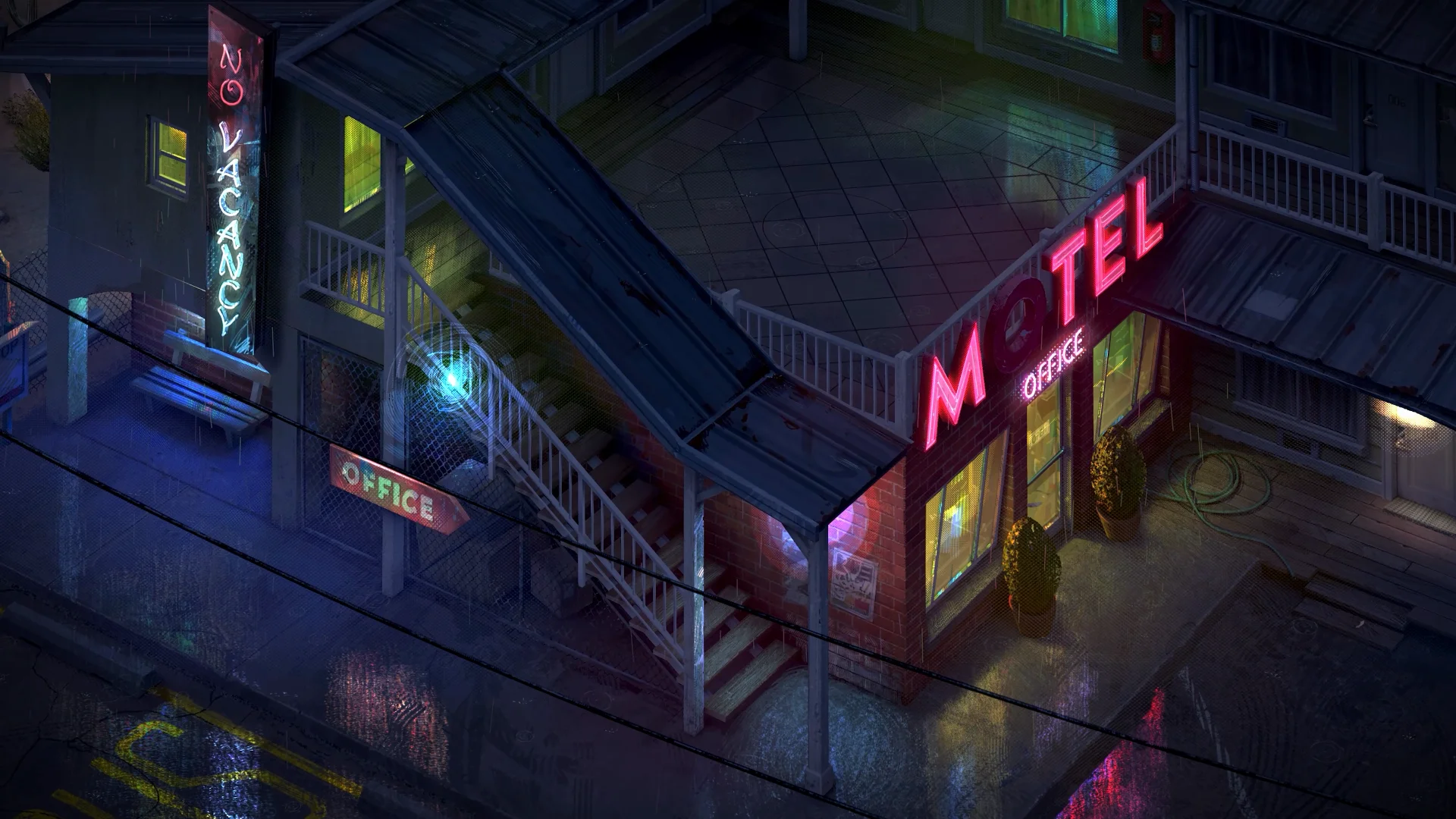
Rue Valley is a time loop game in which we relive the same 47 minutes in perpetuity, like a miniature version of Groundhog Day. What unfolds is a dive into Eugene’s psyche—and potentially every human being’s—as he battles his way out of the time loop. He gets to know the denizens of this remote area, discovers clues to what the hell’s going on, and enjoys a healthy dose of madness.
Part of Rue Valley’s charm is that it goes places, diving into the psychology of a hamster in a wheel. As you may have predicted, the fun lies in the storytelling. Some of the time. Parts of Rue Valley are absolutely captivating with rich language and vocabulary reminiscent of Disco Elysium, albeit with far less wild banter. Rue Valley plays it straight almost the entire time, aside from occasional dialogue options in which Eugene can speak as one of his neurotic characteristics.
Much of Rue Valley can feel like a walking simulator in isometric view. Initially, expectations lead us to believe we’ll be on a series of multiple quests occurring simultaneously as we explore a world full of intricate details that unfold based on our decision-making. Not so. Unfortunately, Rue Valley authentically feels this way only in the first few hours, then quickly becomes a linear jaunt through a small world that we must repeatedly explore over and over and over again.
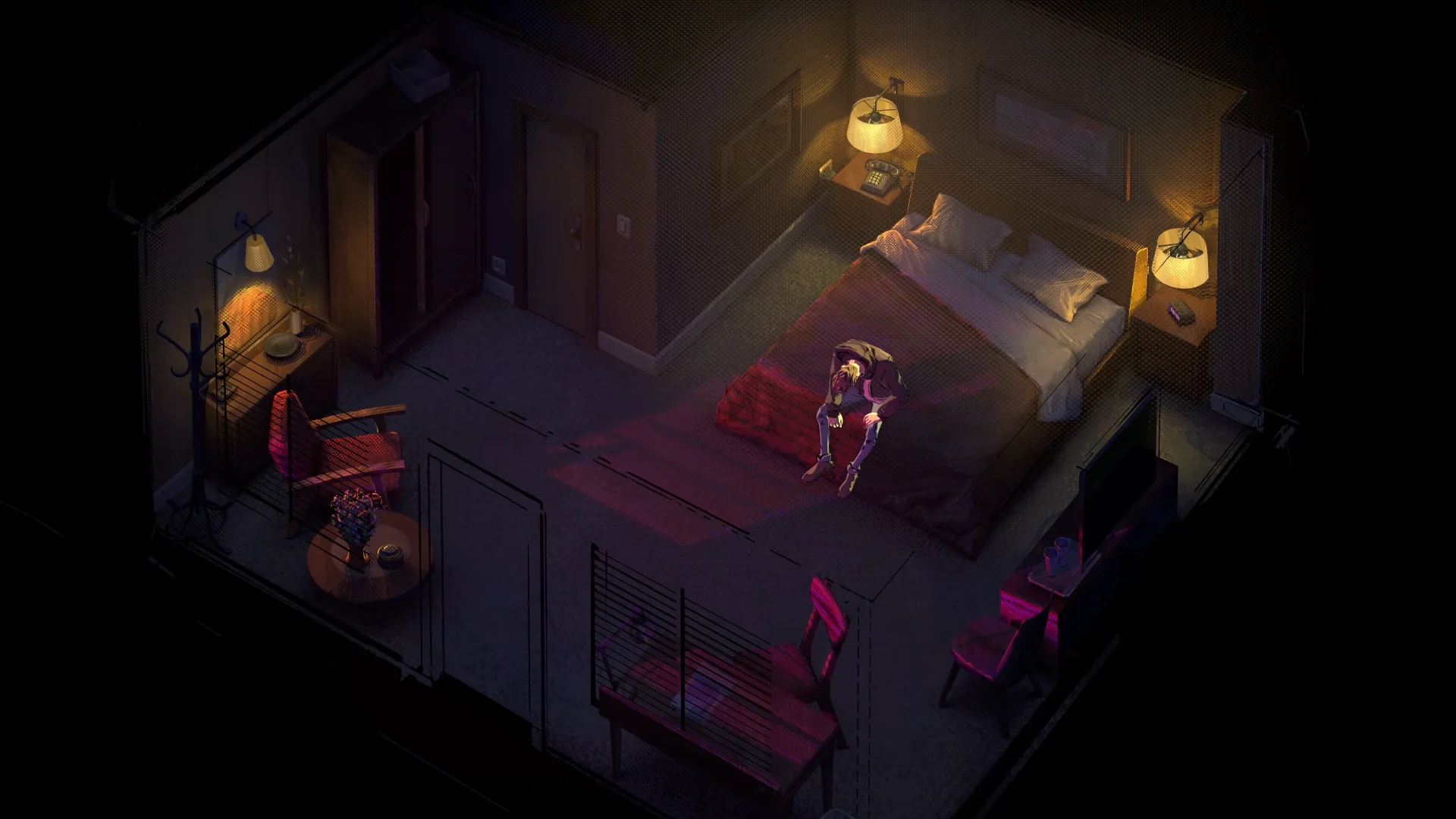
Perhaps the goal was to make us feel like Eugene—the repetitive nature of it all driving us mad, just like him. His experience becomes our experience. I’ve dabbled in games like this that are less about “fun” and more about making a statement. If that’s your bag, then there may be something here, but I imagine most of us want to spend a 20-hour game enjoying ourselves, or at the very least have our time respected. Navigating the world becomes easier with time, but expect to see a lot of the same transition scenes (like walking or driving) as Eugene goes from point A to point B to hopefully unlock one more clue.
In this way, Rue Valley can feel cumbersome and clunky. Walking feels stiff, and Eugene trots around with little urgency, no matter what’s going on. In one particular area, I kept getting caught on the corners of objects in the field, which made an already laborious experience more excruciating. As this is a time loop in which examining differences across the 47-minute hell Eugene resides in is core to the experience, on more than one occasion I felt as if I were spinning my wheels for crumbs that ultimately went nowhere.
That isn’t to say all of Rue Valley is a chore. When new experiences arise, we make a significant discovery, or Eugene has some sort of psychological epiphany, Rue Valley is at its best. The writing is so descriptive and rich that I felt like a starved man sitting in front of a succulent meal about to dig in. Unfortunately, the pace and flow of this 20-hour game is one in which we feel like we’re dragging our feet rather than sprinting ahead, which makes those juicy bits feel less and less appealing as we anticipate the promise of another dry spell.
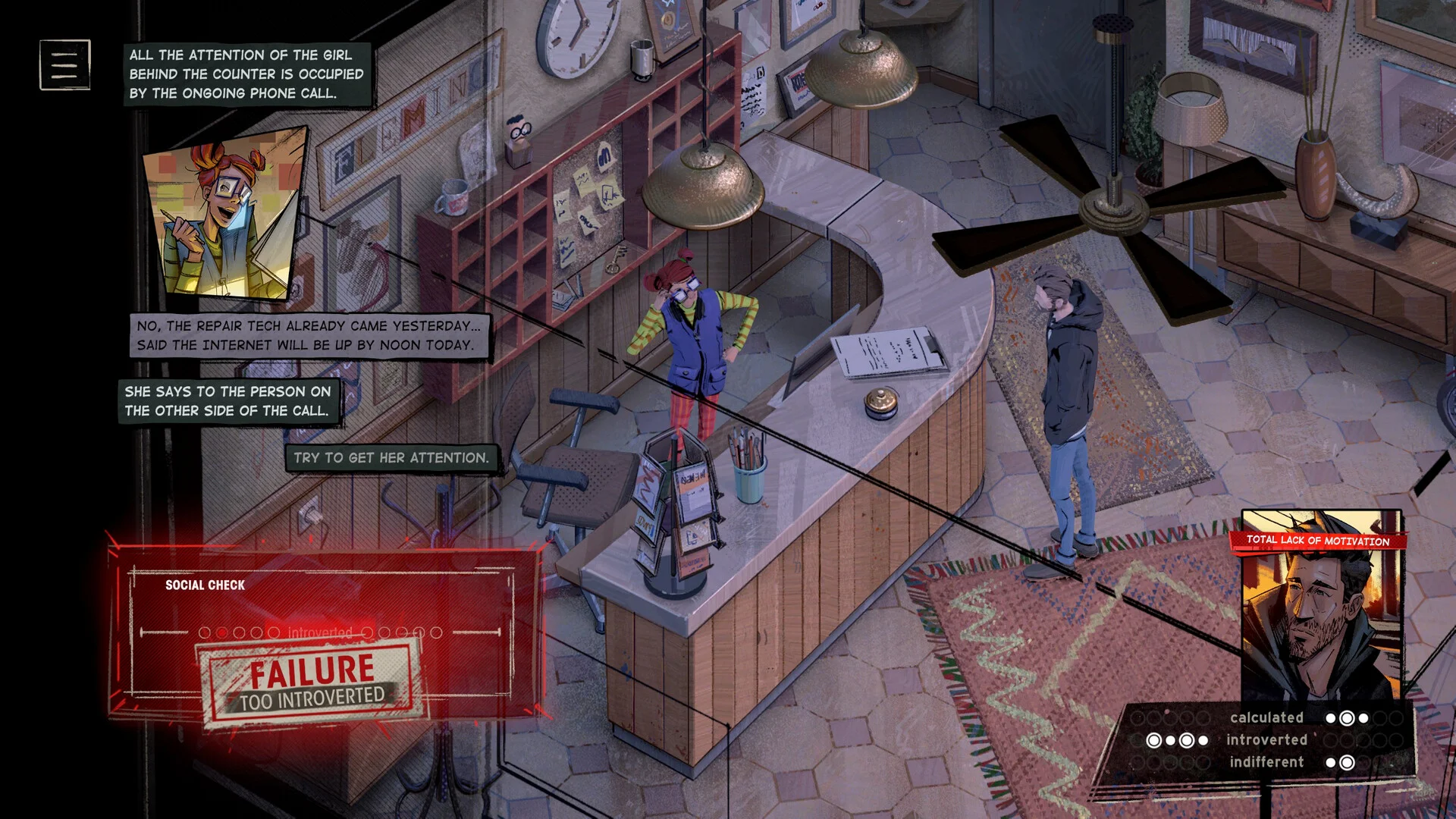
Which is a shame, because Rue Valley goes to some truly fascinating places. The writers have a lot to say about life, the human condition, and rural America. As eloquent as the writing can be throughout, prepare to learn a good deal about family histories and local politics that may (or may not) have substantive relevance to the plot. After getting a fact dump, I frequently wondered: why?
The art style can feel like watching an interactive painting, and if you look close enough, you may even notice some fascinating methods in the lining and coloring Rue Valley’s world. While not the most attractive art in a traditional sense, it is uniquely Rue Valley, and that’s worthy of praise. Unfortunately, the desolate world in Rue Valley won’t inspire awe, and much of the most noteworthy visual effects occur in the sky, which we never get to see on account of the isometric viewpoint. Here, I’m reminded of Final Fantasy VII Remake; Midgar’s detail is incredible, but the slums aren’t the most eye-catching environment.
Musically, much of Rue Valley’s light, ambient instrumentation recedes into the background, though the most somber moments are tastefully coupled with heart-rending tunes that opt for a softer touch over sorrowful horns and strings. Much of Rue Valley’s voice acting falls between capable and excellent. Expect rural accents, lines delivered straight with little emotion, and words that don’t match what’s printed on the screen. While Rue Valley has much to say about this and that, much of the script lacks drama. Most folks here are beaten down by monotony, a disappearing community overtaken and abused by corporations, and meeting an outsider they don’t really care to know (that’s you).
Rue Valley has something to say; in fact, it has some things to say. Unfortunately, philosophical intrigue is mired in inconsequential tongue wagging and book reading, as well as gameplay mechanics that feel left at the side of the road close at the start. While I love the vision and ideas, Rue Valley misfires on the launchpad and never makes it into the stratosphere.