
Looking at and listening to Shadows of the Afterland, one may think they’ve traveled back to 1988, to the heyday of point-and-click adventure games from the likes of Sierra Entertainment and LucasArts. The experience of playing it, though, is far smoother and easier than those games it harkens to, for better or for worse. Is this there-and-back-again murder mystery into the afterlife worth the short time it asks of you?
The story begins in Madrid, 1960. Pilar Cuevas is a tired mom, overworked at her job as a maid, who stops by the zoo each night to confide in a caged tiger. Like the tiger, Pilar is trapped in life. She wants more time with her child, less with work. As the zoo is about to close, Pilar’s soul is suddenly ripped from her body, and her incorporeal form is forced to watch as her body inexplicably climbs onto the railing of the polar bear enclosure… only to be struck dead by a lightning bolt.
Her body toast, Pilar’s soul/ghost travels through a portal into the afterlife, which begins in a sort of visa processing office not unlike the afterlife in Beetlejuice. As if being dead isn’t bad enough, Pilar has no memory of that 1960s zoo, nor of ever being Pilar. Instead, she’s adamant that her name is Carolina, a cop pulled back from 1988 whose birth date is several weeks after the zoo incident. The twofold mystery of Shadows of the Afterland involves figuring out what happened to Carolina/Pilar and navigating the oddities of the afterlife.
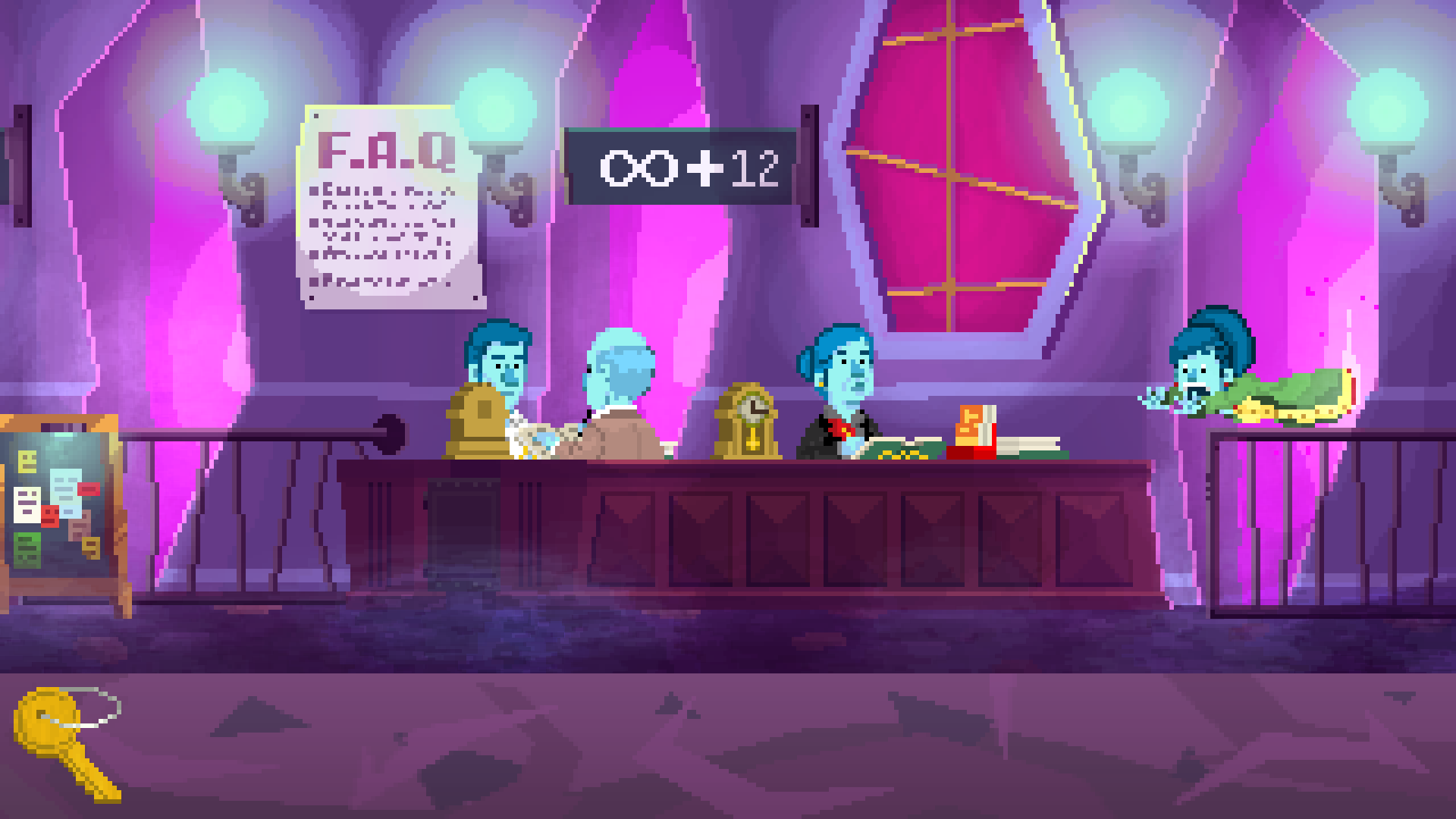
Shadows of the Afterland portrays a very heady mystery that takes an hour or two of rather menial puzzle solving before it starts to make sense. There are a few confusing plot points and character motivations that fell flat (is Pilar’s husband a deadbeat or just down on his luck?), though as a whole the dialogue is well-written and full of personality.
The strongest writing comes when asking other ghosts about their deaths. Given the setting of 1960 Spain, the game’s underlying theme seemed to be martyrdom—people dying for the sake of ethics and progression—as the Spanish Civil War and the Francisco Franco dictatorship are mentioned in hushed passing. However, this compelling background to the story is sidelined by a more straightforward murder mystery and a villain who feels more whiny than fearsome.
Shadows of the Afterland’s visuals are a great mixture of cartoony designs and bespoke pixel art that remind me of Day of the Tentacle. Locales range from the mundane (a library, a gym, an office) to the spiritually exotic: a shop where new baby-souls are made from a cauldron, a reincarnation portal run by a sleazy salesman, a building for “ascension” where pure souls essentially pass through nirvana into whatever lies beyond.
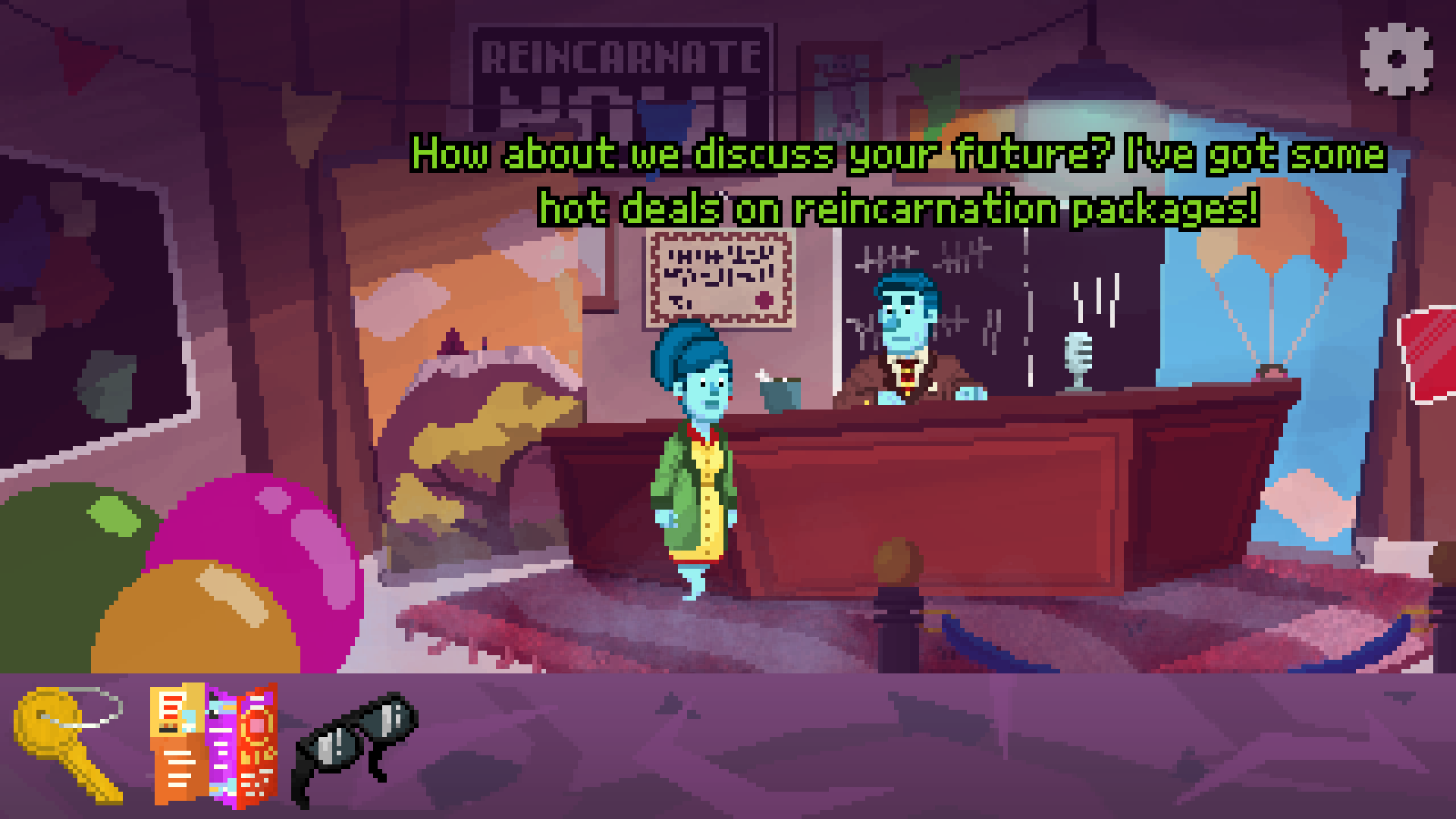
The afterlife looks quirky and colourful, and the ghostly Carolina/Pilar glides around things quickly and smoothly, even in the Switch’s handheld mode. Environmental clues are easy to spot, and text can be resized for easy reading. There’s also a button to highlight all interactable points on each screen.
Shadows of the Afterland can be played like a PC point-and-click game using the right analog stick as your mouse, or via assigned buttons to cycle between objects in the environment. A combination of the standard and console controls is needed, especially for using items in your inventory on the environment. Using the “mouse” is a bit finicky, and touching another button/stick in the slightest resets the mouse, so I found the controls a tad frustrating when there was a lot happening on-screen.
The bulk of the game’s four-hour or so runtime is spent floating back and forth (to call it “backtracking” would be generous) to solve puzzles. The puzzles are among the easiest I’ve experienced in the adventure genre, usually infamous for exceedingly obscure solutions in terms of inventory items. Much of Shadows of the Afterland is remembering a unique item in a certain location and running back for it or for another scrap of conversation with a ghost NPC. The hardest puzzles are in its opening hour—everything beyond will likely have even new players’ brains two steps ahead of Carolina/Pilar.
For example, a newly arrived ghost is upset about how he died and is berating the arrivals clerk, whom we need to ask a question. To soothe the upset ghost, we need a magical microphone to sing a lullaby. To do that, we need a fake mic to replace the magic mic. To do that, we need to convince a wandering soul to reincarnate into his next life. Conceptually, it’s rather ridiculous to have the story come to a grinding halt and to do a multitude of more difficult chores in order to solve an extremely simple problem.
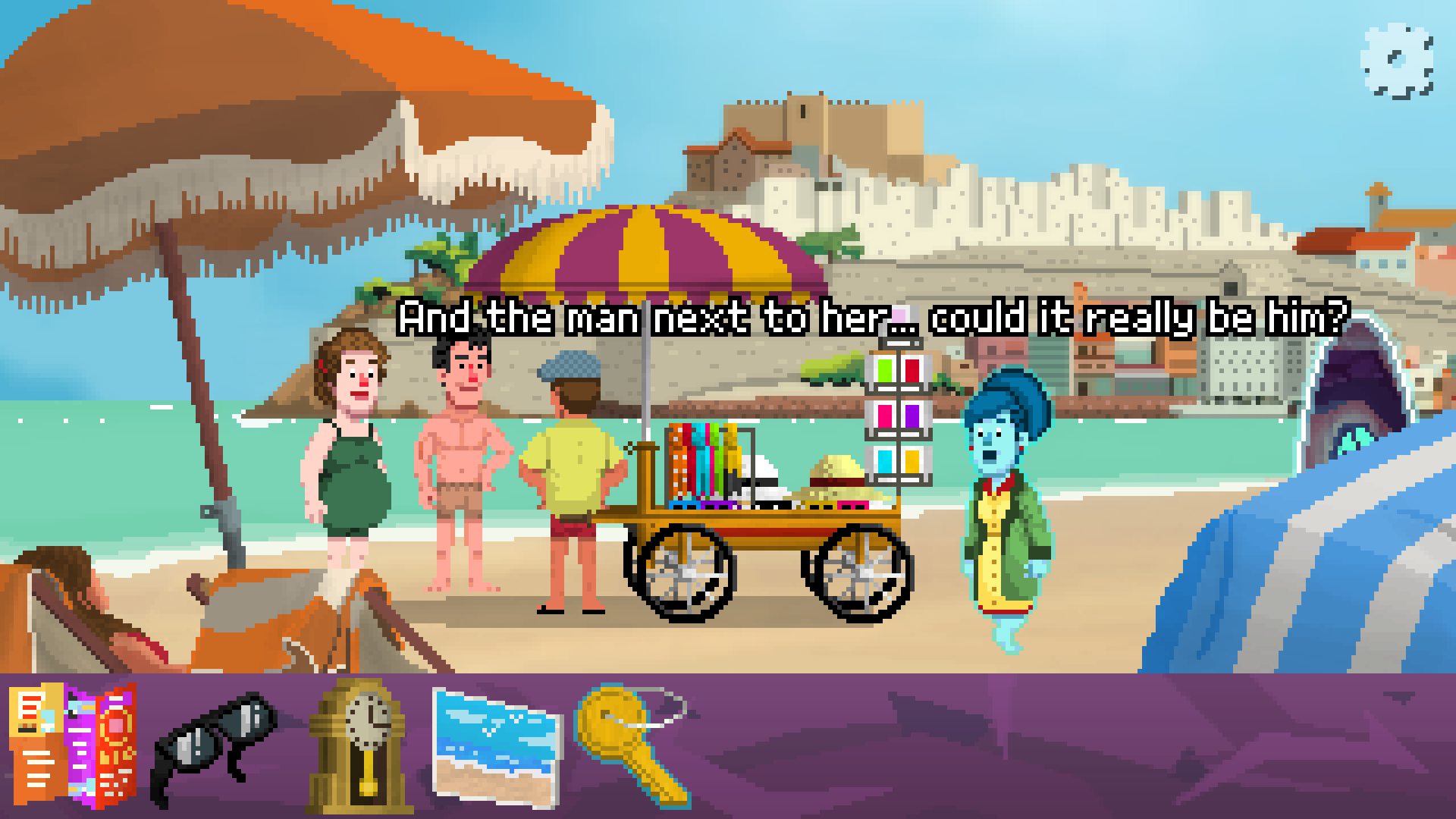
When the story does really pick up in the latter half, we experience many of the best moments through cutscenes, and then regain control when it’s time for mundane chores again. Shadows of the Afterland‘s advertised possession puzzles, in which you hop in and out of the bodies of the living, were more interesting but only came into play a few times. I would have liked more single-screen puzzles like this and less bouncing around the world map.
The soundtrack in Shadows of the Afterland, composed by Juan R. Salgueiro, is playful, atmospheric, and unobtrusive, in the way the best LucasArts soundtracks were. The English voice acting is hit-or-miss. Carolina/Pilar makes for a strong protagonist with a bit of a rebellious streak, and some NPC ghosts like the street salesman Gaspar or the retired cop César read their lines with compelling emotion. Other line reads can be strangely wooden or overacted (though I’d prefer that to the wooden reads). Odd, too, are the infrequent f-bombs and other cursing that feel out of place with the game’s visuals and puzzle simplicity.
Shadows of the Afterland is a better point-and-click adventure than many adventure games in the ’80s and ’90s, though it never quite reaches the heights of the giants of the genre. Its puzzles are simple, sometimes to the point of dissatisfaction, but it makes up for this with its setting and, to a lesser degree, its plot. To play it, you’ll think you’ve died and gone to… well, not quite heaven or hell, but a place between.
5/6/26 Update: The original version of this review erroneously attributed some comments on the dialogue to a translation concern, though the devs reached out to us to clarify it was written in English first and then translated to other languages. No other content or scores have been changed. RPGFan apologizes for this error.