
Towa and the Guardians of the Sacred Tree feels as if playing an anime town builder with Hades-like combat on the side. While enjoying aesthetics, humor, and story beats similar to slice-of-life anime in parts, I find it difficult to know exactly where TGST’s central voice lands. That said, games don’t necessarily need a single gameplay mechanic, as we see with titles like Darkest Dungeon. At the same time, I’m not always sure what the core experience is supposed to be—or which I enjoy more.
TGST follows Towa and her guardians as they attempt to drive off a blight devastating their land. With little mana—the life force—left, civilization may be doomed. Worry not! This quirky entourage has the drive and extremely restrictive abilities to thwart the Magaori.
While that is the central plot, the way the town Towa and friends protect changes as Towa time leaps whenever her friends defeat Magatsu (boss Magaori) is even more compelling. It’s not a new concept, yet we get to witness townspeople grow old, have kids, people move in, people leave, die, and struggle to make their dreams a reality. Life happens, and this part of the storytelling has some genuinely emotional moments. Still, expect some silly anime-style humor and one-note characters with an intense interest often defining their entire personality.
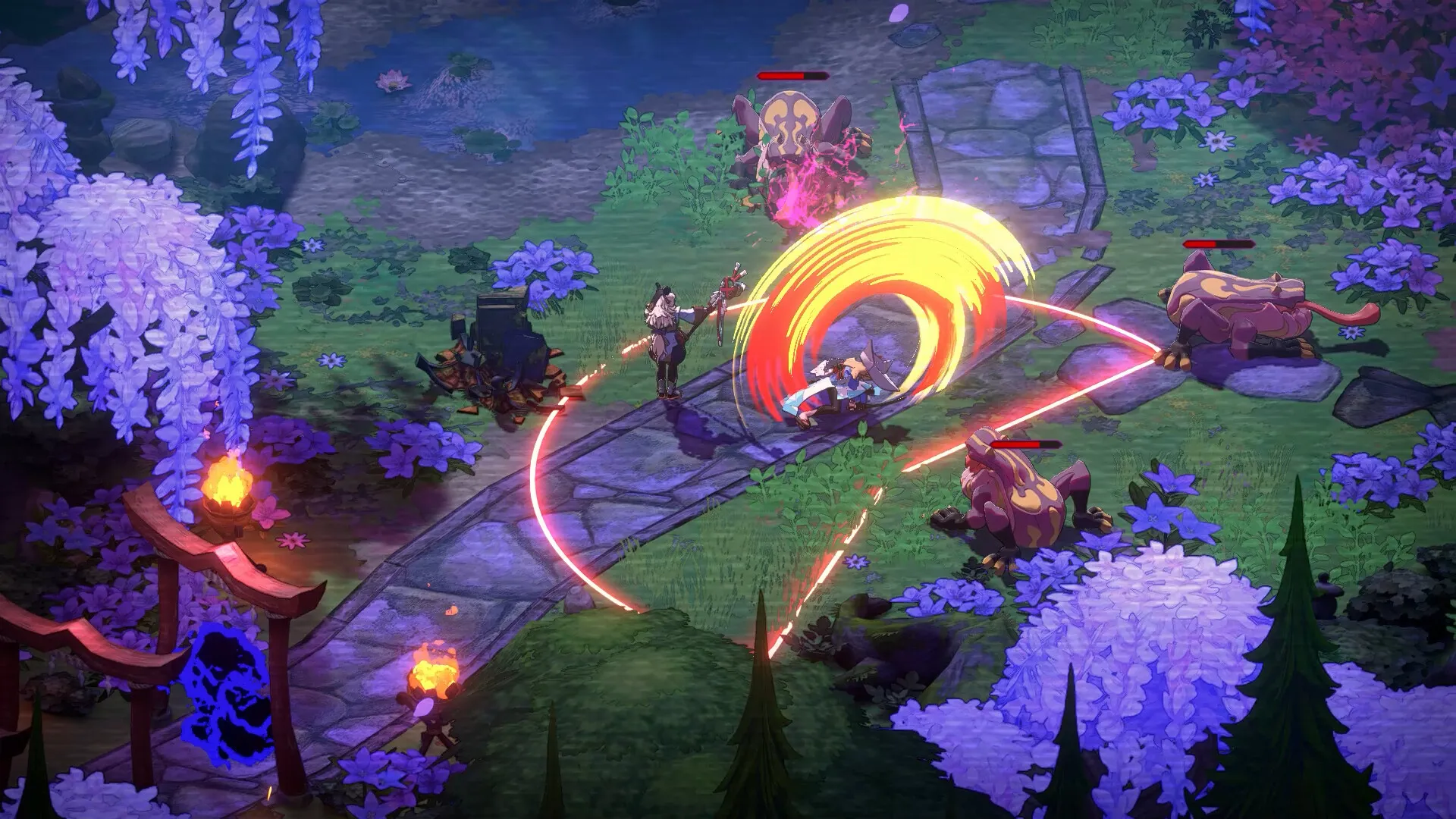
Criticisms aside, the town is charming. I enjoyed seeing its expansion as I added buildings for customization and combat effects, watching stories unfold between and within characters, and taking in the beautiful artistry and detail of the mountain village. Strangely, the ever-encroaching Magaori threat doesn’t come up often in town and clearly spans generations. In this way, I never felt that the combat side of the game meshed well with the quasi-lifesim I witnessed in town because the threat never felt real, as if I was playing two different games.
As suggested, we customize the town by using one of several resources accrued on runs. The facelifts, while real, are subtle—not necessarily poor delivery, but don’t expect punchy changes. Those who enjoy seeing numbers go up and having a sense of progression may enjoy this aspect, but I always felt I was trying to keep my head above water as I maintained my strength and survivability against an ever-increasingly difficult foe. Improvements are safe in that they increase health by 10%, offer the opportunity to craft better swords, and sometimes add options for equippable spells on companions. Don’t expect a vast array of customization or fascinating skill trees to pore over.
Combat is styled as an isometric RPG; players dodge between enemy attacks forecasted with red lines or bars on the ground, and then counter with slashes determined by the character leading. Lead characters have two swords and their own style of attack; some blast enemies from afar, others dive in with spinning attacks, and most do standard slash attacks while standing in place. The twist, I suppose, is that players have a companion by their side that kinda follows them around and does one of two spells when the cooldown resets. Spells range from fireballs to spinning electrical barriers or a delayed smash attack. Enemy patterns aren’t anything to fawn over, either, as enemies offer ample opportunity to dodge ranged or melee attacks.

The most Hades-like element here is passive buffing by picking up different symbols. Unfortunately, the creativity remains lacking, as most offer passive number increases with little gameplay change. Backstabs may stun enemies now, have a higher chance to crit, or make enemies more susceptible to damage for a while. The same bonuses are available for spells and each sword stance. Similar buffs exist, but nothing that will excite players or change strategies meaningfully.
That said, TGST is addicting—for a short while. After about twenty hours, I lost interest in routine hacking and slashing. Without enemies that evolve tactically, gameplay changes, or surprises in general, TGST can feel repetitive after a while, depending on player tolerance. Aside from the passive buffs, players may pick up one of several different ores to use in town to construct buildings, smith better swords, equip passive buffs, etc. These upgrades top out fairly early, as if the developers ran out of steam. Simultaneously, TGST drags on too long and doesn’t end when it should. I get the sense that big ideas became too difficult to implement as the game got away from them, with many incompletely executed ideas.
Clearly, though, a great deal of effort went into the time-leaping aspect of the storytelling, as well as Towa and her friends’ interactions. Because players go into dungeons with two characters of their choosing, I was surprised to witness so much voice acting and unique dialogue, largely dependent on the one-note personalities of the characters. The flow of dialogue is, again, highly anime in that the two will sit beside a bonfire after fighting a boss and have a serious chat about a problem one has, while the other provides healthy perspective. Then one of them says something completely outrageous for humor’s sake, and the conversation ends. I was surprised how often the writers followed this formula, but I didn’t completely mind it. If I’m being honest, it’s because the voice acting and writing are decent.
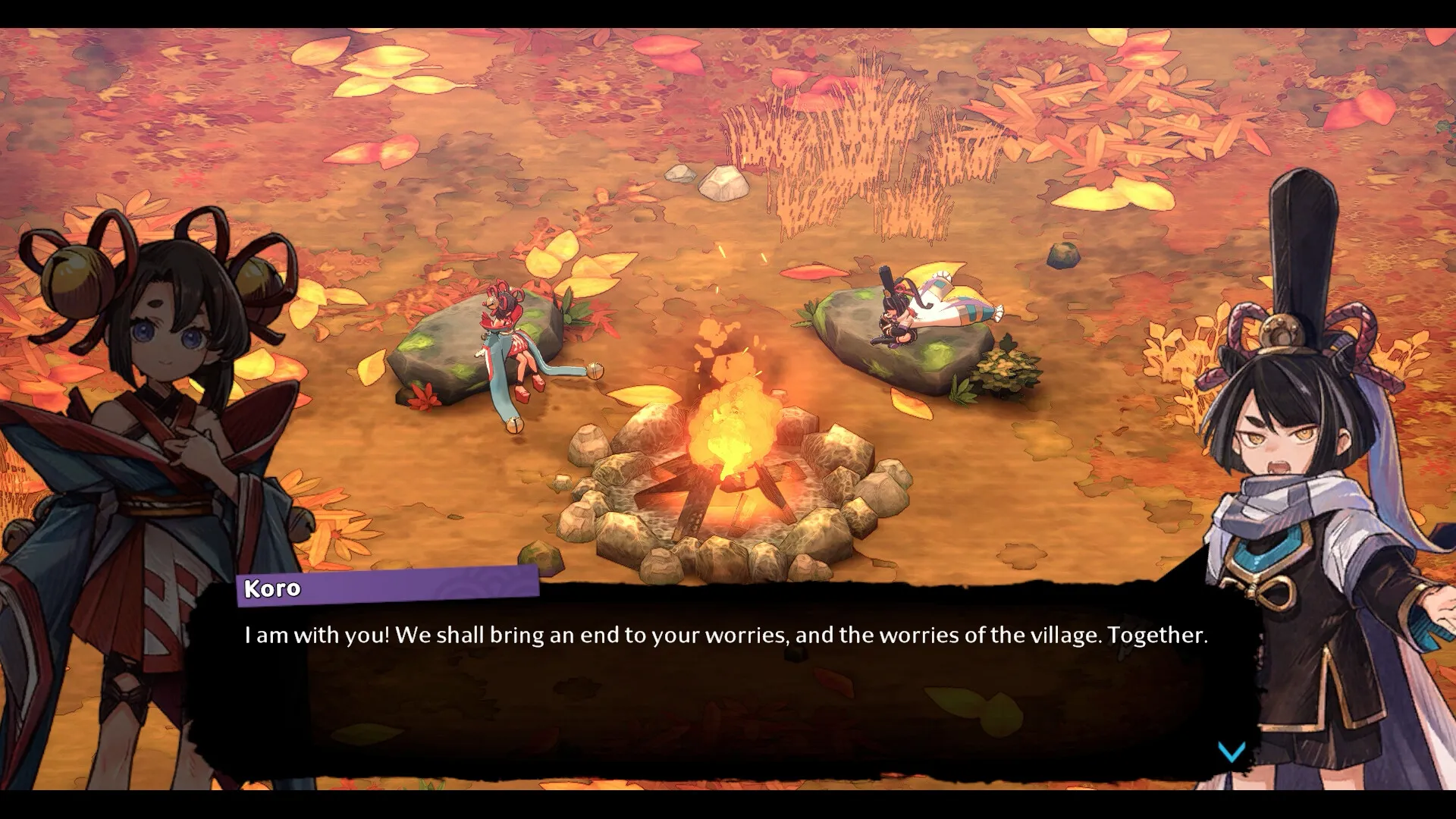
TGST’s music largely falls into the background, though boss fight music complements the intensity of the clash well. Each voice actor does a commendable job reading from the significant script, and they never appear to fatigue, remaining consistent in quality throughout. The game’s aesthetic appears hand-drawn with no animation as characters speak, but the sketch-like quality is easy to appreciate. Watching the evolution of the town from beginning to end remains enjoyable, with the intricate detail suggesting significant care and effort in crafting the environment. If I’m being critical, though, nothing stands out as particularly awe-striking; rather, TGST maintains a practical, calming charm.
Towa and the Guardians of the Sacred Tree has some big ideas that never feel fully fleshed out. This game screams “potential,” but the only aspect that really sticks the landing is the town and inhabitants changing as time moves on. I enjoyed witnessing growth, stagnation, and death. The writers have poignant stories to tell and that is TGST’s best quality. Unfortunately, a commendable combat design that runs out of ideas and creativity quickly languishes the entire experience as I, unfortunately, was eager for the developers to wrap things up.