
Over two decades have passed since the humble (and somewhat dubious) beginnings of the Utawarerumono series as an adult visual novel/tactics RPG hybrid, and exactly twenty years since the subsequent console-friendly rehabilitation it received with its PlayStation 2 release. From here, the series evolved into a unique blend of fantasy and science fiction, drawing heavily on Ainu culture to craft a world unlike any other. Developer/publisher Aquaplus handled the storylines and visual identity, partnering with acclaimed strategy RPG aficionados Sting Entertainment to refine the tactical battle mechanics, resulting in a combination of visual novel storytelling and strategic gameplay that carved out a small but devoted fanbase worldwide.
Between the remake of the original title (Prelude to the Fallen), the incredible Mask of Deception & Mask of Truth duology, and 2023’s foray into traditional, party-based RPGs, Monochrome Mobius, I’ve loved every second I’ve spent immersed in the world of Yamato. However, all good things must come to an end, and Utawarerumono: Past and Present Rediscovered serves as a fulfilling final capstone for one of the RPG genre’s most underappreciated series.
While it doesn’t deliver all the answers fans hoped for, Utawarerumono: Past and Present Rediscovered refines and improves upon the strong mechanical and narrative foundation of Monochrome Mobius, proving that Aquaplus (alongside support studio Design Act) possesses the skills to make a true classic in the traditional RPG genre, and whetting my appetite for their next project.
If you have yet to play Monochrome Mobius, the coming story explanation may be completely unintelligible and/or full of spoilers for that game, so reader beware. This title is a direct sequel and requires familiarity with the previous game to understand and enjoy, much like the connection between Trails in the Sky 1st Chapter and 2nd Chapter.
Utawarerumono: Past and Present Rediscovered picks up right where Monochrome Monobius left off, the initial cutscenes showing the aftermath of Arva Shulan’s invasion of Yamato’s capital, focusing on both our heroes and the leaders of Arva Shulan as they regroup and adjust to their newfound roles. Protagonist Oshtor and his friend and rival Mikazuchi are named Imperial Guards of the Right and Left and formally recognized as Akuturuka, wielders of the powerful masks (Akuruka) that grant immense power in exchange for the user’s lifeforce.
Their friend and ally Munechika returned to Izumo to assist her mother and resume vigil over the pillar that connects Yamato and Arva Shulan, wary of further incursions. Final party member Shunya is left catatonic after the traumatic events in the imperial capital and sleeps peacefully in Oshtor’s home village, Ennakamuy, under the glow of the small Akushana cultivated in Pashpakur’s (Oshtor’s biological and Shunya’s adoptive father) hideout. Once Shunya wakes up and the party reassembles, the Mikado tasks them with awakening the four Gaia Pillars spread across Yamato to prepare for further incursions by the enemy.
Monochrome Mobius largely stood on its own, with some concepts or story beats enhanced by familiarity with past Utawarerumono series titles, while remaining enjoyable as an entry point into the franchise. Past and Present Rediscovered, on the other hand, contains oblique references to events in Mask of Deception, as well as additional background on the science-fiction aspects of the lore and worldbuilding behind Yamato and its ruler, the Mikado.
The addition of a glossary players can reference during gameplay or story scenes for explanations of the various concepts, characters, and proper nouns thrown around is immensely helpful for new and returning players alike. The story is self-contained enough that someone who started with Monochrome Mobius could still understand most of the plot and character moments and would come away eager to see what comes next for Oshtor, Mikazuchi, and Munechika in Mask of Deception.
Similarly, my attachment to Oshtor, Mikazuchi, and Munechika was only enhanced by experiencing their humble origins across these two titles. Watching their skills grow and their bonds develop proved immensely satisfying, cementing this trio as one of my favorite parties in any RPG. The game takes time to resolve the familial conflicts Mikazuchi and Munechika face, allowing them to overcome their personal traumas and, by the end of the journey, emerge with a more holistic, mature outlook on the nature of loss so that they may accept their roles in society with purpose and clarity.
The contrast between the inciting mentorship role Oshtor plays in Mask of Deception and the greenhorn finding his footing across these two titles is compelling, and this journey justifies itself on the strength of his character development, enhancing the impact of his role in that story. Mask of Deception tells you that Oshtor is a legendary warrior and selfless guardian of Yamato; Past and Present Rediscovered proves it.

If there is any negative aspect of the game’s storytelling, it lies with Shunya and the game’s ending, relating to her origins and the resolution of the core conflict. Series fans had expressed some confusion at the existence of Arva Shulan in the previous game; this RPG duology is set only a few years before Mask of Deception, yet Arva Shulan and Shunya are never mentioned. While I won’t spoil the game’s conclusion here, Past and Present Rediscovered answers these questions with a controversial time travel element.
This narrative choice is a bit of a double-edged sword; it is consistent with the game’s science fiction elements (which are at the forefront in this game more than in any other Utawarerumono title) and allows for the game to explore the origins of the world in greater depth than past games in the series, but it also undercuts some of the narrative weight of the plight of Arva Shulan and Shunya’s character relationships with the rest of the cast.
I enjoyed watching Shunya connect with the rest of the party, and the ending resolution is heartbreakingly bittersweet. I can understand why many fans were unhappy with the direction the story took, but I ultimately came away feeling that the journey was more impactful than the destination. The narrative does not meaningfully advance the series’ plot (an impossibility for a prequel); nonetheless, it endeared me to these characters and fleshes out their origins enough to be worthwhile.
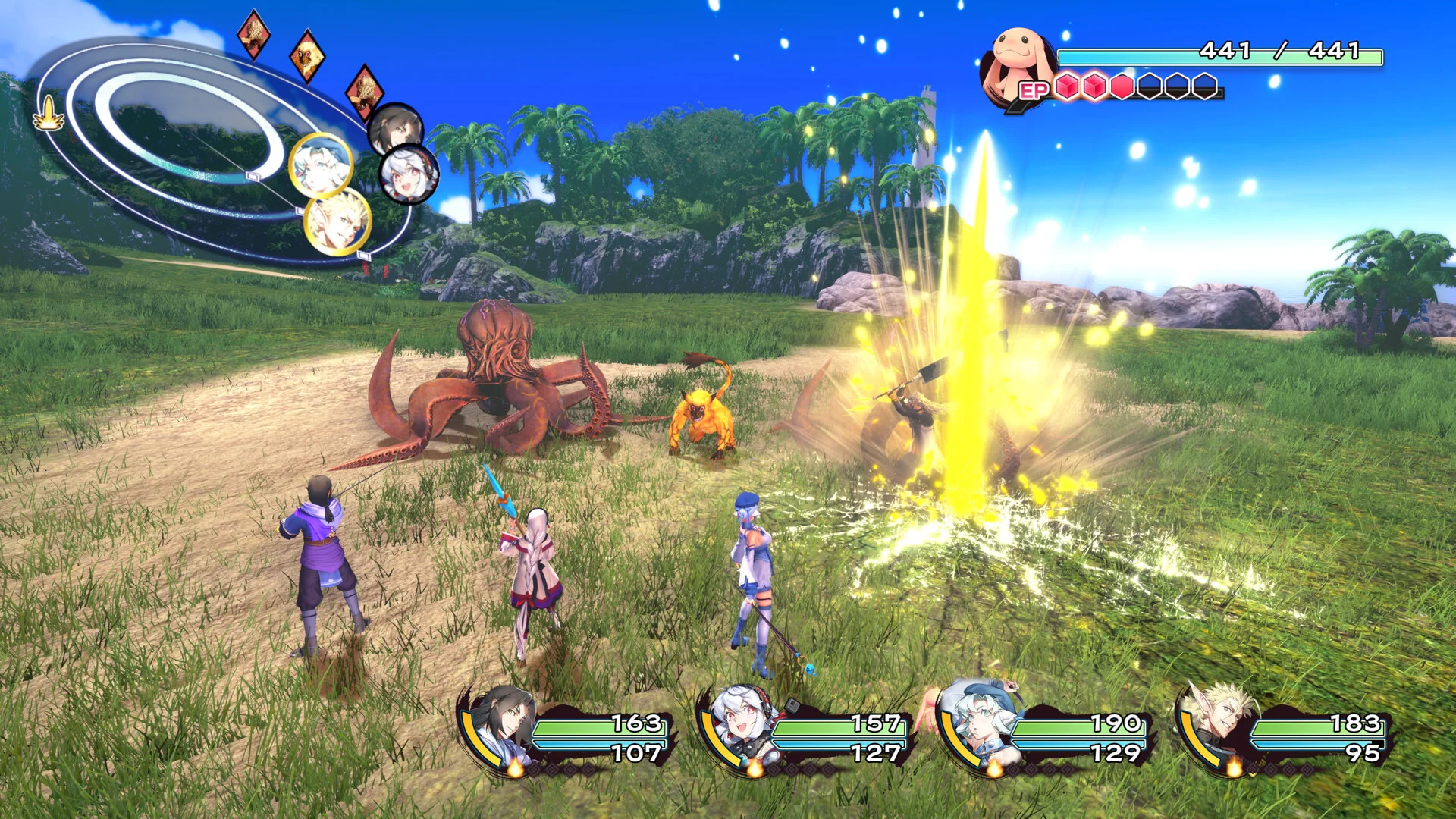
Utawarerumono: Past and Present Rediscovered truly shines by refining the game mechanics of its predecessor. Monochrome Mobius provided a solid foundation: a strong battle system based around the three-tiered action ring, the ability to assign stat points to build out characters, and adaptations from past titles like Zeal (allowing for extra turns or ascension on the action ring when full) and Morale (a stat shared between friends and foes that strikes a careful balance between offense and defense). Where Monochrome Mobius suffered was in the execution of some of these elements, with many of them remaining invisible to the player, poorly explained, or lacking in balance.
Stat allocation was a strong mechanic to encourage player agency, yet the game balance and skill acquisition system tied to stats encouraged simply dumping all your points into offensive stats. Morale was a novel idea, but there was no way to quickly reference the morale levels of your party members mid-battle, so characters would lose morale without warning and disrupt your entire strategy. The presentation was also two generations behind, with laughably poor character models for NPCs, copious environmental asset reuse, and stiff animations, all culminating in an overall cheap, low-budget experience.
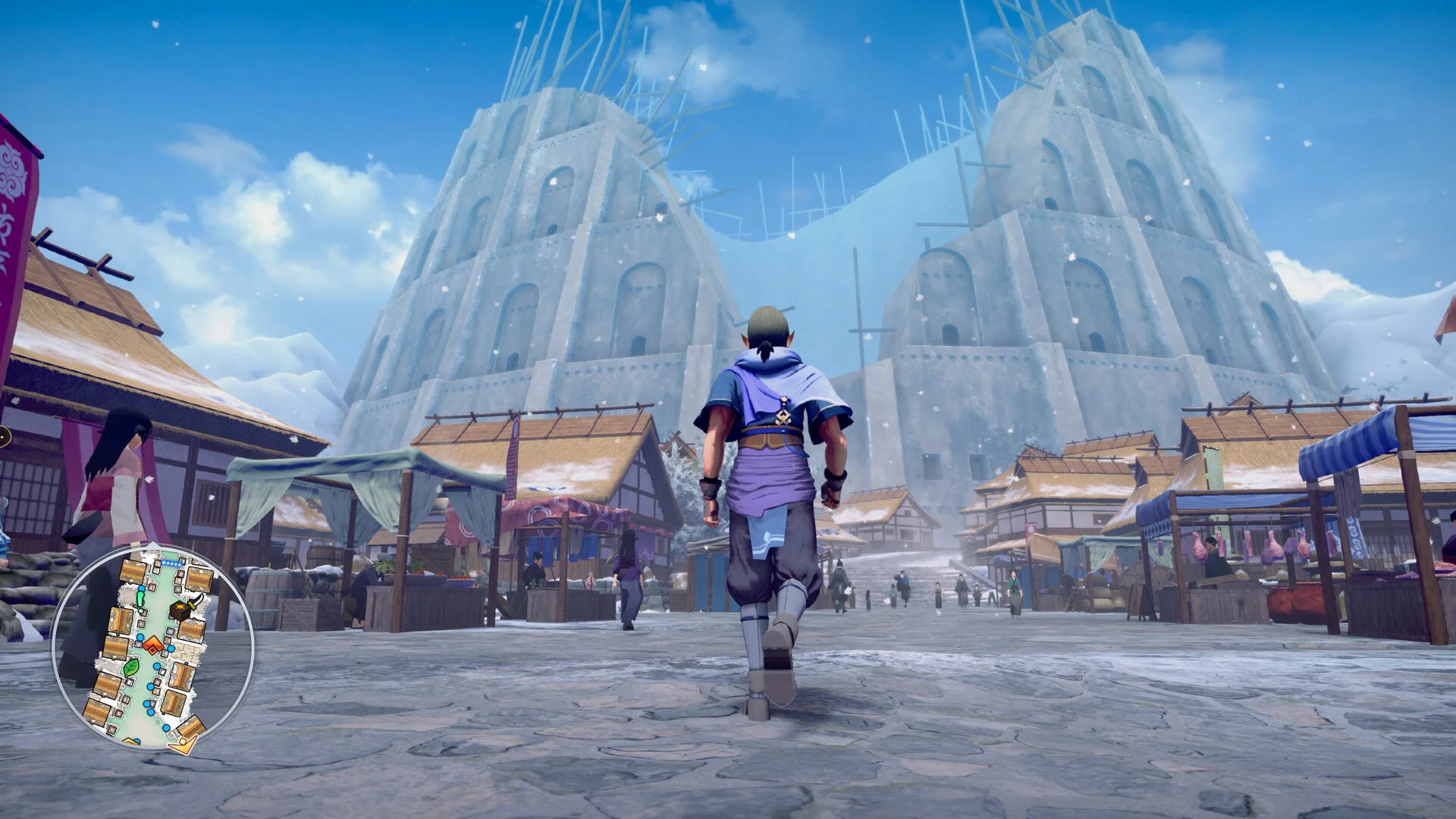
Past and Present Rediscovered addresses all these complaints and further elevates the gameplay mechanics. For starters, the presentation is a significant step up from Monochrome Mobius. The character models and environments are more detailed, there is a wider variety of monster designs, and every character & enemy model has more visually impressive, bespoke animations for their skills. The user interface received a necessary overhaul, with more detailed and intelligible area maps & mini map that the player can reference at any time, a world map that accurately shows the connections between various areas, and battle menus that accurately track Zeal, Morale, and other player conditions through easily readable bars and icons.
The game even features numerous in-engine cutscenes with impressive animation and battle choreography, akin to the coolest fights from your favorite anime series. All these elements strengthen the presentation and seamlessly convey the game mechanics, getting out of the way so as not to disrupt the player’s focus on storytelling and combat strategy.
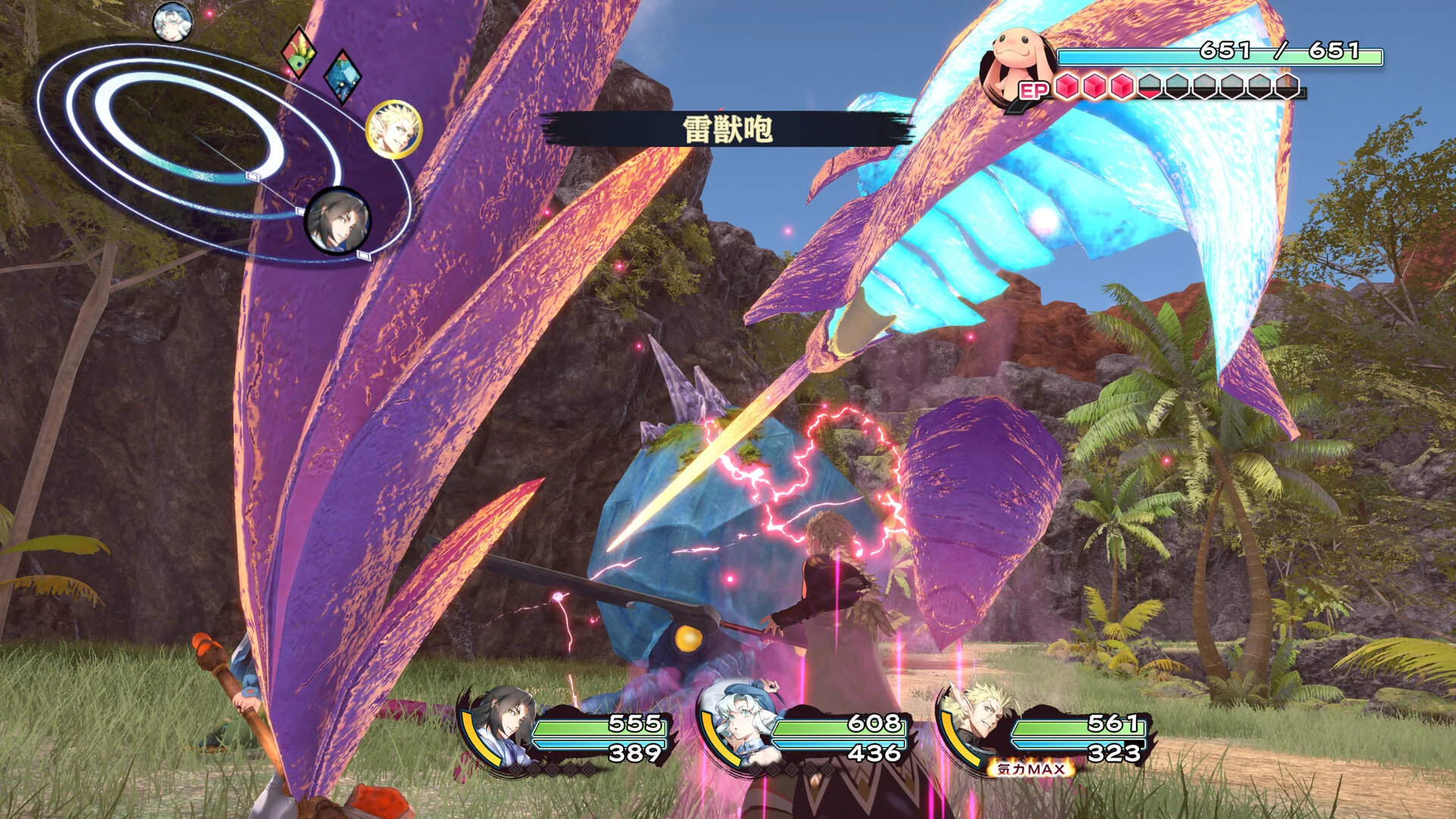
Furthermore, Past and Present Rediscovered adds excellent new mechanics that elevate the game design far above its predecessor. First among these are the Keshin forms for Oshtor and Mikazuchi. As Mikazuchi and Oshtor are now recognized as Akurutaka, they can draw upon the power of the Akuruka at will. However, doing so fully will drain their lifeforce and drive them to an early grave. Thus, the Keshin technique is introduced, a method of partially drawing on the power of the Akurutaka without harming the user (with a visual effect similar to the Susanoo from Naruto).
This provides a diegetic reason why the party has their strength reduced and needs to retrain their skills, and also allows for additional tactical decision-making in combat. When the Zeal gauge is full and the character enters Overzeal, you have the choice between ascending a level on the action ring, using a powerful Okugi skill, or engaging the Keshin form to gain access to powerful attacks for multiple turns. Munechika also receives her own Akuruka later on, which enhances her own similar transformation she acquired in the previous game, making it equivalent to these Keshin forms.
Utawarerumono: Past and Present Rediscovered further alters exploration and progression through the new Conquering system. When entering a new area, the region will need to be “conquered” by fighting a certain number of battles, after which a powerful individual enemy or enemy group known as a “Ruler” will emerge. Defeating this Ruler enables the player to defeat all other enemies in that region instantly on the field with a simple sword swipe.
At first, I was mixed on this change, as it throws out the typical focus on resource management and combat efficiency across numerous battles, the balance that a traditional turn-based RPG relies on. However, I quickly realized that this system serves a dual purpose: it eliminates the monotony of repeated, low-engagement battles with the same enemy groups in a particular area, while increasing the frequency and variety of high-engagement battles against strong foes. Some of the Rulers end up being a stiffer challenge than the story bosses, so this system keeps the player on their toes and ensures that there is always another interesting fight around the corner.
There are fewer distinct dungeons compared to Monochrome Mobius, but each field area essentially becomes its own dungeon with its own miniboss. The few dungeons that do exist treat each floor as a new area, so they are jam-packed with engaging fights. This overhaul strikes a perfect balance between demanding mastery of the mechanics and avoiding time-consuming, low-engagement battles that plague many other RPGs.
This dovetails with the changes to game balance, as enemies tend to hit much harder than they did in Monochrome Mobius, and skill acquisition is tied to character level rather than stat allocation. Instead of dumping every stat point into Strength or Intelligence and rocking a glass cannon build on every character, I had to prioritize defensive stats and ensure a healthy mix of stat spread among my party to survive encounters.
This increase in difficulty and refinement of game balance also made consumable items integral to combat strategy, particularly the use of Zeal and Morale-boosting items. Monochrome Mobius introduced a bevy of interesting but underutilized ideas; Utawarerumono: Past and Present Rediscovered realizes the potential of those mechanics to deliver a high watermark for traditional, turn-based, party-focused RPG combat and progression design.
Utawarerumono: Past and Present Rediscovered is a fitting sendoff for one of my favorite RPG franchises. I have my reservations about the narrative direction, the introduction of time travel elements, and how this title fits into the larger tapestry of the series’ narrative ambitions. However, I cannot deny that the journey to that resolution had me invested from start to finish. I love these characters and the world they inhabit, and any sadness I have about closing this chapter is buoyed by the promise this title shows for Aquaplus’s future.
I cannot wait to see the next world and cast of characters they create, and I hope they continue their work in the RPG genre. They’ve more than proven they have what it takes to create the next great narrative-focused RPG series.