
Reviewer’s note: This review has been written based on the fan translation by the Valkyria Chronicles 3 Fan Translation Project team. While we appreciate their hard work and recognize the difficulty of the task, the unfortunate reality is that this translation was very poor and riddled with both grammatical and technical problems. As such, we decided to omit the story score from the review and assign scores only to “official” facets. About two months before the finishing of this review, a modder known as Akorov released a much improved version of the translation based on the original effort. Most of the problems have been fixed by this release, and it comes highly recommended.
While Valkyria Chronicles was quite the darling on the PlayStation 3, its PSP exclusive sequel made less of a splash. It’s a shame, because although it was riddled with compromises due to weaker hardware and the story was a little silly, it was worth playing as a fun and earnest tactical RPG, with the same excellent WWII-inspired setting and a great third-person shooter-derived turn-based combat system as the first game.
Valkyria Chronicles 3, for what one could assume are reasons related to the poor fan reception of Valkyria Chronicles II, was never released in the West. You can imagine how series fans felt about this, especially once they discovered that, in many ways, it was the best game in the series to date.
Kurt Irving, having graduated at the top of his class at Lanseal Military Academy and lauded as a prodigious tactical genius, wasted no time earning praise as a young squad leader in the Gallian Regular Army during the Second European War. Soon after, however, he is mysteriously charged with a crime that sends him to a penal unit with other criminals, led by the undisciplined and lecherous commanding officer Lt. Col. Crowe. As the new leader of this expendable unit, Kurt, now stripped of his name and known as “No. 7,” is tasked with carrying out dangerous operations, some conventional, some unconventional, and some of the “war crime” variety.

Talk about a strong start. I would say that, generally, the Valkyria Chronicles series is capable of tackling serious subjects with some success. Still, it tends to veer back into safer territory, which I assess benefits the series by allowing the characters to shine and players to connect with events. Here in Valkyria Chronicles 3, we immediately begin not with the idyllic small town nestled in the countryside like in VC, nor with the excitement of the start of a school year, like in VC II, but falsely branded as criminals by corrupt officials.
The series has always done a good job of shining a light on the more unsavory parts of the Gallian military, avoiding the trap of depicting this tiny, desperate, resource-rich nation as completely unimpeachable in its political and military conduct, but in Valkyria Chronicles 3, from the perspective of the falsely accused, the discrimination and mistreatment of your unit, the willingness of command to make your unit break international law, and the series’ narrative staple of Europan racism toward the Darcsen ethnic minority are constant topics of conversation.
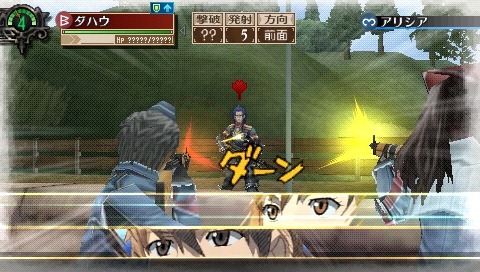
With this in mind, I kept on waiting for actual criminals to join my squad. It seemed that nobody in my unit did anything so horrible that they’d be punished this way. It would have been so narratively stimulating to be forced to work alongside some real scumbags. Fortunately, despite this missed opportunity, many of the characters, especially the main characters, are very well-realized, though most of the supporting characters are one-note (Leila is a particularly unfortunate case).
Again, the series often veers away from serious topics after hinting at them; Valkyria Chronicles 3 has that same tendency, but thankfully to a lesser degree. For example, early on you are tasked with infiltrating enemy territory dressed as civilians. Here’s where the game succeeds in its presentation of this war crime: the characters all show apprehension about committing this act, since, if they’re discovered, it could set a bad precedent for the treatment of civilians in wartime. Here’s where it fails: instead of exploring the consequences of such an act and the moral weight of completing an important mission in this manner, Kurt, in all his genius, goes against command and finds another way to complete it.
On the other hand, a major turning point occurs when a character discovers that command slipped chemical weapons into his inventory, which would have caused him to unwittingly commit a war crime. This event and what follows are emblematic of how this entry can often beautifully follow through with its themes.
This story demands a more thorough exploration of these challenging topics than the first two games, and while it does take things to a darker place than previous entries, often satisfactorily cashing its narrative checks, at times it stops short to wrap up some beats a little too neatly. What we’re left with is still the best story in the entire series to date, the most moving element of which is an excellent, tragic warning on the danger of founding a nation solely on historic ethnic grievances, even if the grievances are well-founded.
Valkyria Chronicles 3 follows a similar structure to all others in the series. You have a map of the operational area laid out before you where you advance the story through cutscenes, receive mission briefings, select your squad, and deploy into missions. New to the series are branching paths, as well as side missions to impose some effect on the main mission, such as disabling artillery bombardments. This is a cool idea, but it isn’t taken very far and is ultimately of little consequence.
In missions, you and the enemy take turns by selecting units on a paper map at the cost of a “Command Point,” a number of which are given at the beginning of every turn. This zooms the camera into the unit and lets you move them around a 3D space as in a third-person action game. You have a certain distance you can move, determined by your AP.
To engage, you shoulder your weapon and use as much time as you need to line up your shot, ideally targeting enemies’ weak points, such as an infantry unit’s head or a tank’s engine, after which you can fire a volley with the press of a button. You can also spend Command Points on “Orders,” as special powers performed by the leader of the team to tilt the battle in their favor, such as healing or buffing units.
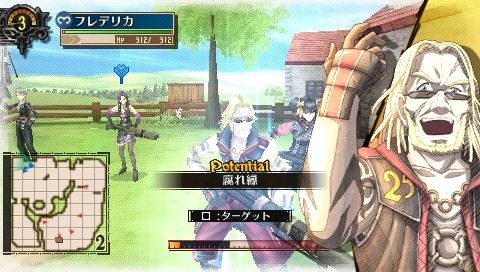
Critical to your approach is effective use of unit classes. Scouts have a lot of AP, which allows them to cover a lot of ground, and can be a good way to capture on-map bases (which is important since bases are how you deploy units and control the map); shock troopers are assault units which excel against infantry, and can be great at defending your bases; anti-tank lancers use cool rocket-propelled armor-piercing lances to attack armored units like tanks, snipers snipe, and so on. This system is the crowning feature of this series, and it is an excellent approach to turn-based battles.
At times, you can win most battles with a methodical approach, slowly thinning out enemies and securing bases, gaining ground by clawing forward meter by meter, but the game rewards you with extra experience and money based on your speed, and some objectives impose a turn limit. This encourages or requires, respectively, that you learn some of the illogical tricks this battle system allows.
For example, in every Valkyria Chronicles game, you can spend a Command Point to forcibly withdraw a unit no matter where they are on the map. In Valkyria Chronicles 3, when you deploy a unit from a base, they deploy immediately. This means you can “cheese” this system to, say, disappear your lancer into thin air, only to immediately spawn the same unit directly behind a tank from a newly-captured base. This seemed unbalanced and unsatisfying to me at first, but if you know anything about these games, then you know that they can hit you with some crazy difficulty spikes.
Although the difficulty seemed much more even in this title, it still can be quite a challenge if you choose not to utilize methods such as these. What made me appreciate these shenanigans on a thematic level was the idea that you are supposed to be a guerrilla force, using the terrain and ambushes to overcome a numerical disadvantage. The system doesn’t allow for that kind of guerrilla action in any real way through normal play, so using this minor exploit was, for me, thematically appropriate once a rhythm and knowledge of the battle system was achieved.
This possibility also made me appreciate a handicap brought on by the technical limitation of the PSP, the only platform on which you can play both Valkyria Chronicles II and 3. Since the hardware was so limited, one of the main complaints was that maps were no longer contiguous, but broken up into sections connected by specific bases, which allowed you to move between them. Though unfortunate, this gives the PSP games a very different flavor, as how the map segments connect becomes an added strategic concern. For Valkyria Chronicles 3 in particular, the guerrilla tactics you’re supposed to employ mean that this is a praiseworthy design choice in the face of restrictions.
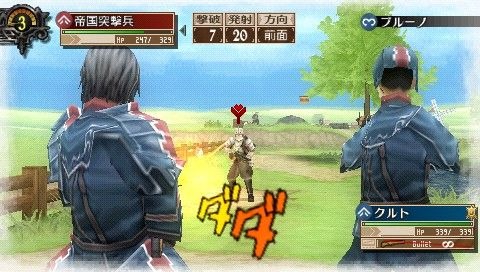
Unfortunately, the biggest problem with the PSP’s scanty power is that so many maps are repeated. You will see the same cave systems, cozy villages, desert trenches, and urban blocks many, many times. The map designers did an admirable job of changing base locations, cover locations, objectives, and other map elements to keep it as fresh as possible, but those efforts only helped the lack of variety up to a certain point.
Despite this, Valkyria Chronicles 3 sports visual upgrades over its predecessor, with more detailed character models, more colorful locales, and an overall more artful presentation. Both games do a credible job of presenting the series on the PSP, but this one is further refined. The sounds of battle are what you’d expect from the series, which is to say, often underwhelming and quiet. The music, composed by Hitoshi Sakimoto, is good, with appropriately military-style pieces for the missions and quiet pieces for the quieter parts.
Valkyria Chronicles 3 attempts a darker, more serious story with a unique perspective. For the most part, it pulls it off wonderfully. At times, I was pleasantly surprised with some of the story beats or, more often, how some of the characters communicated their inner beliefs and goals. Not every character is great, and not every story beat will make you ponder the human condition deeply, but the (mostly) likable cast and strong themes carry this game a long way.
All the while, Valkyria Chronicles 3 is driven by one of the more unique and exciting turn-based battle systems to come along in a long time, with few imitators since. This is a special and sometimes thought-provoking game worthy of the time of anybody who reads this publication, and it’s been played by a criminally small number of people so far. Let’s change that.