While FromSoftware fans like me are rabid for more Souls-likes new and old, it seems they have shifted away from the first-person action RPG King’s Field series that acted as a spiritual predecessor to Demon’s Souls. Enter indie dev Kasur Games with Verho – Curse of Faces. Rarely do I see such open advertising as an homage to another title, yet the first line in Verho’s marketing is very upfront: “a Dark RPG following the tradition of the King’s Field series.” Is this merely mediocrity flattering greatness, or can this imitation revive a style of game lost for a quarter of a century?
Verho takes place in a medieval world centuries after its ravaging by a mysterious curse that wiped out most of the population within hours. This began three hundred years of the Era of Solitude, in which the dregs of humanity survived in sequestered caves, kingdoms, and villages. Only then was the truth of the curse discovered by a man known as the Maker: any human who sees another’s bare face condemns both to death.
Thus, the Maker, taking on a somewhat messianic cultural role, created masks for the remains of humanity to wear, beginning the Era of Masks where the player’s story begins. The player journeys to the ancient kingdom of Yariv, said to be the source of the Curse of Faces, only to be enveloped by a strange mist that saps all who enter the kingdom of their memories. Thus begins your quest to explore Yariv.
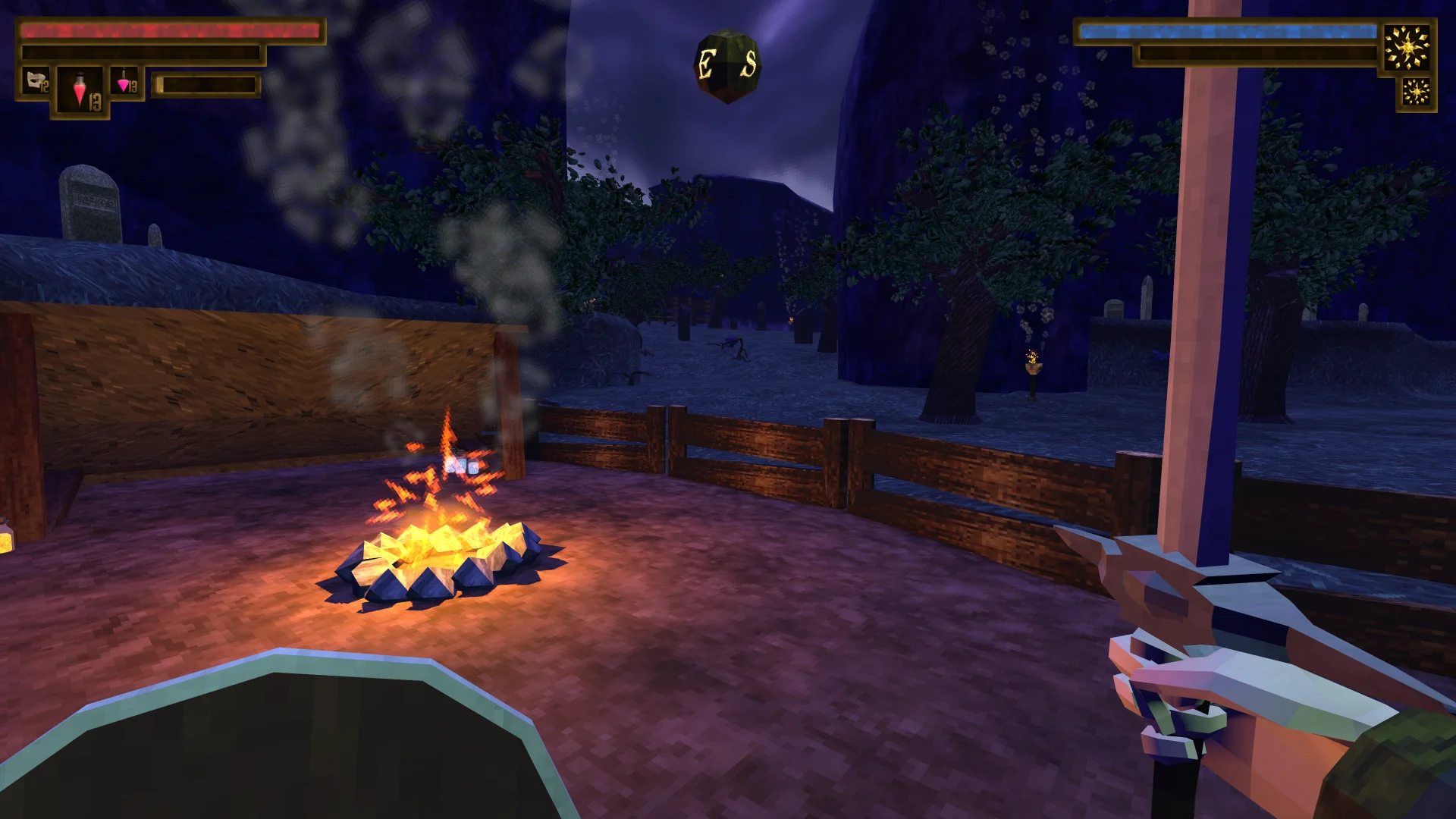
I’ll be direct: I loved this game for the entirety of my fifteen-hour run. Verho – Curse of Faces takes the chunky, blotchy-textured polygons of the first three King’s Field games on PS1 and combines them with the complex terrains and verticality of the final King’s Field game, IV, on the PS2. The visual cues are apparent: the foggy, saturated colour scheme of the first half of Verho, the floating compass on the HUD, the VCR-slot buttons on walls, half of the enemy designs.
Verho very much feels like the King’s Field V (or 3.5?) that never was, so my biggest caveat in recommending it is that if the history or style of that difficult-to-access series is of no immediate interest to you, then Verho will be a tougher sell.
Many criticisms I could make of Verho could equally be written off, depending on my mood—“That’s just the way games were then! It’s authentic to the late ‘90s!” I wonder how a younger Souls-like fan, or one not accustomed to the frustrations of retro gaming, would feel. Namely, the enemy tracking demands a lot of patience. Once you’ve aggroed an enemy in, say, Dark Souls, it’s just as easy to escape their line of sight and have them lose interest. Every enemy you aggro in Verho endlessly hounds you like a young me chasing the sound of the ice cream truck on a summer day.
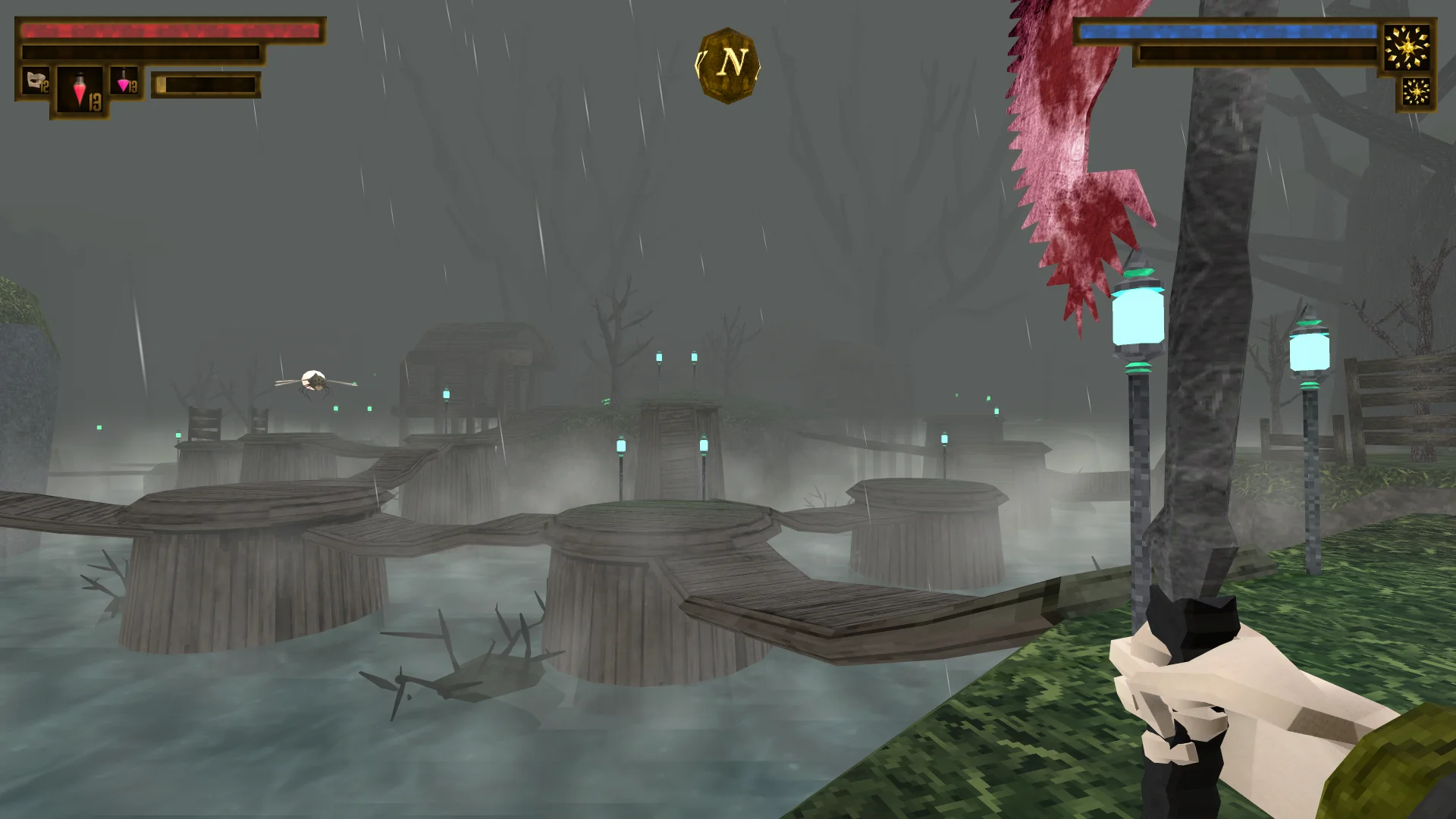
Some enemies will leap (read: teleport) to you, clipping through walls, trapping you, and otherwise ruining your progress. Aerial enemies like bats and bloatflies are especially egregious, phasing through obstacles and bouncing at and away from you with annoying paddle-ball AI. Just when you think you’re safe and listening to an extended dialogue with an NPC, a ghost bat you didn’t know was tailing you may appear through the wall and end your run.
Most environs reuse the same one or two enemy types ad nauseam, give or take some variation in sizes or properties like poison, fire, and so on. Most enemy types have around two quickly read and understood attack animations. Thankfully, there’s a huge number of areas that never overstay their welcome, and enemy patterns become more varied and complex as the game goes on. The challenge of the game, then, comes from staying calm and coolly applying the pattern recognition you’ve mastered.
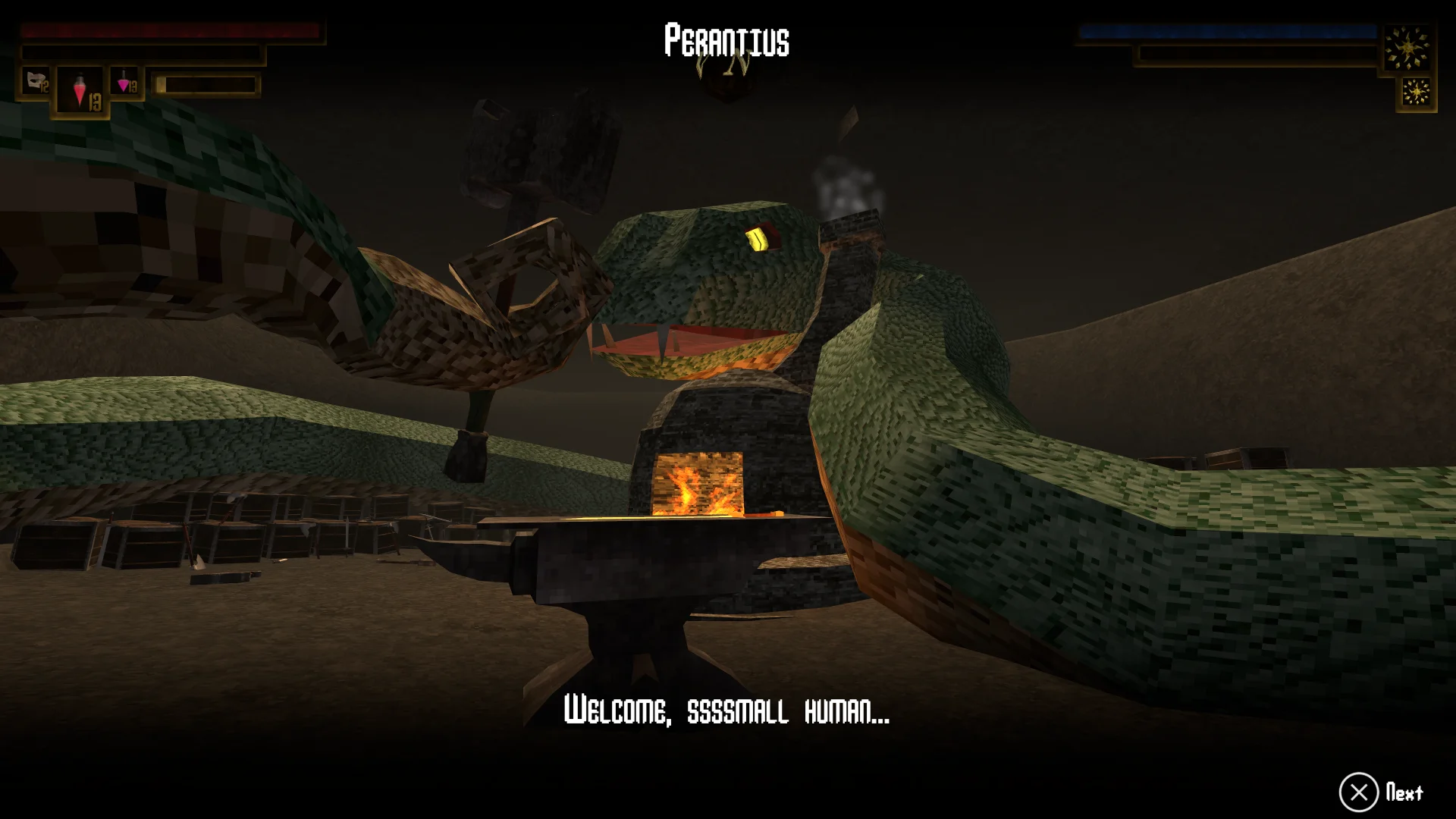
All that to say, Verho demands patience and precision from players. Death is only ever a few hits away, though once you know where you’re going, death is only a momentary lapse before you rush back into the action from the Maker shrines that serve as bonfires, fast travel waypoints, and places to level up. Then there’s the Nameless Village, a very Souls-like hub for merchants, blacksmiths, and crestfallen warriors alike. I particularly liked the giant snake blacksmith coiled around his forge.
Verho has no shortage of NPCs who consistently reappear throughout Yariv, each with their own backstory and quest. Like modern Souls-likes, finding and speaking with these NPCs furthers their sidequests, leading to some interesting lore revelations and even some assistance from them in a handful of boss battles and areas. On paper, NPCs have interesting stories (which they will unload on you through lengthy dialogue). However, none of the characters were particularly memorable, considering most of the time we just see them resting between the cool things they’re implied to have done.
There is plenty of platforming as well, and lava, spike traps, poison lakes, and bottomless pits to contend with. Improving on the King’s Field games, movement is buttery smooth. As the game went on, the pace quickened, and the final few hours felt less like Demon’s Souls and more like the first two Doom games, what with the quick traversal and how you must strafe in and out of enemy hitboxes.
I started as a blank slate level one “Forgotten” mask, though there are preset builds for sorcerers, thieves, knights, and so on. I played a strength build, as I’m wont to do in Souls-likes. This went from duel-wielding longswords and torches to eventually two-handing towering greatswords and axes. Sword swings are limited to one button, held between a max of half a second and two seconds depending on weapon size. A green energy bar under your health bar shows the charged power of each swing—anything less than full is practically a waste of time.
As a bonus, if you time the release of your swing perfectly with your bar fully charging, you get a critical hit. Melee combat, then, is about rhythm and timing. Backstep, charge swing, rush in, release.
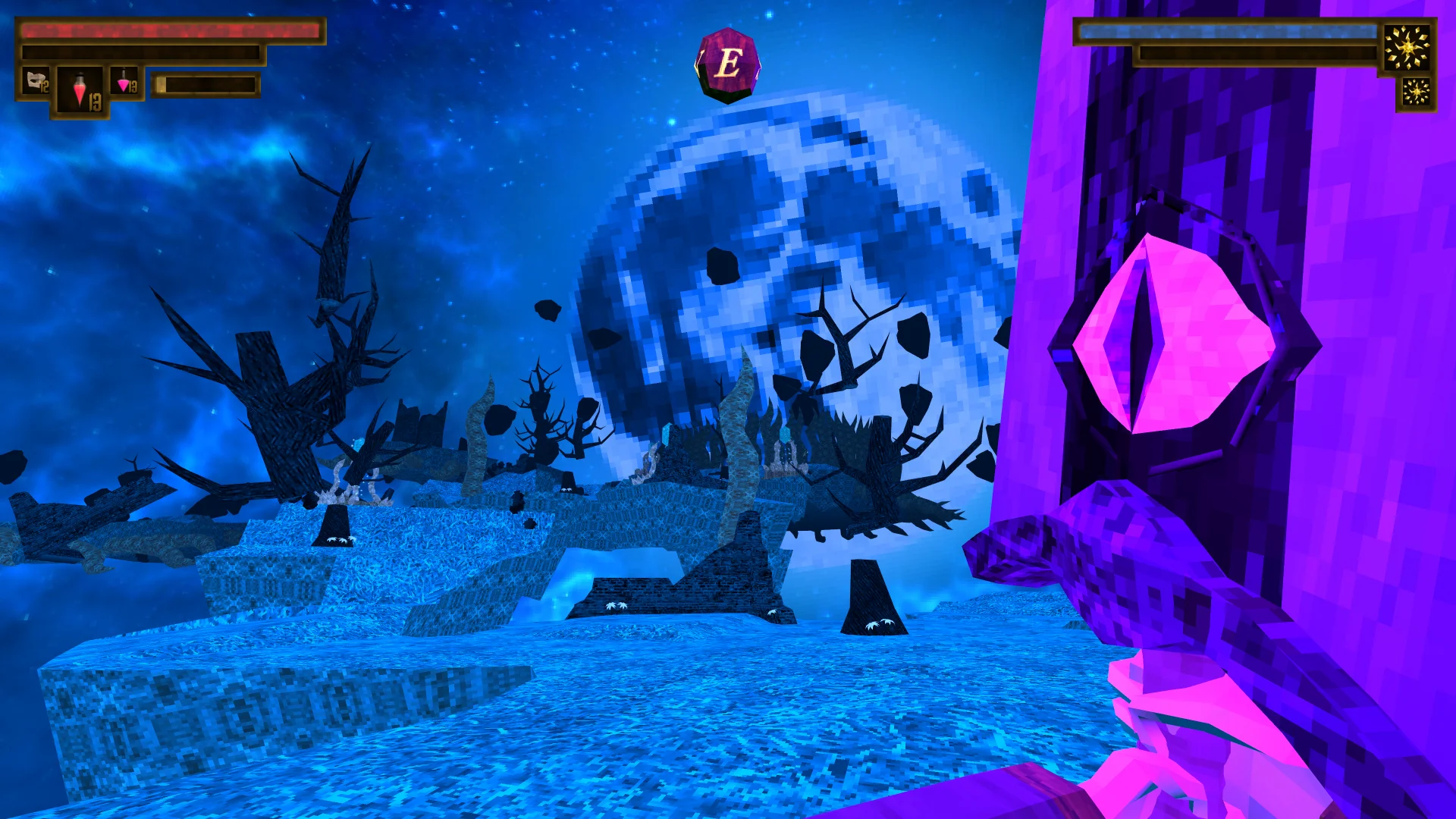
There is a surprising range of weapons, but a vast number of learnable rune spells for intelligence builds. Throughout Verho, I found a handful of Blank Masks that let me reset my skill points to try out this variety of build, but hey—big sword make big number.
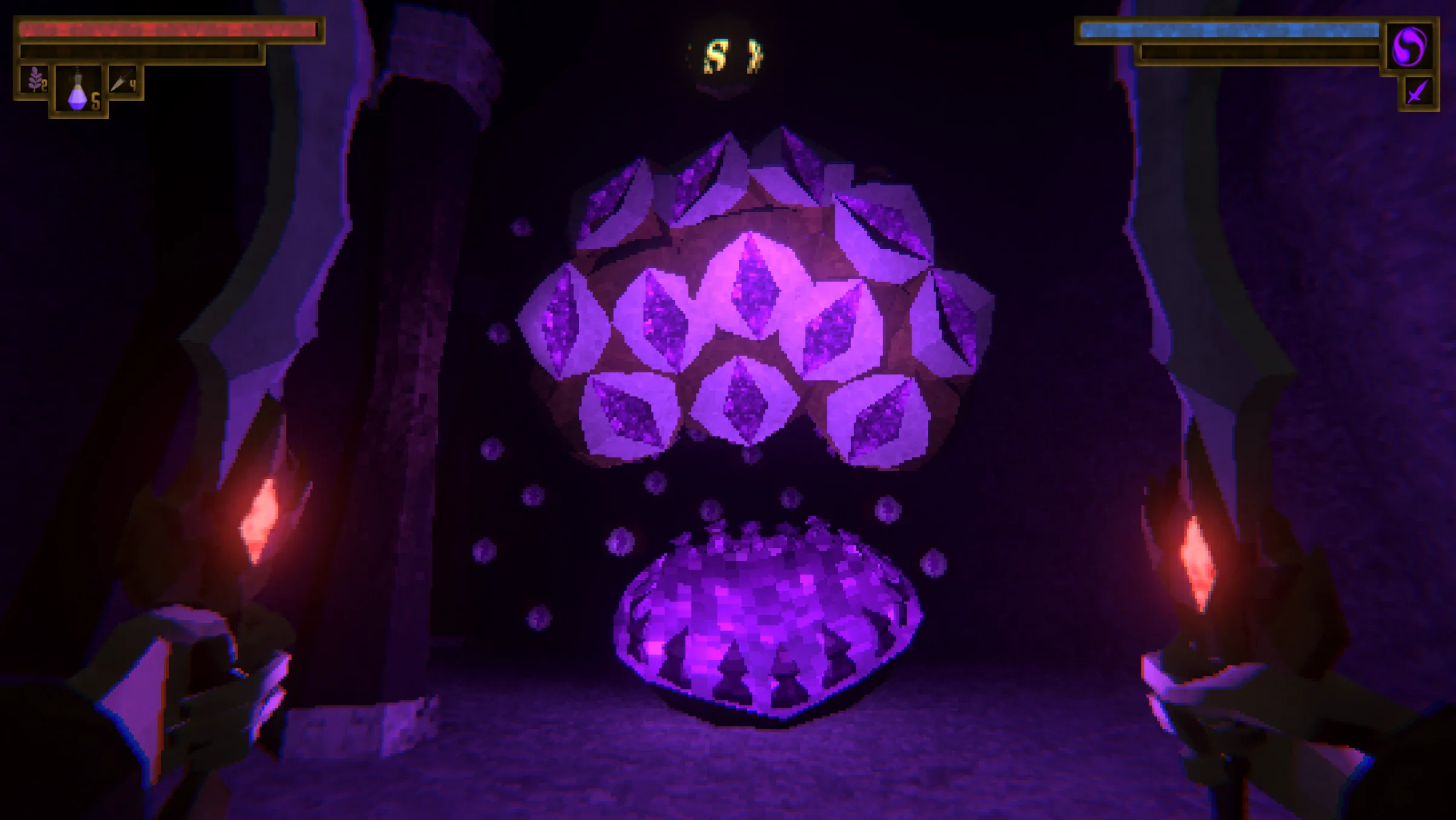
I can’t stress enough that this game does not frontload its best moments. The first few hours and areas are foggy and saturated in colour, like much of the King’s Field series or, say, Boletaria in Demon’s Souls. However, for every haunted barracks or bleak and abandoned temple, there are crimson-soaked swamps and bioluminescent hellscapes that keep things fresh and interesting. The level design is wonderfully varied, blending mazes, open plains, simple puzzles, and consistent combat into layouts that often wrap back into themselves with unlockable shortcuts to Maker shrines.
Bosses are somewhat hit or miss. At times they are barely more complex than standard enemies, just requiring more patience to whittle down their health pools. Elsewhere, they are more epic in scope and ambition, with many patterns and phases. The simple gameplay leads to a unique blend of movement in combat. Unlike many Souls-like bosses, Verho will often demand you jump or crouch below attacks. Combined with timing sword charges and strikes, this means I was constantly engaged. Besides the multi-stage final boss, nothing was ever too complicated or challenging, so don’t go in expecting Sekiro levels of difficulty.
As I said, there is a lot of dialogue expounded from NPCs, all fully voiced. The voice acting is somewhat amateurish and odd-sounding, like a handful of actors whispering line-reads in the strangest voices they can muster. Yet this was another case where an isolated weakness lent to the overall charm and mystique of the game. In fact, given the limits of the polygonal style, the weird voices are the most distinguishable characteristics of NPCs. I just wish the horrific groans and squeals of enemies chasing me were not so omnipresent.
The soundtrack, composed by Valentino Cervini, is a wonderful dance between atmosphere and melody. At times it evokes high fantasy in the vein of Jeremy Soule’s scores for The Elder Scrolls, namely Oblivion and Skyrim, though it just as easily opts for whimsy during exploration (see “Swamp of the Abandoned”). Fingerstyle guitar features prominently, as in “Yariv – Lower City” and the haunting yet soothing hub theme, “Nameless Village.” At three hours, it’s an ambitious soundtrack that excellently complements each area and battle, imbuing the game with a delicately balanced mood of hope and hopelessness.
On the whole, Verho – Curse of Faces relies heavily on the mood and expectations that come with a blatant King’s Field-like. Its retroness is a boon more often than a bane, and its ever-increasing pace and sense of discovery kept me enthralled for a dense weekend of playing. Speaking as someone who has always been curious about King’s Field, Verho truly delivers an experience that felt authentic yet palatable.