
Tension arising from unknown variables. Foreboding atmosphere. Moment-to-moment tactical decision making. These elements form the foundation of any good survival horror game, yet they could just as easily describe the nail-biting experience of playing an engrossing turn-based strategy title. Team Vultures‘ debut title, Vultures – Scavengers of Death, capitalizes on this convergence of mechanics between two otherwise disparate genres to deliver a hybrid survival horror/turn-based strategy title that marries the shared strengths of each without sacrificing the core identity of either. Invoking the experimental ethos of hybrid titles from the mid-90s to mid-2000s survival horror golden age (Parasite Eve and Koudelka in particular), Vultures nails the vital core pulsing at the heart of foreboding, atmospheric horror and tense turn-based tactical combat, faltering only in its technical execution.
Vultures – Scavengers of Death follows the titular VULTURE, a special forces extraction team sent to the Salento Valley to uncover the causes of a viral contagion developed by villainous corporation Eugenesys. A familiar setup for any Resident Evil fan, and the game wears its inspirations and devotion to Capcom’s survival horror classic on its sleeve. The two playable characters, Leopoldo and Amber, mimic Resident Evil‘s protagonist duo Chris Redfield and Jill Valentine. However, the game’s structure differs significantly from its main inspiration; rather than a single set location you explore throughout the game, Vultures is divided into a variety of missions in different locations and assigned to either Leopoldo or Amber. Leopoldo is beefier and can use his superior strength to push enemies or reposition objects in the environment. Amber, on the other hand, is lithe, stealthy, and possesses a grappling hook, enabling her to traverse long distances or gaps in a single turn.
Missions are set to specific characters because the level design incorporates these unique skills, and you can choose the order in which you complete the available missions. There are an equal number of missions between the two protagonists, and the game builds upon these minor differences in move set across each mission. This culminates in the final mission, which you can complete as either character. The story is perfunctory at best, and cutscenes generally consist of mission briefings between VULTURE’s client Alexei, remote handler Satsuki, and the two protagonists. Most dialogue focuses on basic plot progression, with very little room for characters to express personality or develop. Narrative depth isn’t necessary for a mechanics-focused strategy title, but its absence leaves Leopoldo, Amber, and crew feeling like pale imitations of the larger-than-life personalities that populate the Resident Evil universe.
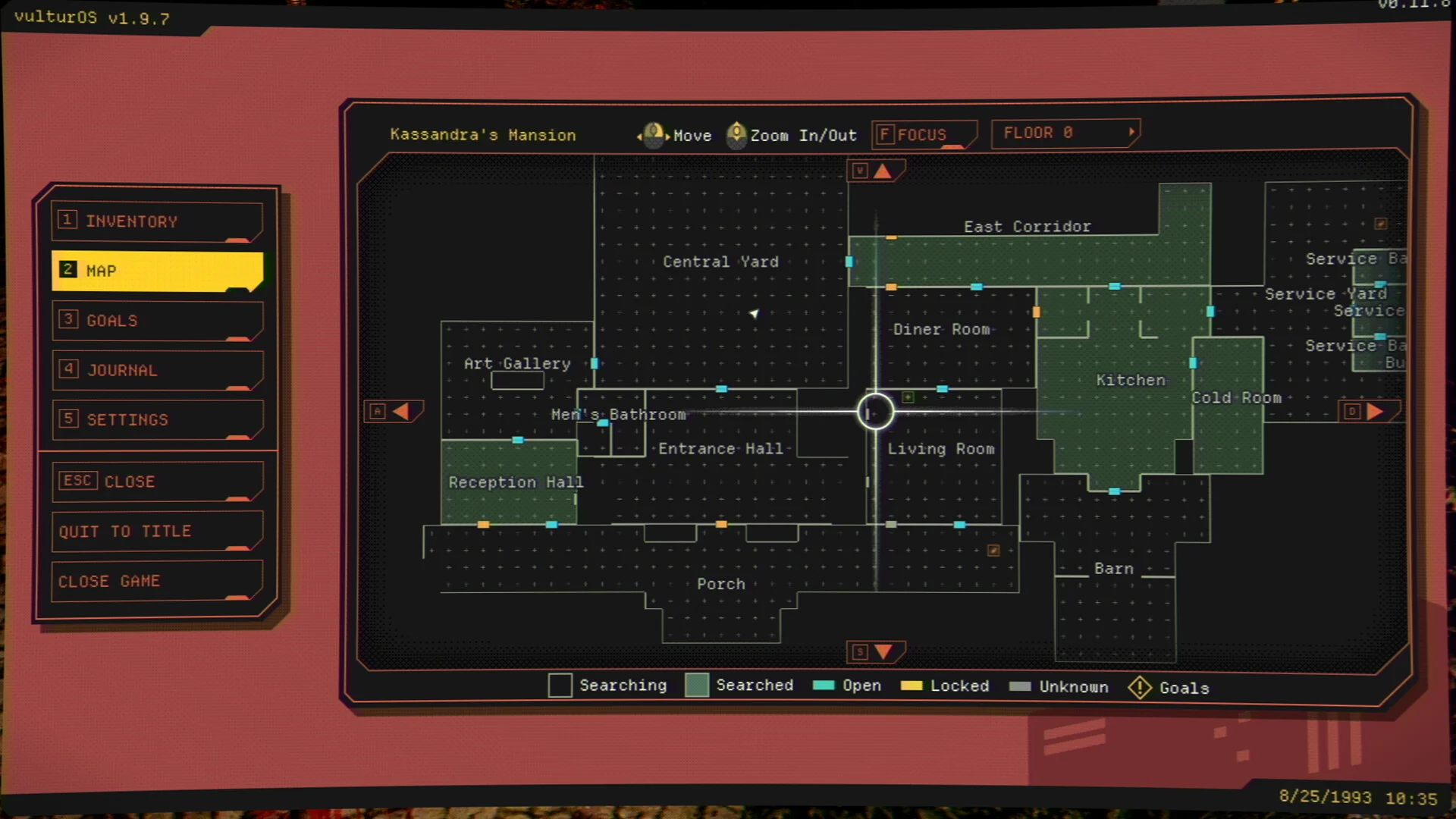
Each mission is essentially a small-scale version of the Spencer Mansion or Raccoon City Police Station, where you explore room to room, gathering resources, solving puzzles, and completing objectives, just like you would in any survival horror title. The settings range from spooky mansions and overrun police stations to military facilities, underground laboratories, and abandoned prisons, hitting virtually all of the typical locations from various Resident Evil titles. I appreciated the sense of familiarity and the addictive, room-by-room pace of exploration and backtracking, though I would’ve liked to see more urban or residential locations that show the virus’s impact on Solento Valley beyond the corporate conglomerate’s research and testing sites. The visuals and audio are on point, creating an unsettling atmosphere with the low-poly environments and ominous hum of ambient mechanical sounds. The game employs a visual CRT filter that fittingly obscures the fine details of character models and environments, though I eventually turned it off for sharper visual quality and easier readability during combat.
Movement is grid-based and real-time outside of combat, and the protagonist can run, walk, or sneak through areas. Stealth is a major component of the gameplay, resembling the stealth systems in other strategy titles like XCOM 2 or Mutant Year Zero: Road to Eden. You employ stealth to get into a favorable position in a room full of enemies, perform takedowns, or even avoid enemies entirely. Walking is used most often during normal exploration and combat, and I only saw fit to run when I needed to cover a lot of ground while backtracking through areas cleared of enemies. I appreciate the thoughtful inclusion of multiple movement options with clear strengths depending on the situation at hand.
There is a fog of war mechanic that obscures environments and enemies relative to the character’s line of sight and light sources in each room, ensuring that you must tread carefully as you advance in a mission and load into a new room after opening a door. Old school survival horror games used fixed camera angles to obscure the player’s vision and tank controls to limit their evasiveness and heighten danger during encounters. Vultures employs familiar strategy game mechanics to achieve the same goal, striking a delicate balance of elements common to both genres to create a sense of tension and unease driven by uncertainty. It’s a very unique combination, and Vultures – Scavengers of Death proves that the marriage of strategy and survival horror is ripe for further experimentation.
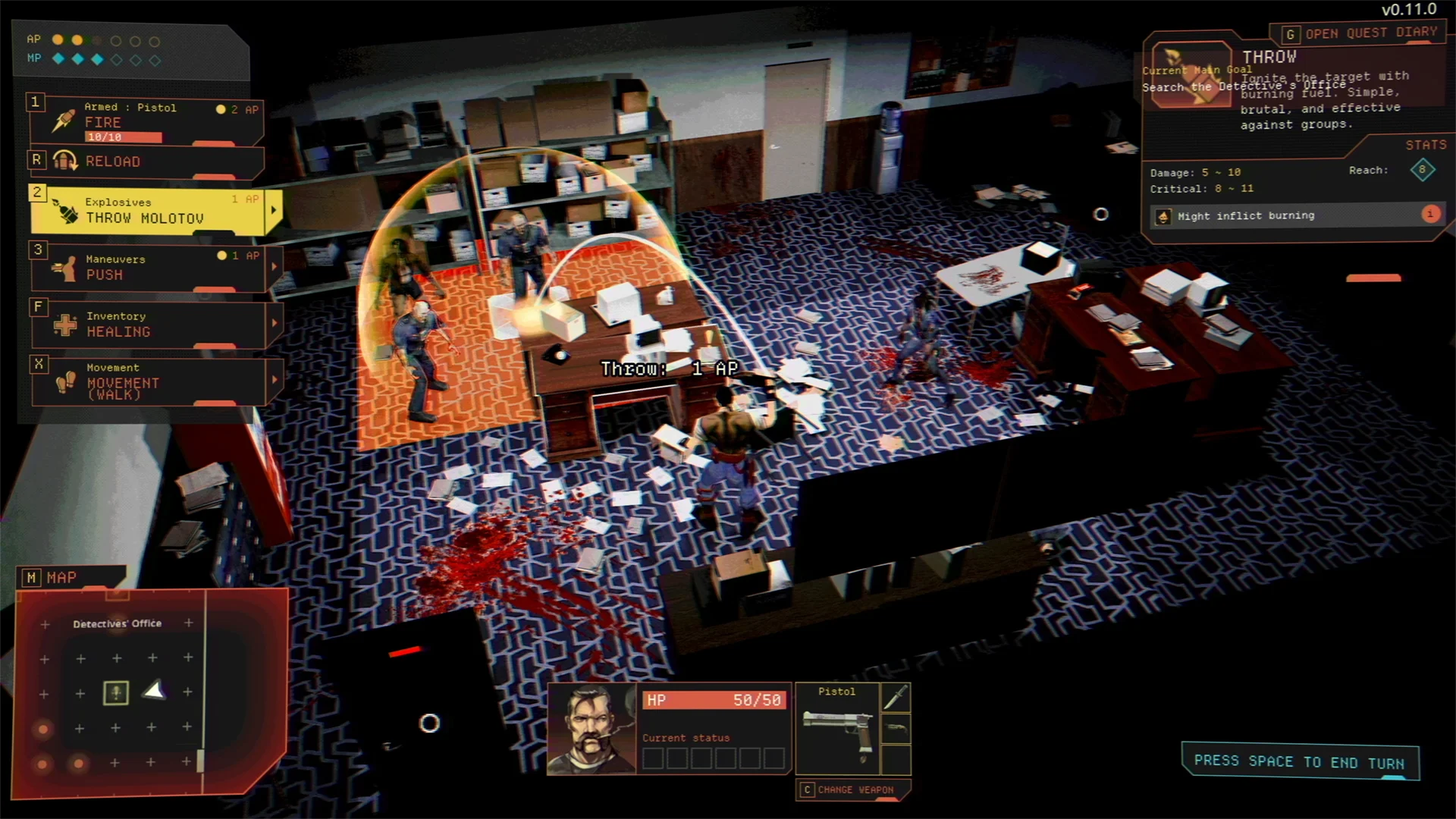
Combat sees the game transition to an entirely turn-based system, governed by action points (AP) and movement points (MP). Generally, the player has access to 3 AP and 3MP each turn, but these can be increased through consumables or equipment upgrades. Standard zombies have the same limitations, so in combat, I quickly learned to maneuver myself at least four spaces away from enemies to avoid taking damage. Since you only control a single character at once, even a couple of enemies ganging up on you can be disastrous. Many rooms (particularly late in the game) can have upwards of four or five enemies at once, and enemies hit quite hard relative to the player’s health. Combat becomes a careful, deliberate dance of managing AP and MP while keeping out of the fetid clutches of your undead foes. I found the action economy well-tuned, giving just enough room for creativity and expression without leaving the player overpowered.
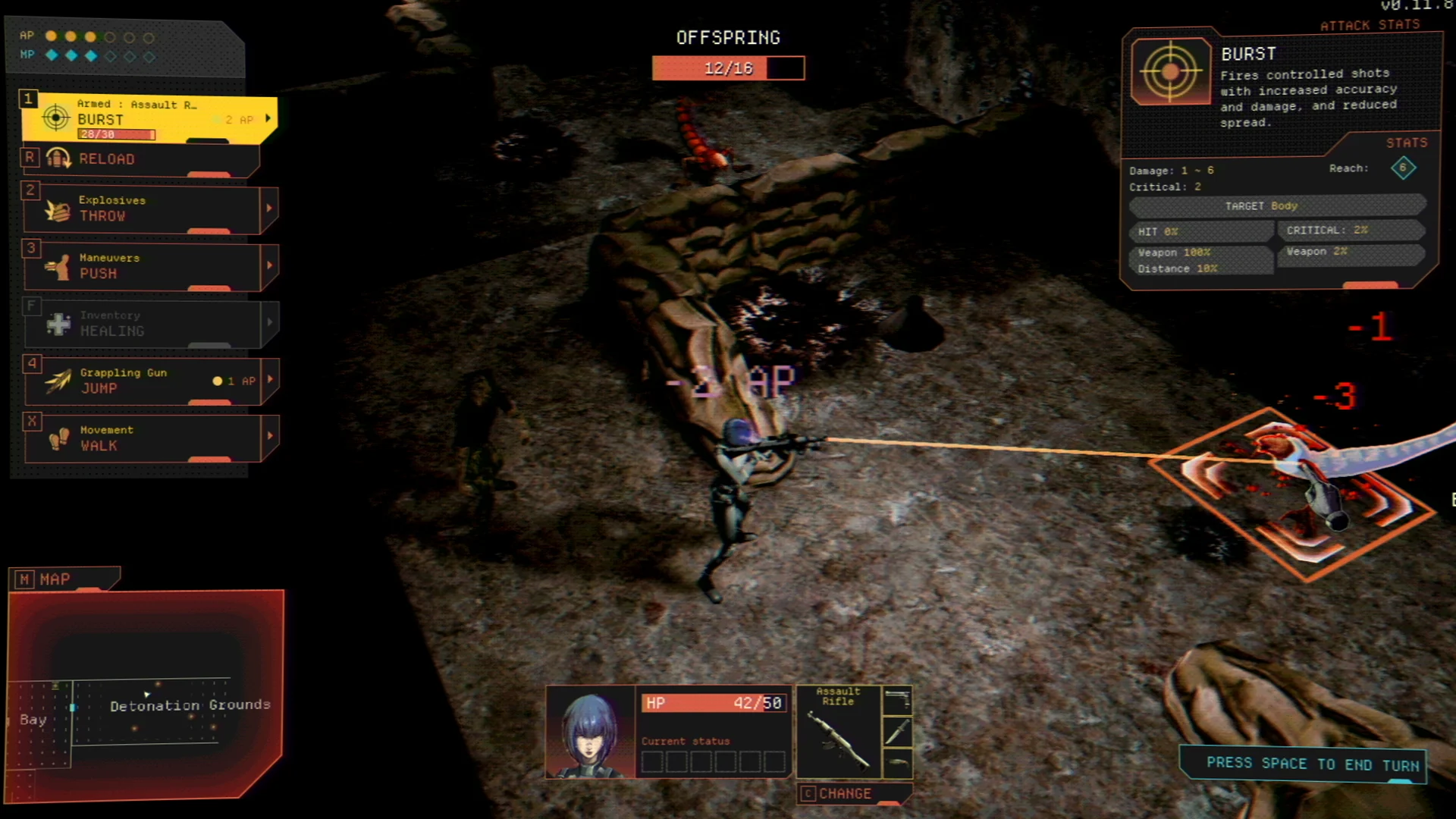
Most of your weapons are firearms, so there is a focus on ranged combat. You can target certain parts of the body to deal more damage or sacrifice power for the chance to disable a foe temporarily. Enemy variety is not extensive, but I found the enemy types all served a purpose, and that most encounters combined them in clever ways. While most enemies need to be within melee range to strike, some enemies can quickly rush forward multiple tiles and attack, others can burrow underground to avoid damage on their approach, and some even employ ranged attacks. Thankfully, you have access to a wide variety of weapons and tools to dispatch foes, and most missions reward you with a new addition to your arsenal if you explore thoroughly. The trusty pistol and knife are mainstays that cannot be unequipped or removed from your inventory, with other weapons serving situational roles. For example, the shotgun is great up close and can stun enemies, but falters at range. The assault rifle, on the other hand, is great for burst fire over long distances or spraying a wide area against multiple foes, but it applies damage more randomly. Mastering these tools is key to success, and I found that each weapon had clear uses and drawbacks I needed to integrate into my planning.
Resource management is a core pillar of survival horror game design, and Vultures – Scavengers of Death commits to this tenet well. My initial experience with Vultures had me swimming in resources near the beginning, while the later missions required everything at my disposal to survive, winnowing the surplus I’d carefully collected over the initial hours. This difficulty curve is inverted from most survival horror titles, where the game is often hardest at the beginning but gets easier as you acquire more weapons and ammunition over the course of the game. Although I never died during my playthrough, keeping Leopoldo and Amber alive required full strategic engagement and provided a satisfying challenge.
I do wish the game had introduced more variety in objectives, as most missions boil down to finding keys, activating switches and panels, and solving puzzles to open hidden areas. These are all survival horror mainstays, but ultimately boil down to keeping the protagonist alive. The best strategy games offer variable objectives beyond simply surviving, like limited turn counts, shepherding vulnerable NPCs, or defending specific points. I think the decision to limit the game to a single character was a wise choice to maintain the appropriate survival horror tension and atmosphere. However, the focus on one character does limit strategic options compared to turn-based strategy classics like XCOM 2 or Into the Breach, something more objective variety could alleviate.
I’ve been quite positive about the game up to this point, and I firmly believe Vultures – Scavengers of Death is a great proof-of-concept for fusing turn-based strategy and survival horror mechanics. Unfortunately, the game begins to fall apart in its technical execution. I’m not exaggerating when I say that it’s more riddled with bugs and glitches than there are maggots infesting the skull of one of its undead foes. My initial hours with the game revealed a cornucopia of minor issues, from interactive elements in the environment failing to trigger to the odd camera glitch obscuring my viewing area after cutscenes. As I progressed further, more frustrating issues began to arise, like UI elements overlapping in the hub between missions (aptly called The Nest) that prevented me from transferring items from the character inventory to the storage, or stacks of ammunition suddenly disappearing. I could navigate around these minor issues, but the game really began to fall apart at the seams in the last few missions.
In two separate late-game missions, I hit significant progression bugs. One instance was because an existing key item vanished from my inventory, and another was because the objective would not advance despite having already been completed. Both of these bugs happened at the very end of long missions (over an hour of progress each time), and neither loading old saves nor relaunching the game solved the problem. I was forced to choose the “abort mission” option, which resets all your progress and puts you back at the mission hub. It reminded me of playing Baldur’s Gate III at launch, where the first two acts were littered with small annoyance glitches, but then the third act was almost fundamentally broken. Vultures was already delayed once from its original late April release date to mid-May, but honestly, the developers should’ve taken even more time to iron out the issues. I am sympathetic to the fact that this is a small team (only two developers), but having to repeat so many long missions destroyed the tension and unease that the game spent so much time cultivating in its early hours.
Vultures – Scavengers of Death proves that strategy and horror can coexist and even thrive when paired together. The uncertainty derived from hit percentages and fog of war complements the tense exploration and foreboding atmosphere of the carefully crafted horror locations. I’d love to give a firm recommendation to survival horror fans and turn-based strategy veterans alike, but only under the condition that you wait for the technical issues to be ironed out. There is a real diamond in the rough here, but only if you wait for the cleanup crew to wipe away the blood and viscera first.