
When Disco Elysium was released in 2019, it was immediately regarded as a genre-defining work of RPG narrative design. From the way it recontextualized player agency and decision-making, how it represented the various mental faculties and barely-restrained impulses of protagonist Harry Dubois as anthropomorphised residents of his own mind, or its uncanny ability to immerse the player in heady concepts like religion, political ideology, and existential philosophy while simultaneously maintaining an uproariously funny (and deliciously crude) tone, one thing remains true: there has never been another game like Disco Elysium.
I’ve made my love for the game clear across numerous podcast episodes and pieces for the site over the years. I’ve followed the aftermath of the game’s development, including the firing of the creative leadership team (Director and Lead Writer Robert Kurvitz, Lead Writer Helen Hindpere, & Art Director Aleksander Rostov), and the subsequent dismissal of most of the remainder of the original development team (including writer Argo Tuulik) after the cancellation of several Disco Elysium follow-up projects. Suffice it to say, the story of Disco Elysium after its release has been characterized by despair and disappointment.
However, the studio ZA/UM still exists, under the direct control of investors Tonis Haavel (previously convicted of financial crimes) and Ilmar Kompus. This duo allegedly stole the studio and its intellectual property from under the original creative team and brought us such masterful innovations in merchandising as the $165 plastic bag. Not exactly an auspicious foundation—but I decided to approach ZA/UM’s newest title, Zero Parades: For Dead Spies, with an open mind.
The “espionage RPG” concept was distinct enough to pique my curiosity, and the game certainly looks the part of a Disco Elysium successor. My time with the game has left me torn much the way protagonist Hershel Wilk is between her former compatriots; the core experience remains compelling in much the same way Disco Elysium was, but the game never truly steps out of its predecessor’s shadow and stands on its own merits. Zero Parades: For Dead Spies is ultimately defined by an inherent comparison to what came before, and crumbles beneath that pressure.
Zero Parades follows protagonist Hershel Wilk (cryptonym CASCADE), an Operant (spy) for the Communist Superbloc. She has just been deployed for fieldwork after five long years sequestered at a desk job inside the Superbloc spy agency Opera’s archives department thanks to a botched assignment in the independent city-state of Portofiro. Her new assignment sees her returning to Portofiro (specifically the neighborhood of Quisach) to assist her new double (partner), PSEUDOPOD, with his work, given her familiarity with the location.
Upon arriving at the photo development shop they are to use as a safehouse, Hershel discovers PSEUDOPOD has been zeroed out by the enemy, left in a catatonic state by a mysterious red disc. It’s an intriguing start, albeit similar to Harry Dubois’s disheveled beginnings. It’s up to Hershel to investigate her surroundings, ascertain the details of her assignment, and assemble her previous comrades (The Whole Sick Crew). Doing so requires that you walk around, talk to the locals, and stick your nose where it doesn’t belong, all while avoiding detection.
The new team at ZA/UM wisely set Zero Parades in a new setting, rather than Elysium from the previous game. The world of Zero Parades evokes the Cold War conflict of the 1970s and 1980s: a grand conflict of subterfuge and ideology between the forces of communism (The Superbloc), a techno-fascist expansionist empire (La Luz), and the capitalist neoliberalism of the Developed World (ruled by transnational bank EMTERR, a stand-in for the IMF). Portofiro is caught in the crossfire, similar to various countries in the Non-Aligned Movement, which struggled to develop and thrive amidst the animosities of the multi-polar world established after World War II.
Portofiro is an amalgamation of Italian culture and various South American cultures; the colorful streets full with tourists, the local bazaar bustling with black market goods, the locals eking out a meager living in service roles. Portofiro had previously flourished and then fallen into disrepair under a dictator named Nestor and his “Nestorism” (inspired by Argentina’s Peronism), a nationalist ideology with elements of both socialism and capitalism.
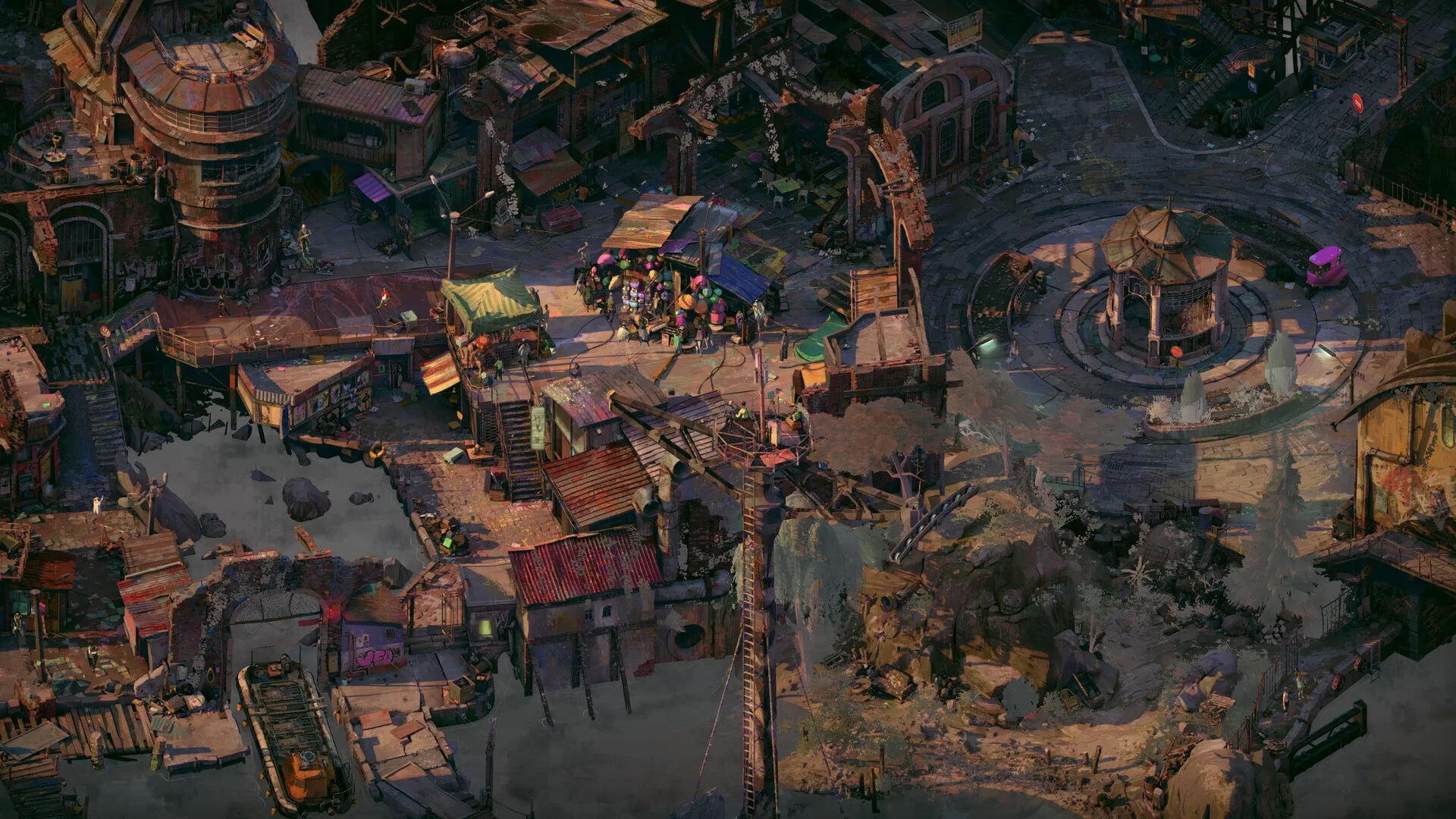
Against this backdrop, the spies of Opera, La Luz’s Weeping Eye, and the hired guns of EMTERR compete for dominance. Each major power has its own methods for bringing countries like Portofiro under its influence. For La Luz, it’s cultural domination, flooding the bazaar with cheap Luzian goods (pop music, fast fashion, and violent animated children’s television), followed by the threat of military invasion if the cultural approach fails. For the bankers of EMTERR, domination is financial: cutting high-interest loans to struggling economies and then enforcing their will when the bankrupt nations cannot keep up with payments.
The Superbloc’s influence is waning in this war waged through financialization and commodification, forcing the communists to resort to disruption tactics. For Opera, gaining influence over Portofiro is a foregone conclusion; keeping them out of the hands of La Luz or EMTERR is the only achievable victory.
The Cold War-style setting is a fitting backdrop for an espionage tale, and it’s clear ZA/UM know their history. Where the game falters is in its adherence to Disco Elysium‘s structure. It made sense for Harry Dubois, a known police detective, to bumble around the streets of Martinaise and engage the various residents in conversation to solve a murder. Hershel Wilk, on the other hand, is a spy trying to keep a low profile in hostile territory, so the main mode of gameplay (open conversation with strangers) feels significantly out of place.
Similarly, the core design elements of scrounging the environment for consumables and equipment are equally ill-fitting; it made sense for an amnesiac with poor impulse control to drink alcohol he plucked from the garbage and wear a strange assortment of secondhand clothes, but it’s strange for a trained assassin (for whom stealth is paramount to survival) to assume the same behaviors and draw attention to herself.
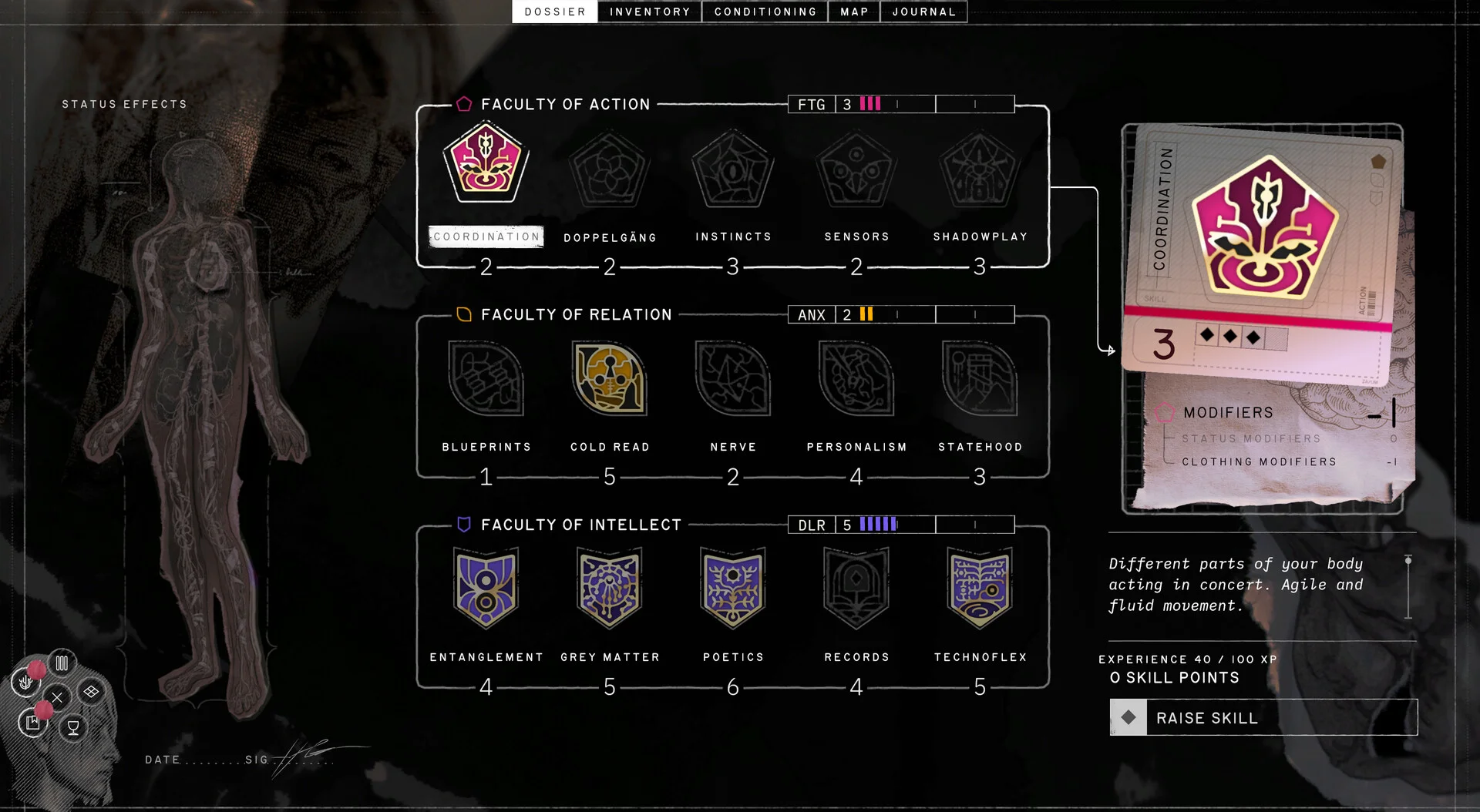
Zero Parades‘ mismatch of mechanics and narrative carries over into the character-building and roleplaying elements. “Conditioning” replaces Disco Elysium‘s Thought Cabinet, serving the same purpose of internalizing various thoughts and proclivities gleaned from conversations and character backstories. These personality quirks convey various passive bonuses in conversation and boost various stats, broken down into three major categories—Faculty of Action, Relation, and Intellect—with five distinct skills in each category. These skills determine your chance of success in dice rolls during conversations, as well as your options in action segments (Dramatic Encounters).
Apparently, there is only a nominal difference between the skills of an alcoholic police detective and an international spy. Perhaps the biggest diversion from Disco Elysium‘s format lies in managing Hershel’s Delirium, Fatigue, and Anxiety. Conversations or various actions (such as physical exertion) will spike one of these three parameters; when they max out, the player is forced to lower a corresponding Intellect, Action, or Relation skill. In theory, this serves as an additional pressure on the player befitting the high-stakes nature of spycraft. In practice, it serves as a steep punishment at the outset when Hershel’s skills are low, and an easily ignored annoyance later in the game when you have the consumables and equipment to compensate.
One of Disco Elysium‘s foremost innovations in RPG design was its ability to convert failure states into unconventional outcomes rather than simply impeding progress. This naturally discouraged the player from ingrained practices like save scumming, encouraging players to live with their decisions and, in turn, heightening immersion into the world of Elysium. By contrast, Zero Parades is far more reliant on repeatable skill checks, where failure does not permanently impede progression, but also fails to transition into novel states of play, instead prompting players to return to the check when their stats are higher.
For the checks that are single-attempts, failure rarely resulted in novelty, instead forcing the player to achieve the desired result via a different stat check, or another environmental path. In Zero Parades, I never experienced a failure state with an unexpected or heterodox result. This inability to replicate one of Disco Elysium‘s defining design flourishes is accentuated by a Conditionable thought in Hershel that grants significant stat bonuses at the cost of a metatextual restriction on manual saving. Some might see this as an inventive solution to common RPG player behavior, but I found it to be the developers admitting they couldn’t craft significantly interesting failure states such that players would avoid reloading saves of their own accord.
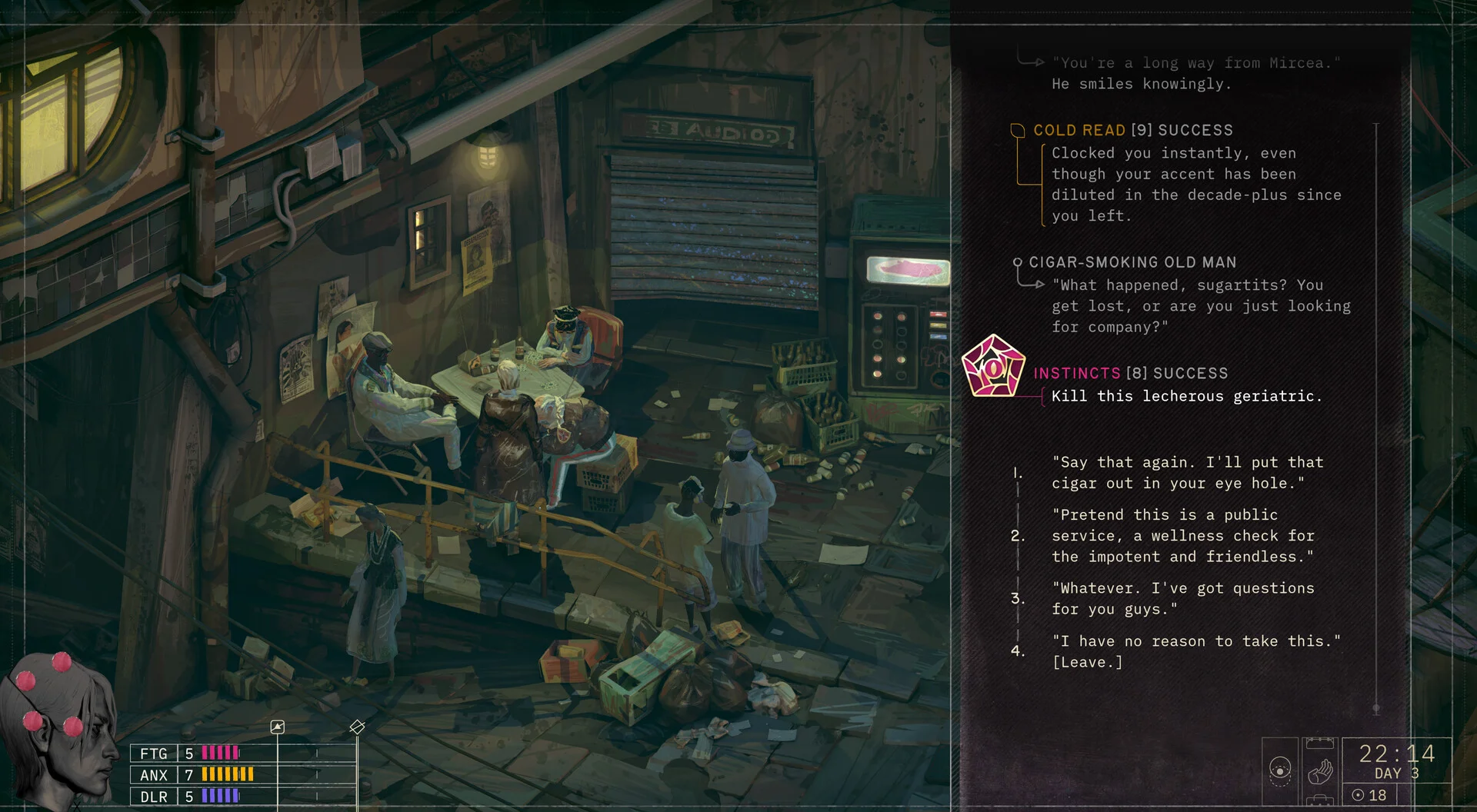
As with the mechanics and design philosophy, the writing and aesthetics never step far enough out of Disco Elysium’s shadow. The art style is carried over almost exactly, with spartanly animated 3D character models that contrast with the impressionistic 2D background art. It certainly looks nice, and the change in scenery is appreciated despite it feeling overly familiar. While the NPCs crowding the streets should make Zero Parades‘ Quisach feel alive and bustling, the inability to interact with the vast majority of said NPCs makes the world feel emptier than Disco Elysium‘s Martinaise, where you could talk to nearly everyone.
The writing is engaging, with a general bar of quality above most games. Certain characters, like Petre the Format Fetishist, EMTERR banker Oskar Metamoto, or unlicensed medical provider Doctor Ganza are as fully realized as any Disco Elysium character. The surviving members of Hershel’s Whole Sick Crew are particular standouts, with clearly defined personalities and intriguing backstories. Unfortunately, the quality of writing is inconsistent—many of the characters you can interact with don’t meet this standard, and the internal monologue inside Herschel’s head tries too hard to emulate the esoteric neuroticism of Harry’s various competing psyches.
Another issue with the writing is anachronisms that don’t fit the setting. I appreciate that the writers wanted to comment on absurd modern cultural and economic phenomena like TikTok shifting or Buy Now, Pay Later microcredit schemes. However, this behavior is synonymous with the digital age, emerging from the social and financial relations created by communication and commerce over the internet. Zero Parades‘ world is decidedly analog and defined by a multipolarity in which communism remains undefeated. Including elements of late-stage capitalist domination, where the free hand of the market has us all in its iron grip, undermines the immersion and authenticity of the setting in exchange for cheap, referential humor.
The biggest flaw with Zero Parades‘ narrative is Hershel’s characterization. Disco Elysium‘s Harry was a blank slate; he had a set backstory that led him to Martinaise, but due to his psychic break and resulting amnesia, the player could mold and develop his personality as they saw fit. Furthermore, his interactions with other characters and his constant companion, Kim Kitsuragi, provided ample opportunity to get a sense of who you wanted Harry to be and how he related to the world around him.
Hershel, by contrast, has a rigid past and a rather one-note personality. You can influence her skills as a spy, yet she remains utilitarian in expression and persona, without a companion to act as a foil or further develop her sense of self through relationship development. She’s not that compelling on her own, and I never developed a sense of what Hershel was truly like beyond her work as a spy and her regret over her past failures. Her most interesting interactions are with her former comrades, but these are established relationships shown in short glimpses. It’s a poor replacement for witnessing the satisfying development of new character dynamics.
Zero Parades also fumbles the fundamental lessons for introducing political concepts into the narrative. In Disco Elysium, the characters do not just espouse their political ideology; they embody it. The dense political conversations and musings go down easily because they are rooted deeply in the humanity and personalities of the various characters. The fascists are motivated by a deep insecurity and fear of the unknown, the liberals a sense of moral superiority and rational practicality, the communists by theoretical understanding applied to their material conditions. In Disco Elysium, every character is a true believer; in Zero Parades: For Dead Spies, every character is a cynic.
Characters will explain the political ideology or aspirations of their side, only to undercut those explanations immediately in self-service. Perhaps this is more accurate to a bunch of spies, trained professionals who care more about the execution of their assignment and chasing thrills than the cause they are ostensibly fighting for. Unfortunately, it makes it much more difficult to buy into the political content of the narrative, turning most of these digressions into pastiche rather than genuine insight.
Finishing Zero Parades: For Dead Spies, I had no sense of what the developers wanted me to take away from this story, and felt decidedly empty despite being sufficiently entertained throughout the game’s 15-hour runtime. Disco Elysium spoke to me as a game about broken people in a broken and forgotten place, where a broken man finds community and purpose among the wreckage wrought by vast political forces and his own mistakes. Zero Parades is ostensibly about the people who break places like Revachol and Portofiro, but is so consumed in illustrating how they destroy a community that it offers very little insight into why they risk life and limb to destabilize places already hanging by a thread.
Something I reflected on after finishing Zero Parades is the capital-serving perspective the industry takes toward game development. Players and publishers alike think of gaming in terms of franchises and intellectual property rather than the people who make them. It’s not uncommon for AAA development teams to shed themselves of veteran and rookie talent alike upon completion of a project, scattering the team members to the four winds until they inevitably hire a new crop of exploitable labor and set them hard at work applying the franchise formula to the next entry.
I think part of what made Disco Elysium so innately compelling is that it was developed so far outside of those conditions, by an artist collective who had carefully crafted their world of Elysium over years of communal tabletop roleplaying sessions and other creative pursuits. Disco Elysium represented the culmination of all their creative energies, and the result was almost magical in its ability to speak to the human condition and connect with players. Leading up to the release of Zero Parades, writer and voice-over director Jim Ashivel commented on perceived similarities between Disco Elysium and Zero Parades in an interview with IGN:
“I think it would have made sense for us to go in a completely different direction if the entire team was comprised of new talent. But since such a large number of the key players that built Disco Elysium are here to build Zero Parades, it just didn’t make sense for us to just disregard that part of our experience as amateur game makers and start learning new ways of telling stories. We’re still the same people.”
Current studio head Allen Murray, whose long list of AAA credits includes games like Halo and Destiny, clarified that 35% of the developers on Zero Parades worked on the original Disco Elysium or the Final Cut (dialed in Disco Elysium fans will know the studio scaled up significantly between original release and the release of Final Cut). While these statements from Murray and Ashivel are both technically true, they are also disingenuous.
Of the original core writing team for Disco Elysium (Robert Kurvitz, Helen Hindpere, Argo Tuulik, Cash DeCuir, and Olga Moskvina), not a single member remains. Aleksander Rostov, the art director who painstakingly established the aesthetic identity for Disco Elysium, and Martin Luiga, an original member of the artist collective who helped establish the setting of Elysium, along with too many others to name here, are long gone.
The only names shared between the original core development team and Zero Parades are Justin Keenan (additional writing on Disco Elysium, writing director on Zero Parades), Jim Ashivel (voice-over director on Disco Elysium), Sim Sinamae (additional writing on Disco Elysium, writer on Zero Parades), Kaspar Tamsalu (artist on Disco Elysium, art director on Zero Parades), and Eduardo Rubio (animator on Disco Elysium, principal animator on Zero Parades). These people are immensely talented, as are the rest of the team who worked on this game as their first original project with ZA/UM, and I wish I could see what a truly original vision looks like from them, no longer beholden to the mechanics, aesthetics, and structure intended for Disco Elysium.
What troubles me about Zero Parades is that its journey to release is more typical of the industry: numerous canceled projects, mass layoffs, all culminating in an almost entirely new team building a new game using the tools and design template established by creatives long since disposed of, meant for an entirely different world and built for an entirely different purpose, repurposed for this title. In that context, it’s a miracle the game is as competent, humorous, and well-realized as it is, despite not fully standing on its own or carrying the torch for what made Disco Elysium so special.
The investors want their return on investment, and while they can’t own the people who created what we love, they can own the product of their labor under the guise of intellectual property, and wring out as much value as possible. It’s a reminder to value the people who made the games you love, and hope for the best for those still working within the system. The developers at ZA/UM recently unionized their workplace, a first for the British game industry. Hopefully, that’s the sign of a bright future ahead.