

After hearing about publisher Boss Fight Books from podcasts and reviews (like Alana Hagues’ review of BFB title Final Fantasy VI) over the years, yet somehow never picking up one of their titles, I jumped at the opportunity to review their newest addition to their vast library of documentary-style writing on games. Boss Fight Books has published books on many acclaimed and influential RPGs: EarthBound, Chrono Trigger, Baldur’s Gate II, Final Fantasy V & VI, etc. It goes without saying that all of these monumental entries in the genre deserve to have a book written about them. However, the true test of the “each game gets its own book” concept lies not within the most acclaimed titles that have had countless pots of proverbial ink spilled about them since the dawn of video game writing and analysis.
Rather, the ultimate proof-of-concept of Boss Fight Books’ mission is a book about a game that remains obscure to the modern RPG audience, a game modest in its scale and ambition, something oft-forgotten in the rush to establish the ultimate canon of the best RPGs in existence. If someone could write a book about, say, a little Game Boy fishing RPG from 1998 that barely anyone remembers and make it compelling and insightful, then it would prove beyond a doubt that any game deserves to get its own book. Well, I’m pleased to report that author Alexander B. Joy has done the impossible, delivering a book on Legend of the River King so rich with cultural context, literary analysis, and philosophical insight that it’s hard to believe so much could be fished from the murky, shallow pond of an 8-bit cartridge.
Joy begins the book with a clever juxtaposition, setting the stage by comparing Legend of the River King to its most important contemporary and erstwhile rival for the target audience’s hard-won allowance, Pokémon Red & Blue. This comparison serves to explain why Legend of the River King remains relatively forgotten, a blip on the radar during the tsunami that was Pokémon’s arrival on Western shores, and also as the basis for the argument Joy makes about River King’s importance and enduring legacy. Whereas Pokémon (and most other RPGs for that matter) are fundamentally about the player’s domination and subjugation of natural forces, Legend of the River King is about coexistence and communion with nature. This idea is central to Joy’s analysis of the game, the core around which all his other observations, allusions, and anecdotes revolve. By the end of his treatise, I was thoroughly convinced.
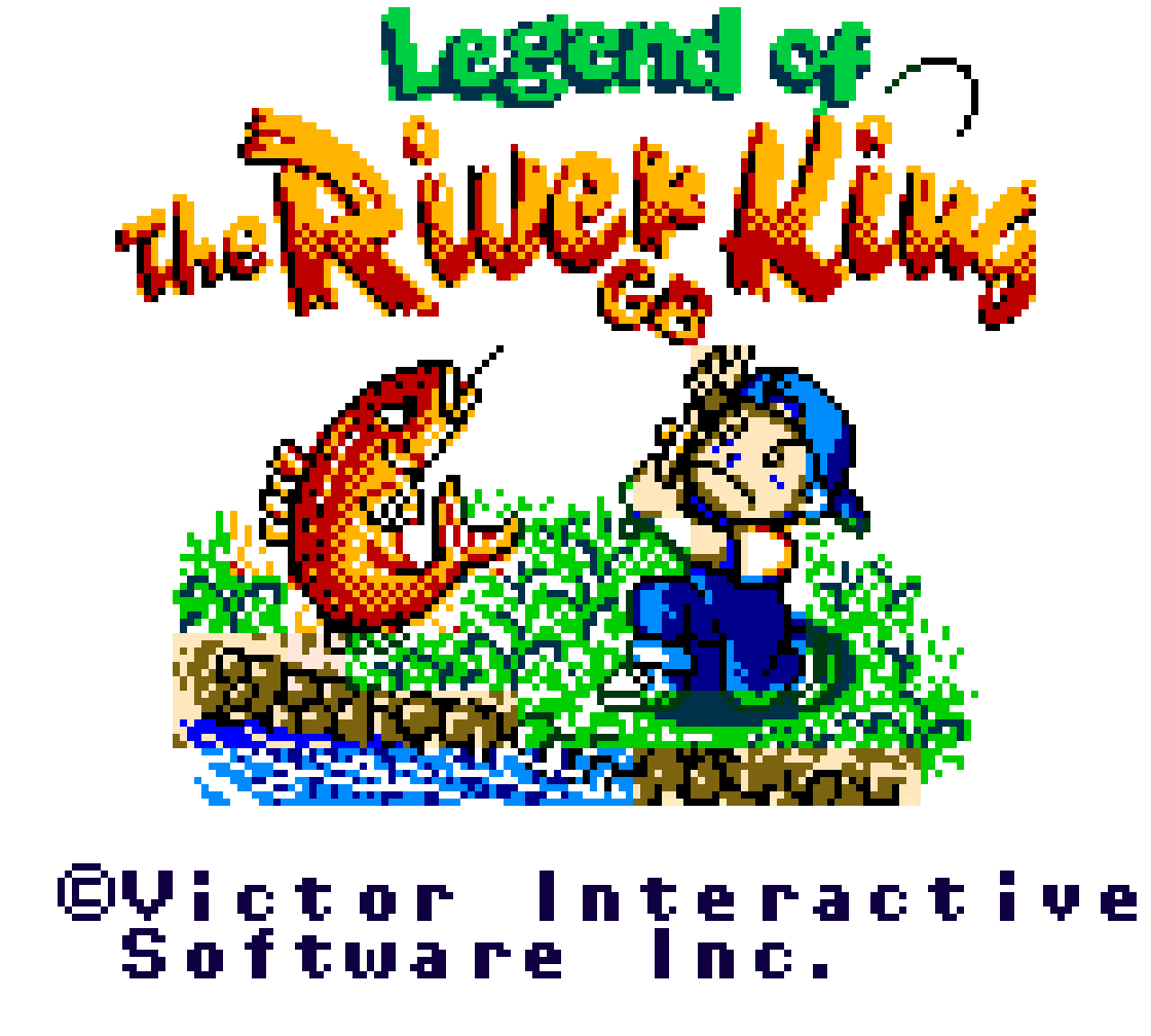
Perhaps the most impressive aspect of Joy’s book is how effortlessly it weaves between cogent analysis and detailed summary. It is, at its most basic, a complete walkthrough of the game’s mechanics and main quest. Joy exhaustively details the particulars of the game’s fishing mechanics and economy, guiding the reader through each area of the game the player visits during their journey to catch the fabled Guardian and save their sister from her mysterious illness. At the surface level, the book functions much like the game guides (both professional and fan-made) that were common companions to nearly any game released in 1998. Joy outlines the required (and often unintuitive) steps one must take to see the game through to the end, warning the player of major pitfalls and offering helpful tips on how to navigate the world or hook a particularly troublesome fish.
Where the book really shines is in the many asides, anecdotes, and musings peppered throughout this walkthrough, peeling away the mechanics and fetch quests like the layers of a silvery fish skin to reveal the rich, succulent meat of subtext and cultural context buried beneath. I was surprised by how much I learned about the cultural context behind things I had taken for granted when I played the game as a kid. For example, did you know that the save points are meant to represent Jizo statues? Joy effortlessly explains the origins of Jizo Bosatsu, the guardian deity of lost children in Japanese folklore, and reveals the deeper meaning behind an otherwise common mechanic. You are a child on a journey alone afterall, so it’s fitting that the developers would use such a well-known symbol to serve as a resting place. There are many Japanese cultural touchstones in the game that Joy shines a light on, from how it draws on the storytelling philosophy of famed Japanese writer Yasunari Kawabata to why so many NPCs are obsessed with the Ayu sweetfish, a regional delicacy. Such details would be obvious to the average Japanese player, and Joy goes to great lengths to explain their significance to a Western audience so that we might also understand what the game conveys only through sparse text and hard-to-discern sprites.
One of the strongest elements of the book is how Joy utilizes his knowledge of RPG genre conventions to explain how Legend of the River King bucks those trends in pursuit of its overarching thematic goal. The game has a rather unique approach to progression and combat, with only one stat (HP) serving as a measure of both your health and strength. Joy argues that by tying everything to one stat, combat becomes more realistic. As you take more hits, you become weaker, and each battle with the various forms of aggressive wildlife is less a beautiful dance of spectacle and skill like in most RPGs, but rather a grim battle of survival between the player and nature. Joy writes that “you’ll fight because you must. But you’ll never enjoy it,” because a fight between man and nature is not something to be celebrated. Joy makes a similar argument about the game’s choice to show the fishing sequences from the underwater perspective of the fish. This is in contrast to how most RPGs portray their fishing minigames from the player’s perspective on the dock or shore, and Joy suggests this perspective encourages you to empathize with the fish and better understand their struggle at the end of your line.
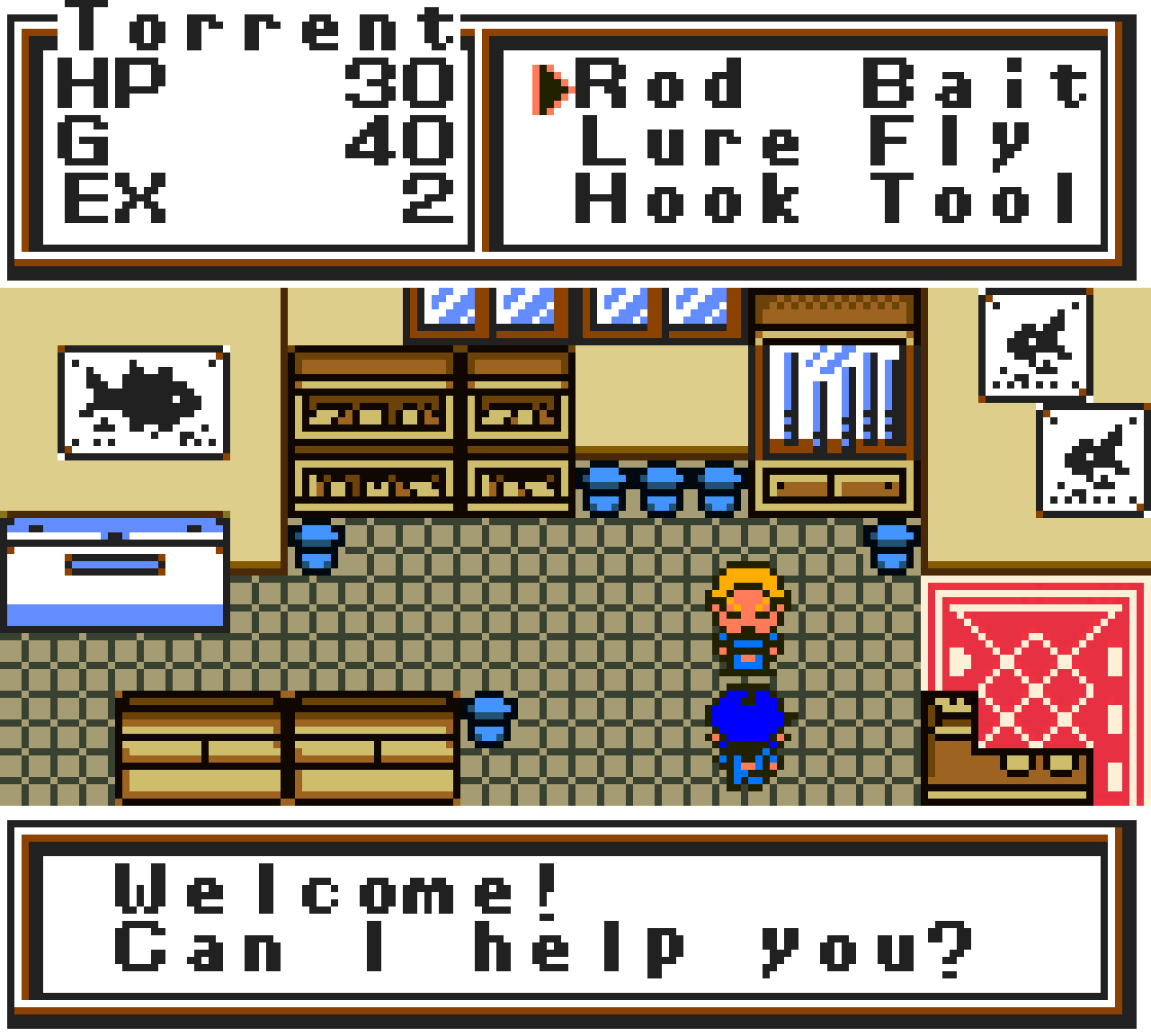
Some of the most humorous observations in the book are Joy’s ruminations on the occupations and limited dialogue of the various NPCs that populate the world. While many of these oddities and quirks can be explained away by technical limitations of the Game Boy or the meta-textual demands of gameplay convenience necessitating contrivance over realism, Joy’s interpretation of their backstories and personalities was an endless source of wit and entertainment throughout the 200+ pages of the book. One could suggest Joy is reading a bit too much into these sparse lines of dialogue; nonetheless, I enjoyed reading his headcanon about the various inhabitants of this fishing-obsessed little world, even if it likely extends beyond the intentions of the developers. His willingness to speculate about the interiority of these NPCs illustrates how video games, like all forms of art, are open to interpretation.
I was so impressed with Joy’s writing that I tracked down his personal blog, where I found an entry he wrote about the publication of this book:
“You see, I’ve long suspected that the true dream of every writer (or artist more broadly) is not only to produce something worthwhile. It’s to create something that justifies you – that gives purpose to every bit of indignity, sadness, and sacrifice from your life. This is not to say you’re aiming to inflate your own importance, or convince everybody to love you, or anything like that. Rather, it’s something simpler and more personal: To make it so you did not suffer pointlessly; to ensure that all your bad days had value behind them in the end, because they led to the work of art you made. And believe me when I say it can feel crushing when you’ve yet to bring that off…With Legend of the River King going to press, though, I’m free of all that at last. The pressure is off. I can tell myself that I made good on everything – the precocious linguistic abilities that made adults believe English was my future as a child; the undergrad degree I finished in three years; the doctorate I never put to use despite the torturous hours of striving for it; the tired, solitary nights after work that I spent wringing out the last of my energies to put the right words to paper. They all amounted to something. They all mattered.”
To put it simply, I deeply resonate with Dr. Joy’s sentiment here. The desire to write something meaningful, to feel as though all those years spent in school honing your craft weren’t a waste of time, the fulfillment that comes with a job well done and the knowledge that someone, somewhere might have read your thoughts and gotten something out of what you’ve written. That’s what motivates me to contribute to RPGFan. Legend of the River King is the definitive text on a charming little game, a lovely read that justifies Boss Fight Books’ entire mission statement. Reading it made me wish that every game I’ve enjoyed could receive a love letter as thorough and heartfelt as this one. Dr. Joy states in the initial pages of the book, “If readers come to appreciate River King even the slightest bit more after finishing this book, then I consider my efforts a success.” Alexander, I’m happy to say that from one writer to another, you’ve done it.
You can purchase Legend of the River King digitally or pre-order the paperback version, which is due to release sometime this year, on the Boss Fight Books website.
This article is based on a free copy of the book provided to RPGFan by the publisher. This relationship in no way influenced the author’s opinion, and no compensation was provided in relation to coverage. Learn more on our ethics & policies page.