
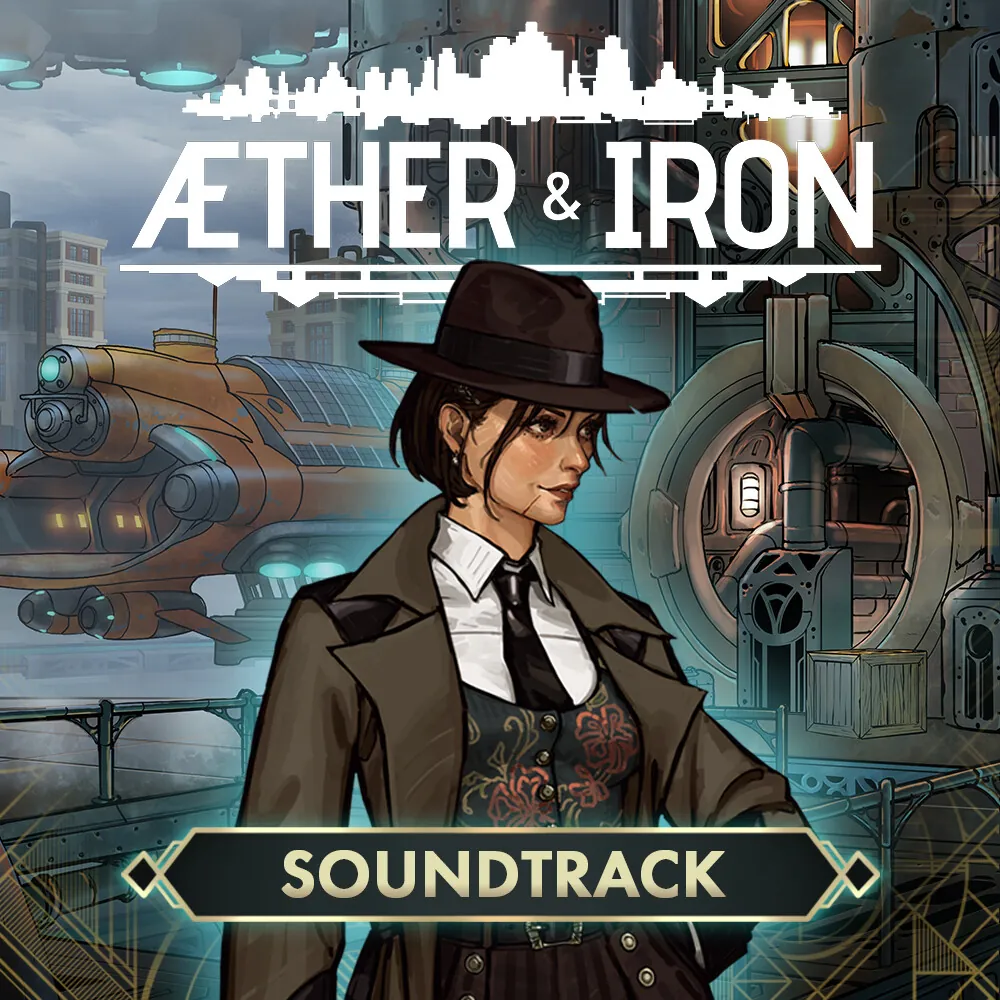


I recently learned about Aether & Iron after reading my colleague Jerry’s review of the game. The game itself looks cool. But when I read that the Aether & Iron Soundtrack was co-composed by *the* Christopher Tin and another formidable orchestral guru, Alex Williamson, I had to check it out for myself.
My first impression? The musical score for Aether & Iron exemplifies quality over quantity. With each passing year, I find myself inundated with soundtracks to massive RPGs with equally massive scores. Six hours used to seem the upper limit for a single game. Nope. Lately I’ve been running into soundtracks approaching the ten-hour mark. And yes, sometimes, those scores can hit that incredibly rare sweet spot of high quality across hundreds of songs. Most of the time, however? You could boil down those many songs to ten great ones and then a bunch of songs that fall between “pretty good” and “filler.”
In contrast, Aether & Iron‘s full score clocks in at just under an hour, with a bonus “disc” (all digital) available to those who purchase the album via Steam: six additional tracks, running an additional 20 minutes. And I can hear the skeptics among us asking: “Okay, so the music doesn’t overstay its welcome. But is it actually any good?”
I acknowledge my bias at this point. I have been following Christopher Tin’s career since he penned the famous opening theme song for Civilization IV, “Baba Yetu.” A re-recording of this track, alongside his song cycle project Calling All Dawns, was the first piece of music written for a video game to receive a Grammy win—over a decade before the Grammys even opened a category for game music. Since Calling All Dawns, Tin has produced several more choral-focused song cycles, with my all-time favorite being The Drop That Contained the Sea.
With so much great music under Tin’s belt, you may wonder if I’m giving the maestro preferential treatment. On the contrary, Tin has set the bar so high for himself that if he didn’t bring quality music, it would be a notable letdown. His reputation will not let him rest on his laurels when he brings new music to the table.
Based on the metadata tags on the files provided in the Steam soundtrack release, only one track is credited exclusively to Tin, and that is the opening theme “A City of Aether and Iron.” It is a marvel. Drawing on ample 19th and 20th-century harmonic structure, this orchestral recording demonstrates Tin’s ability to masterfully orchestrate even without his favorite instrument: the human voice. Aether & Iron‘s central melodic motif is established here. Tin also explores a range of evocative strategies with builds and fades, moving through feelings of sorrow, danger, adventure, hope, and suspicion: all things you’ll want in a good noir-themed adventure!
Now then, let’s get to Alex Williamson. Williamson himself has gotten a taste of the big-name awards ceremony, as he was nominated for a Grammy for the 4X strategy game Old World (alongside Tin) in 2022. I am again relying on the metadata to ascertain which tracks were handled by which composers. Most of them are tagged as shared work between Tin and Williamson. Tin takes sole credit for the opening track. Williamson’s solo contributions are “Sun On The Breeze,” “For Nellie,” “Turning Over Stones,” “Nations Crusade Adagio,” “What We Leave Behind,” and the ending track “In The City’s Shadow.” So let’s explore what Williamson brings to the Aether & Iron score.
“Sun On The Breeze” is a perfectly light piece that leans into the big band jazz sound of Aether & Iron‘s alternate-timeline 1930s without neglecting the “pops” orchestral sound that runs throughout many of the jazzy numbers here. Do you like pitched percussion? Marimba, xylophone, vibraphone, the works? I know I do, and if you do, you’re going to love what “Sun On The Breeze” offers. This is a fast number, and I find myself struggling to determine which section I want to focus on with each subsequent listen. This track works so well and is definitely one of the brighter spots for a game with noir-style visuals and narrative elements.
“For Nellie” embraces all things noir. This has the air of a solid film score, something that would fit with, or supplant, some of the musical stings of classics like The Maltese Falcon or The Big Heat. There’s just enough work in major keys to offer some hope, but much of what we hear is something between lament and intrigue. A perfect addition to the score!
The trio of tracks nine through eleven (“Turning Over Stones,” “Nations Crusade Adagio,” and “What We Leave Behind”) is where Williamson shines brightest. As the track title suggests, “Turning Over Stones” serves as music for uncovering the mysteries of Aether & Iron‘s world. Effective use of ostinato and sparse stings from piano, string, and brass keeps my ears engaged in the opening minutes before the tenor sax takes center stage.
After that? A surprising change, with sweeping piano chords that explore impressionist harmony (think Debussy, or if you only know game music, think Masashi Hamauzu). “Nations Crusade Adagio” is a melancholic piece mixing choir and orchestra, with a soundscape somewhere between the romantic era of classical composition and a good Hans Zimmer film score. “What We Leave Behind” is a powerful, brass-heavy piece that, frankly, reminds me of some of Hitoshi Sakimoto’s biggest and most bombastic works (see Final Fantasy XII).
Finally, “In The City’s Shadow” is a tasty noir-jazz treat. Mute trumpet? Check. Vibraphones? Double check. Dark, melodic tones from the sax? Checkity-check check check! This is the perfect jazz number to go out on. And by “go out,” I am excluding the bonus tracks. My understanding is that Aether & Iron‘s main 15-track OST is what streaming services will get, at least for the time being.
Looking back over the tag-teamed work between Tin and Williamson, a significant chunk resembles a cross between John Williams’ Star Wars and Hitoshi Sakimoto’s Final Fantasy XII. And that’s appropriate, given the game’s theme of crossing magic and technology. “The Easy Kind of Trouble” blends the orchestral sections nicely, both in the mix and in the featured time each gets in the composition.
“A Dangerous City” feels like a boss battle theme, though I’m not certain of its in-game context. The low brass and percussion do some heavy lifting at different points, while decorative flourishes from the harp, trumpet, and string ensemble hold the listener’s attention in the upper registers. Just one more well-crafted piece!
My favorite composition among those credited to both composers is track 14, “Elegy.” The piano is so centrally focused within the first minute, which tricked me into thinking it might be a piano concerto. However, once again, the full range of instrumentalists (and choral vocalists!) from throughout the entire project get their time to shine in this five-minute powerhouse. I think I recognized some motifs from earlier pieces woven into this one. But “Elegy” has its own motif that is memorable, even singable. For all its variation, all its shifting and building and burrowing and weaving, having a good four-measure melody to sing along to has made it an earworm for me.
Now, what about these bonus tracks? I have no idea about their origins, or their use (lack of use?) in Aether & Iron. What I do know is that there are a couple of fantastic pieces. For example, “Dreamland” is a perfect tribute to the Benny Goodman “Big Swing” sound. I absolutely want to get up and dance when I listen to this one. It’s easily my favorite of all the jazz pieces across the OST, main portion and bonus combined.
Having said that, anyone looking for more of that jazz-noir sound like we found in “In The City’s Shadow” will find more in the final bonus track, simply titled “New York At Night.” Scaled back nicely with brush on the snares, a smooth upright bass, and melody trades between trumpet and sax, this is peak smoky barroom jazz. Hire a private eye and enjoy your glass of scotch.
So why purchase Aether & Iron‘s soundtrack when you can listen to it streaming? I have a few reasons in mind. First, you’re supporting the artists directly. If you think the music is good, you’re letting them know. It is a vote of confidence that you like real music recorded with real musicians. In the year 2026, that is something worth thinking about. Next, there are those bonus tracks. The jazz ones are my favorites, but I think others may enjoy the orchestral “Fog And Mirrors” more.
Finally, for you high-fidelity snobs out there, the purchase nets you more than just MP3 files. FLAC and WAV also come with your purchase automatically (similar to Bandcamp’s distribution model). I’m usually unable to pick up on the difference from my PC’s built-in speakers, but when I put headphones on, I am absolutely pulling up the lossless versions. Given the richness of the full orchestra, you’re going to want the uncompressed experience.
If you loved Aether & Iron, you already know the music is great and should consider picking the soundtrack up. BUT! Even if you have no interest in the game or played it and found yourself not attached to the gameplay loop, you may still want to take interest in this music. Given the name recognition and the quality orchestral recording, I think this might be on the shortlist for next year’s Grammy nominations. It would be well deserved. If you’re looking for more about this score and the composers behind it, be sure to watch the Aether & Iron Dev Diary 2: How We Scored Aether & Iron with a Real Orchestra.