
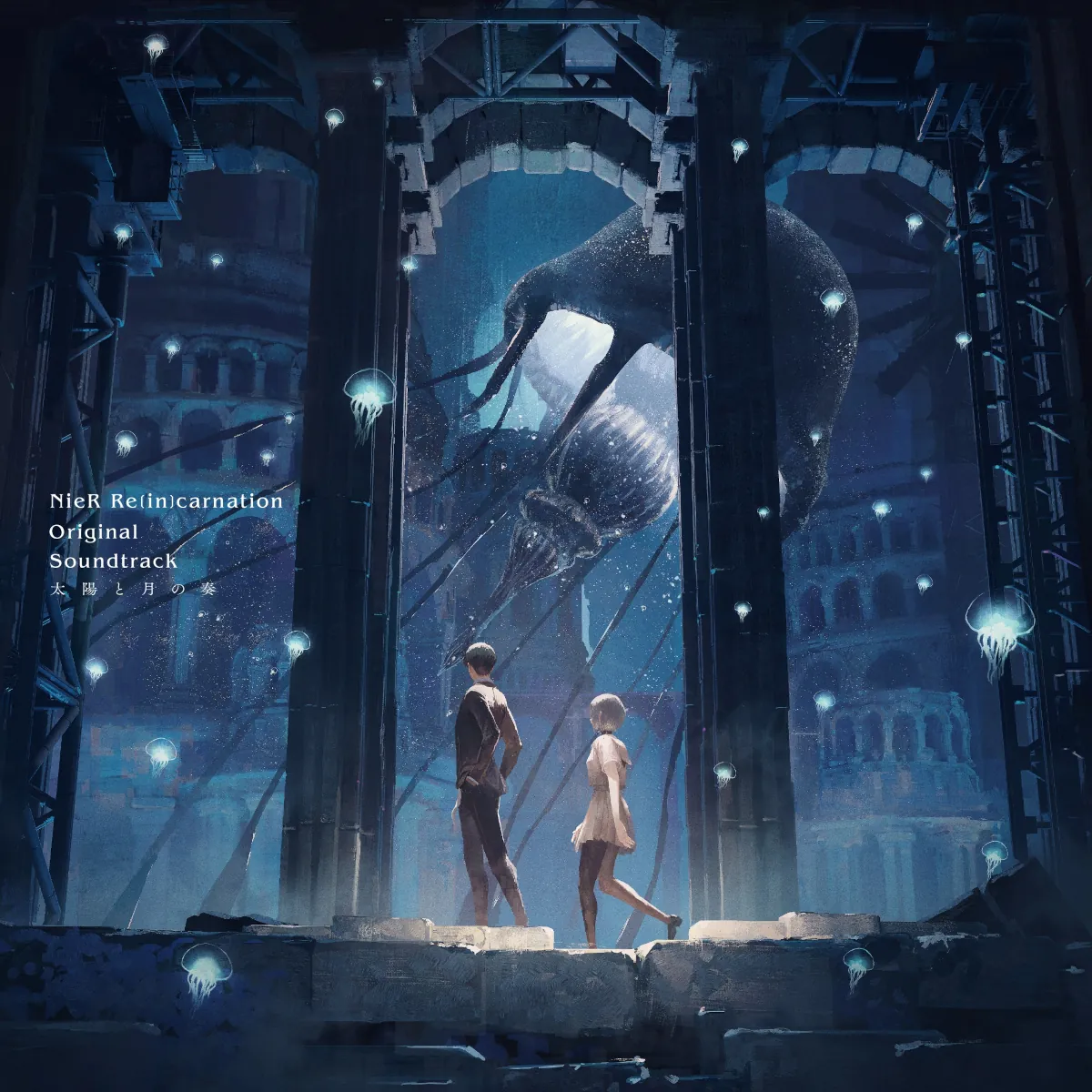


In reviewing the second volume of MONACA’s NieR Re[in]carnation OSTs, I continue my grieving process through reflection. Yes, I am referring to the live service mobile title in the NieR series that had its servers permanently shut down in April 2024. I have been grieving the loss of this surprisingly robust, story-heavy title. Yet, the music remains with us always.
This album covers NieR Re[in]carnation‘s second “season” or story arc, The Sun and the Moon (technically, its Japanese title was Song of the Sun and the Moon). It opens with an epic vocal track, “Kizuna (Bonds).” For my part, “Kizuna” is to the first season’s “Inori” as Kingdom Hearts‘ “Passion” is to “Hikari.” Which is to say, while the popularity of the first game’s vocal theme is likely to eclipse the second for most players/fans, I am more drawn to the dynamism of the second game’s vocal theme.
I really like the melody with its large jumps on the first two beats of each measure in the chorus. Also, it’s worth keeping this melodic strain in mind, as we’ll revisit it in the end. Then there’s the way it serves to tell the story of The Sun and the Moon‘s dual protagonists (estranged siblings Yuzuki Kurezome and Hina Akagi).
Next on the docket is some fantastic menu/hub music. “Komorebi (Dappled Sunlight)” serves as BGM for the first bits of gameplay in this story arc, with the player controlling either Hina or Yuzuki and meeting their paired-up ghost guides (Mama and Baby for Yuzuki, Papa for Hina). “Komorebi” offers a fitting, ambient soundscape for these memory characters, pulled from their normal lives in present-day Tokyo into the strange world of The Cage.
“Yoi no Tobari (Evening’s Pall)” and “Madoromi (Forty Winks)” are both BGM for additional early portions of the player’s experience in the cage, and their introductions to the first paired memory characters: the girls Saryu and Priyet, who attend a magical academy together. “Madoromi” is particularly noteworthy with its excellent use of marimba paired with a simple vocal melody. While not as childlike as the “Pascal” theme from NieR: Automata, MONACA co-composer Shotaro Seo still created something sweet and memorable with this one.
The next five tracks on The Sun and the Moon are all from Keiichi Okabe, MONACA’s leader and the composer for much of the NieR series. The first of these tracks is perhaps my favorite of the whole OST. “Madan (Magic Bullets)” serves as the standard battle music for the Saryu and Priyet stories, and it is an absolute blast to listen to. Two vocalists carry sustained notes in upper registers while the pulsing beat and unrelenting piano ostinato keep the song lively. In this track, so many elements of what I love from previous NieR soundtracks come together, but the end result is something so stylistically unique to NieR Re[in]carnation.
I only wish I knew which vocalist(s) were participating on this track. Vocalists Yukino Orita, KOCHO, and Saki Nakae are all credited for this album, but I have no idea who is singing on which tracks. The only one I know for certain… well, we’ll get to it.
Other notable tracks in the Okabe block include the creepy waltz-like music box track “Jigi (Children at Play),” the somber vocal piece “Mizukagami (Water Mirror),” and the storied battle theme “Normandy.” If that name rings a bell for you as a NieR fan, very good! Years before NieR: Automata was released, not long after Drag-on Dragoon 3 (later dubbed Drakengard 3 for Westerners) had hit shelves, lucky fans in Japan had a chance to see a stage play called YoRHa Girls.
The script and story to this stage play were reworked many times over the years, but the base experience generally utilized music from Drag-on Dragoon 3 despite no noticeable connection between that game and what would become a prequel story to Automata. In 2014, the group behind the stage play released a very rare CD containing the songs “Normandy” and “Guadalcanal.” These were later confirmed to be unused tracks from Drag-on Dragoon 3, then repurposed as Japanese vocal tracks in the stage play.
In 2023, “Normandy” was re-repurposed, with a chaos language makeover, as the battle theme for NieR Re[in]carnation‘s AI city-state administrators of opposing realms, named Marie and Yurie. It’s difficult to say if these characters do, or could, fit within the same timeline(s) as DrakeNieR; thankfully, The Cage makes all stories possible. And so, this gritty, intense battle theme left on the cutting room floor then shoved into a stage play, found its way as a battle theme in a now-defunct mobile game. One wonders where “Normandy” may crop up next!
The next grouping of tracks from Shotaro Seo is designated for the last pair of memory characters: would-be lovers in the form of a lowly pickpocket, Yudil, and a sorrowful princess, Sarafa, in a story sequence matching that of Scheherazade. In my NieR Re[in]carnation Postmortem Retrospective, I wrote in-depth about these characters, and they remain some of my favorites to this day. Musically, I think this is a strong block of tunes to match their intertwined stories. Honestly, I’m not certain the context for “Sekiryō (Desolation),” and it might have even been used for Yurie. But it’s one of Shotaro Seo’s strongest compositions on this volume, especially as a slower piece. Piano, strings, vocals, executed perfectly.
“Kagerō (Heat Shimmer)” and “Sajin (Dust Cloud)” are the story BGM and battle music, respectively, for Yudil and Sarafa. The track titles fit with the visuals and with the style of the music. Seo makes great use of the Persian setar (variant of the Indian sitar) and isn’t afraid to dig into those modal scales. The vocal performance for “Kagerō” is so good that it starts to rival NieR classics like “Temple of Drifting Sands” or “Vague Hope.” Well, maybe not as good as “Vague Hope.” I really could’ve used Emi Evans here. Nonetheless, the Re[in]carnation vocalists are a wonder all their own!
This brings us to “Shūu (Downpour),” music that serves for the cutscene and story BGM for the climax of the actual characters in the cage, Hina and Yuzuki. This music is so eerie, so haunting. There’s a specific chord used here that I cannot manage to parse out. It’s using what I think is a diminished chord, perhaps half-diminished (minor 7th).
I remember first hearing this harmony, pulling a minor chord down to something creepy and dark, but somehow shimmering as well, in Michael Andrews’ soundtrack for the film Donnie Darko (check out the song “Burn It to the Ground“). I think I’d also heard this same unique chord progression in one of the many variants of the princess’s theme in Brandon Boone’s Slay the Princess. Point is, “Shūu” has this haunting musical quality that I never want to lose. Once again, while the game is gone, I am glad the soundtrack remains.
For The Sun and the Moon‘s big finale, a faster-tempo piece with new melodic strains comes together in the duet “Kusabi (Wedge).” This song utilizes the same melody from the chorus of “Kizuna,” with the same woman singing. But there’s another vocalist present! Likely representing the brother Yuzuki, composer Shotaro Seo himself is credited as the male vocalist on this track.
The title is also perfect. Paradoxically so, because the ties binding Yuzuki and Hina together are a family so dysfunctional that it leads to violence, driving a wedge between those bonds might be the only way to save them. Do the siblings find their way back to each other? Can they forgive one another for what’s been done? These deep emotions are captured in the music and lyrics of this incredible ending piece.
There is a final bonus piece, “Mama’s Errand,” a cute and peppy chiptune demake of “Kusabi.” This is a nice addition, and given what we eventually learn about Hina and Yuzuki’s ghost companions, it’s fair to say that Yuzuki’s “Mama” was more saccharine sweet than the ‘true’ Mama from the first chapter. She’ll be back, just get ready for my review of NieR Re[in]carnation‘s third OST volume, The People and the World.