
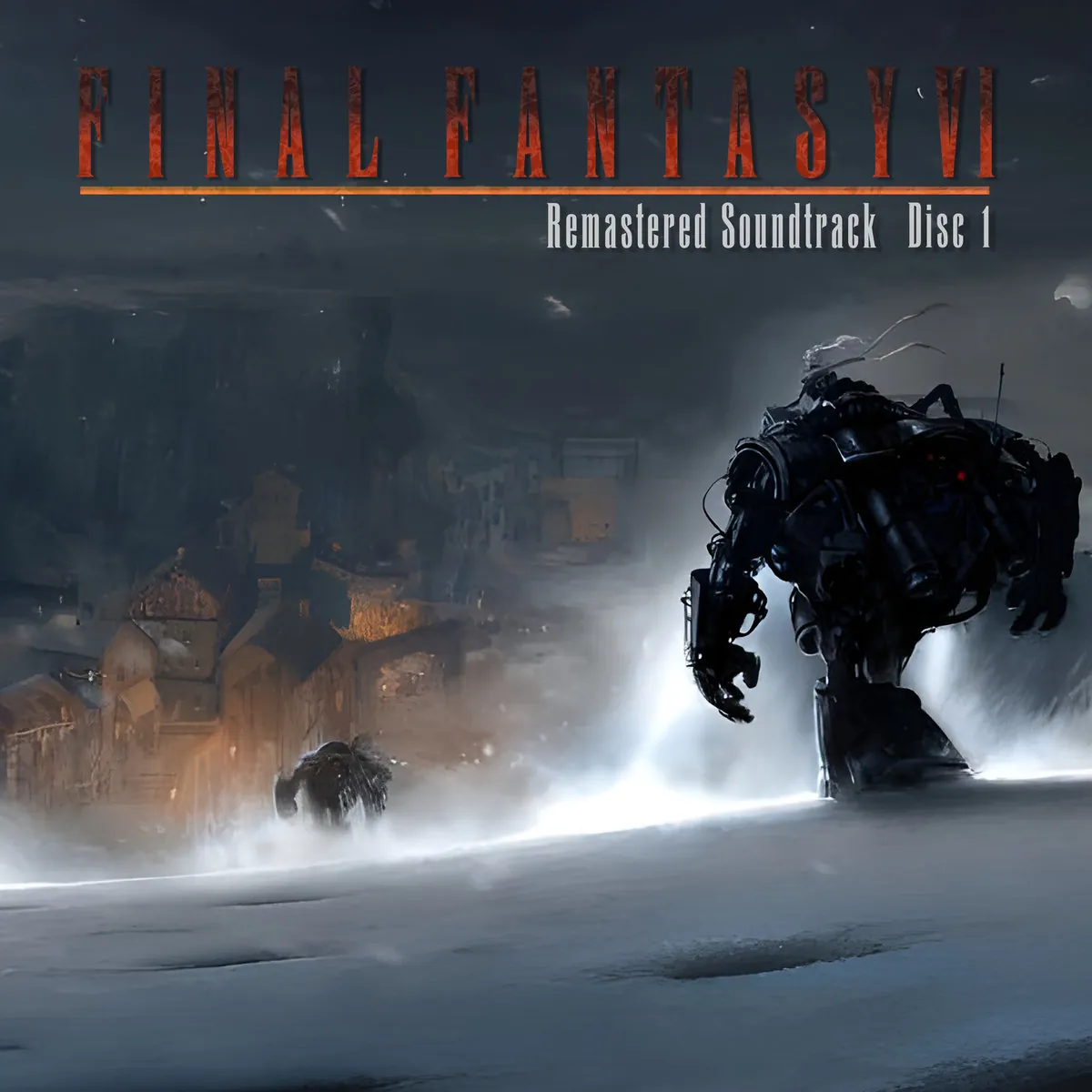


Editor’s note: this album is the 2024 updated version of the Joypad Records release Final Fantasy VI Remastered Soundtrack: Disc One, originally released in 2013. Arranger Sean Schafianski completed his three-disc remaster project between 2024 and 2025, including this upgraded version of that 2013 Remaster project, which encompassed only the first of three discs.
So, in 11 years’ time, what changed in this collection of Final Fantasy VI audio? For one, it’s a more impressive, holistic listening experience. Best as I can understand it, Schafianski utilized his 2013 Remaster audio as a baseline, updating some of the sound banks with improved versions, and toying with the arrangements to provide a little more life. Granted, Schafianski rarely goes wild with the arrangements here, as the audio is meant to be a true “Remastered” approach—maintaining original structure, with improvements focused on the audio quality.
I observed this faithful arrangement approach right away with the opening “Omen.” The crashing lightning strike is more life-like than its 16-bit counterpart, and the combined choir and organ sound closer to the real thing. The rumbling thunder continues through the piano solo transition until we arrive at the dark, brooding string ensemble. This is the part where the player is introduced to the history of the Espers, magic, and now the Gestahl Empire and Magitek.
After that? It’s our first taste of the Terra motif, in the famous scene of the three Magitek armors marching through the snow. Everything in this opening track fits with the 16-bit OST counterpart, even more faithfully than in the Final Fantasy VI Pixel Remaster.
Other improvements are small, but lovely. The snaps and ambient air/breath noise in “The Mines of Narshe” sound brilliant. The organ lead in “The Decisive Battle” is top-notch. And the layers of strings in “The Serpent Trench”—I’ve died and gone to heaven. It sounds so good.
Now, I know I said Schafianski doesn’t finagle with the original music too much. I think there is one notable exception. Being a woodwind master himself, especially with saxophone, there are times he lets his skills shine. The flutes on “Awakening,” “Cayenne” (that’s “Cyan” for the old-school localization fans), “Mystic Forest,” and “Kids Run Through the City” all have little flourishes that suggest a live recording, as opposed to running through an audio sequencer. Among these tracks, I think “The Mystic Forest” benefited most from Schafianski’s expertise. Granted, the source material here is one of my favorites from Nobuo Uematsu, so I may be showing my bias.
Before wrapping up, I do think it is worth discussing something Schafianski disclosed when we interviewed him for episode 164 of Rhythm Encounter. For this project, as well as some other recent projects, Schafianski acknowledged using the AI-based music tool Suno. While I think the tool’s presence has been both sparse and judicious—helping to fill out the rock tracks with decent drums based on rhythmic patterns input on a keyboard seems to be its key use—I’m also aware of arguments fully against the use of any AI tool. For music, this seems especially noteworthy, as it appears these tools were trained on millions of songs that were protected by copyright.
This is a complicated subject, and I acknowledge the challenge. I also assert that Schafianski is not “phoning in” these Remastered arrangements through the use of these tools. Rather, he is getting by as a one-man band when he doesn’t have the financial resources to run his own full studio with session musicians and dozens of instruments.
Furthermore, I cannot help but wonder what other composers and arrangers are also utilizing Suno or other AI-assist tools for their work without disclosing it to their listeners. I suspect this will become a more salient issue in the coming years, and as listeners and consumers, we’re all going to have to come to terms with the trend and determine how it may affect our listening and purchasing habits.
At the end of the day, I can’t help but love these arrangements for what they aspire to be: a modern take on classic, 16-bit material. As to whether Schafianski’s Final Fantasy VI Remastered project holds up across the remaining two discs, that’s a discussion for another day and another review.