
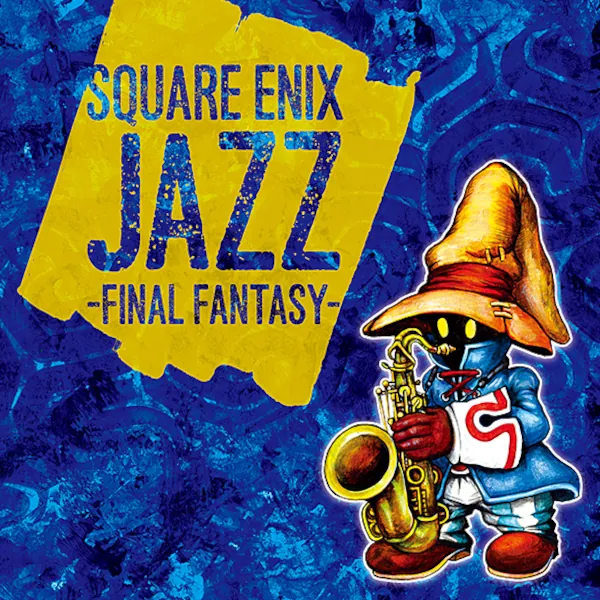


Square Enix Jazz -Final Fantasy- marks the start of a long-running series of prominent, jazzy albums with a core group of musicians behind the whole run. I’m a music lover, but somehow managed to overlook much of this series for nearly a decade. I am choosing to acknowledge and remedy this oversight, starting with a deep dive into this very album.
Let’s start by taking a look at the tracklist. With so many Final Fantasy titles out there, one wonders what one might find on any FF series arranged album. The good news is there’s plenty of diversity here. The team behind this album offers at least one arrangement per main numbered entry across the first ten FFs. Well, not every single one. At the time, Final Fantasy VII was a noteworthy absence. However, that was all part of the plan! The FFVII arrangements are absent here because they were already planning a standalone FFVII jazz album. If you want FFVII exclusively, check out that album!
So, yes, one track minimum for I through X, and then surprisingly, two tracks from Final Fantasy XIII: “Blinded By Light” and “Serah’s Theme.” Sadly, no XI, XII, XIV, or even XV, which was the latest entry at the time of this album’s release. Personally, I would’ve loved to see how they’d jazzify some Hitoshi Sakimoto tracks from Final Fantasy XII. Ah well!
Next up, let’s talk a bit about the team. The entire Square Enix Jazz lineup is the brainchild of the duo Eijiro Nakagawa (trombone) and Ryu Kawamura (bass). Alongside being accomplished musicians as part of the core set of instrumentalists, Nakagawa and Kawamura handled the arrangements for every track on this album and every other album with the Square Enix Jazz moniker. Prior to enjoying this album, I’d already heard the SaGa and Chrono Trigger albums.
And let me say, these are very talented arrangers. They understand that the goal of arranging a familiar melody for jazz is to invite opportunity for surprises without losing sight of the core musical structure. Improvise, change timing, tinker with the intervals in a melody, reharmonize: yes, that’s all good, but don’t destroy what the song was in the process. That’s the delicate balance in any good jazz arrangement.
Alongside this duo, we have guitar, drums, keys, trumpet, sax, and then some featured performances on individual tracks with flute, clarinet, violin, and even vocals (yes, you saw “Melodies of Life” in the tracklist, didn’t you?)! The core seven instrumentalists, with the occasional features, are all it takes to put together some gorgeous, layered arrangements. So without further ado… let’s get to the arrangements themselves!
I’ll start with my favorite from the bunch: “Battle With the Four Fiends” from Final Fantasy IV is a top-tier arrangement. As far as battle themes go, I think this was a natural pick. The song is so malleable; you can do so much with it. And Ryu Kawamura, who handled the arrangement, decided to do many things in the list of “so much.”
My favorite among them is the choice to pull back the whole crew to just two or three instruments (piano, drums, maybe a soloist) for a small portion— just eight measures or so —forcing the listener to lean to hear the melody. It catches you off guard, and when the band bursts back in, it’s at just the right time. Speaking of timing, the track also plays with straights vs swing time, fitting the melody into different time signatures, and generally just havin’ a great time. Rubicante and friends have a great new backing track, and they deserve it.
The aforementioned “Blinded By Light” (FFXIII) is this album’s opener. Put simply, if you are familiar with the opening theme song for the Cowboy Bebop anime (“Tank!”), then you know what you’re getting into. Latin-infused with the hand drums, up-tempo big-band jazz with just a touch of trademark bebop. The impressive part of this arrangement is how well arranger Eijiro Nakagawa made that wall of sound show up with such a limited number of performers.
The star of the show is absolutely Eric Miyashiro on trumpet. In fact, near the end of the piece, Miyashiro does this absolutely insane dip and fast chromatic ascent into the highest range, and I thought to myself: “That sounds *exactly* like ‘Resistance Line’ from Wild Arms 2!” So I checked, and… guess who’s credited for trumpet on Wild Arms 2 (and most of the Wild Arms series for that matter)? That’s right, it’s Miyashiro.
And guess what else? Miyashiro is credited as a member of The Seatbelts, the band that recorded the entire Cowboy Bebop soundtrack with Yoko Kanno! Miyashiro wasn’t a member of the group at the time of the original Cowboy Bebop recording, but he is a current member who recorded for the Netflix adaptation and is part of the 2026 touring group that played at Anime Boston and Kings Theater (New York City). All this to say, Eric Miyashiro is an amazing trumpet player and he stole the show on “Blinded By Light.” What a champ.
Another music legend appearing on this album? Percussionist Tappi Iwase. I’m used to seeing his name spelled “Tappy Iwase” (or sometimes just TAPPY). Iwase has been doing composition, arrangement, and recording (drums, keyboard) for decades, starting with Konami’s Kukeiha Club in the early ’90s. Iwase composed music for Policenauts, early Suikoden titles, Metal Gear Solid, and more. As a drummer, he’s recorded for Final Fantasy XIII, Gravity Rush 2, and several arrange albums (Tokimeki Memorial, Star Ocean: The Second Story are stand-outs!).
It was very exciting to hear Iwase on this album. For Square Enix Jazz -Final Fantasy- in particular, Iwase appeared to stick with arranger Ryu Kawamura’s ensembles. Two stand-out spots for Iwase? His work on “Battle at the Big Bridge” (FFV) is ever so precise, marking the starts and stops during these fun breaks where sound effects from FFV are piped in to add to the zaniness of it all. Additionally, “Serah’s Theme” (FFXIII) is a great track for Iwase. This one is just a piano trio (piano, bass, drums), and you can hear how perfectly synchronized Iwase is with Yasumasa Kumagai’s piano work.
And who could deny the strength of vocalist Junko Iwao and violinist Yu Manabe on the stand-out track “Melodies of Life~Final Fantasy” (FFIX)? This is a classy, jazz-club ballad version of the classic FFIX vocal theme. It’s not flashy or shocking. It’s exactly what you’d want it to be and expect it to be. No frills, just smooth, pristine, and absolutely worth replaying.
Are there any weak tracks on this album? I think so. And sadly, I think it’s one that I really wanted to enjoy. “Searching for Friends” (FFVI) is an amazing tune from Nobuo Uematsu. For those who might not remember, this is the world map music in the game’s second half (World of Ruin), where you are, predictably, searching for friends, trying to regather your party that’s been flung to every corner of the world. No one can deny how good this song is. But this arrangement? It feels flat. It didn’t surprise me or inspire me. I kept waiting for the moment I could say, “Oh, now it gets good!” That moment never came for me.
Even on some less impressive songs, the soloists could still save a less-impressive arrangement—one example being “The Rebel Army” (FFII). Sadly, there just isn’t much I found redeeming about “Searching for Friends.” I mean… it’s a capable arrangement. No one sounds bad. It just pales in comparison to the rest of the album.
So the album’s not perfect. But man alive, is Square Enix Jazz -Final Fantasy- a fantastic start to a great run of arranged albums! I actually think this might be the weakest of all the albums in the series, and it’s still impressive as can be, so I think that’s a good sign! The next album in this series is the hodge-podge, weirdly-named Square Enix Jazz Vol.2. I’m looking forward to digging into that one with you, dear reader, in the near future!