
Ever wonder about the chaos a package carrier must be dealing with when you get the notification that your order will be late? Calamity Angels: Special Delivery takes a fantastically imaginative view on the obstacles a delivery person might encounter en route to your home. Sure, there are less far-fetched problems like thieves, extreme temperatures, and general navigation difficulty you might face in our world, but how about monsters, rickety bridges, poison? You’ll face all of these and more trying to do your job and deliver those packages on time in Calamity Angels. But is this a five-star effort, or does your order get lost in transit?
Calamity Angels follows Yuri (whose gender is your choice), an up-and-coming team leader in the Delivery Guild, an organization devoted to making delivery runs. Yuri is put in charge of the Cupid Angels (yes, delivery teams in this world have bangin’ nicknames), though in the biz, they’re often referred to as the Calamity Angels, telling of their poor reputation. Yuri aspires to make the Angels the best team, so he has to get them back on track and climbing the ranks of the Guild.
Despite the unique package delivery premise, Calamity Angels is largely your standard RPG. In combat, you’ll face the typical monsters, like vicious animals and blobs, in a traditional turn-based style. It’s mostly a typical anime-ish fantasy setting, and despite being delivery employees, your party members wouldn’t feel out of place in most other RPGs. I’ve also recently been playing the excellent Trails in the Sky 1st Chapter, and if Calamity Angels were based in that universe about a young Bracer trying to build their rep, it wouldn’t need many adjustments to work. The atmosphere is light, and the game goes to surprising lengths to demonstrate how unserious it is.
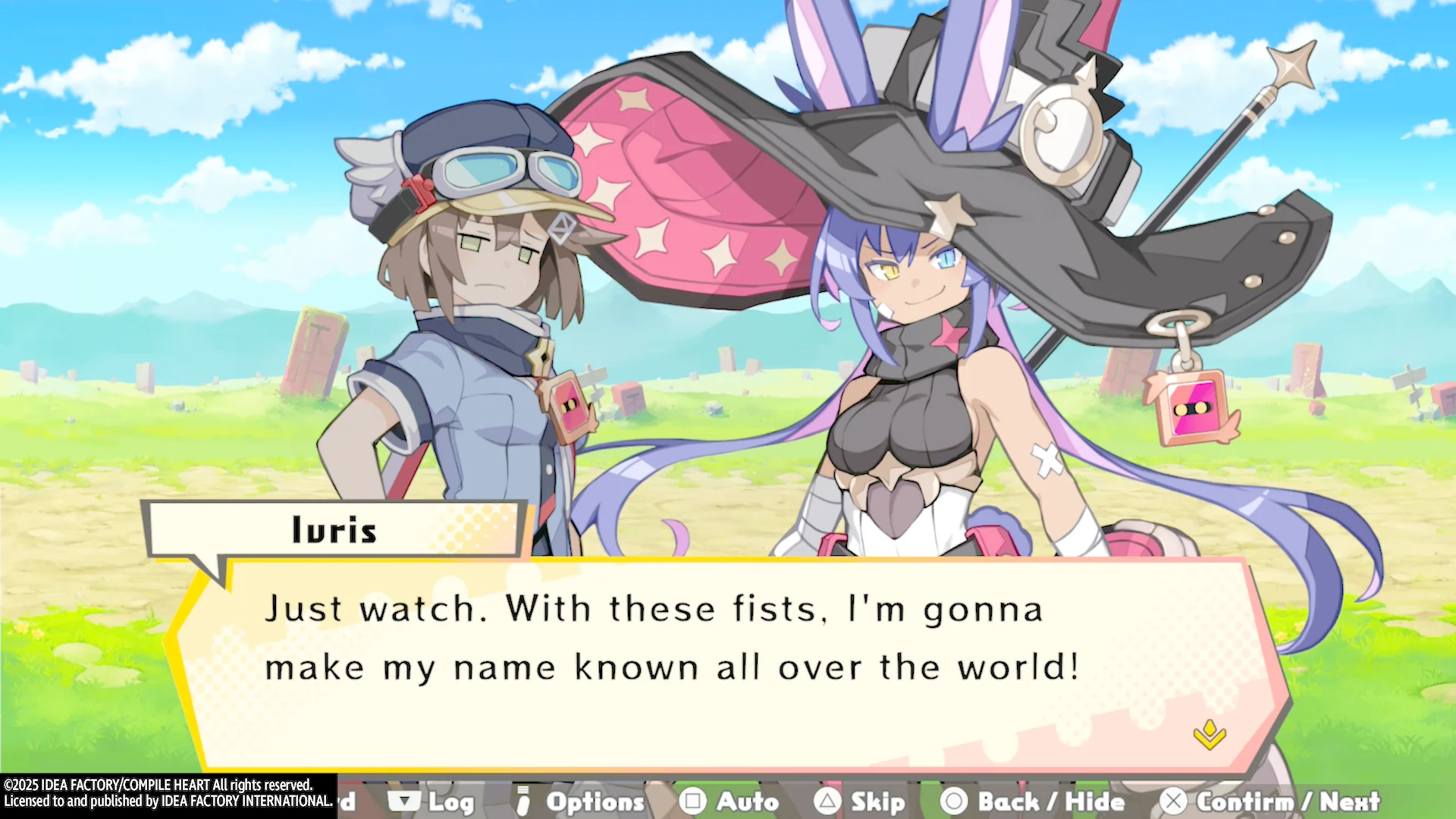
Calamity Angels is in love with its characters above all, as in the story and combat, everything revolves around them. In the main story segments, your party members come off as pretty one-note with meager attempts at adding depth. They require no setup because you’ve encountered these characters before: You have the sleepy girl, the strong-headed woman, etc. As the main character, Yuri is the least interesting of the crew: a typical milquetoast leader and a young, aspiring competitor who wants to be the best but lacks confidence. All of these folks are still likable or intriguing, but rather shallow.
Combat is where Calamity Angels is at its best. On its face and at its root, it’s a standard turn-based RPG. Pick moves one at a time for each party member, you know the drill. Aside from picking your actions, you must contend with an unexpected challenge: your own characters must be in the proper state of mind to get them to follow your direction. They all have a tension level, visible in their portraits, and when it’s higher, it’s more likely they’ll do what you want them to. If you tell them to perform an action they don’t feel like doing, there’s a chance they’ll instead do something else—or nothing at all.
The positive side is that if your party member goes off-script, their action will also be more powerful. Somnia, your strongest fighter, would usually prefer to sleep than fight. Though it makes her unavailable, sleep can be good because it raises her tension and other stats so she’s ready to unleash when she wakes up. But sometimes, you don’t want her to sleep, and you have to find ways to get her motivated to fight. More than dictating actions, you’re managing the party’s personalities.
Thus, the standard RPG combat gains some complexity through finding ways to turn your characters’ stubbornness to your advantage. As you get used to the complications of the six party members, you can learn to consistently steer them in a beneficial direction and even create satisfying combos. Though in this case, the combos don’t lead to uber-powerful attacks; rather, they’re just getting your characters to be more reliable.
Where Calamity Angels gets weirdest is when unique skills pop up. These are extremely powerful limit break-esque actions that can completely swing the momentum in battle, though sometimes not in your favor. How to trigger them is a mystery you can guess at based on the characters’ personalities, but they often fire off unexpectedly. Some major battles wound up humorously anticlimactic because my characters immediately obliterated the enemies without me even pressing a button. Other times, it looked like I was about to lose a battle, but one of my party members surprised me by taking matters into their own hands, completely turning it around.

The lack of control might sound frustrating, but instead I was always entertained by the wacky directions battles would take. In Dragon Quest or Final Fantasy, you’d fight so many random battles that you’d develop muscle memory patterns for defeating groups of monsters. Occasionally, things go haywire and your entire squad gets turned into frogs or an enemy casts so many defensive spells on itself that you can’t damage it. In Calamity Angels, most battles feel like those weird ones; it’s refreshingly unpredictable and dynamic. Battles do more to provide your characters with depth than the main story does.
However, while there are tactical considerations, the unique skills can be so powerful and random that it sometimes feels like you’re not doing anything. My other complaint is that Calamity Angels is overall too easy, as I lost just a single battle in my entire run, and there was almost no consequence from it. Not that being too easy made things boring, but being able to scale up the difficulty might have made tactical considerations more interesting.
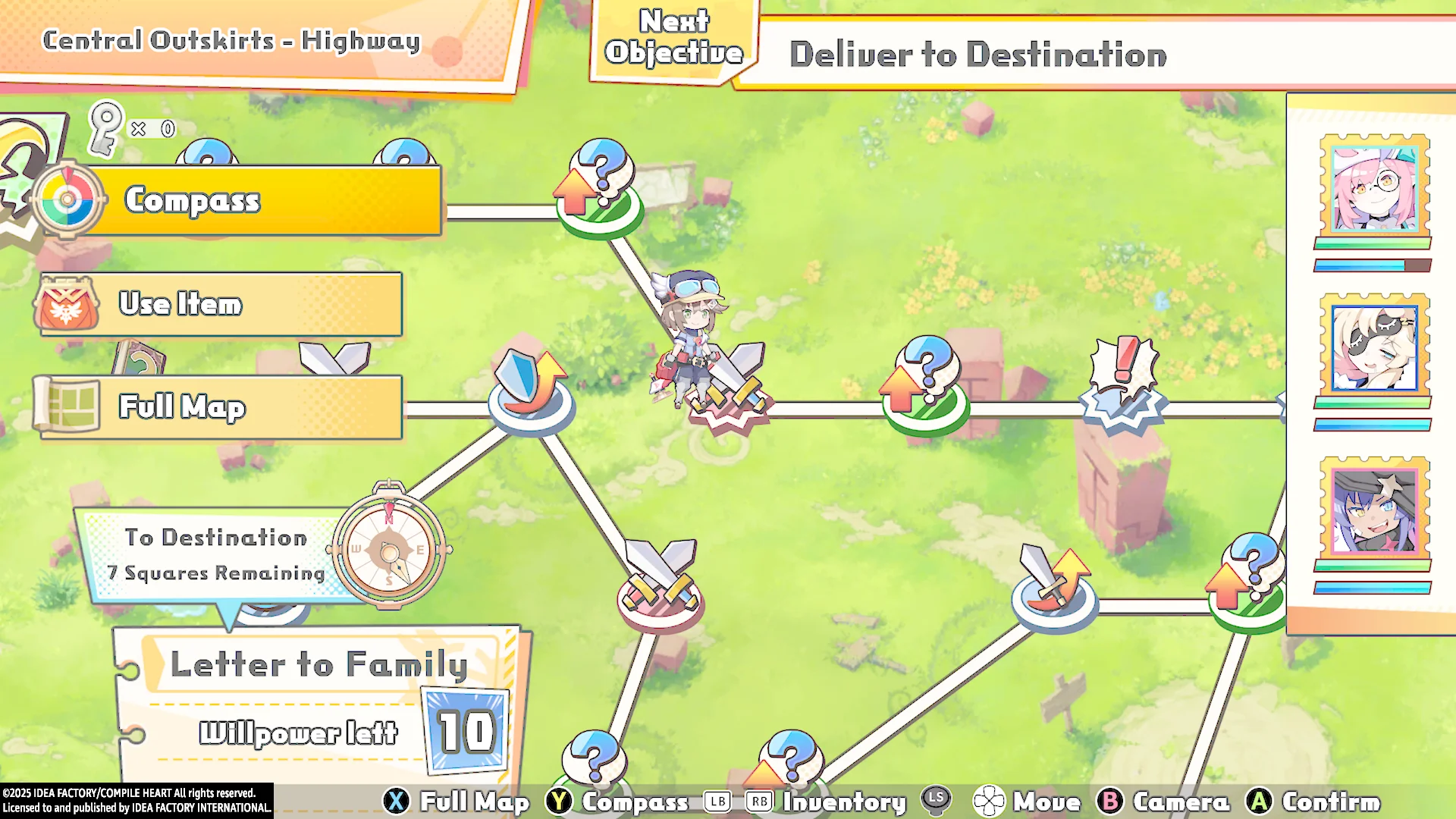
Less fascinating than combat is the board game-like exploration. It’s not terrible, but there’s nothing exciting about it either. Spin the spinner and move around the Mario Party-looking board and get whatever result you landed on, which could be a stat boost, a status effect, a battle, and so on. For your deliveries, the time limit is the main challenge. There were a couple of times I came close to the limit and had to make my moves more efficient.
On the positive side, the board presents a different take on random battles in that I could see the battle space coming up, making it feel less random than it was. The most dynamic element of exploration is the imposing Omoikurai monsters roaming the map. These add tension at first, until you fight a few and discover they aren’t that tough. During these parts, I was mostly just wanting to get back to Calamity Angels‘ combat.
Similarly, the story is just there. The main story reads like a standard if thin RPG narrative. Once you get through some early info dumps disguised as banter, your little delivery crew encounters a gang of thieves, the Murtamars, notorious for stealing packages. That’s funny on its own, but this concept is stretched out to be the entire plot. Calamity Angels confuses a surprising amount of convoluted lore for story.
Also, as the weakest team in the Guild, I often felt like the Angels were in the subplot of someone else’s story: I do the dirty work so other characters can do the cool stuff. There’s a way to do this type of “sidekick” story well, but this ain’t it. The story is also generally reduced to fodder for characters to have something to quip about rather than building a compelling narrative. Again, it’s intentionally a lighter experience, but if that’s all it wants to be, it teases too much about building to something substantive while never actually doing so.
Package delivery isn’t the most interesting concept to me, but it is a unique one that gets the imagination spinning about the potential stories of wacky or mysterious items being delivered to wacky or mysterious customers. Well, forget that. Calamity Angels doesn’t do much with its odd premise. Aside from main quests, which have plenty of dialogue to set the stage, most sidequests are practically empty as far as narrative.
Character-based sidequests add some intrigue to some of the characters until they start opening storytelling doors to potential tangential follow-up missions, only never to be followed up on. It feels like a lot of missed opportunities. Again, I can understand wanting to keep the mood light, but stop teasing me then!
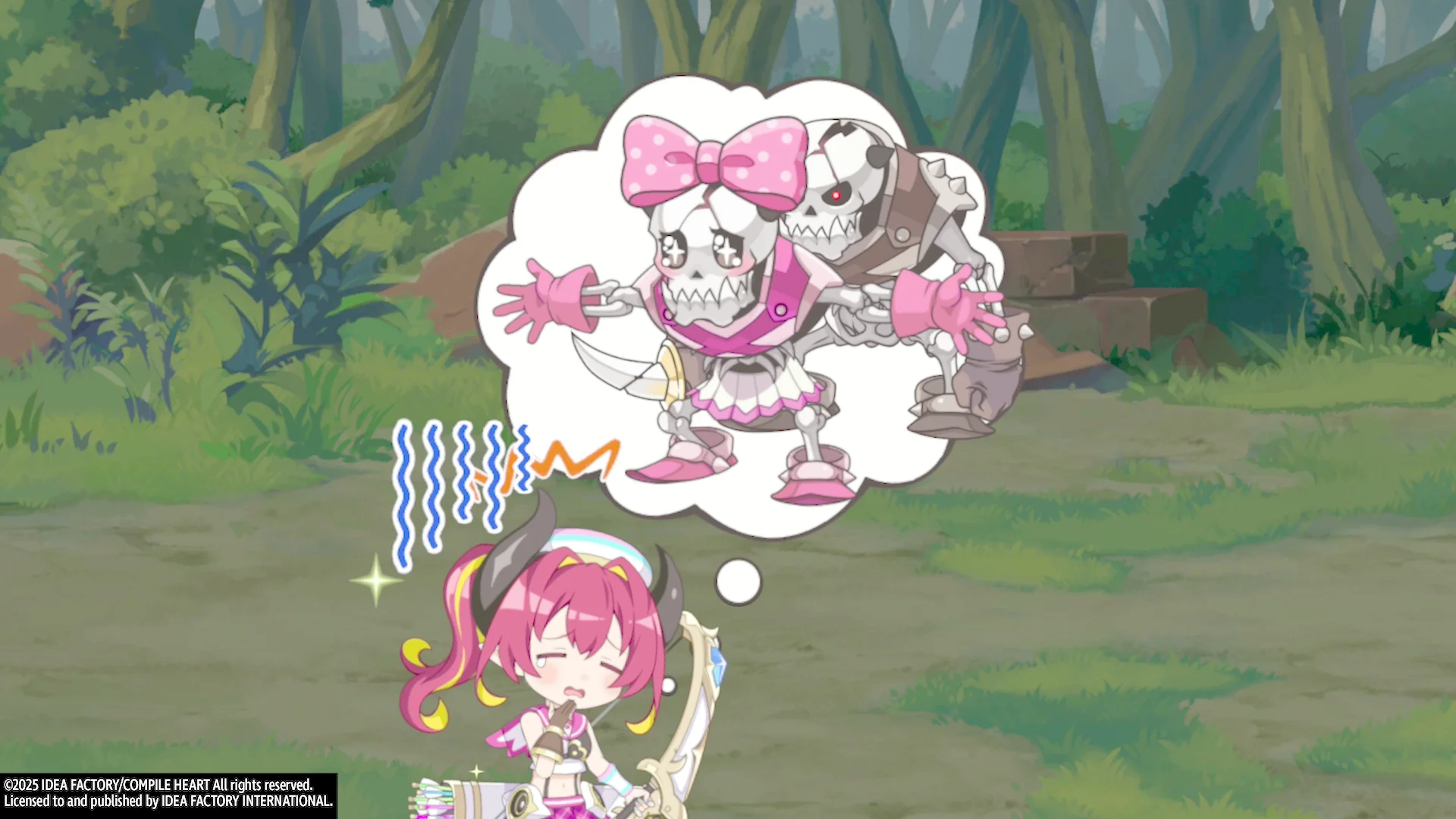
The characters’ art style is over-the-top with more details in their outfits than a human can visually process, but their looks are evocative of their eccentric personalities. Unfortunately, the visual presence of Calamity Angels is overall limited, at least outside of battle. You’ll sense a pattern here, but combat is more of a visual treat, with the bombastically elaborate unique skills being the peak of visual experience in this game. Despite being released on other consoles too, the game feels made for the Switch’s handheld mode, which is how I played most of it.
Music is enjoyable, though none of it stands out. The jaunty, jazzy tunes help remind how light this all is. The voice acting is also merely present. I preferred the Japanese acting over English as it was more energetic, with Selma, the timid paladin-tank who’s also terrified of bugs, being the standout. Also, every line of dialogue is voiced in the Japanese track, but not in English. In a turn-based, actionless game like Calamity Angels, the controls aren’t a major concern, but they were perfectly sharp anyway.
Calamity Angels is most excited to direct you quickly to its unique combat, which the game supports by investing heavily in your fighters. When I say it’s experimental, I don’t mean it’s half-baked; in fact, it’s refined and confident in itself.
There have been other games where your party members don’t do what you want them to, but I can’t recall any other case where that was this fun. Here, it’s so exciting that it feels like opening your eyes to something new and special. It’s frustrating to see how a little more here and there outside of combat could have built Calamity Angels up into a classic. You know the item was sold “as is,” but you get what you paid for. At least it delivers on its main draw.