What do you get when you combine 2D Zelda-ish world design, cute coloring book mechanics and aesthetics, and a story featuring sincere depictions and reflections on depression and impostor syndrome? Turns out one of the most enjoyable, original, and impactful indie games yet made. I never got around to playing American-Canadian developer Greg Lobanov’s previous game, Wandersong, but I had heard some high praise for its appealing style and characters. Chicory: A Colorful Tale shares these strengths while marrying its core painting mechanics and narrative themes in a manner that’s effortlessly compassionate and truthful.
I’ve spent many years of my life as a graduate student. It’s hard to do that and not feel a degree of impostor syndrome at some point. Why would anyone else care about some niche interest that, for some reason, means the world to you? How are you supposed to live up to the legends whose work you’re building from? Why does external validation feel simultaneously necessary and irrelevant? Why am I so stupid to have spent so much time on any of this?
If you commit your livelihood to a creative pursuit, it better mean something to you. It better be because it feels like your existence depends on it. If you lose that essential drive that can only ever come from your own interest (however “senseless”) and determination (however “misguided”), it might start to feel like your entire life has no meaning and you have always been a failure.

These are the internal conflicts that the character Chicory is struggling with. Chicory is a master painter who has inherited the legacy of the wielders—a lineage of intimidatingly talented artists who can use the legendary Brush. Every wielder in history has used the Brush to color the land of Picnic and so bring joy to its residents. Despite her artistic talent proving she can become the next wielder, Chicory has lost the drive to do so. She’s locked herself in the room many wielders before her have resided in, having evidently fallen into a depression.
So, Chicory is not our protagonist. Our protagonist is a cute, incredibly naïve, and somewhat dense little dog who works as the janitor in the illustrious tower of the wielders. You are encouraged to name the dog after your favorite food. Apparently, the canon name is Pizza. But I didn’t control no Pizza. My protagonist’s name was Pierogies, and I grew quite attached to them, so I will be referring to them as Pierogies for the rest of this review. And yes, pretty much every name in the game is food-related.
During a casual work shift, all the existing color is suddenly drained from Picnic, reducing the world to black and white. Pierogies decides to check in on Chicory and finds the Brush discarded outside her room. Having always idolized Picnic’s wielders and fantasized about being an artist themself, Pierogies picks it up, eager to fill in Chicory’s rabbit shoes. You can see portraits of the previous wielders lining the tower’s halls. They are stately-looking anthropomorphic animals—a visual far cry from Pierogies’ dinky appearance. You can try to color the portraits in. Chances are you won’t do them justice.
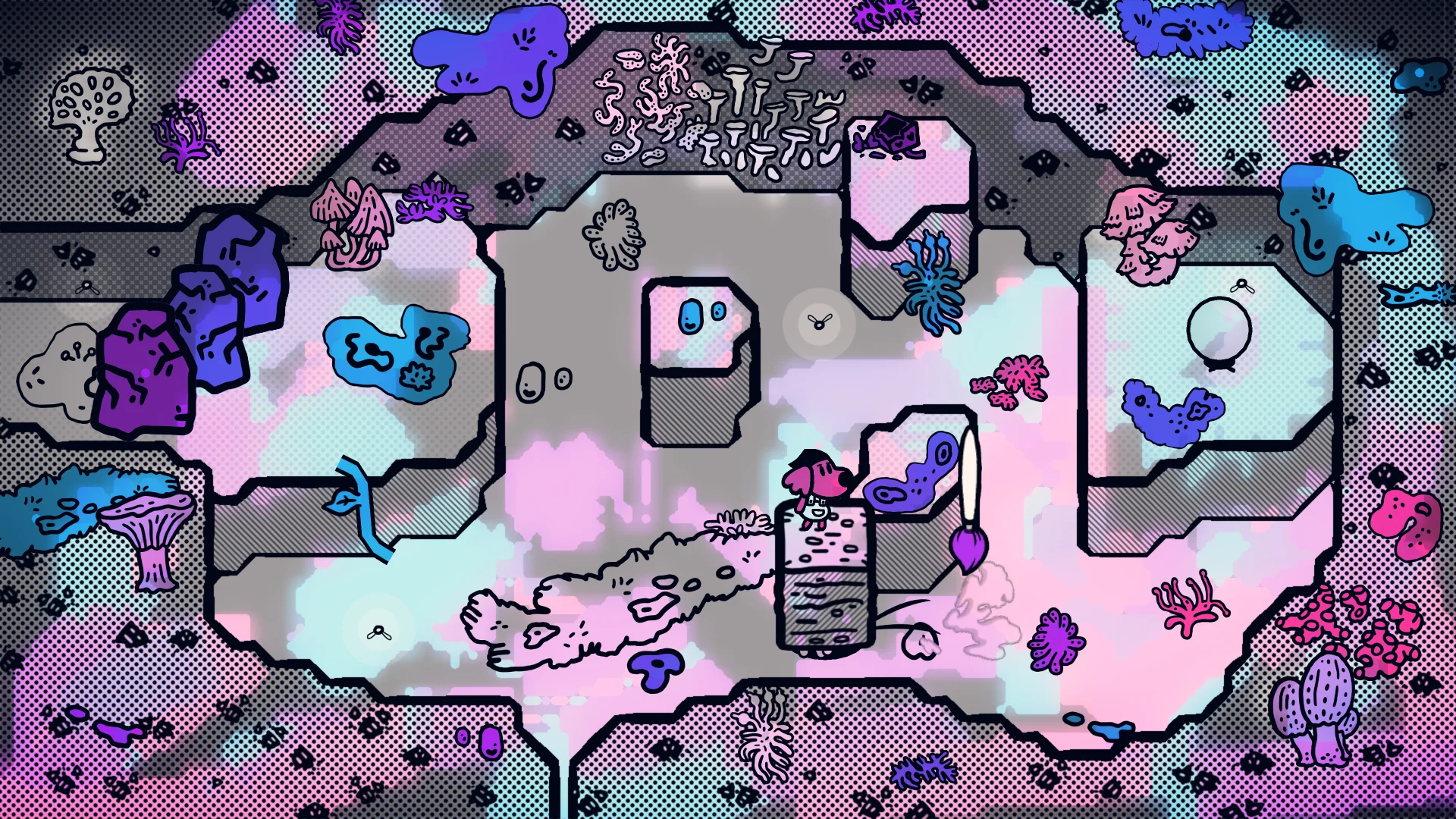
Your goal as the would-be wielder is to return color to Picnic by your own hands and skills as a player (*gulp*) and to discover the source of the corruption that drained it. Along the way, you’ll encounter traversal-related paint puzzles on just about every screen for progression and/or collectibles (such as lost kittens or wearable clothing articles), making the most of the game’s Zelda influence. You’ll come across towns with vibrantly drawn and written NPCs that might give you modest quests. It all feels thoughtfully balanced and paced, and not a single bit of the map is wasted. There can be a fair amount of backtracking, but the small world size prevents it from ever feeling tedious. It also serves as a great incentive to color some more when you are confronted with your previous lazy work and think: “actually, I can do better.”
The prospect of being prompted to color in a whole game world might be intimidating enough for some players to steer clear of Chicory, yet it makes this interactivity feel consistently smooth and manageable. The Brush is always present on the screen’s canvas and movable with the controller’s right stick (or via mouse). You can intuitively swap its size or color, and hold the controller’s right trigger (or the mouse’s left click) to start painting. For each of the game’s distinct regions (forest, swamp, mountain range, etc.), you’re provided a palette of usually just three colors. This is an essential design decision that helps prevent overthinking things, gives each region its own visual identity, and keeps your progression through screens moving at a nice pace.
Coloring the game’s world and objects can be as simply satisfying or painstakingly precise as you want it to be. Favoring the former, I would mostly use the area-fill function—which has a very pleasant audiovisual sensation—to paint in broad strokes. A color for the ground. A color for the sky or water when it’s there. Two colors for trees, buildings, and characters. Some contrast for smaller objects. It was enough to feel like I was having an impact as the wielder, however improvised and unremarkable. NPCs who commented on the job were often delighted just to see some color; at other times, they were… more honest in their assessments.
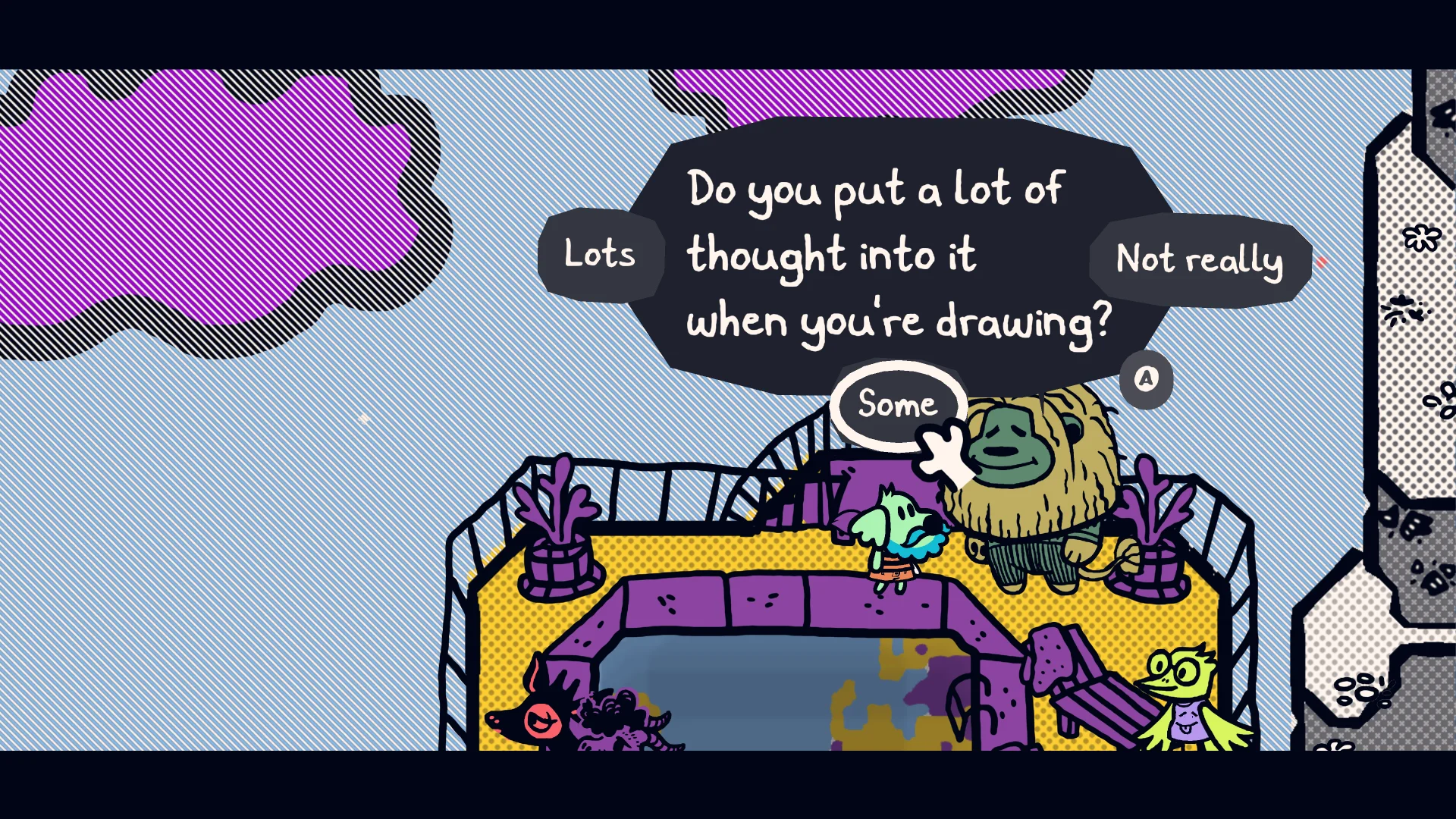
The game’s most brilliant achievement is in how it contextualizes this coloring book premise through its narrative design. Pierogies is wholesomely (and sometimes painfully) oblivious to their lack of talent. For the first half of the game, they’re just doing their best while telling themself that’s enough. As Pierogies, I was a terrible wielder. I have no talent for the fine arts, and my coloring job across Picnic’s regions and interior spaces would probably earn me an E for Effort in Chicory’s art class. But that never felt disheartening given how both the game mechanics and story support this premise.
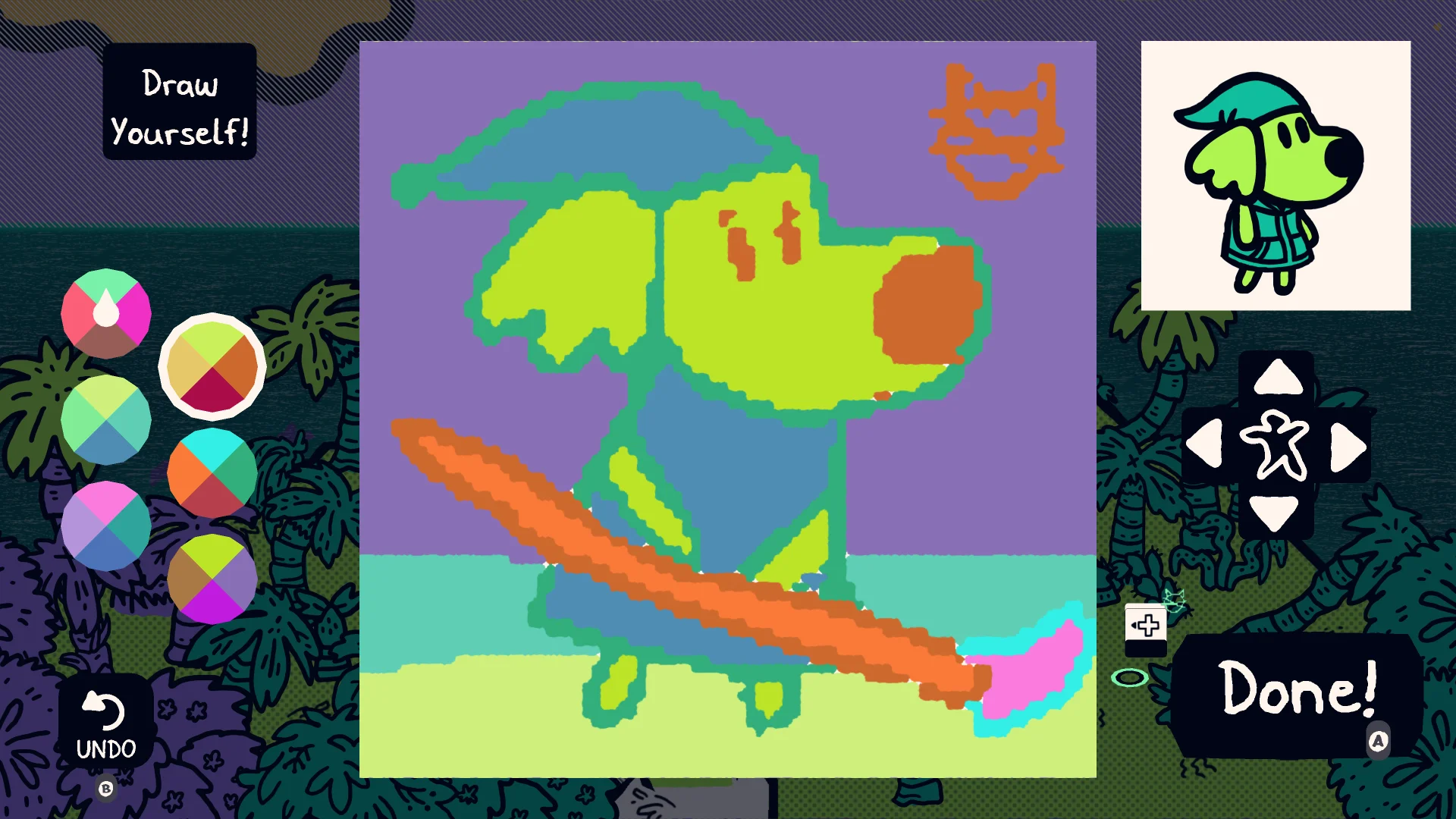
It’s easy enough to fake it when you’re mass-filling backdrops, but there are also parts of the story that require you to be more hands-on with your artistry. These include moments where Pierogies is supposed to demonstrate their expertise by recreating an existing artwork in a class, or is asked by Chicory to paint a portrait of her (no pressure…). The game did a phenomenal job motivating me to try my darndest in these moments despite my total lack of faith in my ability. While I laughed in embarrassment at some efforts, I felt a real, uplifting pride in others—like a first grader who managed their first meaningful drawing. I created an artwork exceeding my expectations that was playfully acknowledged in the narrative context. What a beautiful gesture on the game’s part.
The game’s OST is handled by the illustrious Lena Raine of Celeste fame. Her score in the overworld feels appropriately playful and natural—a reflection of the game’s regions and Pierogies’ innocent artistic mindset. The puzzle-filled dungeons in the corners of the map provide a stark contrast. These are ancient, important places to the wielders, but have become the primary sources of the corruption, manifesting as dark blemishes on the screen that cannot be painted over. As you descend into the dungeons, the music becomes moody, serious, and brutally anxious when approaching their corruption-manifested bosses—the game’s only moments of combat. It’s not hard to gather that the corruption is somehow related to Chicory’s troubled state of mind.
As you progress, you interact more with Chicory and past wielders, learning more about them, their history and relationships, and the psychological demands that their artistic gift/burden can cause. That’s not due to some impersonal supernatural phenomenon, mind you. It’s just the consequences of ambition and expectations gone wrong. Pierogies even ends up becoming more self-conscious about their abilities as events develop, and the drama escalates from there. Without going into spoilery specifics, the story is remarkably powerful in the empathetic portrayal of self-doubt, jealousy, and mental illness that unravels.
If you’d prefer to have some help with the burden of being a wielder, Chicory has seamless drop-in co-op. Just connect a second controller and another Brush will pop up on the screen. While Player 2 doesn’t get their own avatar, since so much of the game’s interactivity is premised on painting they can participate in everything from puzzle-solving to simple coloring. My partner popped in on a few occasions, contributed some better visual detail than I ever managed, and dropped out when she had enough. It was easy, low stakes, and very fun.
Aside from the struggle with your own artistic limitations, Chicory isn’t a very difficult game. The puzzles are engaging and creative, but they are fun little obstacles rather than real head-scratchers. It feels like a considered design choice rather than any kind of failure in the game design. I would call Chicory a “cozy game” if I hadn’t developed a cynical, commercialized association with the term. A “cozy game” wouldn’t have such a visceral darkness underlying its comforting veneer.
If it sounds like I didn’t find any fault with Chicory, it’s because I didn’t. If I had to nitpick something, it would be that the gamepad controls might feel too loose for players with more artistic ambition than me. Aside from that, everything about it coalesces into a seamlessly cohesive, authentic, and truly fresh experience. It’s one of my favorite games of the decade so far and one of my favorite indie games from any decade. I can’t guarantee it will have the same impact on you that it did on me, but as a product of inspired design and storytelling it is an indisputable artistic triumph.