
The evolution of games whose core appeal centres on the strength of their narrative is astounding to me, whose first experiences with gaming involved extremely basic, text-only adventures. Playing Directive 8020 in 2026 feels like magic sometimes, a scientific miracle bringing my disparate interests together into one discrete package. And yet in many ways the experience is the same: the thrill of the campfire ghost tale, but delivered digitally through your fingertips.
Directive 8020 is the fifth mainline entry in The Dark Pictures Anthology, a series of horror titles that are distinct but take place in the same shared universe. Developer Supermassive Games created them as a successor to their better-known, Sony-published title Until Dawn. I have limited experience with the games, having only played the opening moments of the inaugural Dark Pictures title, Man of Medan, but that was enough to convince me that I needed to get the series in my orbit. This feeling increased when I saw the trailer for Directive 8020, and now I have escaped the gravity well of inaction to reenter Supermassive’s ever-expanding universe of terror.
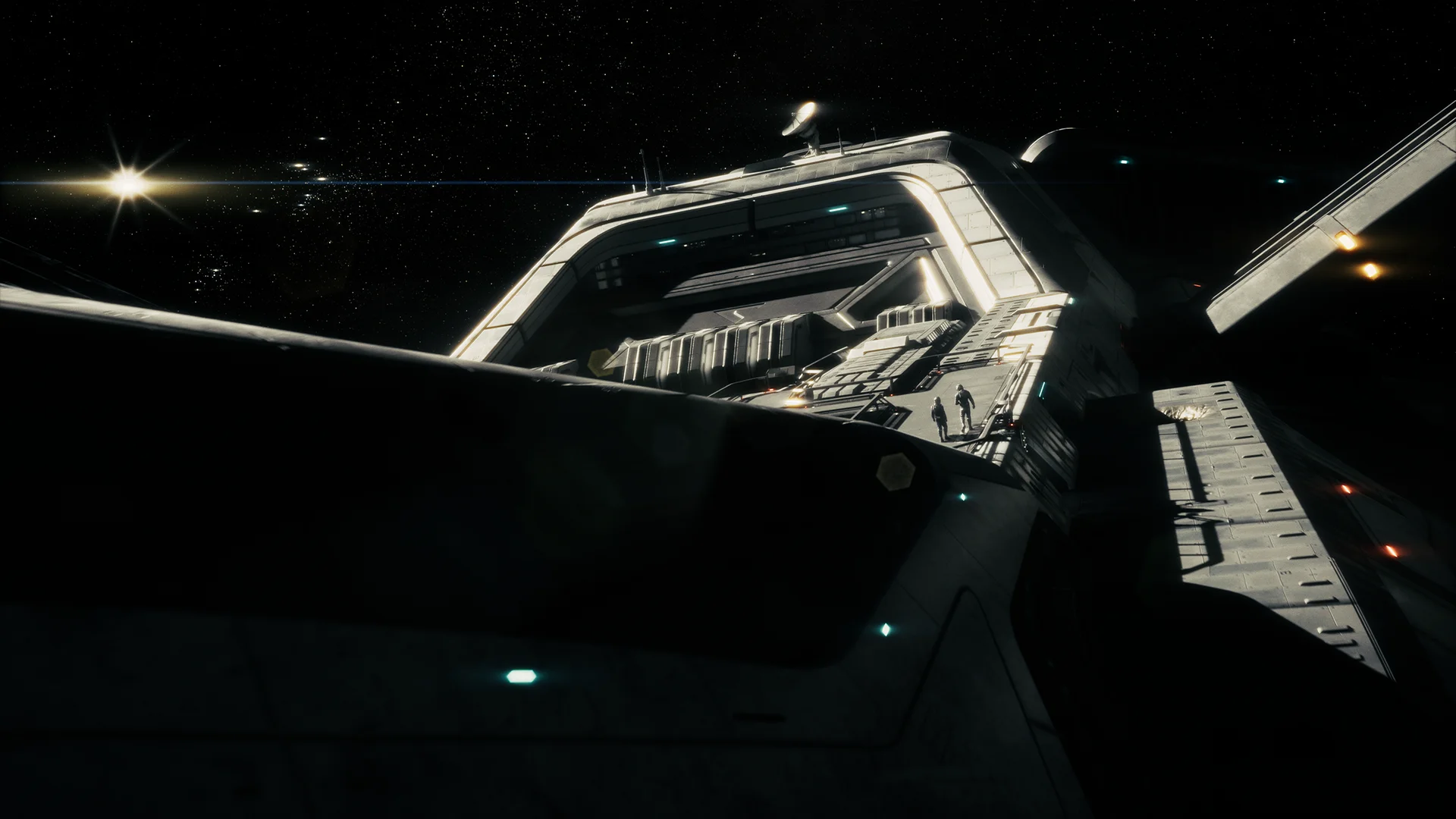
Let me bring you down to earth for a moment, so that I can tell you more about this tale of sorrow in the stars. Directive 8020 takes the formula of the Dark Pictures and adds a layer of science fiction, as you join a group of astronauts onboard the space ship Cassiopeia, which is reaching the end of a four-year-long journey to the planet Tau Ceti f. Their task is to pave the way for the ship that follows them, the Andromeda, which carries colonists looking for a new home.
You swiftly learn that the Earth is suffering from a catastrophic event, the nature of which is not immediately revealed, and the two ships may well be humanity’s only hope for survival. All except two of the brave pioneers are sleeping in suspended animation. Simms and Carter’s duty is to look after the sleeping beauties, who, I’m afraid to say, will not be woken with a kiss on this occasion. They are forced to deal with an emergency as an unidentified object hits the Cassiopeia and the rest of the crew are driven from their slumber straight into a waking nightmare.
Like its forebears, Directive 8020 is designed as a filmic experience, and its publicity has focused on one actor as the lead: Lashana Lynch, best known for playing Maria Rambeau in the Marvel Cinematic Universe. This is not a true reflection of the experience that the game delivers, as throughout Directive 8020 you take on the role of each of the core members of the crew, barring a few who remain unplayable.
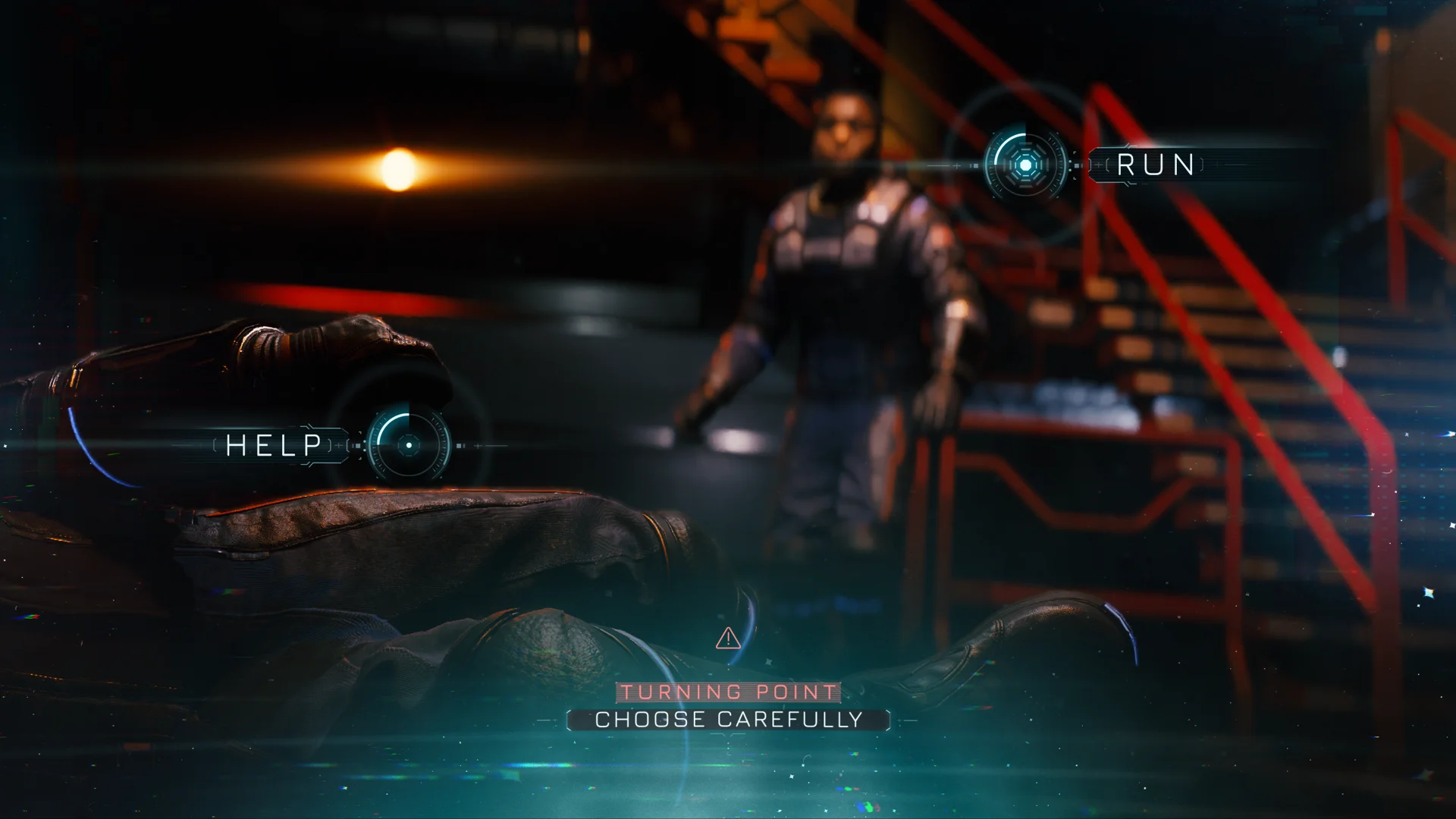
The main thrust of the gameplay revolves around a choice-based system, as Directive 8020 presents you with different scenarios and asks you to make key decisions for the characters. Sometimes this may be as simple as a dialogue choice, whilst at other times you must choose between dramatically different courses of action, the ramifications of which may not be immediately obvious.
It’s a familiar structure, notably found in titles such as Telltale Games’ The Walking Dead series and the various entries that comprise Life is Strange. It is not an easy format to perfect, but there is a strong case that Supermassive has made giant leaps here toward achieving that goal.
The first small step taken in this direction is the introduction of the Turning Points system. By bringing up the menu, you can explore a branching path that illustrates all the possible major choices and outcomes, with your current route clearly visible. At any point, you can choose to revisit a section you have previously played, with the most pivotal moments highlighted. This effectively means you can tailor your experience more to your liking without having to live with an unfortunate choice or action.
I used this option almost immediately at the beginning of the game. It helps to stave off the impression during your first playthrough that you are being punished for not knowing the systems well enough. At the same time, there is something to be said for playing without a lifebelt, and Directive 8020 offers a Survivor mode that keeps the Turning Points system locked until the game is completed. Nearly every choice you make feels consequential, and there were many occasions when I found myself locked staring at the screen, as I tried to deal with the latest impossible dilemma.
It’s not just the larger moments that engage. Choice is engineered into every aspect of Directive 8020. Each character has three potential traits reflecting aspects of their personalities that you can develop through the dialogue decisions that you make. Do you want them to be kind or logical? Funny or determined? Each exchange drives the characters in a specific direction,and depending on what you do, it unlocks one of two destinies that influence the course of the game.
I appreciated that these traits were not universally shared by the crew, as that would have made distinct characterisation problematic. Instead, it feels as if specific facets exist within each individual, but your choices emphasise the one selected. Your characters have portable communications devices that they can use to speak remotely to each other. These smaller moments serve to bring them closer together, whilst paradoxically underlining the loneliness of the Cassiopeia’s interiors.
Supermassive’s excellent casting choices are the engine behind Directive 8020’s success. Lynch provides a bravura performance as co-pilot Brianna Young. She holds the piece together with her portrayal of Young as she faces down horrors both moral and physical, whilst her dream of space travel slowly unravels.
There is no shortage of acting strength amongst her fellows, though. In particular, Lotte Verbeek’s depiction of Senior Mission Officer Laura Eisele, a seemingly cold and logical individual who is responsible for much of the design of the mission, provides a counterpoint to Young’s more personable demeanour. Additionally, Anna Leong Brophy’s experience as a comedian comes through in her role as Samantha Cooper, the ship’s Medical Specialist, who finds plenty of call for her skills during the trip.
Directive 8020 never seeks to hide its influences. From the start, as Simms and Carter struggle against unexpected adversity whilst their shipmates rise from torpor, the inspiration provided by Alien is apparent. From the darkened corridors filled with reminders of the ship’s corporate origin, to the isolated environment, which seems even more so when comparing the few passengers with the vastness of the ship, the vision is clear.
Soon after this, the paranoiac chills of the classic movie The Thing dominate, as an alien threat that can appear as any of the travellers makes it impossible to know who you can trust, and who might just be willing to shove an electrified multitool right through your head when you’re not looking. Directive 8020 offers more than a playable version of these cinematic greats, and the later twists in the plot throw a quantum wrench into the works, all to the accompaniment of the immortal song “Roads” by Portishead.
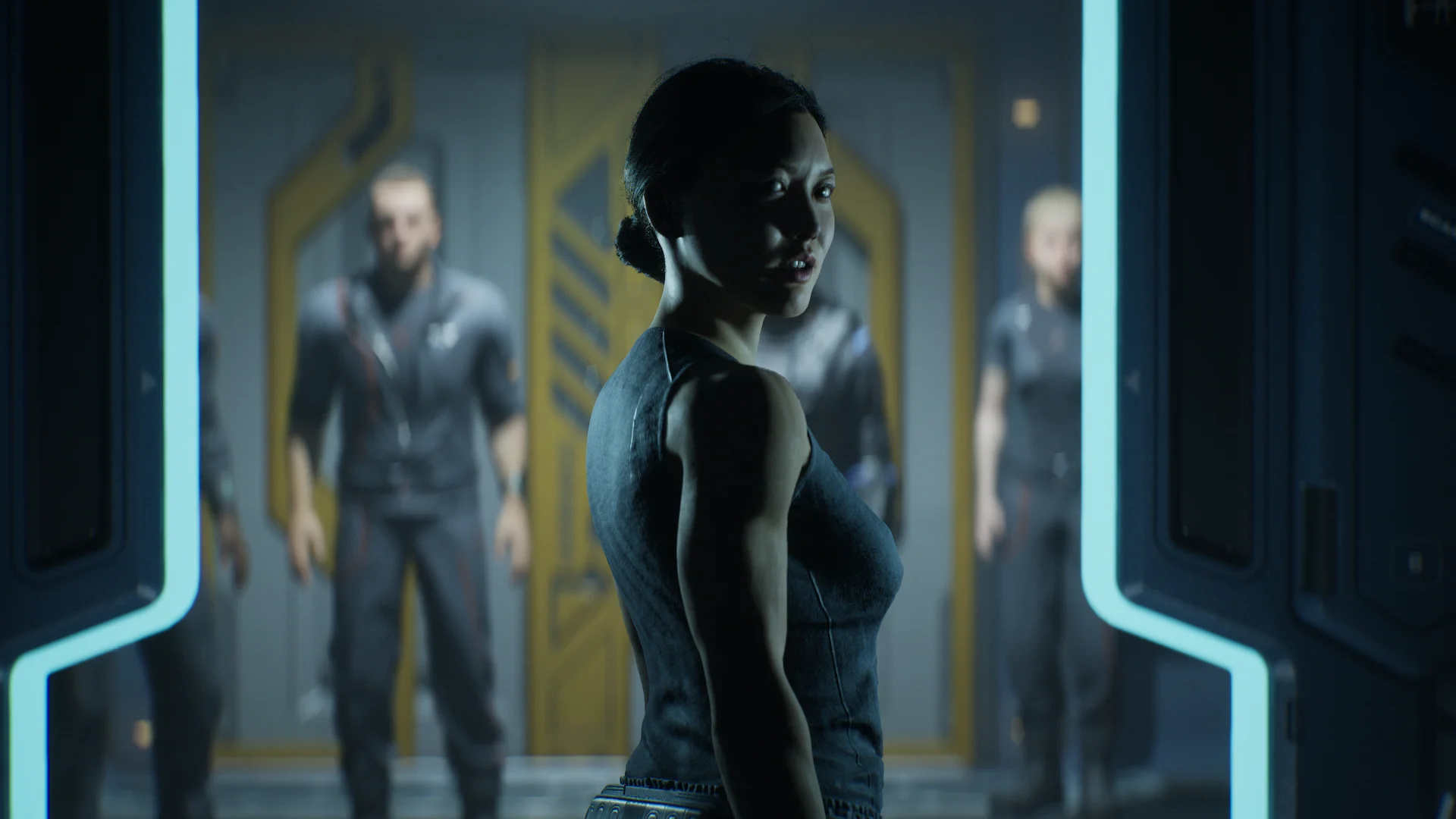
The rest of the soundtrack, composed by series regular Jason Graves, is good yet unobtrusive; a difficult balance to strike in horror games. It is supported by a selection of licensed tracks from established artists, which only occasionally miss the mark. Nevertheless, the two-piece band Blood Red Shoes hit with each of their tracks, with the dramatic punctuation provided by “Murder Me” enhancing the story beats greatly.
Directive 8020 is well-paced thanks to the sprinkling of quicktime events throughout the game, which add an adrenaline rush of excitement at points where you may have eased into relative comfort. The quicktime events enhanced the experience and never grew obnoxious or felt unfair. A variant on this is the frequent need to use your specialised tool to open doors, requiring you to match two coloured dials with a button press as one spins quickly around, which is fine until something is hunting you through the dismal hallways of the Cassiopeia.
And you will be hunted: several sections see you take full control of your character as they sneak past enemies, desperately trying to remain unseen as they crawl through death and debris. I found my heart frequently racing as I attempted to find my way out of these areas, as enemies called threats and appeals whilst I hid.
This gameplay element has little of the sophistication of a dedicated stealth title like Metal Gear Solid or the like, but it doesn’t really need it. It is just complex and difficult enough to break up the flow of the calmer parts of the Directive 8020. I would have liked a few more opportunities to distract opponents or otherwise interact with them, but the suspense of fixing power units in the darkness as some indescribable thing stalks after you is truly effective.
Directive 8020 is that perfect short experience that can break up your gaming rut, with its eight episodes of intense storytelling, each around 1-2 hours in length. You can stop there or go back for more, exploring alternate pathways in a way I’m rarely drawn to, but I immediately felt compelled to do after reaching one of Directive 8020’s conclusions. You can play the game multiplayer if you wish, either in couch co-op or online, although the former is obviously the way to go for the ultimate communal horror experience. However you choose to play, please do, as you don’t want to be the one left behind on this doomed planet once the Cassiopea starts its voyage.