
In the pantheon of high fantasy strategy RPGs, few series have clung to their roots with as much persistence as the Disciples range. Ever since Disciples: Sacred Lands launched in 1999, Nevendaar has felt like a setting perpetually stuck in the final five minutes of an apocalypse. Disciples II: Dark Prophecy arguably remains the high-water mark, while later entries, including the recent Disciples: Liberation, have struggled to add much new to the blueprint. With Disciples: Domination, it’s clear that new developer Artefacts Studio isn’t looking to reinvent the wheel so much as they are intent on ensuring it keeps grinding over the same jagged, blood-soaked stones. It is, in many respects, a continuation of the series’ classic sensibilities, maintaining life in a character that hasn’t changed its wardrobe much over two decades.
As in the previous games, Disciples: Domination draws on the major factions and deities of Nevendaar and continues the story of Avyanna, the heroic Queen who fought and reunited (to some extent) the disparate peoples at the end of Liberation. Now, a new evil threatens her past victories, even as she grapples with disillusionment about leadership. If you didn’t play Liberation, the story loses some of its impact, as it assumes familiarity with earlier events and relies on that knowledge to give certain conversations more weight. Before long, though, you fall back into the familiar rhythm: meeting factions, recruiting troops, and venturing into maps filled with enemy armies, treasure, lore fragments, and collectible resources. One additional draw this time is the return of the Dwarves as a recruitable faction, and the plot writes them (and Avyanna’s first companion) into the story early, which is nice. The story spans a wide range of settings, and while the voice acting leans toward the hammy and the musical score isn’t memorable, the script is generally evocative, barring a few odd turns of phrase.
The environments in Disciples: Domination range from ruined medieval farmland to shattered mountain hellscapes. Fine details—like weathered structures and lingering magical effects—help draw you into each location. Still, the art direction can’t fully hide how familiar the setting or character design feels. The core factions—Dwarves, Elves, Undead, Demons, and Imperials—remain largely unchanged, and their tactics and playstyles unfold as you’d expect from similar fantasy games. Real-time exploration feels smooth, and the clean overview UI keeps your attention on scanning the environment for hidden treasures or spots to use companion abilities and unlock new routes.
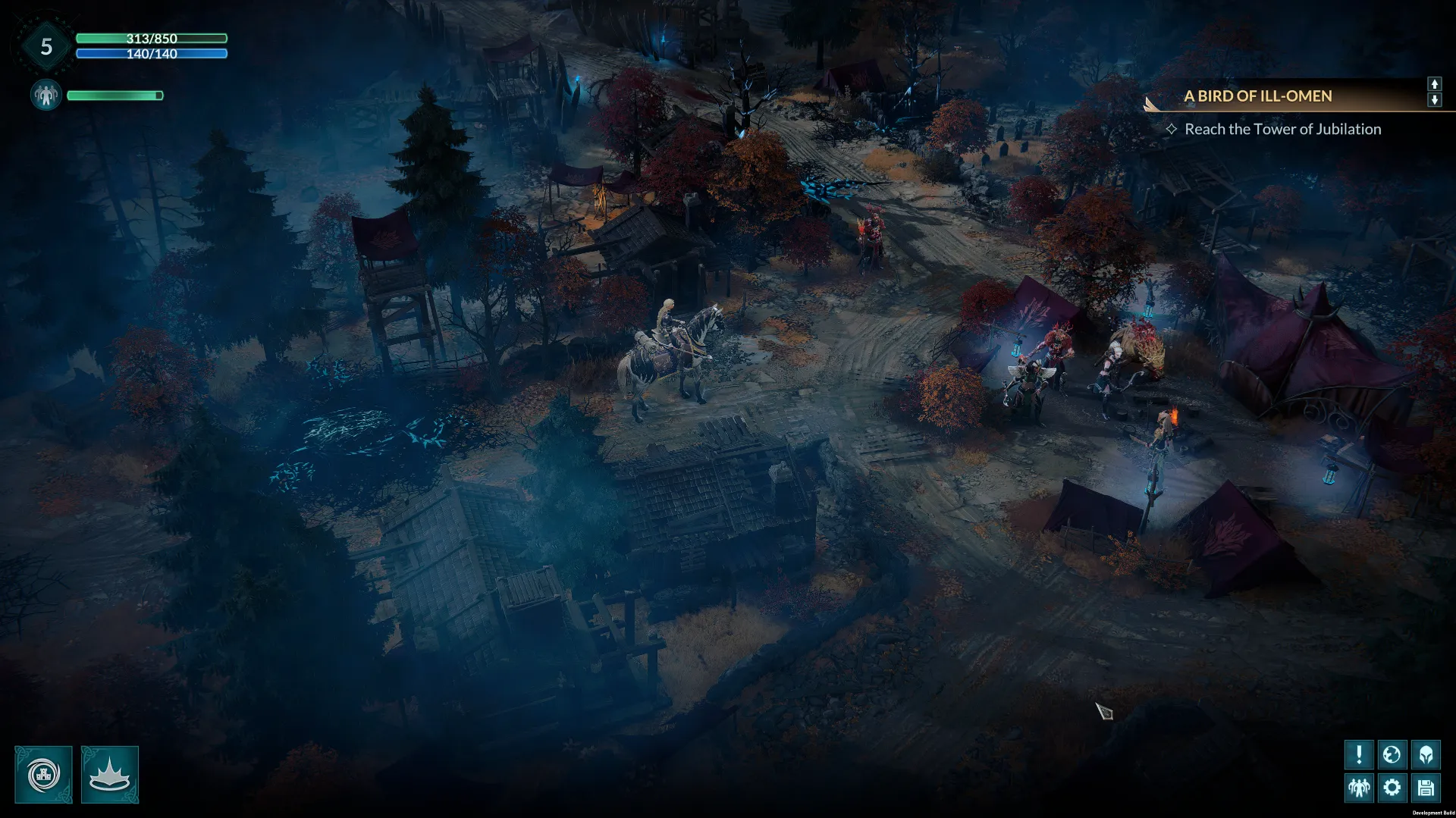
There are four distinct classes for Avyanna—Warmaster, Primordial Ruler, Holy Regent, or Witch Queen—as the main character. The choice feeds into a large, multi-tiered skill tree where you spend points across different disciplines within each build. Each class supports a distinct playstyle. The Warmaster, for example, can lean into tank-style abilities that strengthen Avyanna when she’s surrounded, or shift toward a more aggressive setup that inflicts Bleed damage. Despite the range of spells you can research and equip, progression often feels slow. Many upgrades offer only small percentage boosts or minor passive effects, which can feel underwhelming when you earn a single skill point per level. This sense of stagnation deepens because Avyanna and her chosen party only ever gain access to two core combat skills per build. Outside of spells, you don’t unlock many new active abilities.
To be fair, this is where the wider cast of Disciples: Domination fills the void. Avyanna’s passive Leadership stat enables her to build a squad of story companions, unique heroes, and standard mercenaries. She can balance her tactical approach through these choices. Elves tend towards strong ranged attacks mixed with nifty stealth tricks. The Imperial troops offer a good balance, with tank-like Paladins matching well with the healing and Divine-damage dealing Disciples and Priestesses.
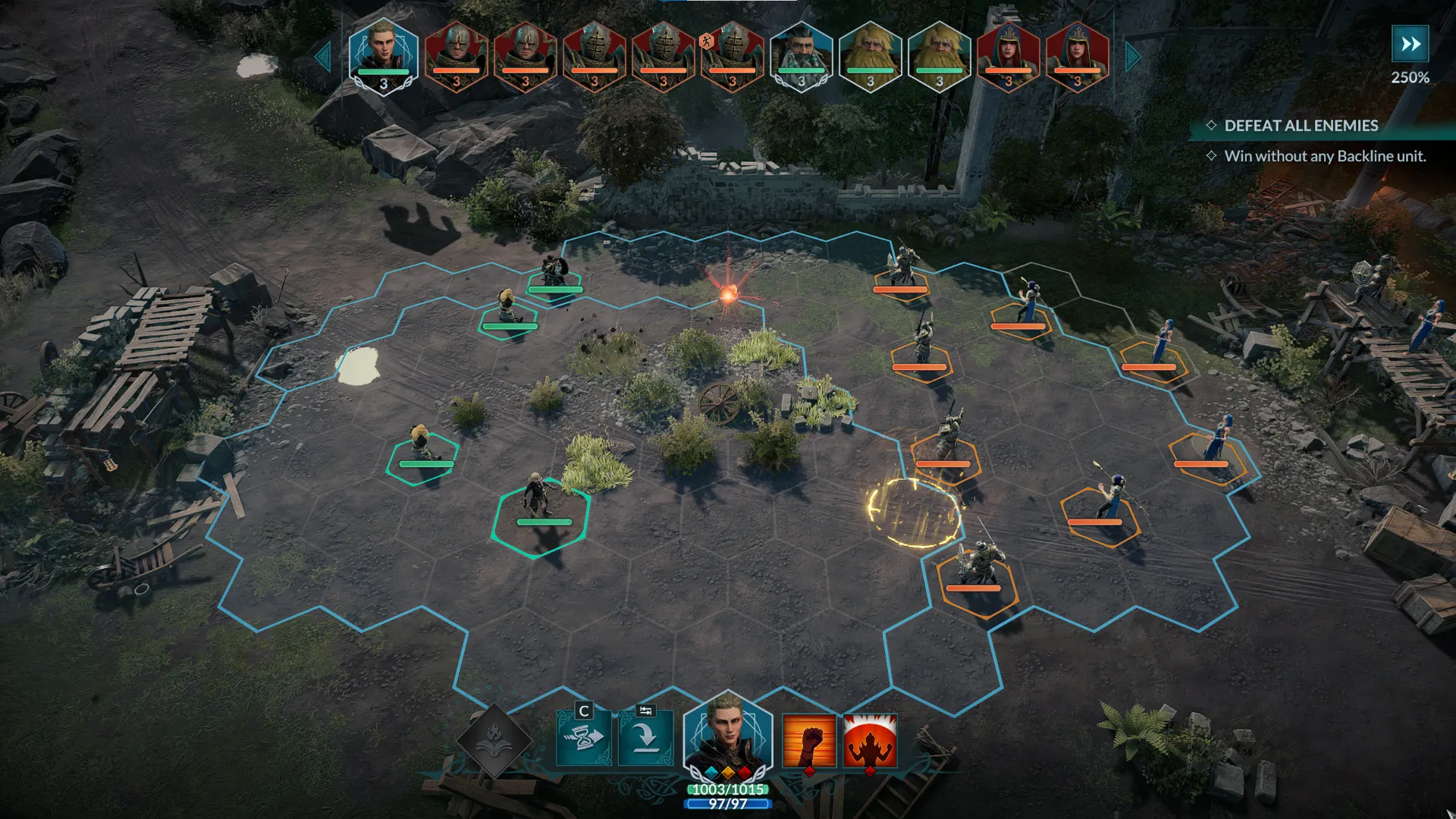
Units fight in turn-based combat on small, hex-based maps. While the maps themselves aren’t large, they feature a wide range of positive and negative status effects, such as Regeneration buffs or Blinding effects that reduce accuracy. Each unit operates with different types of action points: some govern movement, while others combine to trigger limited abilities or Avyanna’s spells. Abilities vary in range, cooldown, and area of effect, and Disciples: Domination places strong emphasis on skills that reposition units around the battlefield.
Because units can’t pass through one another and the maps stay compact, positioning becomes crucial. Lining up effects, bottlenecking enemies, and delaying key actions often matter more than raw damage output. With each unit limited to a small set of tactical options, you can also start predicting their behavior in a chess-like manner. Support units tend to cluster around allies to buff them before moving into combat, while sneakier rogues rush in, strike, and then vanish into invisibility. Excess movement usually goes toward avoiding straight lines or adjacency to your own units. At first, this simplicity feels restrictive, but as new map effects, unit types, and abilities begin to overlap and interact, combat reveals itself as a real tactical puzzle.
Character progression fuels the emphasis on preparation and roster management in Disciples: Domination. Levelling primarily increases basic stats and doesn’t unlock new abilities in most cases, although it does increase Avyanna’s ability to recruit stronger units or field larger numbers of weaker ones. Keeping pace with the difficulty curve can feel demanding, since each map offers only a limited number of encounters tied to specific level ranges. You can take on higher-level enemies for bonus experience, but more often the game becomes a search for the next suitably matched fight within what appears to be an open world.
Side quests and companion stories add variety, but you’ll often need to abandon them temporarily until your party grows strong enough. While level gating doesn’t inherently bother me, its implementation here sometimes undercuts the impact of individual story beats and lore drops. In doing so, it reinforces the game’s core identity: Disciples: Domination expects you to enjoy combat above all else, along with the constant cycle of planning, optimizing, and refining your unit strategies.
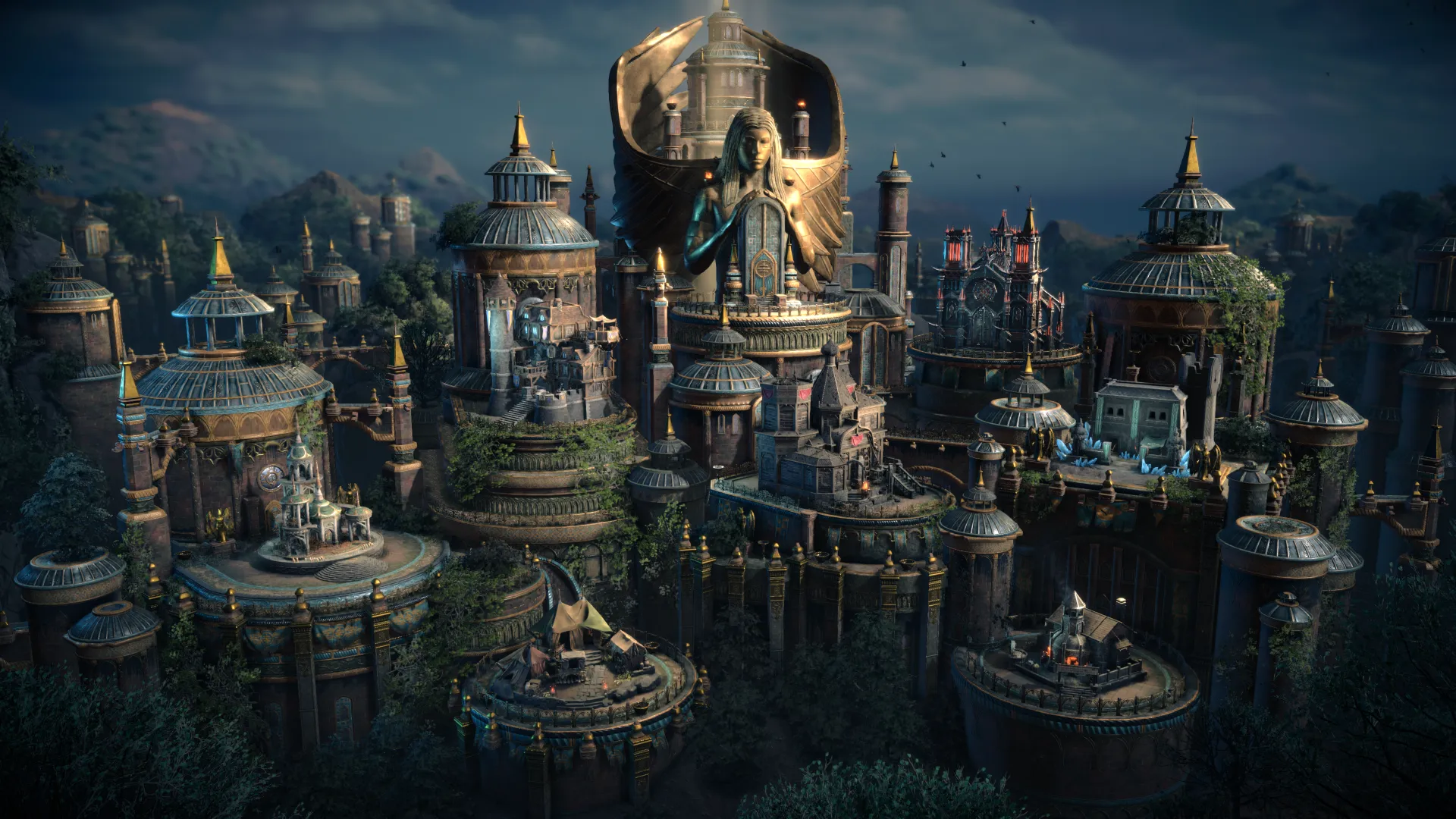
Battlefield decisions exist alongside light strategizing in Avyanna’s hub world, the mythical castle of Yllian, your personal pocket-dimension hub that has grown into a sprawling seat of power by the events of Disciples: Domination. It’s a satisfying, if somewhat rigid, loop: you spend your hard-earned resources—Gold, Iron, Wood, and the rarer Essences—to upgrade buildings that unlock higher-tier units or items. The catch? You’re bound by the level of your castle, meaning your military ambitions are often held static by your progression through the main narrative. It’s less about creative layout and more about the strategic bottlenecking of power, forcing you to choose what to prioritize as resources permit.
You buy, upgrade, and manage equipment and Shards in Yllian. Avyanna can equip a wide range of weapons, armor, and items depending on her class. For example, the magic-focused Witch Queen only uses wand or staff-type weapons. You find gear out in the world or at Yllian’s marketplace, with rarity tiers making it easier to judge possible upgrades on current loadouts. Each item also offers an optional upgrade path that can unlock extra effects, such as adding Burn damage to attacks or healing Avyanna when she defeats an enemy. Unfortunately, item management often feels clumsy, and this system in particular would have benefited from a more thorough interface overhaul. Shards, magical crystals that all units can equip, further boost stats and abilities, increasing things like health or critical chance. As Yllian develops, you can merge these into stronger versions. Both systems draw from the same limited pool of resources, so progression becomes a constant exercise in prioritization—or a waiting game while real-time resource nodes slowly generate what you need.
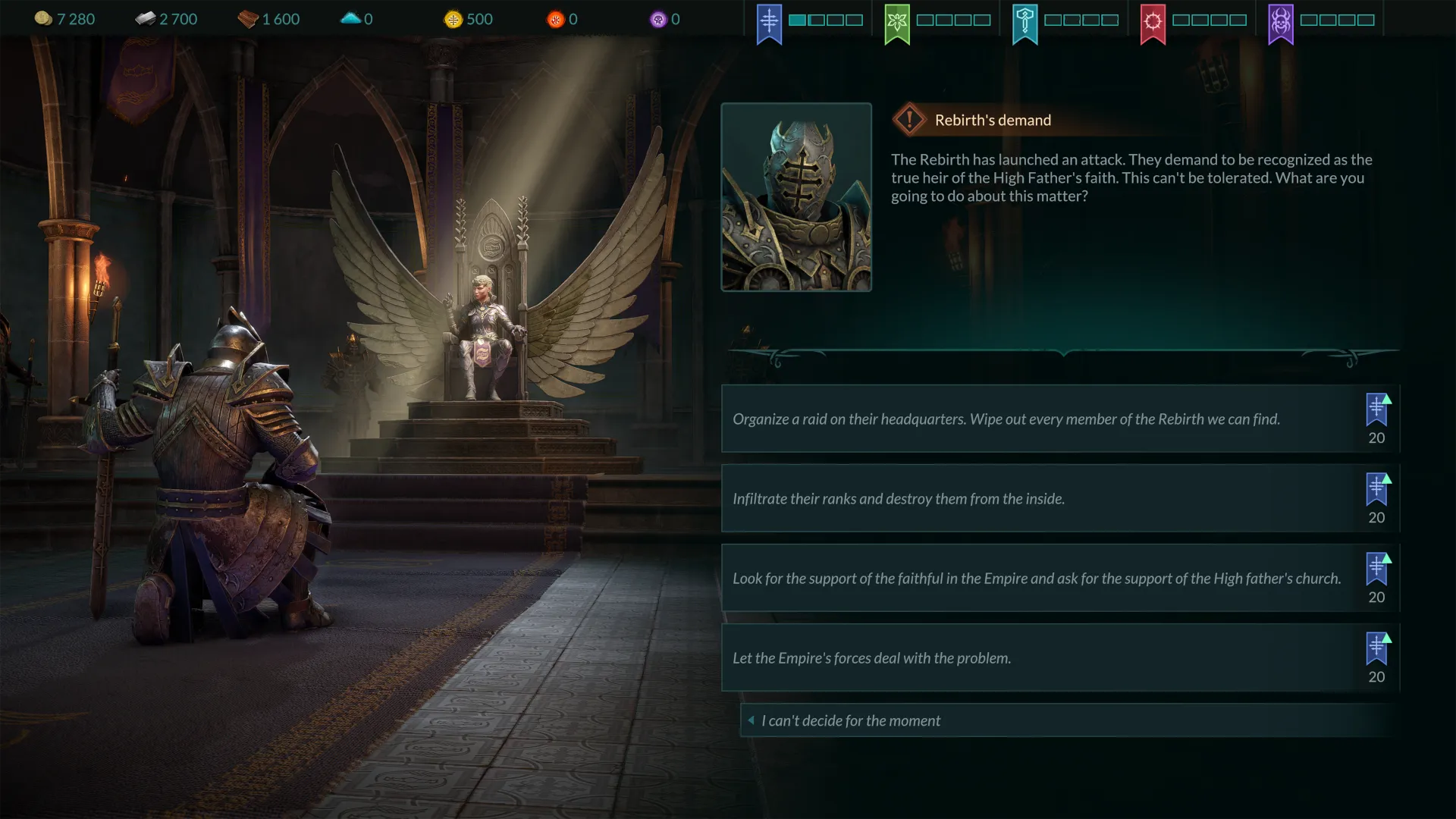
Finally, you need to manage your standing with the various factions of Nevendaar. Previously, favour usually shifted through side quests and occasional character interactions, but Disciples: Domination introduces a new system: Grievances. These take the form of short narrative scenarios that play out in Avyanna’s animated throne room, where you choose from multiple responses. Some grievances appear naturally as the story progresses, while others unlock after meeting specific characters or triggering certain events. Each choice adjusts faction favour, with the option to spend resources to increase it further. In practice, faction benefits often felt less urgent than upgrading equipment or managing Shards, and I rarely prioritized them, but it’s a system with poignant links to Avyanna’s absent rulership and how she tries to address this.
The breadth of quests, companion combinations, and high-level gear in Disciples: Domination can easily keep you busy for dozens of hours, and the standard difficulty offers a genuine challenge. Without learning enemy weaknesses and mastering how to chain and maximize status effects, you may end up adjusting the generous difficulty options. By the late game, individual storylines begin to blur together, but there’s always something to do on any given map, whether it’s a roaming horde you ignored earlier, a mine you never cleared, or a grievance you still need to resolve. Secondary battle objectives, such as winning without companions or managing environmental hazards like rockfalls, keep progression feeling fresh. On a technical level, Disciples: Domination runs smoothly and never demands much from your system. I only encountered the occasional frustrating freeze (oddly, most often during Ice Storm maps). Although it’s not currently rated, the game feels well-suited to the Steam Deck thanks to its bite-sized encounters and modular structure. Gamepad support works well enough, too.
It’s difficult to fault Disciples: Domination for what it does well. The game delivers a tight tactical experience, supports a wide range of distinct factions, and offers plenty to explore. Its visuals are detailed, and the UI holds up well across long play sessions. Where the game stumbles, it does so in familiar ways: a disjointed narrative, forgettable voice acting, and the risk of loot overload. The game doesn’t push far beyond its predecessor, nor does it significantly shift expectations within the genre; its systems, story, and presentation all feel largely familiar. Like a friend whose dress sense hasn’t changed in twenty years, Disciples: Domination struggles to be truly relevant or fresh, but if you’re willing to dance to her older tunes, this is a queen who will happily conquer your doubts.