
Cooking and RPGs aren’t something I’d usually pair, but Dosa Divas, a smaller JRPG from Outerloop Games, has tried to change my usual diet. The story of three sisters trying to come to terms with their pasts and their futures attempts to combine deep revelations with irreverent humour and whimsy. Unfortunately, the final mix of this JRPG doesn’t quite come together: the bland world design, and the sometimes-infuriating combat and recipe systems get in the way of this dosa going down smoothly.
Dosa Divas tries to tell a heartfelt story blending elements of sci-fi adventure with themes of food, culture, and family. The plot follows sisters Samara and Amani as they reunite and travel across a fractured world in a sentient food mech, working to undo the damage caused by their estranged sister Lina, whose powerful fast-food corporation, Linaworks, has erased traditional cooking and cultural identity. Along the way, the sisters battle corporate forces, cook meals for communities, and rebuild connections with others while confronting their own complicated past.
Despite its ambitions, Dosa Divas’ story struggles to land. It’s cool that the story tries to use food not just as a gameplay mechanic but as a symbol of memory, identity, and resistance, even if the sci-fi elements involving the food mechs and their history feels tacked on for the sake of a more mythical bent. The script and dialogue never quite reconcile the sisters’ emotional core—particularly the reasons behind their original departure and Amani’s subsequent return—with the game’s more irreverent humour. Scenes often clash in tone: light, playful banter with a boastful elder can sit awkwardly alongside a genuinely tragic situation involving a villager’s family.
Some characters make this worse. The recurring shopkeeper, for example, leans heavily on innuendo and flirtation, and his constant come-ons toward the sisters feel more questionable than charming. He comes across as unsympathetic, despite Dosa Divas seemingly positioning him as comic relief. When the robotic Diva characters take on a larger role, their narrative becomes even more muddled, adding but never fully integrating ideas.
Even the presentation struggles to lift things. Key dialogue receives voice acting, but the uneven script undercuts most performances, making it difficult for any real emotional depth to emerge. The music hints at a more distinct cultural identity in its opening moments, but the soundtrack settles into a loop of light, bouncy rhythms and plucked guitar that rarely enhances the atmosphere.
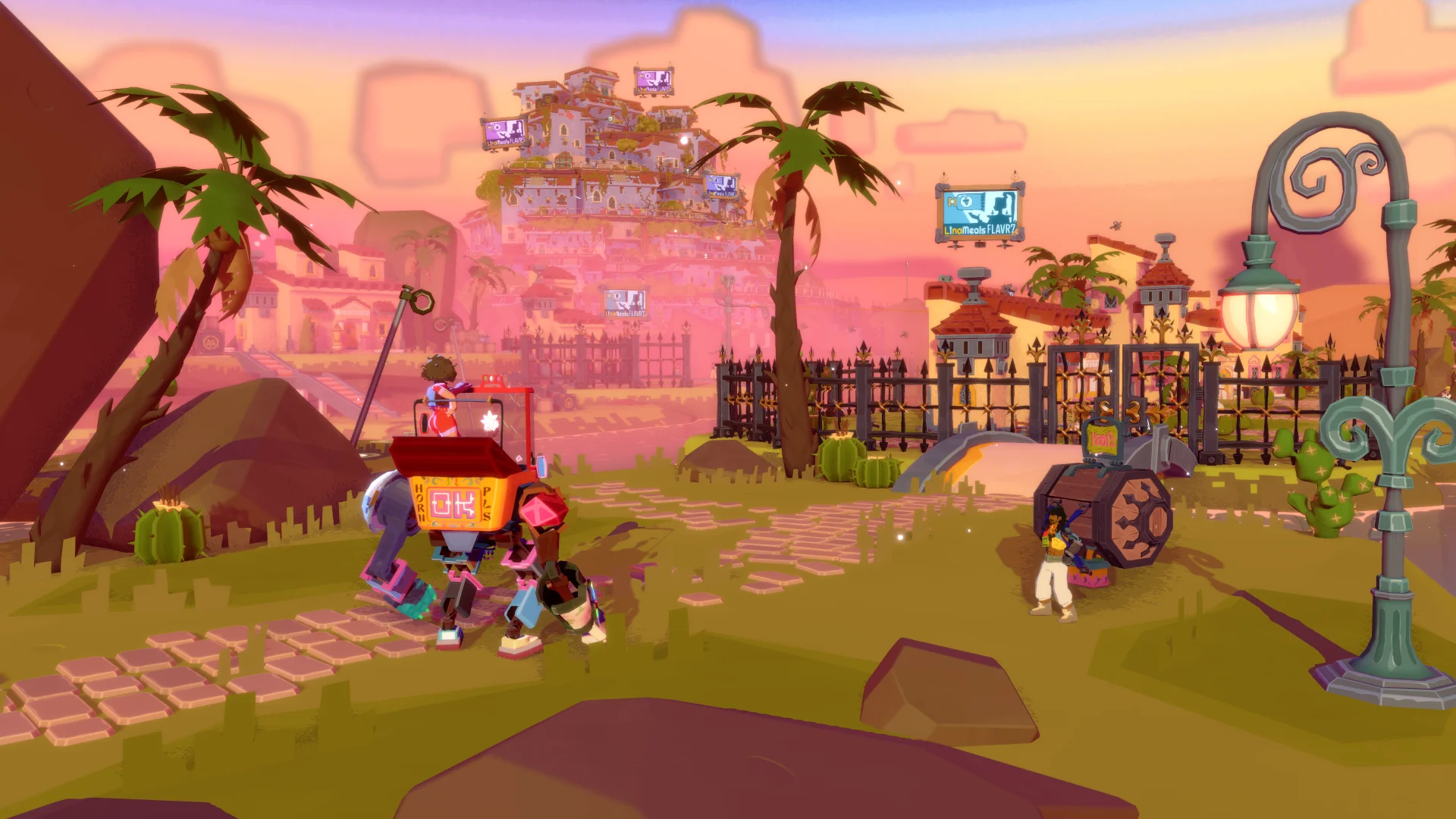
Exploring the world aboard Goddess—the sisters’ food-themed mech—gives the game’s cartoonish art style plenty of room to shine, but the results feel uneven. Characters lean into exaggerated designs, with oversized limbs and unusual facial features, while the wide, often clashing colour palette makes it surprisingly hard to distinguish one NPC from another. The style is certainly distinctive and may appeal to some, but it often undermines the emotional weight the story tries to build.
The environments in Dosa Divas don’t do much to compensate. You move through a small set of familiar locations—a cliffside village, an underground tree root settlement, and a lakeside area—without much variation or sense of scale. The absence of more expansive wilderness spaces makes exploration feel repetitive, even within the game’s relatively short runtime. As you progress, Goddess unlocks traversal abilities like a hookshot and a drill to open new paths, but these additions rarely lead anywhere surprising. Instead, they loop you back through the same environments, adding utility without meaningfully expanding the sense of discovery.
When the sisters and Goddess face enemies from Linaworks, Dosa Divas shifts into a turn-based JRPG system—with a few added twists. You still select standard attacks and skills, but both offense and defense add timed button inputs. Land these correctly, and you boost your attacks or block incoming damage more effectively. Combat ties directly into the game’s food-based elemental system. Each attack carries a flavour type—Spicy, Sweet, and so on—and enemies show weaknesses to specific combinations.
When you identify and exploit those weaknesses, you deal increased damage and begin to break down an enemy’s shield. Once that shield drops, the enemy enters a “Stuffed” state, dramatically increasing the damage they take. Combat carries a strong sense of pace and visual flair. Watching Amani charge up oversized fireballs or Samara bounce attacks around the battlefield looks great in motion, and the system has a clear sense of rhythm.
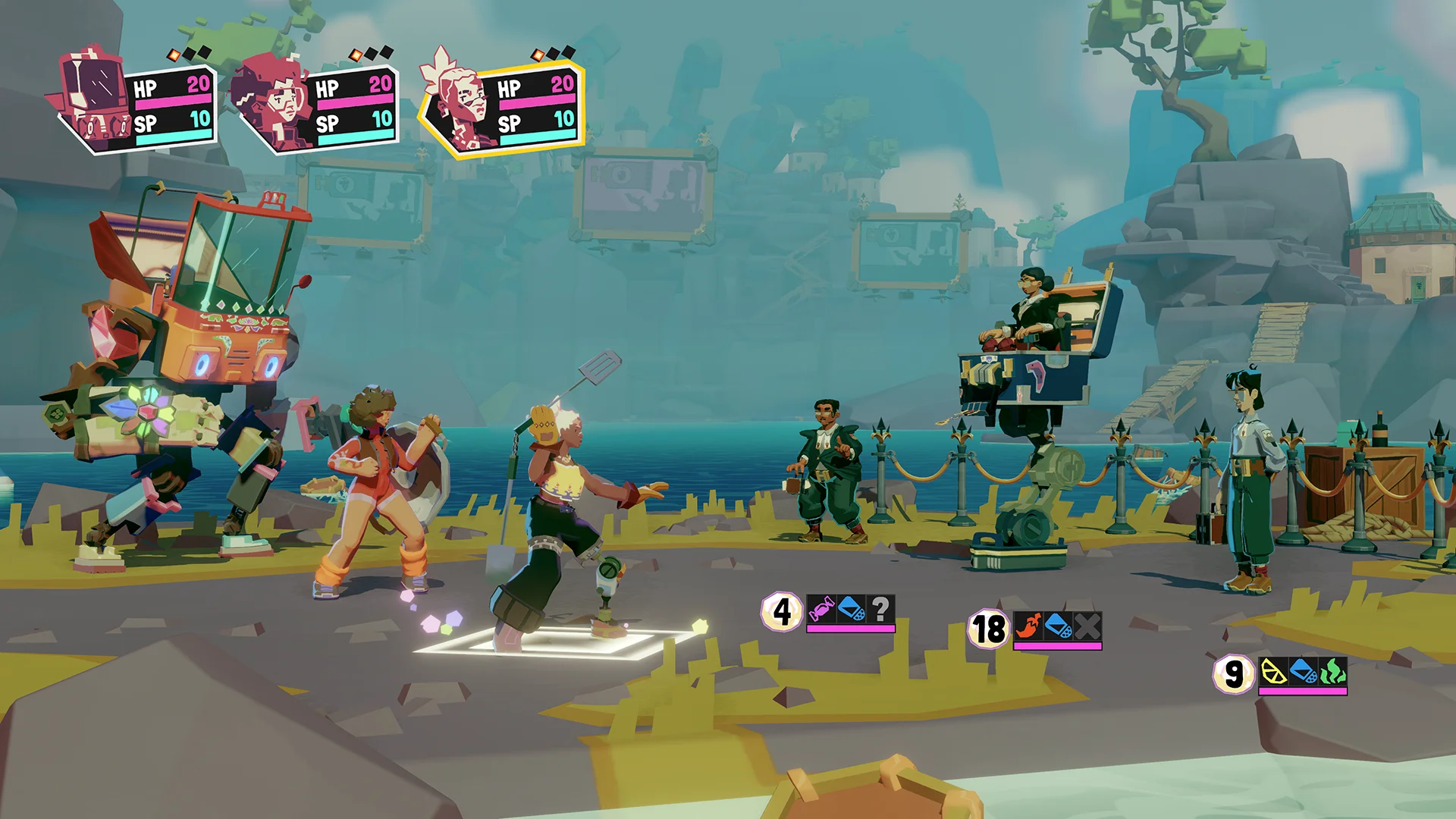
Unfortunately, the rhythm quickly gives way to frustration. The constant QTE inputs wear thin, and with no option to automate them, every encounter demands the same level of precision. Some prompts—especially when blocking rapid, multi-hit attacks—are difficult to read or perfect, making success feel inconsistent. I also struggled to initiate fights on my own terms, often taking the first hit before gaining control, though that may come down to unclear input or feedback.
On Dosa Divas’ normal difficulty, missing a block or mistiming a boost can have severe consequences, and the limited healing options only amplify the problem. Recovering small amounts of health from the odd food item means that a couple of mistakes can quickly spiral into a game over, regardless of preparation. Over time, the system starts to feel less like a test of skill and more like a battle against unclear timing windows and underdeveloped feedback. A more readable interface or more generous input cues would go a long way toward smoothing this out. Easier modes soothe the difficulty somewhat, but not the timing frustrations or sense of skill gap.
Dosa Divas’ standard enemies come from Linaworks’ ranks—lawyers, laptop-toting admins, and security staff—which gives encounters a playful edge. Their animations carry a lot of personality, and they consistently raised a smile when they appeared. That said, even these goons can prove awkward to handle, especially when full enemy groups combine with the game’s inconsistent QTE demands.
Boss Divas push the system further. These fights test your ability to break shields, exploit weaknesses, and manage resources with an even smaller margin for error. They introduce more complex and demanding real-time inputs, particularly when it comes to blocking. Unblockable attacks and status effects add further pressure, forcing you to rely more heavily on items and prepared food to stay alive.
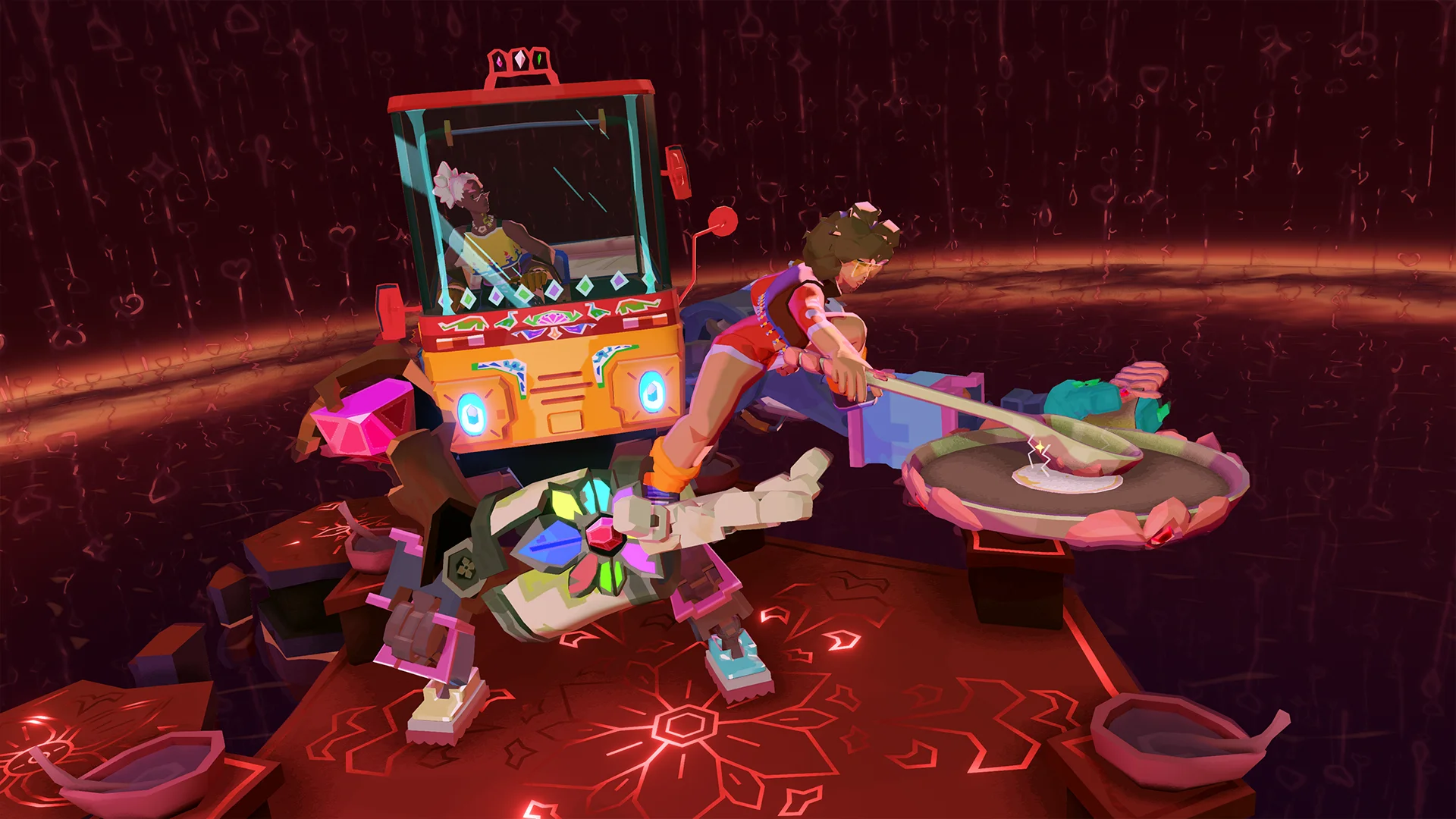
Ah yes, the food. As Samara et al. travel around the world of Dosa Divas, they constantly find and stock up on different loot components, from produce such as bananas and caught fish, to flavourings such as red onions or rock salt. Once they collect these, Samara and Amani can access Goddess’ dosa-making facilities, presented as a sort of cooking mini-game dimension. Here, produce can be combined with flavours and seasoning to prepare and experiment with different meals, both to fulfil orders for NPCs and to create items to enhance stats in battle or replenish lost hit points and the like.
Much like combat, the actual cooking in Dosa Divas is represented in a series of QTE activities, such as rapidly hitting buttons for shaking salt, or rotating the thumbstick at a given speed for smearing oil over a dosa pancake. More difficult ingredients demand tighter timing, or the UI could fade away, forcing you to memorize the correct timing. Achieving a higher rating produces more of the thing you’re making, so there’s an obvious motivation to trying your best each time.
It’s nice to see how some of the actual recipes, mostly focused on dosas (surprise!), aren’t too far removed from what you’d expect to eat in each dish. As an eater mostly unfamiliar with dosas, or any sort of similar cuisine, I felt at least a little more educated.
The problem remains in the QTEs, which although not as consequential as those in combat, are still quite basic, and creating the same foods, multiple times for quests or items, does become a slog. It’s a pity it’s not more refined, as the actual recipe-building and the degree of customization does show promise.
The Dosa Divas crew boosts their attack, health, and skill potency by defeating enemies and levelling up in a standard manner. However, their core skills and Ultimate abilities remain locked behind village affection. You can raise this level by destroying Linaworks’ propaganda, defeating enemies, or cooking for villagers. Because both powerful abilities and story progression depend on this system, these tasks are somewhat mandatory—and the repetitive cooking to order feels like a chore by the endgame given the issues described above.
Furthermore, the game offers almost no character customization; skills unlock at fixed points and cannot be modified or swapped. Goddess can collect various skins for her mech parts, and these can be swapped in and out individually, but it’s a minor cosmetic.
There are minimal diversions in Dosa Divas. Apart from finding and creating different recipe orders, and completing all objectives for maximum village benefits, the only other options are exploring each area for new pathways once Goddess’ transport options open up. Even this is often done in service of the goals above, although most of these paths contain Legendary scrap boxes for loot too which is needed for unlocking better upgrades.
Unlike the full-fat, meaty behemoths of the JRPG and item-crafting genre, Dosa Divas provides a lighter bite, but in mixing so many different flavours together, it doesn’t quite offer a meaningful memory. The story has real thematic potential, but an uneven implementation sours this aspect. Combat and recipe systems can be infuriating, and given so much of the short run-time is these systems, the frustration never fully disappears. Art and sound direction are mixed, and will be off-putting and samey for some.
Ultimately, Dosa Divas is aiming to be a snack-sized delight, but like an amuse-bouche, it still needs to offer enough flavour and texture for you to come back for more. You may find yourself leaving this one on the plate.