

Saying I’ve been excited for Fire Emblem: Fortune’s Weave would be an understatement. Over the three years since Fire Emblem Engage‘s release, I’ve pondered the series’ next direction and pored over every scrap of information I could get my hands on. Fire Emblem is my favorite game series, and I count many of its entries among my most cherished gaming experiences.
On paper, Fortune’s Weave seems like a sure-fire hit: Toshiyuki Kusakihara is back in the director’s seat after delivering the two strongest games in the franchise’s last decade (Fire Emblem Echoes: Shadows of Valentia and Fire Emblem: Three Houses). Fortune’s Weave returns to the rich world and lore established by Three Houses, but now on a new continent across the sea from Fódlan, the land of Dagda, ruled by the gods. The production values are higher and the presentation more polished than they’ve ever been (with an accompanying eye-watering price tag to match).
Fortune’s Weave incorporates Three Houses’ calendar structure into a new format, borrowing equally from Kusakihara’s past work on Shadows of Valentia to bring in more traditional RPG elements like world map exploration and dungeon crawling, coupled with the engaging map design and tested strategy RPG mechanics the series built its reputation on. Fortune’s Weave represents the franchise at its most ambitious, as not since Fire Emblem: Radiant Dawn have we seen a Fire Emblem game with four separate protagonists split into four (or more in this case) parts, each with their own unique challenges and stories to tell, all culminating in one great conflict that unites them all.
It’s a monumental task, and in many ways, Intelligent Systems succeeds. Dagda is the richest, most well-realized setting in the entire franchise. The game has over 60 unique battle maps spread out across its imposing runtime, more than any individual game in the series’ history, with many of these map designs showcasing Intelligent Systems at the height of their creative prowess. Fortune’s Weave boasts one of the largest and most diverse casts of any Fire Emblem title, and even the majority of the side characters with little plot relevance shine brighter than most side characters in titles with comparable rosters (Fire Emblem: The Binding Blade and Fire Emblem: Radiant Dawn).
You may have gleaned, despite the glowing praise I’ve lavished on the game thus far, that a “but” lies in ambush, and you’d be correct. Part of what makes video games compelling is that they incorporate the strengths of numerous creative mediums (visual art, music, storytelling, cinematography, game mechanics) into a single package. Since games need to balance so many disparate elements, the structure that binds them becomes immensely important. Fire Emblem: Fortune’s Weave may be Fire Emblem at its most beautiful, most ambitious, most inclusive of past systems and mechanics. Yet at every turn, the repetitive calendar system and stubborn commitment to its four-path-by-three-act structure rears its ugly head like a Nysiades Sandworm erupting from the dunes.
In an interview given just before the game launch, Kusakihara and other creative leadership on Fortune’s Weave explained that their goal was to improve upon the design template established by Three Houses. While they have achieved that to a certain extent, the calendar structure and time management mechanics buckle under the weight of unfettered maximalism. The result is four inconsistent story paths, a glut of mechanics unable to reach their full potential, and an overarching narrative that, while initially compelling, ends up with major gaps, leaving a disjointed experience stretched thin across a bloated 120+ hour journey.
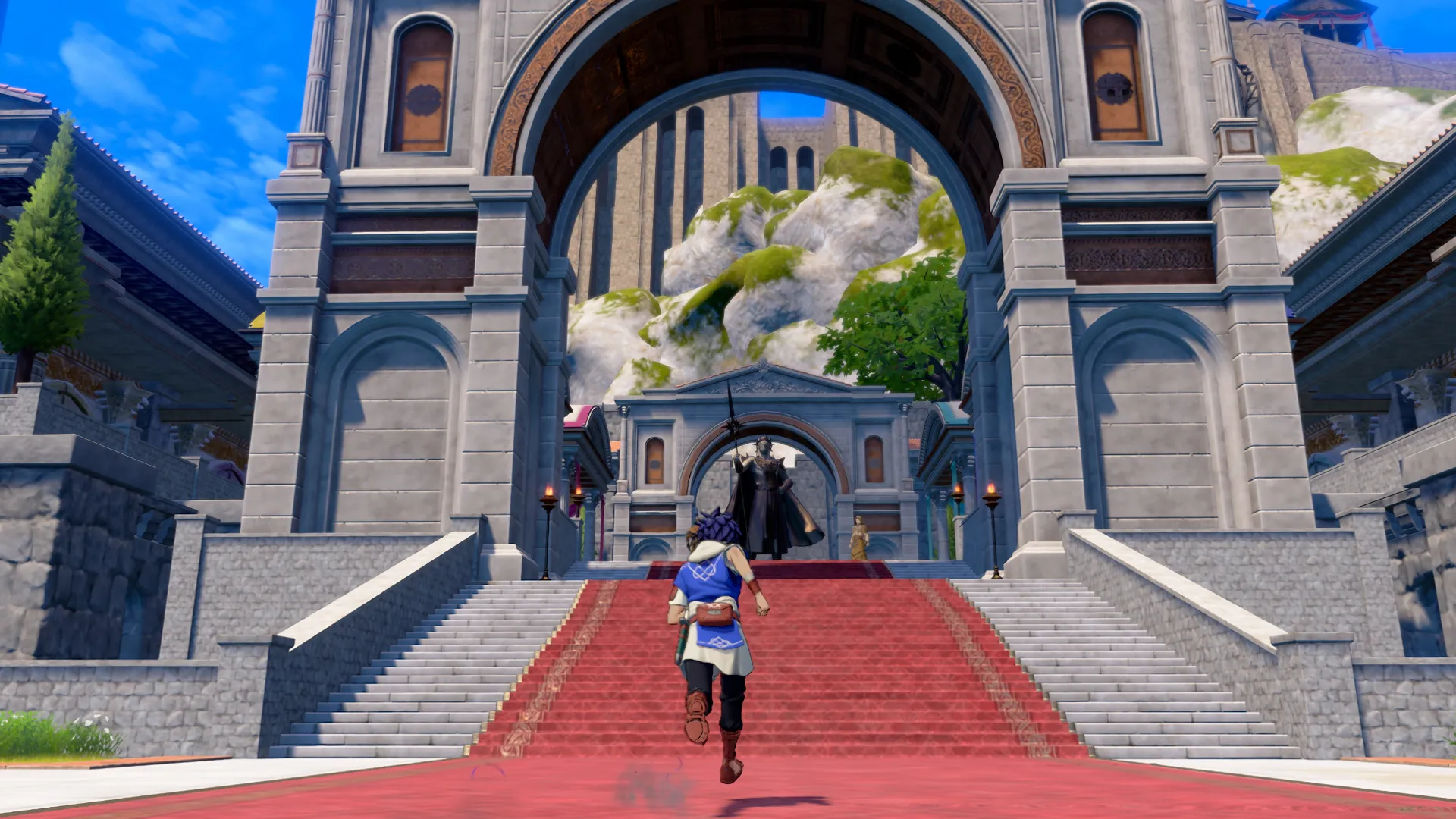
The storyline follows four protagonists (Cai, Theodora, Leda, and Dietrich) as they travel to Dagsion, the capital city of the Dagdan Empire, to participate in the Heroic Games, a gladiatorial contest held in honor of the empire’s founder, Dagda the Great. Dagda has been slumbering for a few hundred years, leaving his son Solel and his other relatives in the Dagdan pantheon to rule the land in his stead. The human-led vassal states of Brezerant, Arago, and Saramis (led by Theodora herself) are all in attendance.
Dagda, the continent, takes inspiration from Ancient Greek and Roman Mythology for its world-building, and Fortune’s Weave uses the concept of a land ruled by gods who walk among the people to great effect. Dagda is a melting pot of cultures, and people from all walks of life inhabit Dagsion’s bustling streets. Religion and governance are one and the same, with the temples dedicated to each member of the Dagdan pantheon administering society’s key functions. The leveraged relationship of gods over humans is a major theme of Fortune’s Weave, and the way the gods support or misuse human beings in the narrative harkens back to classic myths in a way that feels novel yet familiar.
Dagda is now my favorite setting in all of Fire Emblem, largely due to how much effort the team put into the world-building this time around. While Three Houses’ Fódlan was rich with history and lore, confining the player to the military academy kept you from experiencing much of the world outside the walls of Garreg Mach, and most of the characters came from within Fódlan and the same social class. By contrast, the entirety of Dagda is available to explore via the world map, and the playable characters hail from all corners of the empire (and even beyond).
Each character has an information page in the menu containing their age, likes and dislikes, and a timeline of major events in their life, offering a window into their background and motivations even if they barely feature in the main storyline. You get a much better sense of what life is like for the average Dagdan, and the various cultural practices, cuisines, and values that comprise the empire’s population and way of life. This proves incredibly effective when Dagda is cast into ruin by the return of Balor, with the accompanying societal collapse truly feeling like a monumental tragedy and emotional loss.
Each path follows one of the four main protagonists and explores their origins and their motivations for entering the Heroic Games. Conventional teenage Fire Emblem protagonist Cai hopes to rescue his father from prison. While Theodora’s personality is much less conventional for the series (confident and warlike), her status as a noble ruler and her desire to see her kingdom’s religious beliefs recognized and their ancestral lands returned is fairly traditional.
Dietrich and Leda’s paths are the most novel for a Fire Emblem story, and represent the highs and lows of Fortune’s Weave’s narrative approach, so while I played all four paths for this review, I’ll focus on their paths to illustrate what the game does well and where it falters.
Leda’s path is initially compelling, as you witness the invasion of her home by Arago and the murder of her father at Aragoan general Bertrand’s hands. As an adult, she’s devoted her life to hunting down the names on her kill list, the people she believes to be responsible for Arago’s invasion. Once she discovers Bertrand is fighting in the Heroic Games, she signs up to get her chance to cut his throat. It’s a dark motivation, and her otherwise friendly, flirtatious personality contrasts well with her single-minded determination. Unfortunately, as her story progresses, things begin to fall apart, as a series of dubious twists and turns in her story take priority over her development as a character.
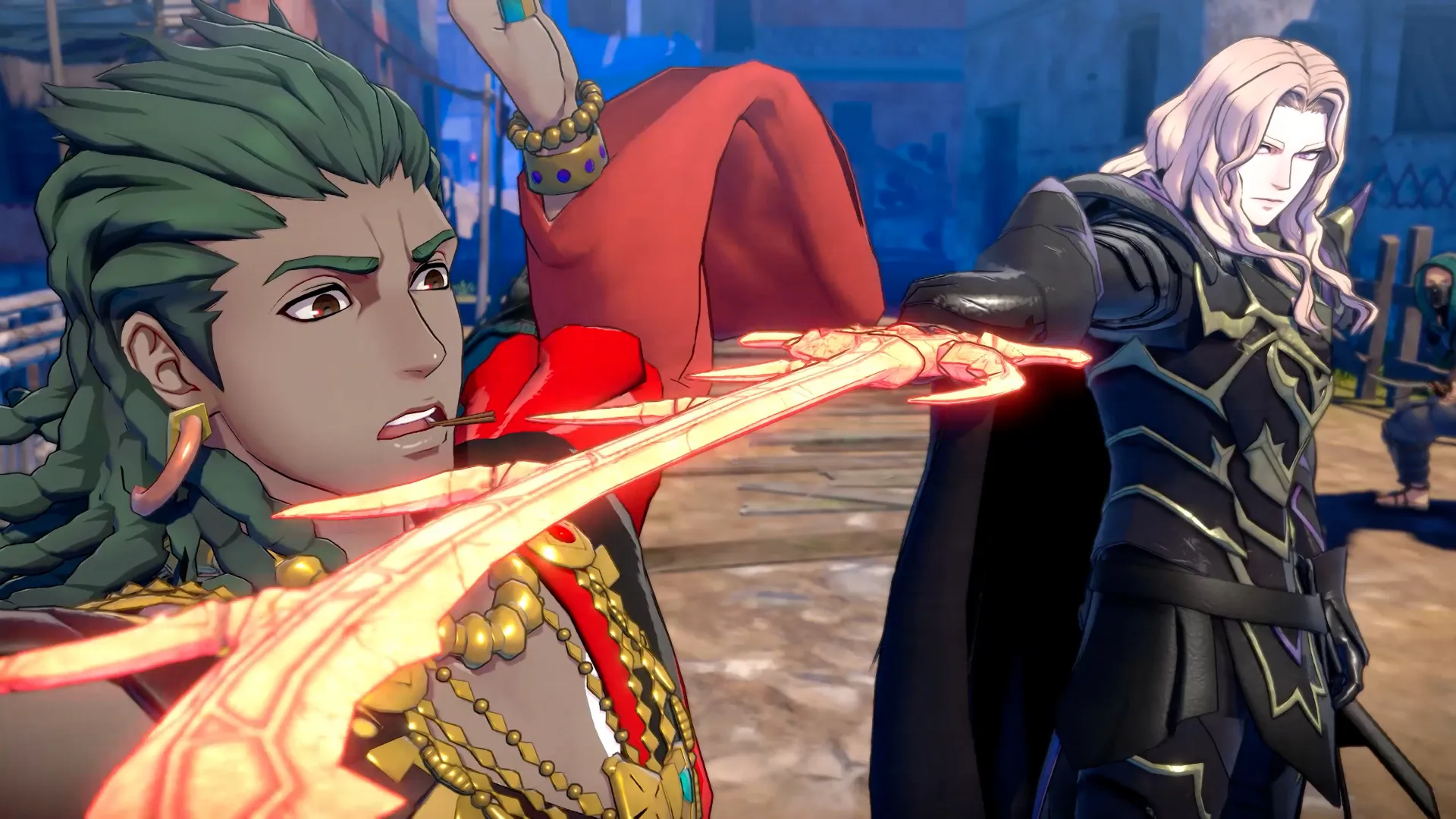
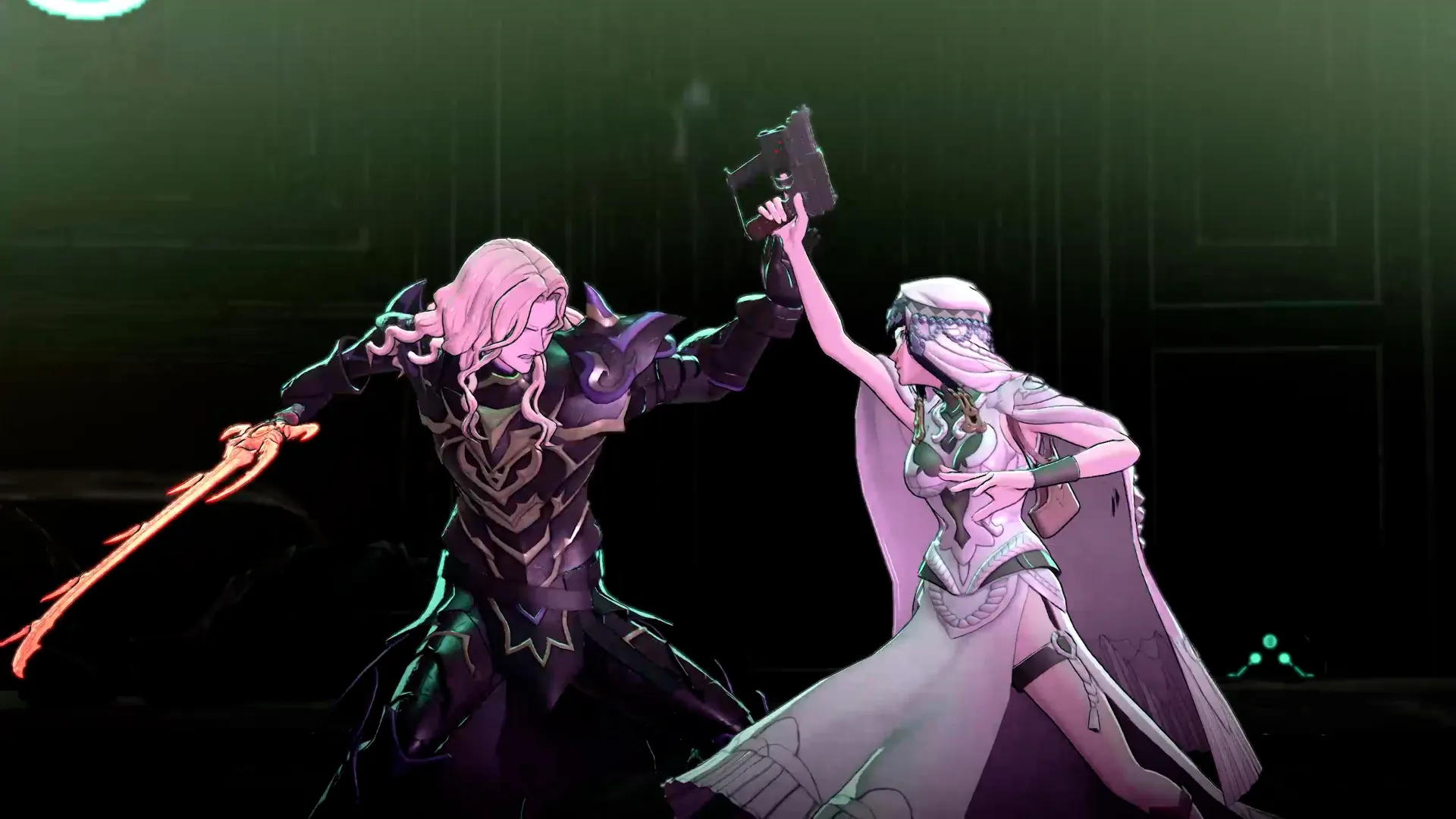
Dietrich’s path, on the other hand, is the narrative’s high point. In any other Fire Emblem title, a character like Dietrich (and his mysterious companion Fabio) would be a villain. He’s bloodthirsty and cares only for chasing the thrill he gets when separating someone’s head from their shoulders. That chase leads him to wash up on Dagdan shores after his ship from Fódlan is destroyed by the sea monster Cetus. He happens upon a traveling missionary from Fódlan’s Church of Seiros named Fabio being accosted by bandits, and fights them off purely to slake his thirst for blood.
The pair then stumble into a nearby village, where they rescue fisherman’s daughter Esmeralda, who had been offered up as a sacrifice to appease monsters nesting nearby. Upon arriving in Dagsion, Dietrich finds himself in another brawl, assisting the mercenary Mikaela and catching the eye of the Order of Mithras, who grant him a magical cloak and arrange for his participation in the Heroic Games.
What works about Dietrich’s storyline is his and Fabio’s character development. Fabio views the humans of Dagda as little more than beasts, and feels nothing as he attempts to hand over the ancient technology dotting the land to Vritra. At first, Dietrich similarly cares for nothing but the thrill of battle, chasing that high even if it harms others or leads to his death. Watching their growth was touching, and I appreciated how Intelligent Systems humanized such a seemingly villainous character without sanding away his rough edges. Dietrich’s path also leans heavily into the science fiction elements Three Houses only hinted at, providing long-awaited explanations about the world’s origins.
The main way this storytelling approach falters is how it fails to come together. Each path tells a contained story of the protagonist throughout the Heroic Games, but also tells the overarching story through various narrative pieces. Due to this piecemeal approach to storytelling, you must play each of the four paths to truly understand what’s going on once the empire-encompassing war breaks out in part two.
Therein lies the problem: each path can take upwards of 20 hours to complete, and each path repeats much of the same content, particularly within Dagsion and the world map. In the lead-up to release, Intelligent Systems gave the impression you could play as many of the paths as you wish. This is technically true; you can play a single story path and take that group of units to the endgame. However, playing the game that way would leave your army significantly underpowered, deprive you of many central gameplay mechanics, and leave you incredibly confused about how the narrative ended up leading to war.
Although seeing everything in this game takes significantly less time and is substantially less repetitive than playing every route in Three Houses, the individual storylines in Three Houses largely stand on their own. As RPGFan’s own Aubrey Bryn so eloquently explored in her recent feature, every single story route in Three Houses leads to a satisfying conclusion. In Fire Emblem: Fortune’s Weave, you must play all four routes to understand the narrative, and even then there are major gaps.
Part two shifts the narrative to Theodora’s perspective as Dagda the Great returns and declares war on Saramis, but there are major events that precede and lead into the war, which are glossed over and never truly explained.
Adding to this confusion are extremely important missable cutscenes that occur within Dagsion’s walls during the initial paths. There is no indication beyond a small pulsing circle on the city map that such a scene will even occur, and major plot threads and character arcs resolve in these scenes. It’s a bizarre choice, especially when players will be so focused on maximizing their free time training units and completing world map activities that most will never think to check.
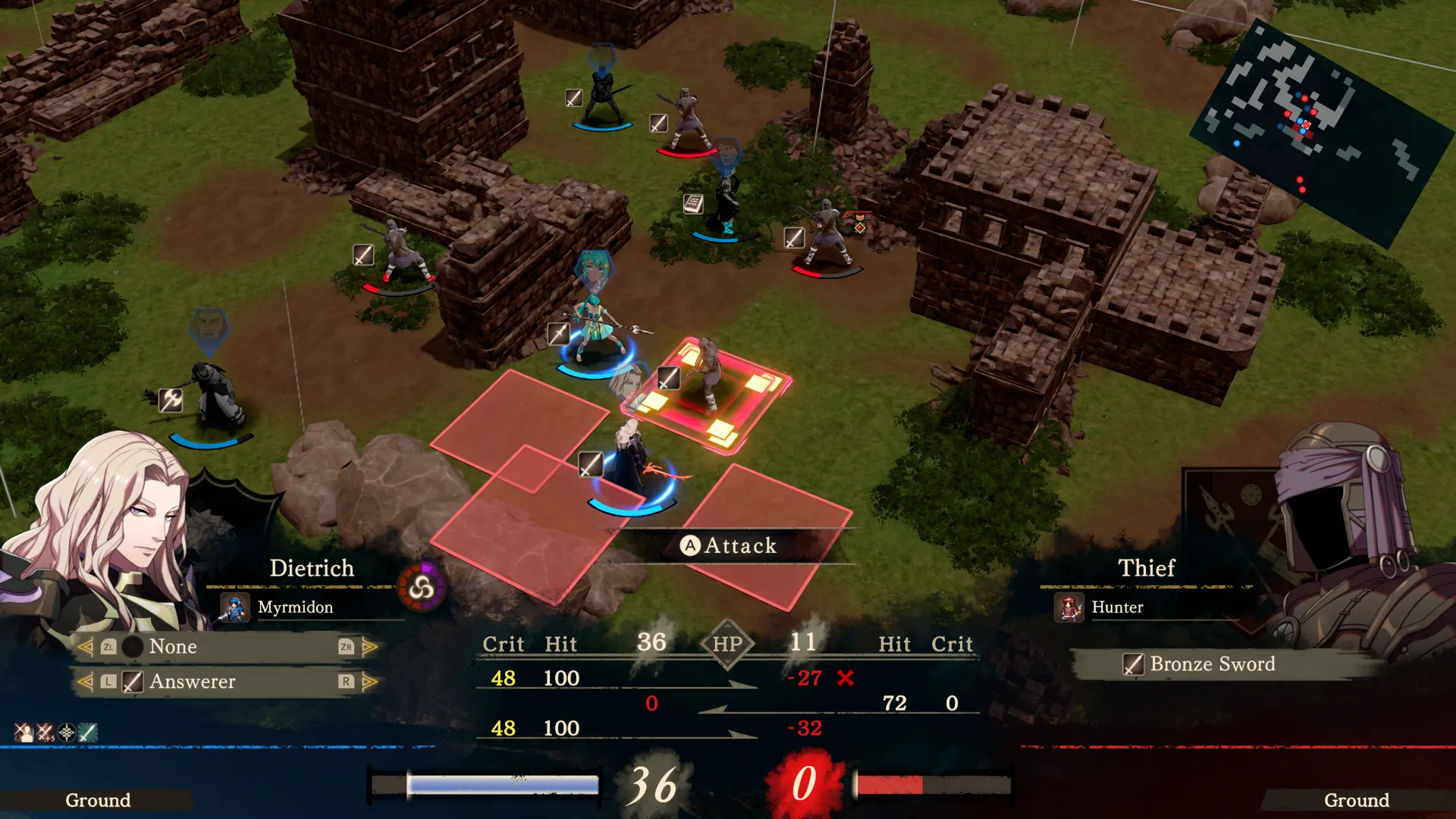
The open-ended, self-directed, yet somehow still rigid calendar structure significantly impacts the game’s pacing and how it delivers crucial gameplay mechanics. Each path consists of about 12 chapters, each with a variety of unique maps. These map designs range from competent and straightforward (Cai and Theodora’s routes) to wildly creative and original (Leda and Dietrich’s routes). Every path has at least one map with a gimmick or mission objective new to the series, and most (especially during the latter half of the Heroic Games) provide an engaging challenge.
The matches in the Heroic Games are based on important battles from Dagda’s long history, and the arena terrain changes significantly depending upon the match. Ship battles, siege weaponry, traps, and other variables keep things from growing stale despite the matches technically occurring in the same place. The gladiatorial framing device is put to good use, as major characters will comment as they spectate the matches, and the roaring crowds can interfere by throwing weapons into the ring.
Fortune’s Weave’s approach to map design shines brightest in the Paralogues, optional side missions based around one of the eight Flame Lords (or other major characters like Solel). Completing these maps allows the player to recruit the associated character in part three, but honestly, playing each map is a reward unto itself, as each exhibits incredibly clever, varied objective and encounter design. Defense missions, escort missions, competitions that upend the traditional Fire Emblem rules and see you racing to defeat enemies or light bonfires to score points against your opponent; you never see the same idea twice.
What proves less rewarding is how you access these paralogues: they only appear during a certain timeframe on certain days inside Dagsion. If you are out exploring the world map, you can easily miss them, and most characters can only access a handful. Dietrich is the only protagonist who can access every paralogue (except his own), but his timeline for accessing them all is incredibly tight, ensuring the only way you will get them all is by consulting an external guide. It’s a truly baffling way to present the game’s strongest content to the player, and emblematic of just how much Fortune’s Weave’s structure undermines its pacing.
So much time is spent between major battles training units, eating meals in town to raise supports, and exploring the world map gathering materials and completing quests that it strained my engagement and interest. Each chapter, the player has a set number of turns to spend on side activities. Every move on the world map consumes turns, and some chapters require you to leave Dagsion’s walls and reach a specific location before a certain date. Fail to reach the location in time, and you will fail the chapter, losing many hours of progress. I appreciate that mismanaging your time has consequences, but this risk is poorly communicated to the player and adds to an already repetitive, grindy game structure.
Each protagonist has different ways to interact with the world map, but switching to a new path frustratingly deprives you of integral gameplay mechanics. By the time you can access every mechanic in part three and can truly experiment with all the systems together, it feels too little too late, as your units will be pushing level 50 and already locked in to their particular builds and strengths. Part two is better paced, as it’s a linear stretch of six large, endgame-style battles with multiple approaches full of tough enemies and repeated reinforcements. However, it’s such a relatively short section that it cannot salvage the underlying pacing problems once things shift back to the world map formula in part three.
The innovations Fortune’s Weave brings to the Fire Emblem formula are a prime example of one step forward, two steps back. Fortune’s Weave is the first game in the franchise to make character growth rates visible to the player, a long-requested feature that gives the player vital information they would otherwise have to consult outside sources like the perennial Fire Emblem fan site Serenes Forest to find. This change is massive, as you can see how different classes will impact character growths and plan out future builds and progression paths for each character to shore up weaknesses and lean into their individual strengths.
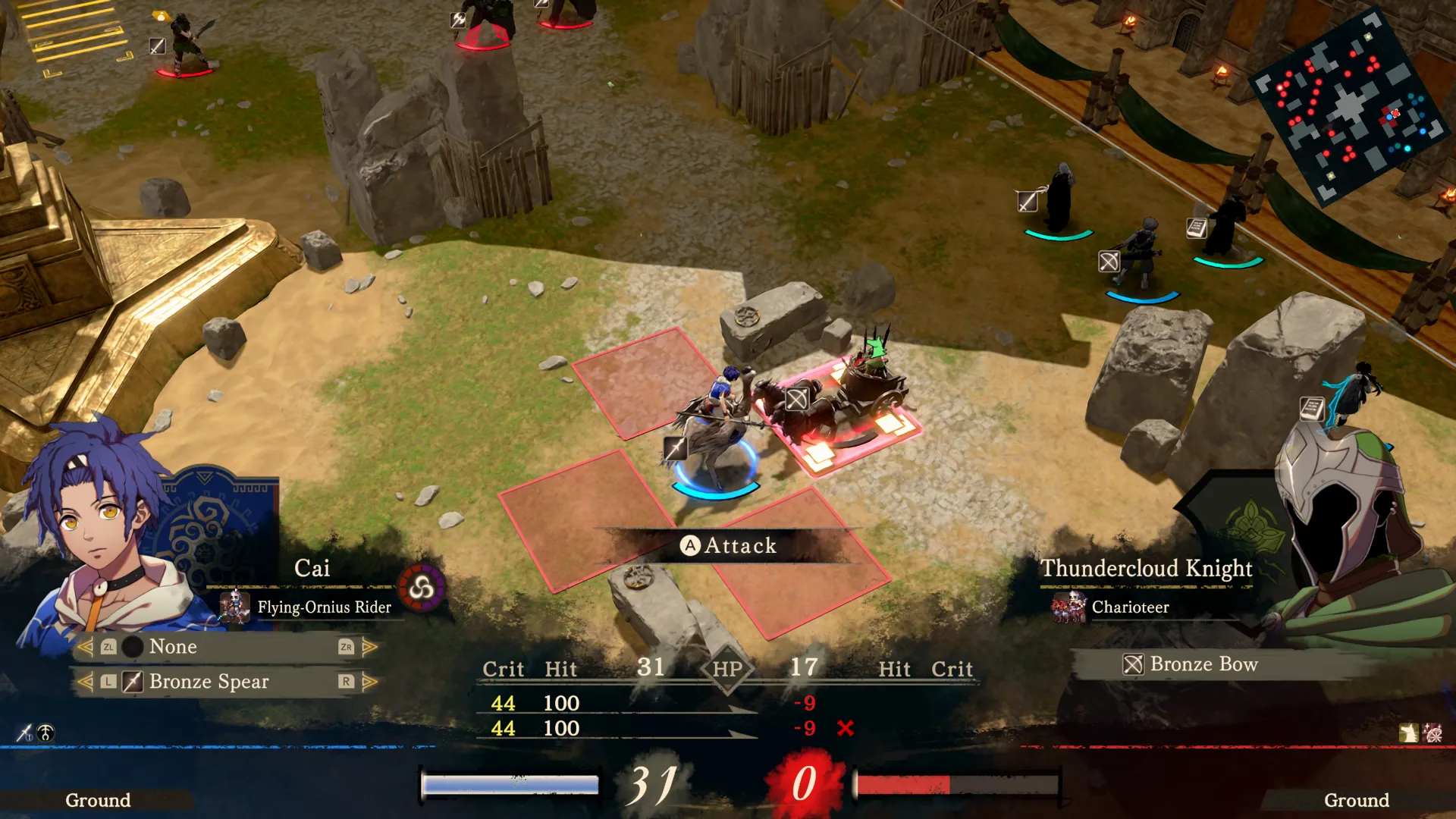
A less successful change is the weapon system. Fire Emblem‘s weapon triangle is a foundational series mechanic, one that was refined expertly in Fire Emblem Engage with the Break system, where attacks with a weapon advantage dealt extra damage and prevented counterattacks. Much like Three Houses before it, Fortune’s Weave once again abandons the weapon triangle system, in favor of granting unique properties to each weapon type outside of the rock-paper-scissors framework. Lances are strong against cavalry, swords do more damage on follow-up attacks, fist weapons provide an attack speed and avoidance boost, and axes have very high might with low accuracy.
While these changes make weapon choice far more relevant to combat encounters than they were in Three Houses, it’s a far cry from the excellent systems design in Engage, and far less balanced. Lances and fist weapons are extremely powerful due to the prevalence of mounted foes and the importance of attack speed and avoid on the enemy phase; sword and axe properties are significantly less advantageous by comparison. Then in part three, swords become the most important weapon type due to a couple specific weapons (Cleansing Blades and Levin Swords) being necessary to combat the prevalence of undead foes, marginalizing the other weapon types and any class that cannot wield swords.
The more I reflect on my 120+ hours spent with Fortune’s Weave and its place in the franchise, the more I’m reminded of Radiant Dawn. Much like Radiant Dawn, Fortune’s Weave takes a familiar world and massively expands the scale and scope of the narrative, delves deeper into the world-building, and creates a real sense of place. The map design in both titles shows repeated flashes of brilliance, offering up some of the most creative and novel challenges the franchise has ever seen.
Unfortunately, it shares many of Radiant Dawn’s flaws. The four-part structure severs the compelling progression from ragtag band to well-coordinated army and thrusts the player’s perspective into too many disparate directions. Each path offers hints of the grander narrative, though the journeys each group takes vary widely in storytelling acumen. Just as Radiant Dawn does in its fourth and final part, Fortune’s Weave struggles to bind these narrative threads together cohesively, leaving major gaps in its storytelling tapestry. With so many characters, motivations, and antagonists to juggle, no one really gets the time to shine in the face of a world-ending threat.
The mechanics are stretched thin across the game’s prodigious runtime, and the need for characters to continuously scale in power leads to power creep that turns some units into unbridled, runaway chariots while leaving the others in their dust. In most Fire Emblem games, limitations provide the bounds by which the player can test themselves and their strategic abilities. Fortune’s Weave, like Radiant Dawn before it, leans so heavily into maximalism, with so many characters, systems, and side elements to pursue that the underlying mechanical foundation simply can’t keep up the pace.
It is already difficult to ramp up to a single narrative and mechanical climax; Fortune’s Weave attempts this ascent six times, lessening the impact each time. Although I enjoyed my time spent in Dagda, that enjoyment and excitement dulled as I went through the motions of each character’s part one; my eagerness at the next narrative revelation or mechanic introduced faded away across dozens of hours of going through the motions of training units, building supports, and exploring the map.
Those mechanical tweaks and story beats eventually arrived, though not with the frequency and potency they could have had with a more limited, focused structure underpinning the entire project. Despite the Mediterranean setting, Fortune’s Weave is a game of many peaks and valleys, with each dip back down into the doldrums lessening my enthusiasm to push forward towards the next climb.
Allow me to borrow a metaphor from the Greek and Roman mythology, much as Intelligent Systems did to build the world of Dagda. Fortune’s Weave is a grand Icarian gambit, with beautiful wings crafted from a multitude of wonderful feathers: a fully realized world that feels authentic in its melting pot of cultures, lore that builds upon the foundation set in Three Houses and takes the narrative in surprising new directions, the most diverse and motivationally varied cast the series has ever seen, excellent audiovisual presentation on par with any rival big-budget RPG franchise, and a wealth of extremely creative and clever map designs utilizing concepts novel to the long-running series.
However, much like the sun, ambition is a volatile thing. Without enough ambition encouraging growth and innovation, a franchise may never reach the lofty heights of its potential and wallow in the shadows. Too much ambition, and the harsh rays can sear and destroy even the hardiest of design templates. Unfortunately, Fortune’s Weave flies a bit too close to the sun; while many of its individual parts rival or surpass what the franchise has achieved before, the structure that binds all these disparate parts together melts underneath the heat. While Fortune’s Weave doesn’t quite crash and burn like Icarus, it struggles to stay aloft, proving a stern warning about the limits of ambition and maximalist design.