
Much of the joy I derive from playing indie RPGs comes from seeing how independent developers remix familiar mechanics and classic presentation towards a singular purpose that a larger studio or publisher would never touch. Many big productions are so focused on appealing to everyone that they lack a cohesive vision or clear thematic message supported by strong mechanics that reinforce that goal. Hermit and Pig is what I’ve searched for: an adorable, quirky RPG that takes mechanics popularized by Earthbound, Paper Mario, and Mario & Luigi titles and intertwines them with a delightfully funny and incredibly insightful narrative. Hermit and Pig achieves what few games can, particularly in such a short run time. It made me laugh, it made me smile, and it made me consider its message.
Hermit and Pig follows the titular duo during yet another day in their sylvan, solitary existence. That is, except for the strange dreams plaguing Hermit’s nights, eerily glowing blue mushrooms haunting even his waking thoughts. Their mundane task of foraging for mushrooms is rudely interrupted by a young girl, Mary, who explains that she’s ventured deep into the woods in search of a mushroom big enough to feed everyone in town, the mythical Jumbo Fungo.
The local factory, run by weapons manufacturer DefenseTek, abruptly closed and left most of the residents out of work and unable to procure food. Meanwhile, the animals of the forest have gone rabid, aggressively attacking anyone who crosses their path. Hermit reasons he can’t let Mary return home on her own and sets out to get to the bottom of these strange happenings that have so rudely dislodged him from his solitude, using the duo’s foraging skills to find the fabled fungi. It’s a simple premise, but one that evolves significantly over the seven-hour journey as more of the mysteries behind Hermit’s dreams and the company that runs the factory become clear.
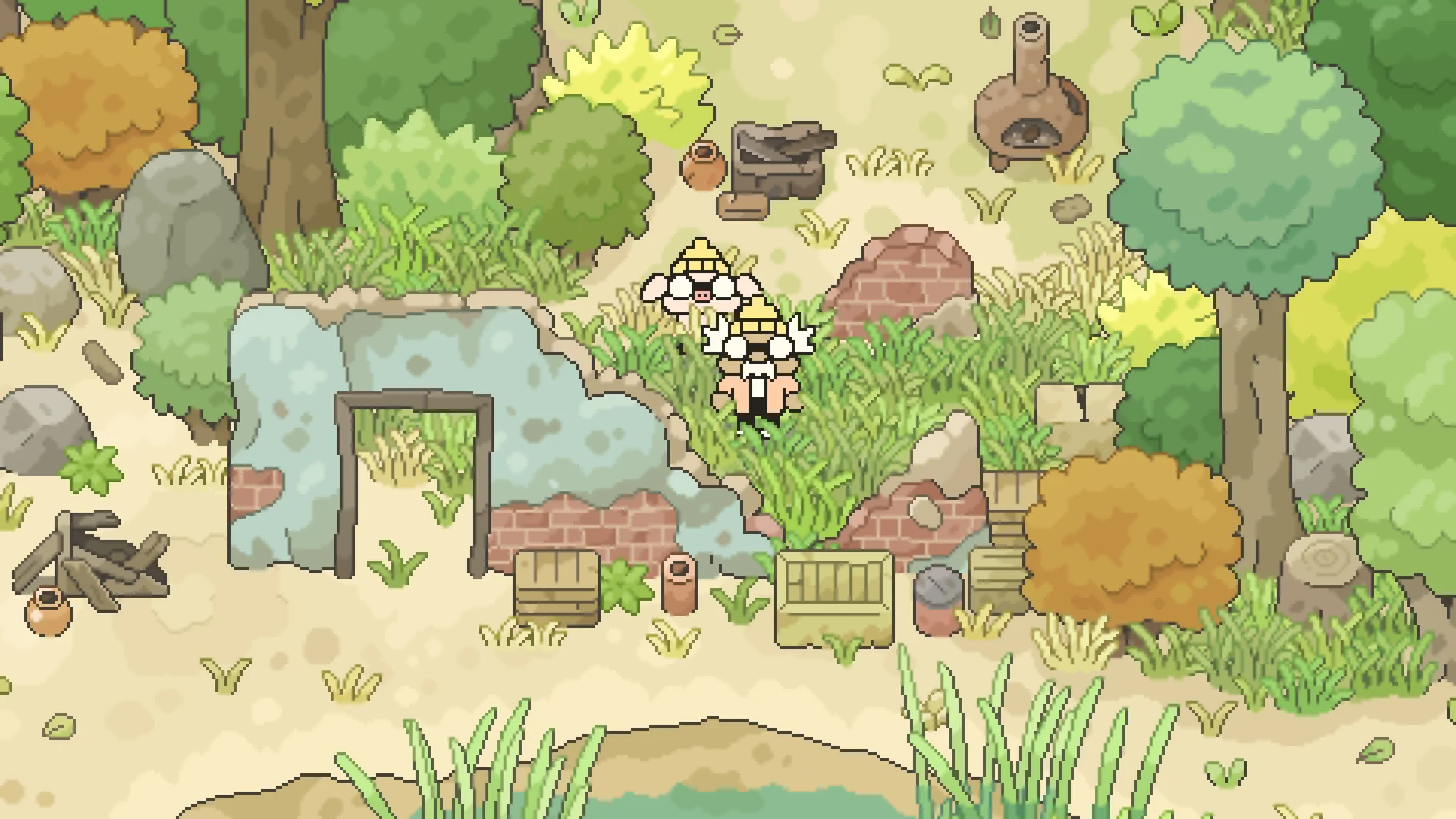
The gameplay borrows heavily from timing-and-input-based combat systems, but Hermit and Pig does not simply replicate its inspirations. After all, Hermit and Pig are just an average old man and his porcine pet, and their options in combat fall within the bounds of possibility for such an unlikely duo, at least initially. Hermit can slap, punch, kick, stomp, swat critters away with his cane, and let off a well-aimed projectile from his slingshot. Combat takes place in first-person, and choosing the best attack requires careful examination of enemy characteristics. A prickly caterpillar? Skin-to-skin contact is a no-go, so the cane or slingshot is your best option. Does the animal have a hard shell? Your weapons of choice might glance off, but a firm kick or stomp will do the trick. Enemies will often change position during combat, requiring Hermit to alter his approach. For example, a snake may retreat into the reeds to heal each turn, leaving it out of reach of melee attacks but vulnerable to a rock from your slingshot.
Furthermore, actually pulling off the chosen attack requires a precise combination of face buttons. Hermit’s handy wilderness survival manual contains the correct combinations, yet each turn is limited by a timer that ticks down, even when referencing the manual or digging through the inventory. This elevates what might otherwise be a simple combat system into an engaging test of reflexes, memory, and time management. If these limitations prove too restrictive or cumbersome, there is a bevy of accessibility options to make combos easier, shift to selecting attacks from a menu, and modify or eliminate the timer. Such options go that extra step to ensure anyone can enjoy the game, but I enjoyed the challenge on offer.
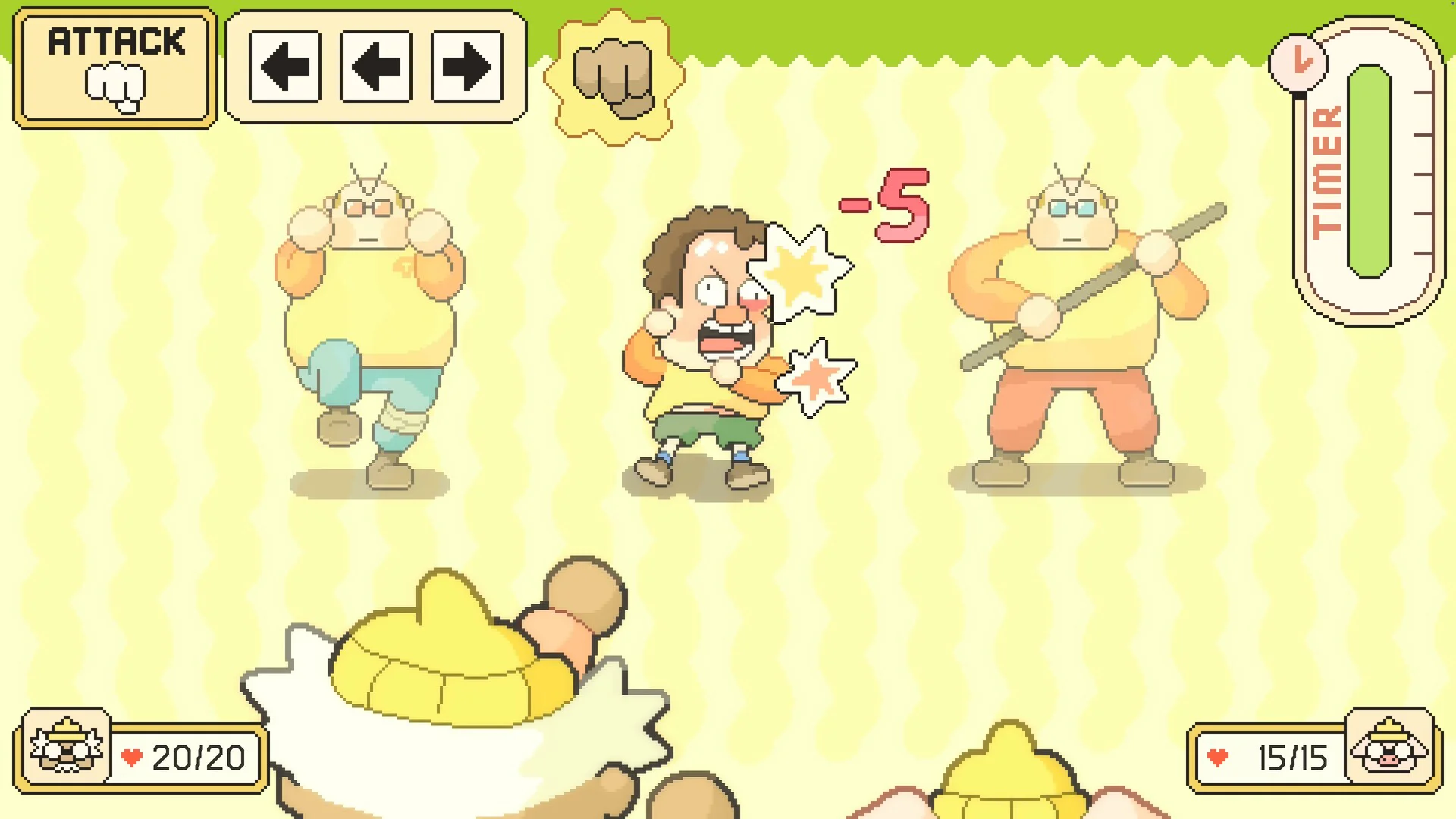
Pig’s abilities, on the other hoof, are support-oriented. He can attack, but his strikes are relatively weak during the opening hours. His real strengths lie in his ability to sniff out enemy weaknesses and forage for mushrooms. Mushrooms are a way of life for Hermit and Pig, and serve as both combat items and currency in the game. Pig can dig up valuable truffles hidden in the environment outside battle, and even forage for fungi mid-battle to aid Hermit. These mushrooms can restore hit points, recover status effects, inflict status ailments or debuffs on enemies, and buff Hermit and Pig if used correctly.
Giving the pair their own defined roles keeps battle strategic, as combat scenarios involve a careful balance of dealing and tanking damage with Hermit while Pig aids his buddy and hinders the opponent. As the game progresses, Hermit and Pig stumble upon additional glowing mushrooms that grant new special abilities for battle. Hermit’s focus on damage dealing, while Pig’s new skills buff the entire party and grant him the ability to speak and negotiate with enemies. They also grow more adept at combat and can take multiple turns, though they remain limited to the same time window for executing attacks or abilities. This keeps combat from growing stale and allows the battle system to layer complexity without getting bogged down by higher stat totals.
Progression is similarly simple yet clever, as leveling up does not grant raw stat increases like a typical RPG. Instead, Hermit gains a single trinket point every time he levels up. Trinkets function like badges in Paper Mario, granting stat upgrades or altering character parameters when equipped. These trinkets are the only way to improve Hermit’s base stats, but the passive upgrade trinkets stand alongside trinkets that add status effects to attacks, increase exp gain, or various other alterations to the game’s systems. This variety enables many different character builds, and trinkets provide a nice reward for exploration and sidequest completion.
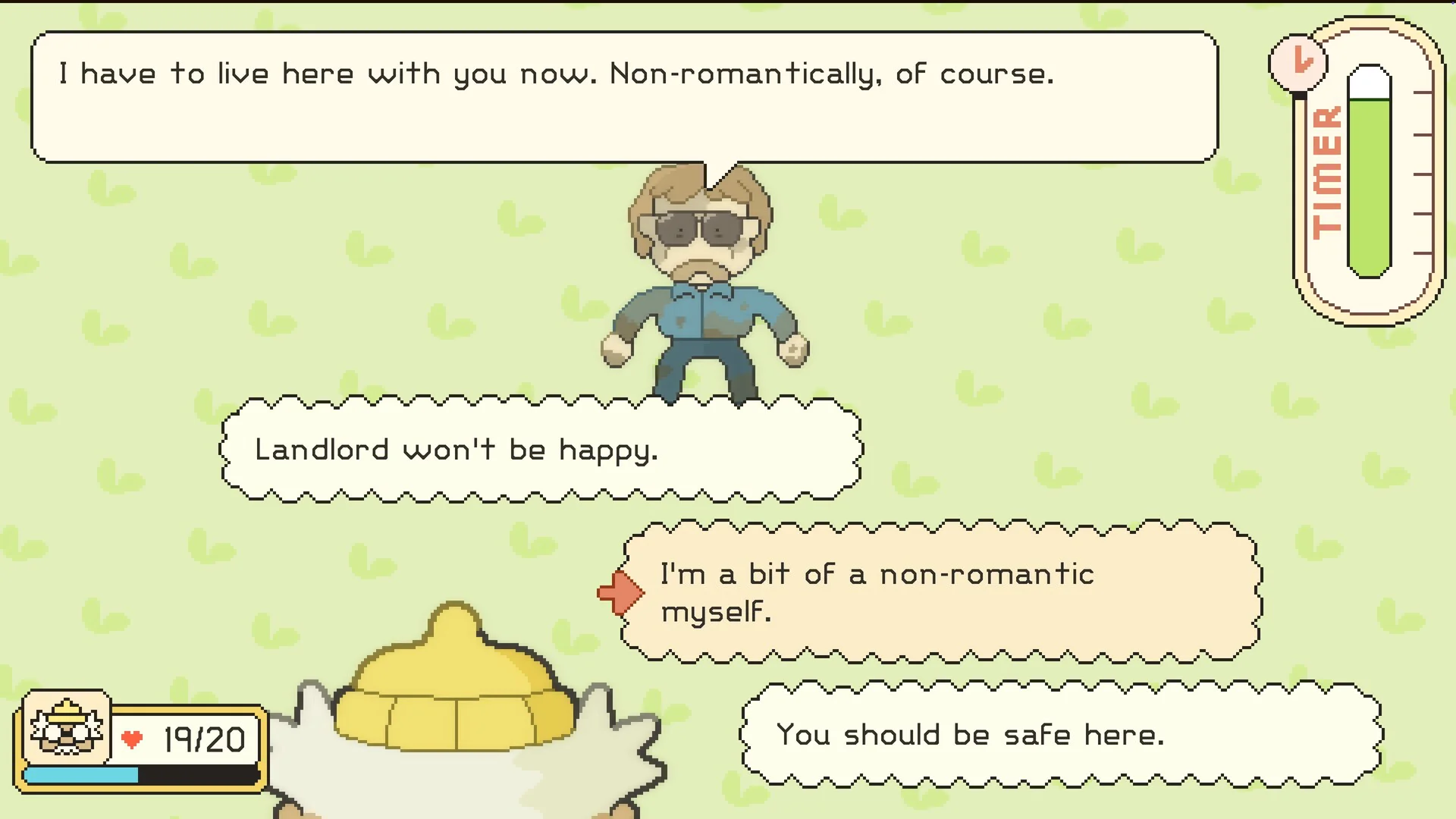
This careful consideration of mechanics applies equally to the game’s narrative. Hermit lives a life of isolation because he suffers from crippling social anxiety. The game represents this by sweat bubbles that radiate from his sprite whenever a human NPC is near. Conversations are presented like battles, with the typical moveset replaced by dialogue options. Selecting the wrong dialogue option during conversations makes Hermit visibly cringe and take damage; successfully making it through small talk with another person rewards Hermit with experience points. For Hermit, every social interaction with another person is as fraught and dangerous as his physical confrontations, and the way the game remixes the battle mechanics for dialogue to reinforce Hermit’s personal difficulties is incredibly clever and empathetic.
These conversations with the cast of quirky, off-beat human characters are the foundation of the game’s humor, and some of the “wrong” dialogue options are so funny I couldn’t help but choose them just to see the other character’s reaction. Hermit and Pig’s journey takes them all across their forest home, into a fishing village poisoned by radiation from a crashed truck, and into the local town where economic strife has everyone at each other’s throats. Hermit and Pig are unlikely heroes, but they end up helping the locals deal with the fallout of the factory closure and resulting environmental damage to the ecosystem despite themselves.
Hermit is repeatedly forced into uncomfortable social situations, like giving a pep talk to a gruff fisherman or inspiring a group of unemployed factory workers, each interaction building his confidence and forming connections with others in the community. This pays off in Hermit and Pig’s penultimate chapter, as Pig is kidnapped by DefenseTek goons, leaving Hermit to continue on truly alone. However, the various people Hermit helped along the way (Mary, Big Zug the fisherman, Thilaxia the mycologist, and Wren the survival guide) come to his aid, tagging along behind Hermit out of battle and joining him in combat. It’s a heartwarming and powerful moment that illustrates just how far Hermit has come in conquering his social anxiety.
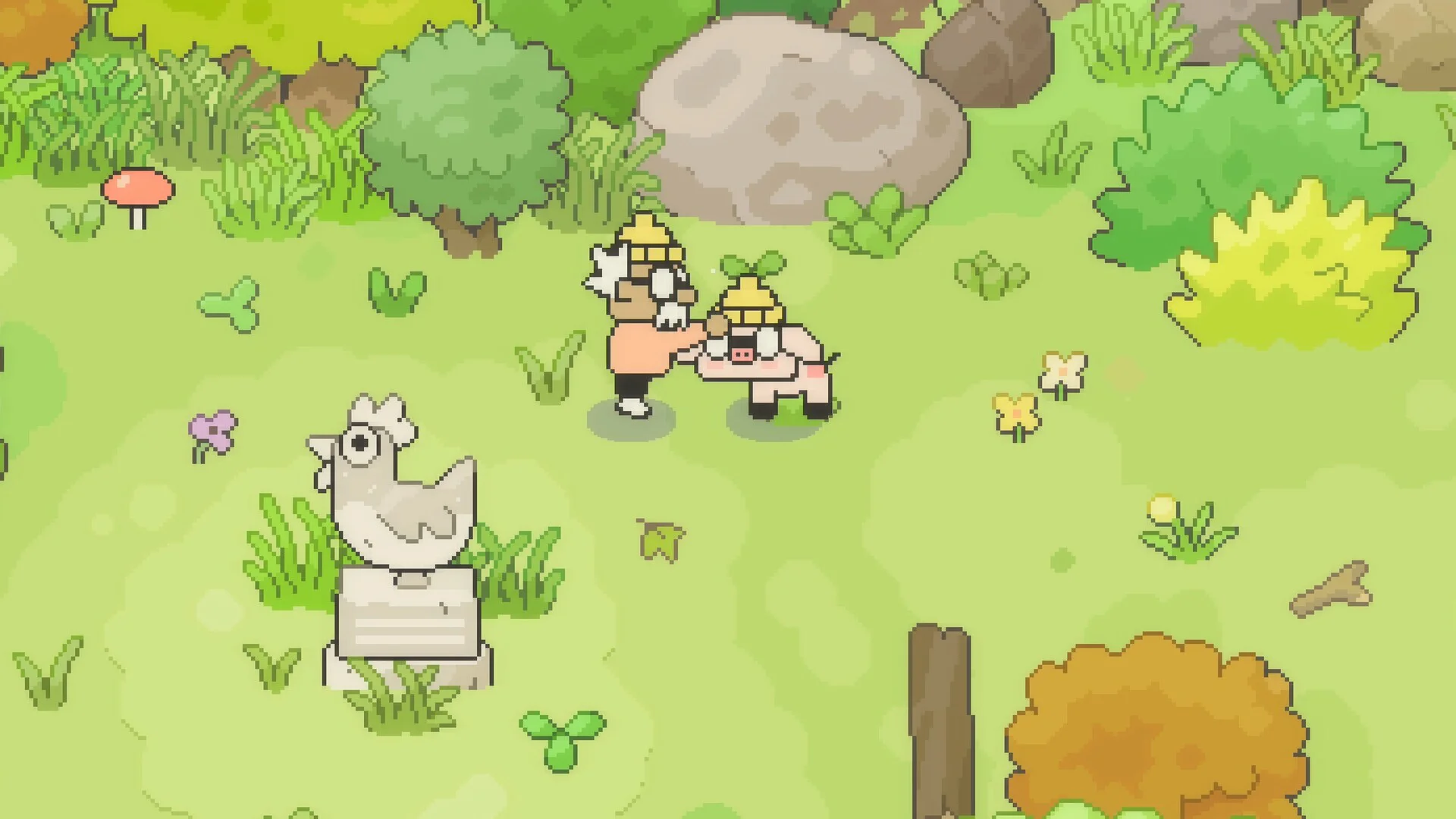
Hermit and Pig isn’t content to rest on this effective tale of personal growth, offering a surprisingly insightful and poignant societal critique through biting satire. The developers at Heavy Lunch Studios take aim at everything from the environmental impacts of industry and the pursuit of corporate profit at the expense of social cohesion, to calling out the boot-licking absurdity of pop country music and the power of collective solidarity over corporate greed. The game’s core message really comes across in the final climax. Without spoiling the final revelations, I’ll say that the mushroom theme is more than quirky set dressing, and the developers use the concept of a mycelial network as a metaphor for solidarity in the face of labor exploitation and the environmental impact of resource extraction and warmongering. Heavy topics, to be sure, but Hermit and Pig navigates these concepts deftly without sacrificing the humor and lighthearted tone that defines the game’s early hours.
I came to Hermit and Pig expecting a cute, humorous take on timing-based combat, and I got that, but I also got so much more. It’s truly rare for a game to have such thematic cohesion in both storytelling and mechanics, but Hermit and Pig delivers on that promise without coming off as pretentious or preachy. Heavy Lunch has something deeply important to say about our current moment, but they say it with a smile and laugh, enough to make the herbal remedy for humanity’s worst excesses go down easy. It’s clear that the developers understand and love human beings, despite all our flaws, and believe in our potential to create a better world than the one we have now, if only we could focus less on the “I,” and more on the “We.”