
Already considered a modern CRPG classic (and responsible for an underrated sequel and gorgeous spin-off), Pillars of Eternity has been freshened up once more with a new turn-based patch. Almost from the beginning, a decent portion of fans called for such a feature. Given the success of the turn-based approach across all manner of RPG subgenres recently, it’s gratifying to see the developers take on such a project for a decade-old game. Indeed, Obsidian Entertainment ran the entire thing as an extended beta, welcoming player feedback and refining the complex real-time systems into a more ordered approach through players’ class combinations and combat feedback. After ten years, most grizzled warriors would be ready to take it steady at the local tavern, but with these new systems, Pillars of Eternity steps out with a new lease on life. One turn at a time.
As the opening text crawl begins—accompanied by a deep-voiced narrator—the game reveals the detailed sprites and backgrounds of the Dyrwood, along with ancient Engwithan Adra formations. Nothing has changed, yet the hand-drawn environments remain expansive, and the thrill of uncovering darkened areas of the map still holds strong, even when many encounters feel familiar and memories more than a quarter-century old tug at the heartstrings. Even the interface, with its wide dialogue box and brass-embossed buttons, reinforces the warm sense of comfort. It feels timeless, helped in part because modern games have continued to adopt and refine similar designs.
Pillars of Eternity‘s writing is richly novelistic. What begins as a simple tale of survival after a botched ritual quickly spirals into something far stranger and more unsettling. The player, marked as a Watcher with the ability to peer into past lives, is drawn into the hollowborn crisis—an epidemic of children born without souls that has left the Dyrwood fractured and fearful. What follows is less a straightforward quest and more a slow unravelling of truth, as ancient secrets, the manipulation of faith, and the carefully constructed illusions of the gods begin to surface. At the centre of it all stands the Leaden Key, a shadowy organisation devoted to maintaining these deceptions, and its ageless master, Thaos, whose designs stretch back through countless lifetimes. As revelations mount, the story leans heavily into questions of identity, belief, and control, ultimately forcing a confrontation with not only Thaos himself, but with the very foundations of the world’s understanding of souls and divinity.
The story and characterization matches the best in the genre, standing comfortably alongside Baldur’s Gate II and Disco Elysium, and the dense, layered narrative demands focus, often rewarding a second reading of key passages or even entire conversations. Returning to the game after a prolonged break reinforces a key point: to fully appreciate it, you have to commit to it. This isn’t a story that lends itself to casual play alongside other RPGs—Pillars of Eternity demands your full attention, and rewards it in kind.
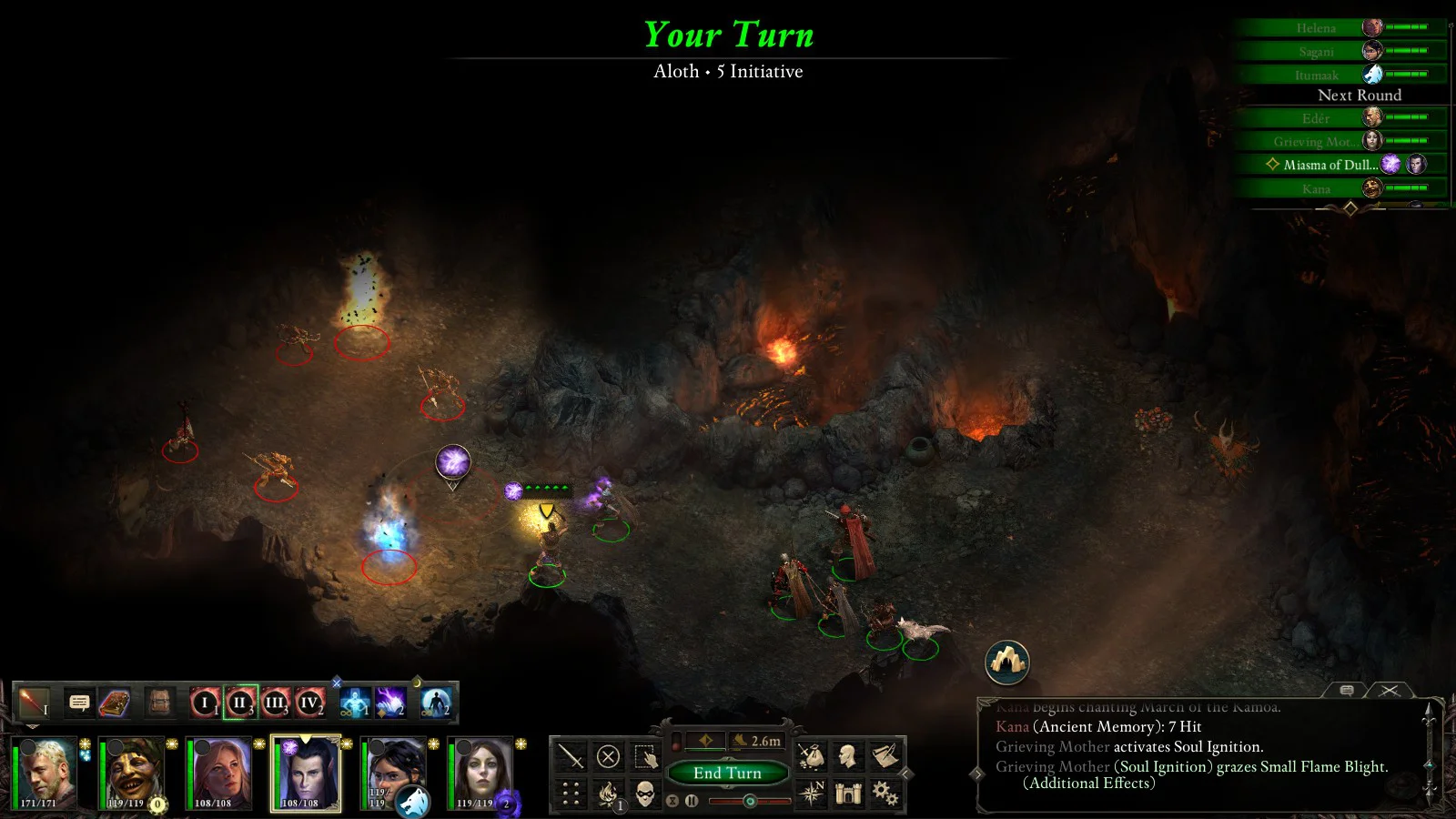
The sense of depth only intensifies through the companions, who arrive faster than I remembered and rarely feel like simple additions to a party. Each carries a dense mix of flaws and private burdens, and their constant interjections—along with their own quest lines—pull focus in a way that feels deliberate rather than distracting. The Grieving Mother stands out among them, as her fractured psyche overlays present moments with echoes of her work as a midwife, hinting at a tragedy that gradually comes into focus.
Elsewhere, Durance rants and wrestles with his fervent devotion to his merciless goddess, exposing a faith that feels as corrosive as it is sustaining; Edér masks his unease with dry humour, though his brother’s fate and his shaken beliefs constantly threaten to surface; and Sagani presses on with quiet determination, having spent years away from her family in search of a lost soul, her optimism tinged with the creeping fear of being forgotten even by her own family. Taken together, they don’t just accompany the journey. They complicate it, enrich it, and demand as much emotional investment as the central narrative itself.
For all its narrative confidence, reworked combat is the true draw when replaying, and it proves a natural fit. Pillars of Eternity originally framed its encounters through real-time-with-pause systems governed by action speed (Slow, Fast, and the like). This turn-based adaptation smartly preserves the underlying logic. Rather than handing each character a fixed action per round or tying abilities to rigid point costs, the system pivots on speed: of the character, of their weapon, of the action itself. The result feels fluid rather than constrained. Faster weapons and lighter builds can act multiple times within a single round, while heavier options demand more patience. It gives combat a rhythm that rewards positioning and timing without losing the tactical clarity of turns.
In practice, that balance plays out cleanly across the party. Kana Rua, lugging his massive rifle around the map, delivers devastating shots but rarely fires more than once per round thanks to long reload times, each attack feeling deliberate and weighty. By contrast, Sagani’s wolf companion Itumaak darts across the battlefield, acting repeatedly: harrying enemies, blocking paths, and creating space. It’s an elegant translation of the original system, one that doesn’t just replicate the old pace, but reinterprets it into something more readable while retaining its depth.
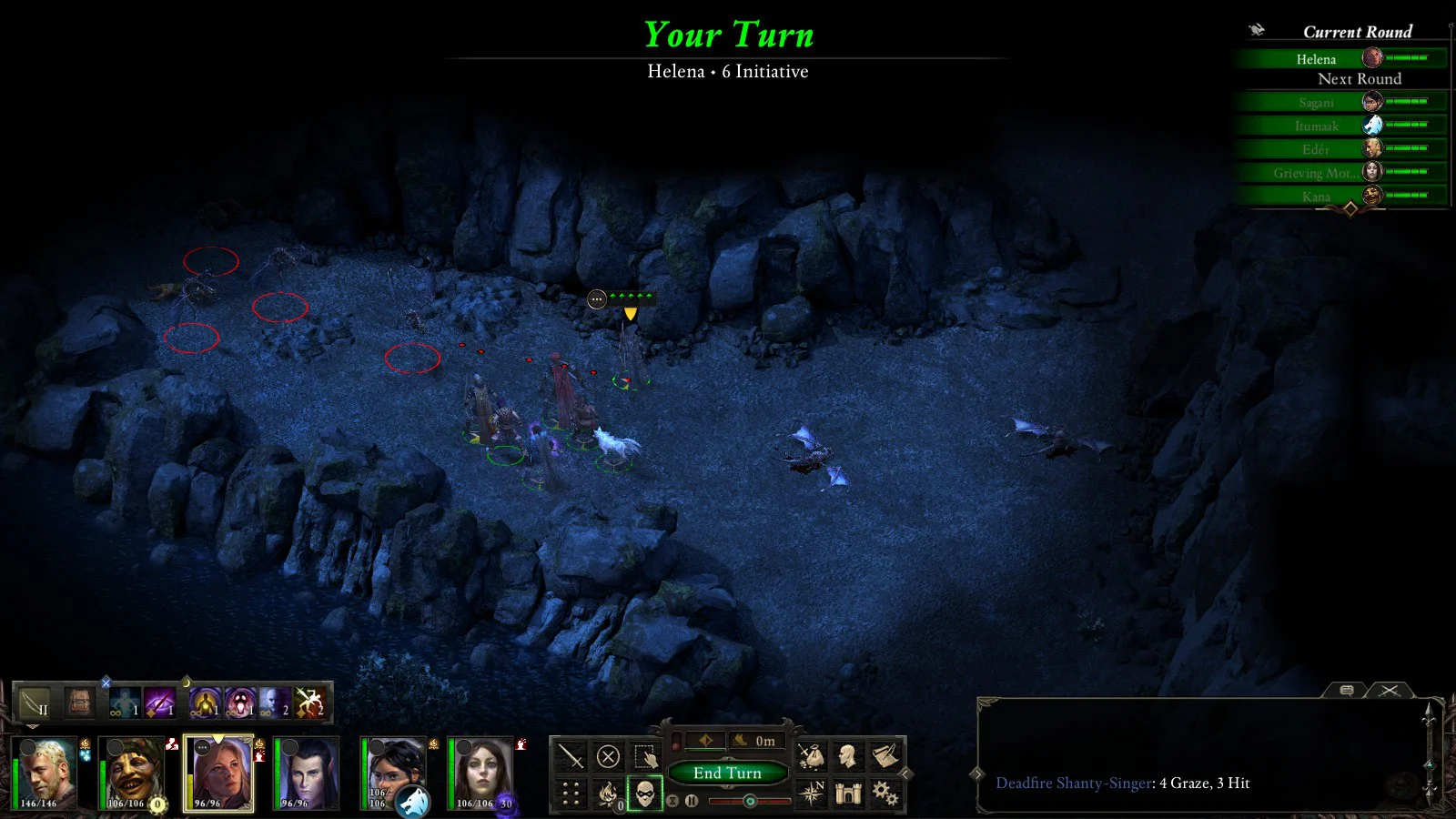
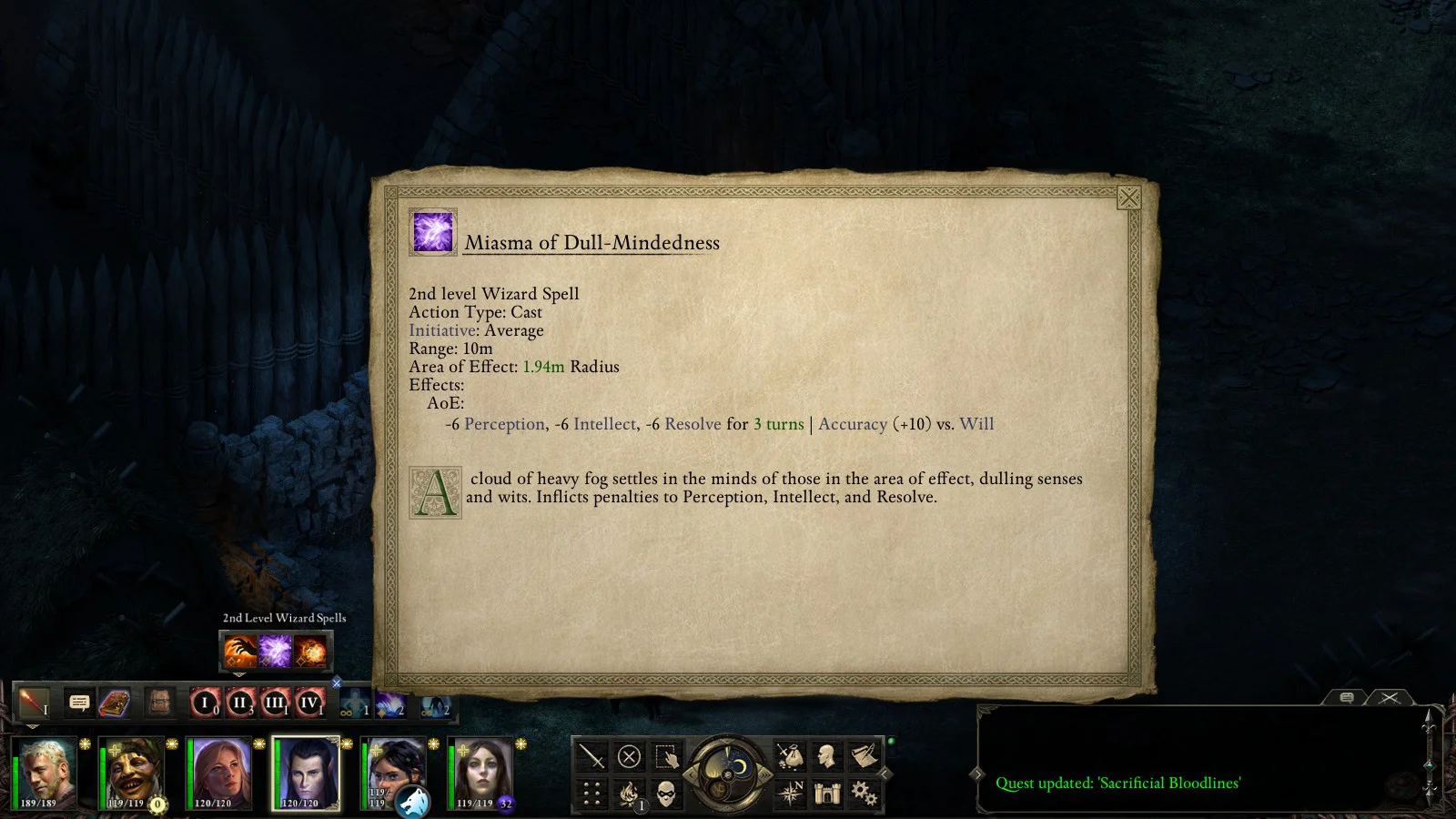
This philosophy carries cleanly into abilities and spellcasting, where the revised system builds on familiar foundations without overcomplicating them. In Pillars of Eternity, spells still demand time, measured now in turns and rounds, to cast and resolve. Abilities retain their “per encounter” or “per rest” limits, echoing the original real-time design. The difference is clarity. With everything now visible and predictable, the guesswork falls away and the system encourages more deliberate, tactical play.
That shift makes crowd control and trap-based abilities far more appealing than before. Where real-time combat often muddied positioning and activation timing, especially when kiting enemies around the battlefield, the turn-based structure invites precision. Spells like Warding Seal finally come into their own: once awkward to deploy effectively, you can now place them exactly as needed, with a clear sense of when they trigger. The same applies across a wide range of similar abilities, many of which feel newly viable as a result. Stealth and backstabs benefit just as much. Instead of hurried clicks and uncertain outcomes, the system lets you judge distance, timing, and detection with confidence, turning what was once a slightly clumsy interaction into something far more controlled—and, crucially, far more satisfying.
On the other hand, the absence of real-time exploits, like kiting enemies endlessly or trapping them in broken pathfinding loops, does raise the difficulty in certain encounters. In real time, it’s entirely viable to funnel enemies into narrow doorways or wedge them against scenery to gain the upper hand. The turn-based system strips much of that away, forcing a more honest engagement with each fight.
There are moments where the turn-based mode reveals its origins as an adaptation layered onto a real-time system. In Pillars of Eternity, I ran into the occasional hiccup—combat locking up with frozen character selection, or combat logs suddenly flooding with what looked like real-time data. They were disruptive, if brief. A reload or restart usually cleared things, and I never encountered a fight that felt completely broken as a result. The overall experience remains impressive for a decade-old game, and likely owes this to the game’s long-term community support as much as its original design. Still, given the sheer scale of the action, a little roughness here and there feels almost inevitable. Both expansions benefit from the same mechanics, and there’s plenty to do across the main story, side quests, and companion stories.
Beyond its expansions and years of patching, Pillars of Eternity remains fundamentally the same game. I still hold it and its sequel in equal regard, for very different reasons. Here, the story stays tightly focused on the “chosen” figure, with a clear throughline built around your awakening and the long shadow of Thaos’s designs. In many ways, it feels like both an homage to—and a continuation of—the kind of narrative Baldur’s Gate helped define, sidestepping the overt faction systems that many modern RPGs (including Deadfire) lean on. The result is a purer, more focused experience.
That same purity, though, carries some of the genre’s older rough edges. Voice acting remains partial, sometimes shifting within a single conversation. Fetch quests and backtracking between areas are common, even with fast animation options. Crafting, too, can feel fiddly rather than intuitive. They’re minor frustrations in the broader context, but clear reminders that this is a game shaped as much by its influences as by its ambitions.
Like any long-running debate, purists will hold their ground on both sides of the real-time versus turn-based divide in Pillars of Eternity. But if this new approach opens the game’s hidden paths, buried secrets, and hard-won rewards to a broader audience, it’s hard to see it as anything but a success. After all, this old warrior still has plenty of stories left to (re)tell, if you’re willing to follow, one turn at a time.