
For decades, Irem’s R-Type series has stood the test of time thanks to its well-established shoot-’em-up credentials, complex bosses, and diverse weapon upgrades. In 2007’s R-Type Tactics, the franchise flipped this legacy on its head, swapping fast-paced action for a turn-based strategy RPG packed with Earth technology and vicious Bydo adversaries, alongside a fiendish difficulty curve. While 2009 brought a sequel, R-Type Tactics II: Operation Bitter Chocolate, it was never localized and remained exclusive to Japan. Now, developer Granzella (formed by former Item staff) has remastered these entries for modern platforms, including a new series of encounters, as R-Type Tactics I • II Cosmos. This collection’s new graphical sheen and interlocking strategic systems make it easier than ever to enjoy the demanding and evocative strategy. However, a lack of onboarding, slow pace, and a barebones story sour this call to arms.
In R-Type Tactics I • II Cosmos, you command the Earth Space Corps during a desperate interstellar crusade to eradicate the Bydo Empire—a terrifying, ever-evolving biomechanical alien armada. As the fleet pushes deeper into hostile space, victory demands a heavy toll. Without giving too much away, the second half of this campaign shifts to the Bydo perspective, forcing you to wage war against humans. The sequel expands the narrative scope by introducing human factionalism. A brutal civil war erupts between the Earth Allied Armed Forces and the Granzella Revolutionary Army, a faction fighting for independence and weaponized Bydo technology. This more complex political strife is further explored through branching paths and shifting moral alliances.
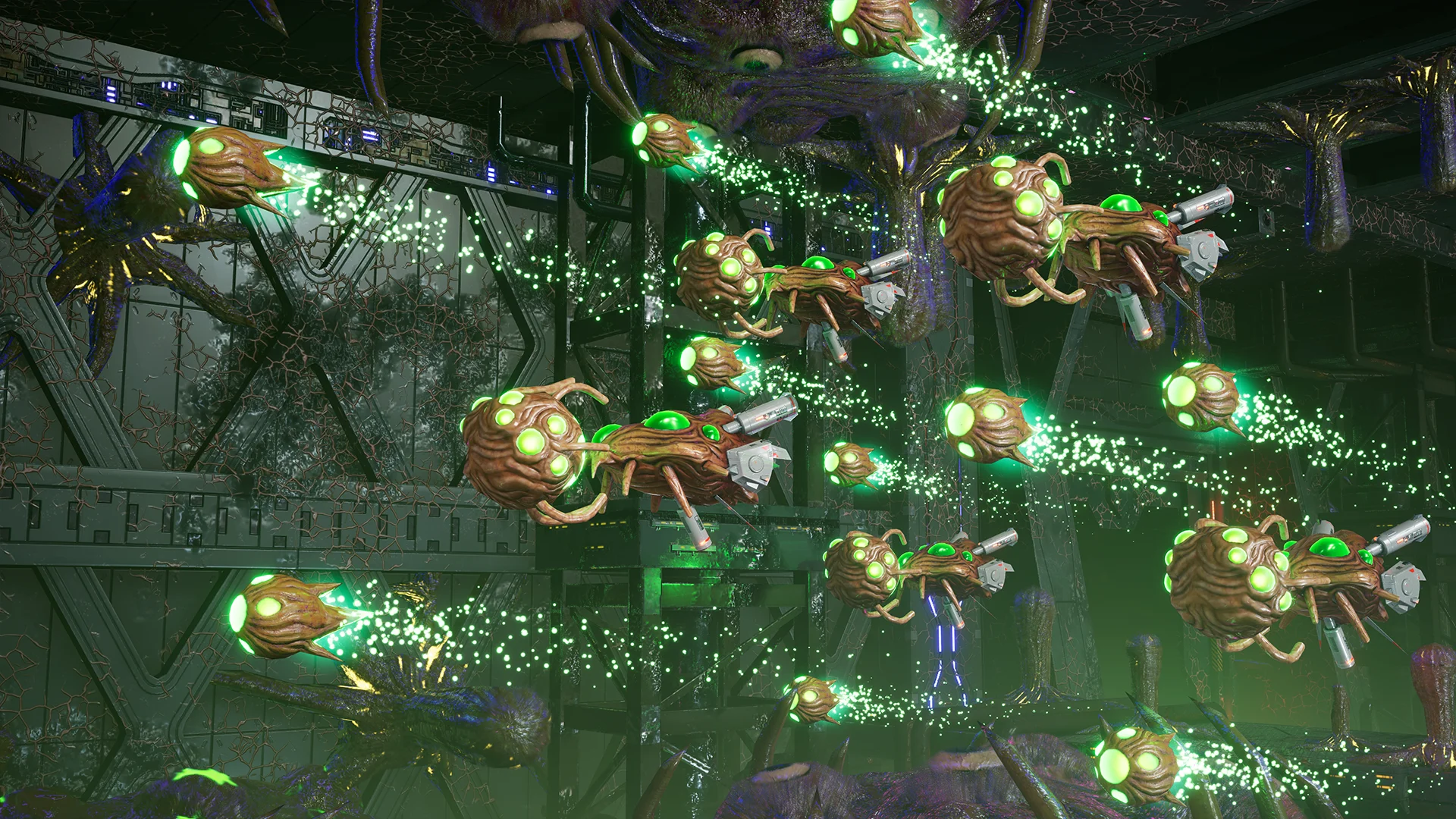
It all looks fantastic: the upgraded scenario cutscenes, R-Type unit rosters, and Bydo adversaries stay true to the original designs while delivering modern visual pop. It’s easy to identify brooding Striders, deploy distinct Force designs, and navigate massive, complex Bydo platforms. Capital ships and towering bosses dominate the screen with lethal, finely animated details and limbs. Sumptuous background and level designs showcase a mix of biomaterials, floating Bydo structures, as well as eye-popping dimension effects. Sharp colors and shading enhance the ship models, which shine during the animated 3D combat vignettes. While you’ll likely skip these cutscenes during longer encounters, they add immersion to the turn-based actions. Voiceovers and a driving, tense soundtrack complete the strong visual and auditory experience of R-Type Tactics I • II Cosmos.
Overall, control and selection work fine, and either controllers or keyboard/mouse can navigate the menu-driven action. However, the gameplay loop frequently slows to a crawl. Even at maximum animation speeds, managing a large army is a chore; clicking through dozens of individual units to move them and assign actions reveals the clumsy, dated bones of the 2007 original. While the developers spruced up the user interface and added helpful tooltips for various units, onboarding remains one of the game’s glaring weaknesses. The title completely lacks an interactive tutorial. Instead, it expects you to wade through a dense, dry, lore dump of text. Compounding this issue, the game fails to explain critical combat keywords and unit statistics well, leaving you to learn their actual battlefield impact through trial and error.
During the tactical combat phase, you command your entire army before handing the turn over to the enemy. Each unit can move once and execute a command—such as launching a direct assault, deploying a defensive decoy, or utilizing specialized support skills. Tactically, R-Type Tactics I • II Cosmos relies on familiar genre staples, yet it deploys mechanics that delightfully resonate with its shoot-’em-up roots. For instance, fighters can attach deployed Force modules. This homage to the original shooters demands forward-thinking, as docking a module consumes an action but unlocks broader attack and defense configurations on the following turn, depending on the Force configuration. There’s more: your fleet always advances from left to right, with unit models maintaining this rigid orientation. It’s more than just a visual nuance, too: charged shots are only generated to the right of your units, and vice versa for enemies.
R-Type Tactics I • II Cosmos’ tactical innovation lies in these franchise-specific mechanics. Balancing long-range artillery units, support craft that resupply ammo and repair hull damage, and multi-attack dreadnoughts transforms the battlefield into an engaging, high-stakes puzzle of positioning and resource management.
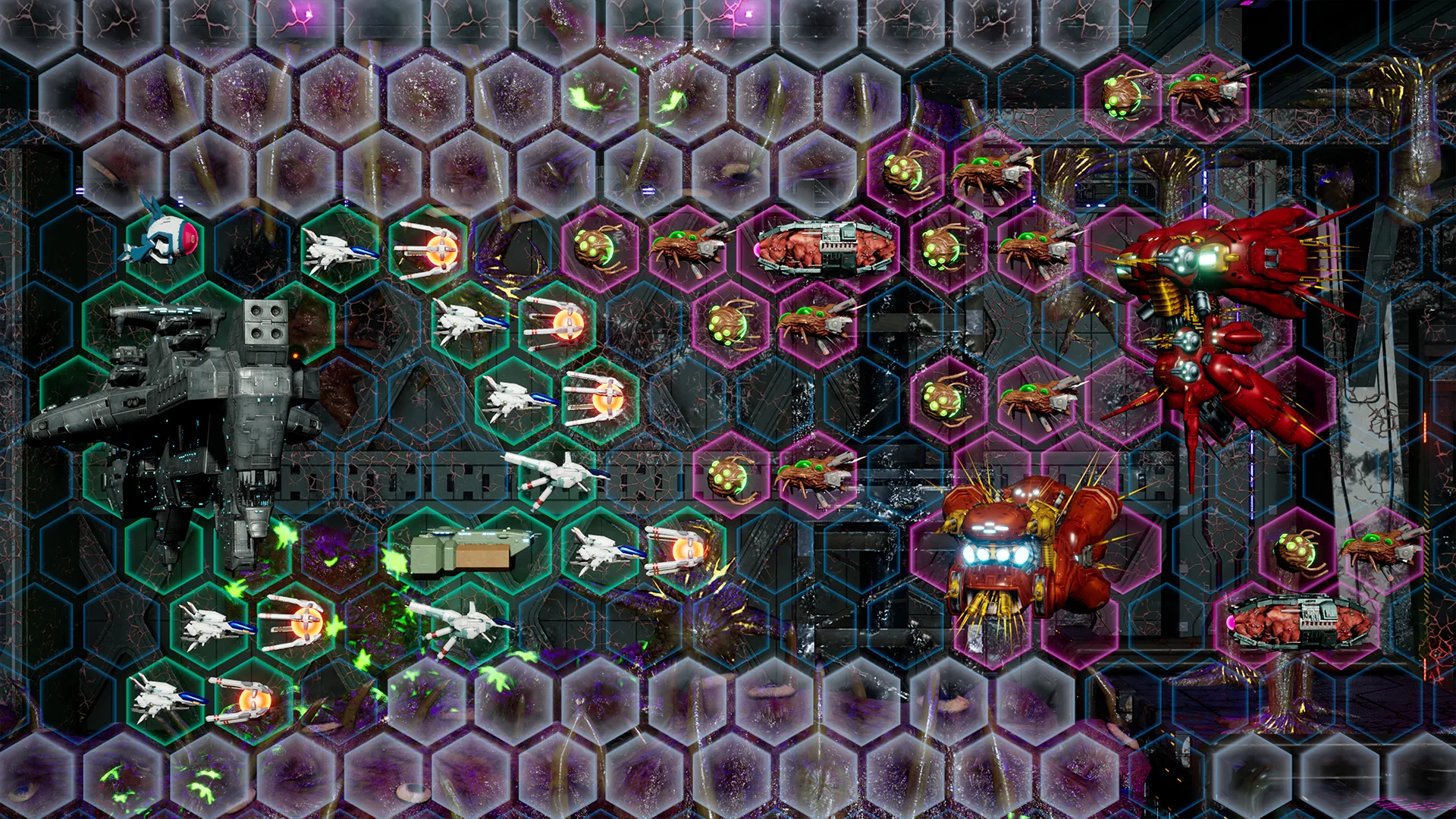
As these unit options expand, the true depth of the game’s positioning and tactical tricks comes to the forefront. Success requires mastering specific battlefield counters, such as using weak, harrying attacks to disrupt and cancel an enemy’s devastating charged strikes. Formation management is equally critical; you’d do well to scatter fighter wings to prevent a single enemy line attack from wiping out entire squadrons. Larger ships take more deployment space, often in odd shapes, so there’s further consideration as to whether a large, bulky cruiser will be as effective as several fighter craft. These fundamental principles manifest early in the campaign. Ultimately, Granzella deserves immense credit for how perfectly this strategic dance mirrors the rhythm of the original arcade games: you must constantly calculate when to push forward, when to withdraw, and whether to unleash a devastating strike or defensively deny the enemy their own.
Later levels demand sensible resource management, forcing you to deploy mobile bases to establish vital supply posts deep within enemy territory. The introduction of “desync” craft and phasing abilities radically expands tactical options, allowing ships to pass through solid terrain. This promotes plans to bypass lethal bottlenecks and ambush unsuspecting foes, though it demands a tight supply chain since phasing consumes fuel more rapidly.
Further variations soon mix up even these expectations. Fog of war, water-based levels that significantly reduce movement, and even vertically-aligned levels to render charged shots less useful are just some of the challenges R-Type Tactics I • II Cosmos throws at you and your fledgling fleet. When combined with strict turn limits, these mechanics create an incredibly demanding experience.
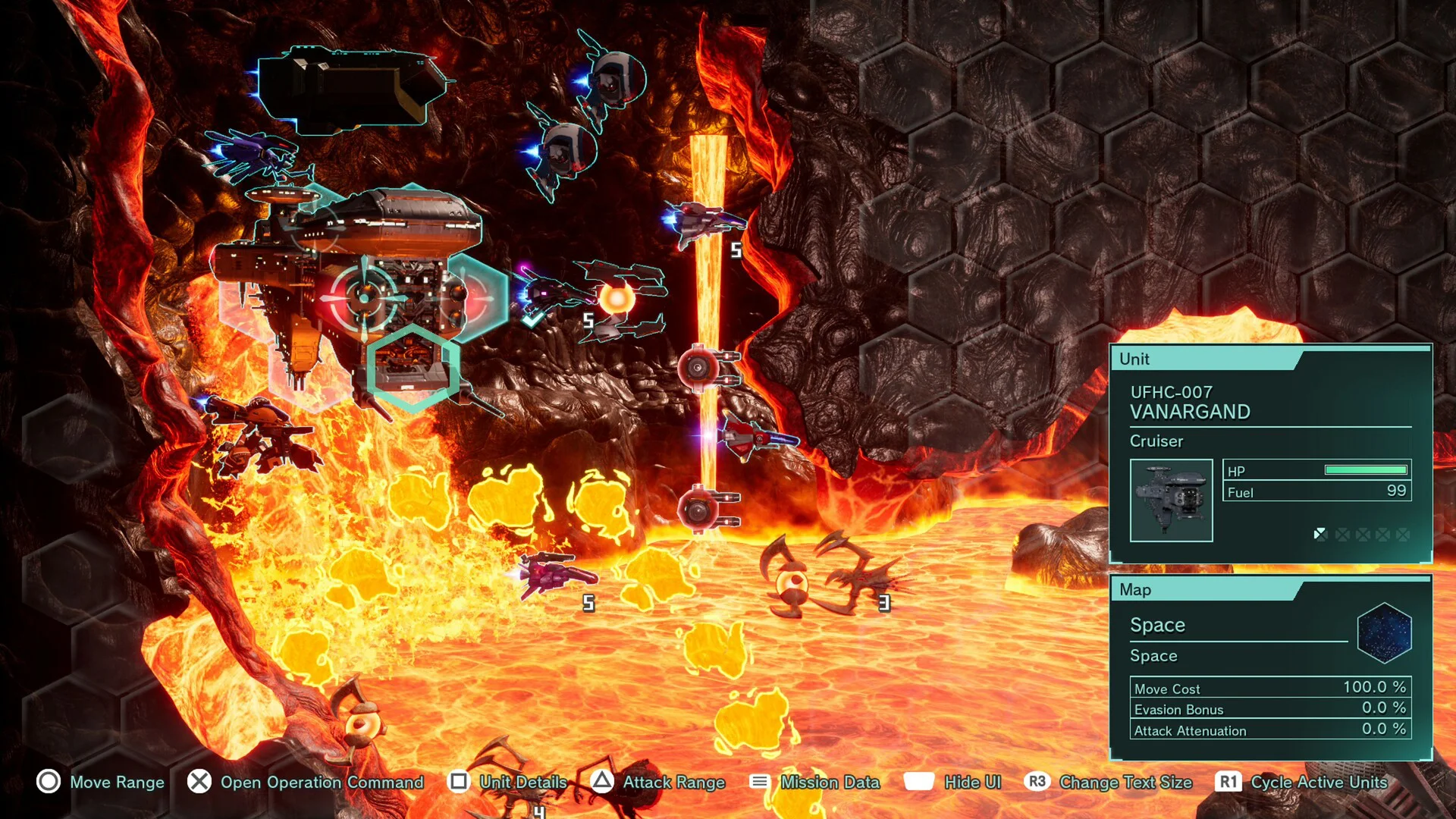
Like its arcade inspiration, failure in R-Type Tactics I • II Cosmos is part of the progression loop; losing a mission but retaining mined resources to reinvest in your fleet is the order of the day. Defeated leaders also slowly accumulate experience, earning minor boosts to health and evasion. Consequently, the game requires far more grinding than it initially lets on. Because the UI provides little direction, you can easily waste precious materials upgrading the wrong ships or unlocking dead-end tech trees. In many ways, the game hearkens back to a punishing, old-school era of design where you’d fail a level just to learn the required loadout and strategy. While not an outright dealbreaker, this trial-by-fire approach becomes tedious as the battles grow longer and more involved.
There’s plenty to sink your teeth into across both games included in R-Type Tactics I • II Cosmos, and the three campaigns themselves are dozens of hours long, with an almost endless variety of approaches possible, assuming you have the time and inclination to collect resources and develop new ship designs. Given that part of the campaign involves playing as the Bydo, the options here literally double the possibilities. The sequel includes more visual novel elements, branching mission paths, and dialogue choices during briefings that alter your campaign trajectory, though the narrative is not on a Fire Emblem or Final Fantasy Tactics level.
Like a swarm of Bydo filling the screen, R-Type Tactics I • II Cosmos is beautiful and compelling, but difficult and overwhelming at times. It’s evidently a huge labour of love, and long-time fans who know their Arrowhead from their Cerberus will have a lot of fun with the game’s clever nuances. For the standard strategy RPG enthusiast, it will require a significant time investment and a willingness to overlook clunkiness in the UI, as well as a rather threadbare story, even in the sequel, where the branching plot points and enhanced characterization are welcome. All those years ago, R-Type initially challenged gamers with, “the fate of two races depends on you. Blast off and strike the evil Bydo Empire!” You’ll have to decide if that fate truly compels you to the far reaches of space and back again. Buckle up: you’re in for a hard fight.